South Korea Web3 Market Report: Comprehensive Analysis of Cryptocurrency Regulatory Policies and Market Uniqueness
TechFlow Selected TechFlow Selected
South Korea Web3 Market Report: Comprehensive Analysis of Cryptocurrency Regulatory Policies and Market Uniqueness
South Korea's extensive internet coverage and highly tech-savvy young population make it a hotspot for cryptocurrency.
 Navigating Web3 tides with focused insights
Author: Aiying
South Korea's position in the global cryptocurrency market cannot be overlooked. With extensive internet coverage and a highly tech-savvy young population, South Korea has become a hotspot for cryptocurrencies. In recent years, unique phenomena such as the "Kimchi Premium" and "Listing Pump" have emerged in the Korean market, reflecting both investor enthusiasm and the distinct characteristics of this market.
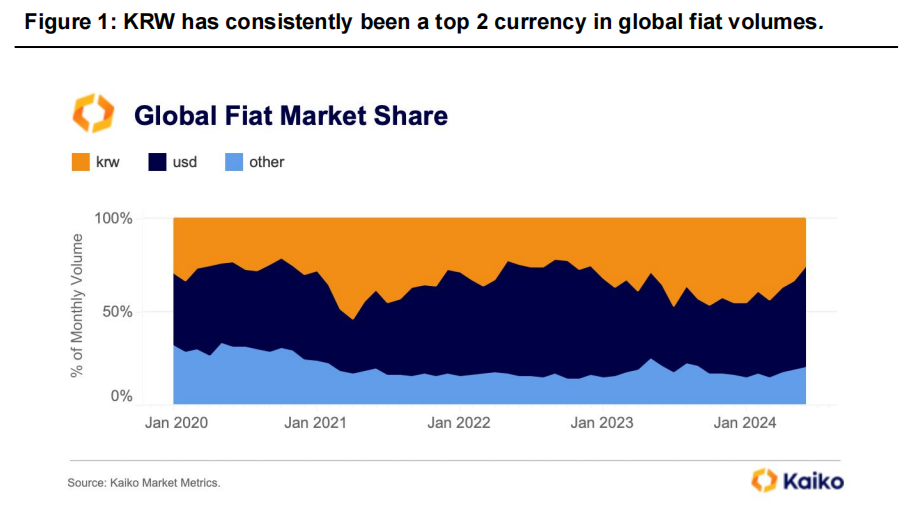
KRW’s share of global fiat trading volume since January 2020
Currently, according to Aiying Aiying, South Korea's cryptocurrency trading volume has already surpassed that of its domestic stock market. For example, on March 8, 2024, the trading volume of the Korea Composite Stock Price Index (KOSPI) was 11.4794 trillion KRW, while the daily trading volume of South Korea’s cryptocurrency market approached 12 trillion KRW.
On the regulatory front, South Korea introduced the "Virtual Asset User Protection Act," which passed through the National Assembly on June 30, 2023, and officially came into effect on July 19, 2024—just last week. Going forward, Aiying Aiying will use Presto Labs’ report to provide deeper insights into the development history, current state, and future trends of South Korea's cryptocurrency market.
I. Unique Market Phenomena
1. Kimchi Premium
Definition: The Kimchi Premium refers to the price premium of cryptocurrencies on South Korean exchanges compared to prices on global exchanges. Specifically, the same cryptocurrency often trades at a higher price on Korean exchanges than elsewhere in the world.
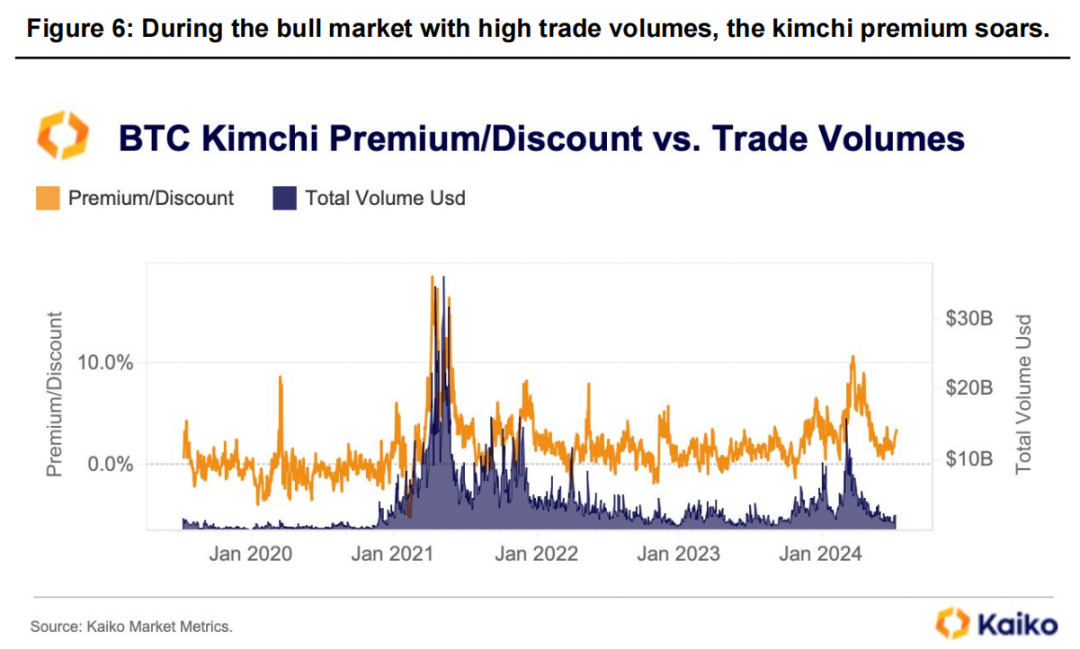
Relationship between Bitcoin Kimchi Premium and trading volume
Causes:
-
Restricted capital flows: Strict capital controls in South Korea make large-scale cross-border fund transfers difficult. This prevents Korean investors from easily engaging in arbitrage trading across borders, resulting in local supply-demand dynamics operating independently from global markets.
-
Strong market demand: High demand among Korean investors, especially during bullish market conditions, drives up prices on domestic exchanges.
-
Limitations on fiat conversion: Restrictions on converting the local currency (KRW) into major currencies like USD complicate cross-border capital flows and hinder price convergence.
Market Impact:
-
Price divergence: The Kimchi Premium creates significant price differences between Korean and global markets. This gap was particularly pronounced during bull runs, reaching levels of 30–40%.
-
Arbitrage opportunities: The premium presents arbitrage opportunities for those capable of cross-border operations, though execution remains challenging due to capital restrictions and operational complexity.
-
Market visibility: The Kimchi Premium has drawn global attention, making the South Korean market one of the focal points for international investors.
2. Listing Pump
Definition: A Listing Pump occurs when a cryptocurrency experiences a rapid price increase immediately after being listed on a major South Korean exchange such as Upbit or Bithumb.
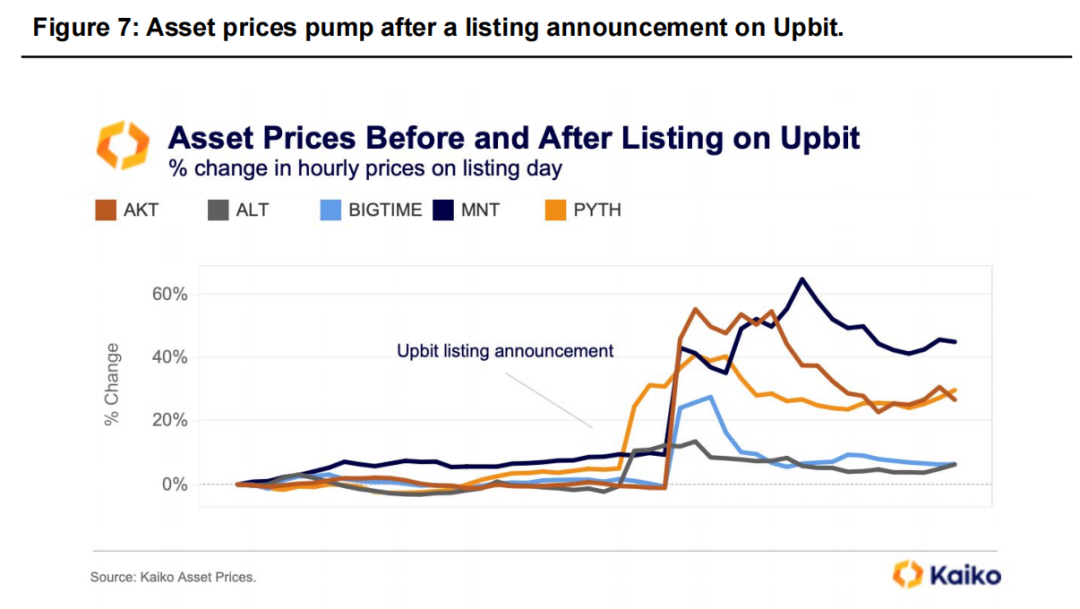
Price changes of different assets before and after listing announcements on Upbit
Causes:
-
Market expectations: Korean investors generally perceive tokens listed on major local exchanges as having high investment value. As a result, anticipation around new listings often triggers sharp price increases.
-
Improved liquidity: New listings bring significantly enhanced liquidity, with increased buy-side pressure driving prices upward.
-
Speculative behavior: Some investors engage in short-term speculation based on listing news, buying quickly and selling after price appreciation.
Market Impact:
-
Short-term volatility: The Listing Pump phenomenon leads to sharp short-term price swings. While prices rise rapidly, these gains are often unsustainable, followed by severe corrections.
-
Increased investment risk: This trend heightens market speculation, exposing retail investors to greater price volatility and requiring cautious participation.
-
Enhanced exchange influence: The Listing Pump highlights the influence of major Korean exchanges in the global crypto market, prompting global projects to prioritize listings on these platforms.
II. Market and Regulatory Policy Review
1. Early Stage (2013–2016)
Prior to 2013, cryptocurrencies had not gained much attention in South Korea. However, starting in 2013, the country began entering an initial phase of cryptocurrency adoption:
- Emergence of first exchanges:
- Korbit: In 2013, Korbit, South Korea’s first cryptocurrency exchange, was established, marking the formal beginning of crypto trading in the country. It provided Bitcoin trading and storage services, offering Korean investors an entry point into the market.
- Bithumb: In 2014, another key player, Bithumb, launched and quickly became one of South Korea’s largest cryptocurrency platforms. By offering multiple digital assets, it further accelerated market growth.
- Increasing market acceptance:
- With the establishment and operation of exchanges, more Koreans began learning about and investing in cryptocurrencies. Though still niche, a preliminary investor community started forming during this period.
2. The 2017 Bull Run
2017 marked a pivotal moment for the global cryptocurrency market, with a widespread bull run attracting massive investor interest—including in South Korea:
- Investment frenzy:
- In 2017, Bitcoin and other cryptocurrencies surged in price, capturing the attention of many Korean investors. Retail investors entered the market enthusiastically, causing trading volumes to spike dramatically.
- Bithumb ranked among the world’s highest-volume exchanges multiple times that year, demonstrating the vibrancy of the Korean market.
- Peak of the Kimchi Premium:
- During the 2017 bull market, the Kimchi Premium reached highs of 30–40%, meaning Korean exchange prices were 30–40% higher than global averages—highlighting intense speculative activity.
- ICO ban:
- In September 2017, the Financial Services Commission (FSC) banned all forms of Initial Coin Offerings (ICOs) to protect investors and prevent fraud and excessive speculation. This ban remains in effect today, reflecting the government’s cautious stance toward the crypto market.
3. Regulatory Measures Post-2018
In 2018, the South Korean government intensified regulation of the cryptocurrency market, implementing several measures to enhance transparency and investor protection:
- Real-name trading system:
- On January 30, 2018, South Korea implemented a “real-name trading system,” requiring all cryptocurrency exchanges to partner with banks to offer verified real-name accounts. This aimed to increase transparency, prevent money laundering, and ensure legal compliance.
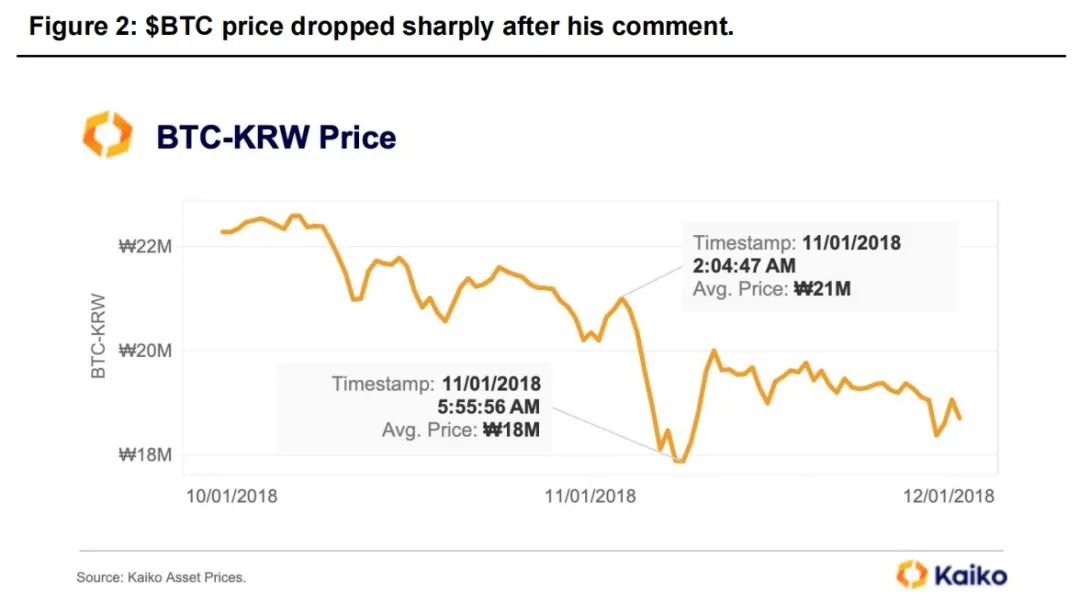
This policy triggered a sharp drop in Bitcoin’s price at the time
- The real-name trading system greatly improved market transparency but also impacted market liquidity.
- Amendment to the Act on Reporting and Use of Specified Financial Transaction Information:
- In March 2020, the National Assembly passed an amendment to this act, requiring all Virtual Asset Service Providers (VASPs) to register with the Financial Services Commission (FSC) and comply with Anti-Money Laundering (AML) and Know Your Customer (KYC) regulations. The law took effect in March 2021.
- After implementation, only 29 out of 63 exchanges successfully registered, and just five (Upbit, Bithumb, Coinone, Korbit, and Gopax) obtained both ISMS certification and real-name account access, allowing them to continue operating KRW markets.
- The law applies to foreign exchanges as well, leading companies like Binance to shut down Korean-language support and P2P services. Currently, foreign exchanges are prohibited from offering KRW pairs, Korean-language interfaces, or direct marketing in South Korea.
Through these regulatory efforts, the South Korean government aims to foster market development while preventing illegal activities and protecting investor rights. These measures have curbed speculative behaviors to some extent, but they have also affected market liquidity and innovation.
4. Implementation of the "Virtual Asset User Protection Act" and Other Key Regulations
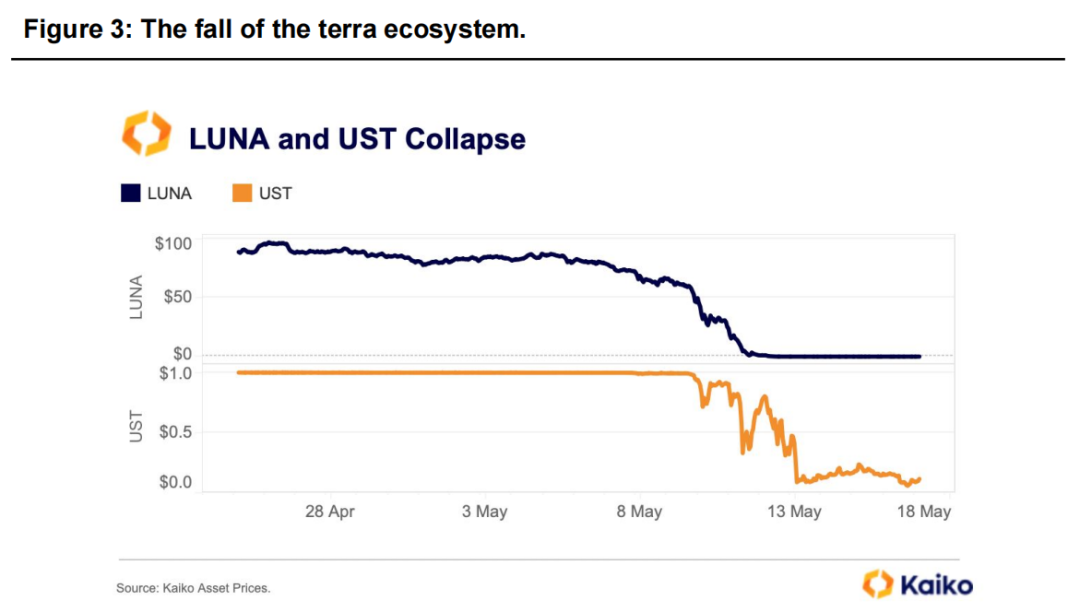
In May 2022, two major tokens within the Terra ecosystem, LUNA and UST, experienced a catastrophic price collapse. LUNA plummeted from nearly $100 to near zero, while UST lost its dollar peg and crashed close to zero in value.
Then in 2023, two digital asset management firms, Haru Invest and Delio, collapsed amid allegations of running Ponzi-like schemes. These incidents heightened concerns over regulatory gaps and investor protection, underscoring the need for stronger oversight.
As a response, South Korea drafted the "Virtual Asset User Protection Act," which passed the National Assembly on June 30, 2023, and came into force on July 19, 2024. The law aims to protect users' funds, regulate virtual asset trading, prevent unfair practices, and grant the Financial Services Commission (FSC) supervisory and sanctioning powers.
Key requirements include:
- Segregated custody of user deposits: VASPs must separate customer funds from their own assets and deposit or entrust them with trusted financial institutions such as banks, ensuring priority repayment to users in case of insolvency.
- Asset custody requirements: VASPs must securely hold users’ virtual assets, storing at least 80% of them in offline (cold wallet) environments to protect against hacking and system failures.
- Insurance and reserves: VASPs must purchase adequate insurance or establish reserves to cover losses caused by hacks or technical failures.
- Regulation of unfair trading: The law prohibits insider trading, market manipulation, and fraudulent activities. VASPs must monitor suspicious transactions and report any anomalies to financial and investigative authorities immediately.
- Record keeping: VASPs must retain transaction records for at least 15 years to facilitate traceability and verification.
Exchange Listing and Delisting Guidelines:
Role of DAXA: The Digital Asset Exchange Alliance (DAXA), formed by South Korea’s five major exchanges (Upbit, Bithumb, Coinone, Korbit, and Gopax), is responsible for developing and enforcing new listing and delisting guidelines. These aim to standardize the process of adding and removing tokens, ensuring transparency and fairness.
Specific requirements: DAXA’s framework includes nine evaluation criteria covering issuer credibility, user protection, technical security, and regulatory compliance. Reviews are conducted quarterly to maintain transparency and fairness in listing decisions.
Travel Rule: Following FATF guidelines, South Korea has adopted the “Travel Rule” to enhance transparency in crypto transactions and combat illicit activities.
III. Key Market Participants
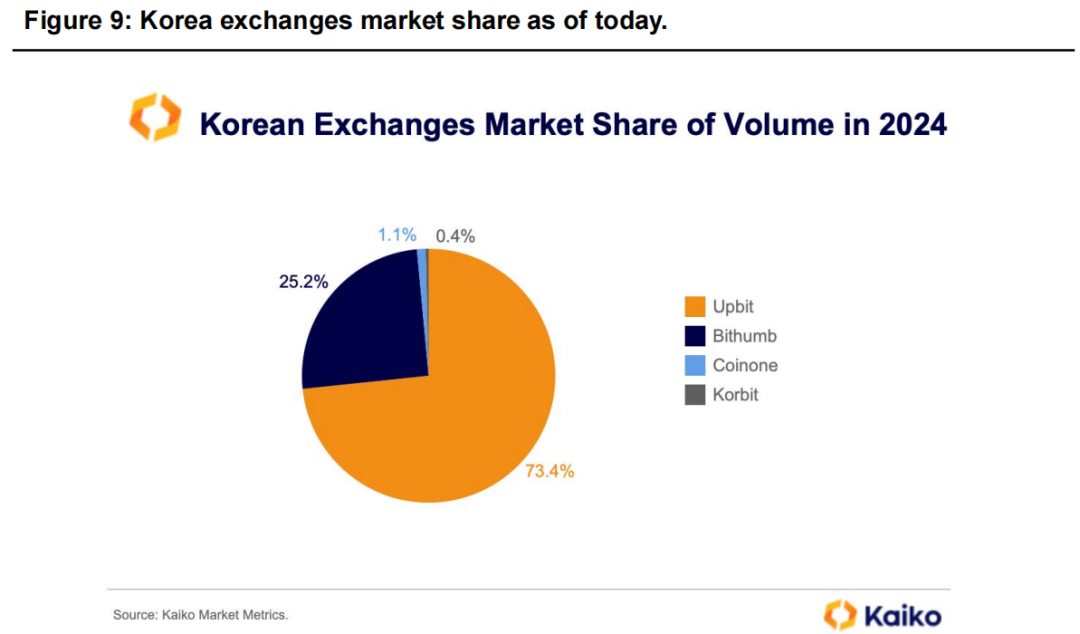
Market share distribution of major South Korean cryptocurrency exchanges in 2024
1. Major Exchanges
Upbit:
- Background: Operated by Dunamu, Upbit was launched in 2017 and quickly rose to become one of South Korea’s largest crypto exchanges.
- Market position: Upbit leads in both trading volume and user base in South Korea. Its trading volume frequently ranks among the top globally, second only to Binance. It offers a wide range of trading pairs including KRW/BTC/USDT, with most volume concentrated in the KRW market.
- Features: Known for high liquidity, diverse token offerings, and robust technical infrastructure. Upbit also excels in information security and user protection.
Bithumb:
- Background: Founded in 2014, Bithumb is one of South Korea’s earliest crypto exchanges and has repeatedly ranked as the world’s highest-volume exchange.
- Market position: Despite a decline in market share in recent years, Bithumb remains a key player in South Korea, ranking second in trading volume after Upbit, with considerable market influence.
- Features: Recognized for its diverse trading pairs and strong marketing capabilities. Although its governance structure has been unclear, it plans to go public in 2025.
Coinone:
- Background: Established in 2014, Coinone is South Korea’s third-largest cryptocurrency exchange.
- Market position: Among the top players by market share, though significantly smaller than Upbit and Bithumb, Coinone maintains notable influence in the Korean market.
- Features: Known for innovative financial products and services, Coinone was the first Korean exchange to list Ethereum, attracting a broad base of crypto investors.
Korbit:
- Background: Founded in 2013, Korbit is South Korea’s oldest cryptocurrency exchange.
- Market position: Though holding a smaller market share, Korbit retains respect as a pioneer in the industry.
- Features: Renowned for stable operations and strong commitment to user experience. As a trailblazer in Korea’s crypto market, Korbit’s legacy remains significant.
Gopax:
- Background: A relatively newer exchange operated by Streami.
- Market position: Though small in market share, Gopax stands out in technological innovation and user experience. Binance recently acquired a majority stake in Gopax to strengthen its presence in Korea.
- Features: Known for its user-friendly interface and strong security measures. Despite limited market share, Gopax is competitive in UX and innovation.
2. Blockchain Projects
Kaia:
- Background: Kaia is a new project formed by merging the blockchain divisions of Kakao and Naver—Klaytn and Finschia. Klaytn was developed by Ground X, a subsidiary of Kakao, while Finschia is Naver’s blockchain platform.
- Development: The formation of Kaia aims to consolidate resources and technological strengths from both platforms to build a powerful Layer-1 blockchain. The project plans to launch by the end of 2024, aiming to advance blockchain adoption across Asia.
- Features: Combining Klaytn’s technical strength with Finschia’s application development expertise, Kaia aims to become a leading blockchain platform in Asia. Key innovations include native staking delegation and priority fee mechanisms.
Delabs:
- Background: A subsidiary of the renowned Korean game company 4:33 Games, founded by Joon Mo Kwon, former head of Nexon, focused on blockchain gaming.
- Development: Delabs is developing three blockchain games: the casual racing game *Rumble Racing Star*, the space survival game *Space Frontier*, and the Web3 RPG *Metabolts*. In February 2024, Delabs launched *Rumble Racing Star*, achieving significant success.
- Features: Leveraging strong game development heritage and deep understanding of blockchain technology, Delabs aims to transform the gaming industry by delivering novel player experiences through blockchain.
Aiying Aiying Commentary: While new regulations have enhanced market transparency and security, they have also posed challenges for innovation and new project launches. Startups must operate under strict compliance requirements, and many small-to-medium exchanges and projects struggle to meet these standards, leading to market consolidation around a few large, compliant platforms. This may constrain the growth of innovative projects. Some Korean blockchain ventures and talent have chosen to relocate to jurisdictions with more favorable regulations, such as Singapore, impacting the domestic innovation ecosystem. However, this situation is not unique to Korea—balancing compliance and decentralization is a philosophical dilemma faced by all regulated markets. It will take time for governments and entrepreneurs to find a sustainable equilibrium that supports local development needs.
Join TechFlow official community to stay tuned
Telegram:https://t.me/TechFlowDaily
X (Twitter):https://x.com/TechFlowPost
X (Twitter) EN:https://x.com/BlockFlow_News
 Aiying Compliance