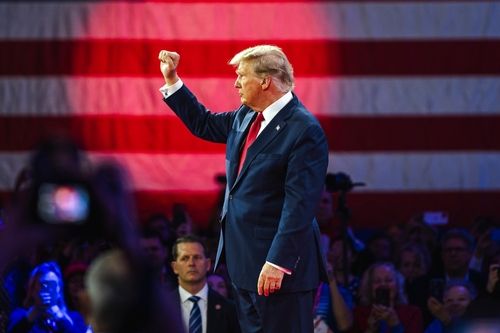
Trump and Crypto: America's Open Strategy
TechFlow Selected TechFlow Selected
Trump and Crypto: America's Open Strategy
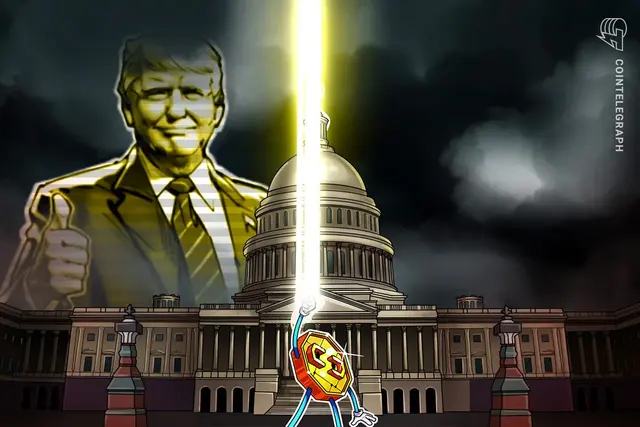
In the previous bull market, Musk was the strongest influencer for cryptocurrencies, popularizing Doge. In this bull market, Trump has undoubtedly taken over from Musk as the new crypto trendsetter.
 Navigating Web3 tides with focused insights
Author: Jessy, Jinse Finance
A bullet passed above Trump's right ear. At 6:11 PM Eastern Time on July 13, 2024, Trump was assassinated.
At that time, Trump not only influenced American politics but also profoundly shaped the trajectory of the crypto industry. After the assassination attempt, the market—which had been sluggish for several weeks—suddenly rebounded. Bitcoin briefly surged past $66,000 on July 17. The positive expectations tied to the U.S. presidential election had already begun to materialize.
Trump once criticized cryptocurrency, but today he has become one of its strongest supporters. With over 50 million cryptocurrency holders in the United States, supporting crypto is a pragmatic move to win their votes.
According to current public opinion, Trump has a high probability of winning the presidency again. His promises to support the crypto industry if re-elected represent significant tailwinds for the sector. Presidential endorsement will accelerate regulatory compliance and mass adoption of crypto.
In the previous bull market, Elon Musk was the ultimate influencer who popularized Dogecoin. In this cycle, Trump has clearly taken over from Musk as the new bellwether for crypto.
The evolution of the industry’s icon—from insiders to business tycoons, now to a former U.S. president—signals crypto's gradual integration into the mainstream. Trump’s current standing in the crypto space reflects how deeply intertwined the industry has become with politics and nation-states.
First a businessman, then a presidential candidate
Racism, incitement to violence, blatant misogyny, anti-environmentalism—these are all negative labels attached to Trump. In an increasingly polarized and radicalized America, these traits resonate with the interests of a large segment of the population.
Trump is first and foremost a shrewd businessman. He cares less about values or political correctness than about tangible benefits. His policy strategies—such as boosting the economy and reducing unemployment—do align with the interests of most Americans.
This version of Trump appeals to young voters. Whether driven by his entrepreneurial instincts or a desire to appeal to his base, embracing crypto is a strategically sound decision. Tracing Trump’s evolving stance toward crypto reveals a clear pattern: his attitude has always been guided by self-interest.
During his first presidential term (2017–2021), Trump opposed the crypto industry. He publicly criticized crypto assets on social media and stated he would never hold any cryptocurrency. At that time, most countries were more resistant than welcoming toward crypto, issuing warnings due to financial risk concerns. As head of state, Trump’s words reflected national policy.
After leaving office in 2021, amid the NFT boom, Trump dove deep into the space by launching three NFT collections bearing his likeness—earning a substantial profit. This moment highlighted Trump’s true nature as a businessman.
In this election year, both Trump and Biden have declared they will adopt pro-crypto policies if elected. In an era when crypto adoption is accelerating, resisting this trend would be unwise. Expressing support for crypto has become a key strategy to win votes—and it aligns with both public and governmental interests.
While Trump is currently a presidential candidate, we must not overlook his identity as a businessman—that remains his defining trait. For him, crypto is first a business venture, then a political tool. This year, Trump announced plans to launch a fourth NFT series. In his view, his previous three NFT drops were successful, selling out 45,000 units in a single day.
As for Biden, during his administration the SEC launched rigorous investigations and lawsuits against major crypto institutions like Binance. Yet during this campaign, he too has voiced support for crypto.
The shifting stances of politicians can be better understood through changes within their respective parties—politicians do not operate in isolation.
On May 22 this year, the U.S. House of Representatives passed the "Financial Innovation and Technology for the 21st Century Act" (FIT21)—a landmark piece of crypto legislation. The bill aims to establish a comprehensive regulatory framework for digital assets. It received bipartisan support, passing with 279 votes (67%), signaling the growing importance of crypto in American politics. Both parties have clearly shifted toward supporting the industry.
This rapid bipartisan embrace of crypto directly paved the way for the SEC’s approval of spot Ethereum ETFs—another milestone for industry development.
The motivations behind politicians’ support for crypto matter less than the outcome.
Musk was the crypto icon in the last bull run. In this cycle, the baton has passed to Trump. This shift reflects the growing influence of crypto—from shaping business to impacting politics.
For the United States, embracing crypto aligns with national interests. As the next U.S. president moves toward genuine pro-crypto policies, Web3 will take another major step toward compliance, and crypto will influence more people and institutions than ever before.
Crypto is no longer just a toy for a small group of tech enthusiasts—it is moving into the mainstream.
Embracing crypto is also a profit-driven move by the U.S. government
In an interview with Bloomberg, Trump said he does not want other countries to dominate the crypto industry. Indeed, in recent years the U.S. has emerged as the undisputed center, big brother, and rule-maker in the crypto world.
To become the industry leader, the U.S. strategy has been to first crack down hard—to make it clear that America is in charge and the industry must follow American rules. Once major players are under regulatory control, the U.S. then promotes industry growth—"ensuring Web3 happens in America." In Trump’s words, the crypto industry is like a baby, and America’s role is to guide and monitor its development into something distinctly "American."
During the last bear market, the U.S. government maintained a hostile stance toward crypto, with constant regulatory pressure.
First, the U.S. Securities and Exchange Commission (SEC)—one of the most authoritative financial regulators, operating as an independent judicial body with absolute authority in economic matters. Initially, the SEC applied securities laws to crypto, classifying digital assets as securities and penalizing individuals and organizations for violations.
Since 2022, the SEC has investigated whether certain assets on platforms like Binance and Coinbase qualify as unregistered "securities." After Ethereum transitioned from PoW to PoS, the SEC classified it as a "security," and recently deemed FTX’s token FTT a "security," thereby intervening deeply in FTX’s bankruptcy proceedings.
The SEC has consistently sued major industry players. In the first half of 2023, it filed suits against Genesis, Kraken, Binance, Coinbase, and others. Coinbase was accused of illegally operating a crypto securities business without registration; Ripple was sued for violating securities laws through its token sale. The SEC’s reach extends beyond U.S. borders—for example, it classified Telegram’s fundraising token Gram as a security and intervened on grounds of protecting American investors.
Second, the Commodity Futures Trading Commission (CFTC), responsible for regulating U.S. commodity futures, options, and financial derivatives markets. In 2021, the CFTC sued Tether and Bitfinex, accusing them of fabricating trading volumes, misappropriating customer funds, and violating anti-money laundering laws. In 2020, the CFTC, FBI, and Department of Justice jointly sued BitMEX and its executives for failing to implement compliance measures, violating the Anti-Money Laundering Act and Anti-Terrorism Act.
In March 2023, the CFTC similarly sued Binance over non-compliant options and futures trading and failures in KYC and AML compliance. It also participated in litigation related to FTX.
Under such intense scrutiny and regulation, the crypto industry faced repeated dark days—especially in 2022 and 2023. During those years, the SEC and CFTC conducted strict reviews of crypto exchanges, launching year-long investigations into Binance and Coinbase. In 2023, the SEC sued Binance and its founder Changpeng Zhao, delivering heavy blows to the industry.
Looking at the current pro-crypto stances of presidential candidates, the bipartisan shift in May, and reflecting on earlier harsh regulations, it becomes clear: the U.S.’s initial strictness and long-arm jurisdiction were ostensibly to protect American interests and prevent financial risks, but in reality served to consolidate control of the crypto industry within American hands. Once power was secured, looser policies could then foster industry growth, ensuring that "Web3 happens in America."
Today, crypto penetration in the U.S. is extremely high. According to TripleA, the U.S. has over 52 million crypto users and ranks among the top nations in adoption rate. In the U.S., crypto ownership is concentrated among wealthier, highly educated individuals.
The U.S. is also the largest government holder of Bitcoin. In terms of hash power, the U.S. controls nearly 40% of Bitcoin’s network—the highest globally. Its spot crypto ETFs manage the largest capital pools. In crypto venture capital, Galaxy Digital data shows the U.S. hosts 324 dedicated crypto VC firms—far surpassing Singapore’s 66, the second-highest.
As crypto becomes increasingly entwined with nation-states, it inevitably drifts further from Satoshi Nakamoto’s original vision when he wrote the code in 2008. Under government support, Bitcoin will become more mainstream. While its code remains unchanged, Bitcoin has ultimately been absorbed by traditional finance and co-opted by the very nation-state structures it was meant to resist.
Join TechFlow official community to stay tuned
Telegram:https://t.me/TechFlowDaily
X (Twitter):https://x.com/TechFlowPost
X (Twitter) EN:https://x.com/BlockFlow_News