








Bitwise CIO: Ethereum ETP will push ETH price above $5,000
TechFlow Selected TechFlow Selected
Bitwise CIO: Ethereum ETP will push ETH price above $5,000
The first few weeks may be volatile, but by year-end, new highs are expected to emerge.
 Navigating Web3 tides with focused insights
Author: Matt Hougan
Compiled by: TechFlow
ETP fund flows could have a bigger impact on Ethereum than on Bitcoin.
Everyone is wondering how ETH’s price will react after the launch of spot ETPs. Here’s my prediction: inflows into ETPs will drive prices to new all-time highs, surpassing $5,000.
However, this won’t happen immediately—in fact, I expect the first few weeks to be volatile, as there may be outflows from the $11 billion Grayscale Ethereum Trust (ETHE) during its conversion into an ETP. But by year-end, I believe new highs will emerge. If inflows prove stronger than many market commentators expect, prices could go even higher.
Here’s why.
Supply and demand rule everything
The best way to forecast the potential impact of ETP launches on asset prices is to consider supply and demand. While ETPs don't change the fundamentals of underlying assets like ETH, they do introduce a new source of demand.
Look at what happened to Bitcoin's price following the January launch of spot Bitcoin ETPs. Since that day, Bitcoin ETPs have purchased more than twice as much BTC as miners have produced:
-
BTC bought by ETPs: 263,965 BTC
-
BTC produced by miners: 129,181 BTC
Unsurprisingly, the price went up. Since the January 11 launch of Bitcoin ETPs, Bitcoin has risen about 25%, and over 110% since October 2023 when markets began pricing in the launch.
Bitcoin returns since January 2023
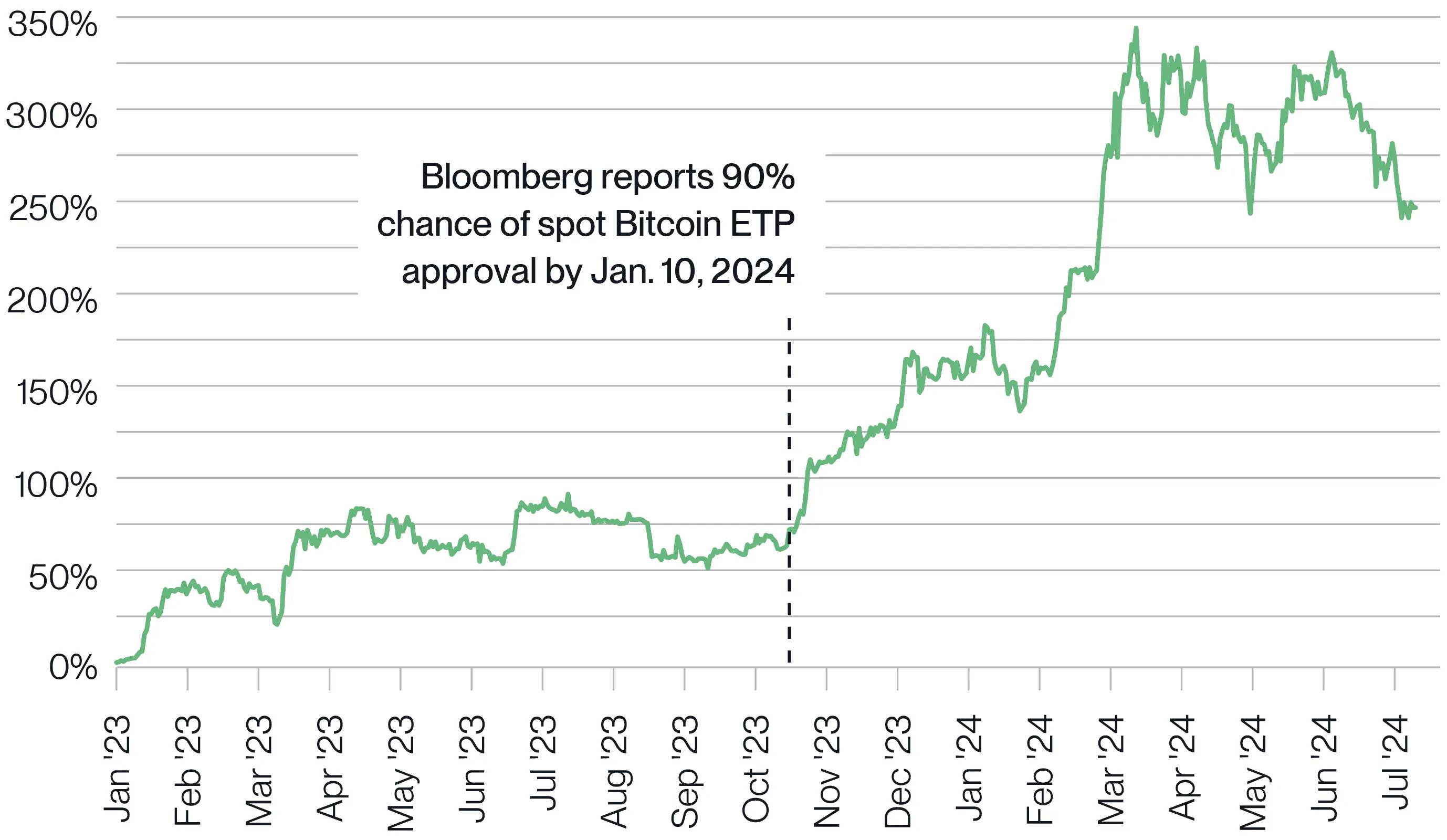
Source: Bitwise Asset Management
Data from December 31, 2022 to July 11, 2024
Will we see a similar effect with ETH? In fact, I think the impact could be even greater.
As I previously wrote, I believe the new Ethereum ETPs will attract billions of dollars. And I think the inflows into these new ETPs will have a larger impact on Ethereum than on Bitcoin, for three structural reasons.
Reason #1: Lower short-term inflation rate for ETH
When Bitcoin ETPs launched, Bitcoin’s network inflation rate was 1.7%. In other words, the Bitcoin network produces about 328,500 BTC annually—worth around $16 billion at the time. This means we need $16 billion worth of Bitcoin purchases each year just to maintain equilibrium.
In contrast, Ethereum’s inflation rate over the past year has been exactly 0%: there were 120 million ETH a year ago, and there are still 120 million ETH today. This is because while small amounts of ETH are created daily (similar to Bitcoin), users of Ethereum applications—from stablecoins to tokenized funds—also burn ETH. Over the past year, these two forces have balanced each other out.
Significant new demand meeting zero net new supply? I like that math. If activity on Ethereum increases, so does the amount of ETH burned. This is another organic demand lever in favor of investors.
Reason #2: Unlike Bitcoin miners, ETH stakers don’t need to sell
The second key difference is this: Bitcoin miners typically must sell their newly mined coins, while ETH stakers face no such requirement.
Bitcoin mining is an expensive process requiring high-end computer chips and massive energy consumption. As a result, miners usually sell most of the BTC they mine to cover operating costs.
Ethereum, however, doesn’t rely on mining. Instead, it uses a system called “proof-of-stake.” In this system, users lock up ETH as collateral to ensure they validate transactions accurately and honestly. In return, stakers receive newly minted ETH as rewards.
A critical difference between Bitcoin mining and Ethereum staking is that staking involves no significant direct costs. Therefore, Ethereum stakers don’t need to sell the ETH they earn. Even if Ethereum’s inflation rate rises above 0%, I don’t expect meaningful selling pressure.
In the short term, Ethereum faces far fewer forced daily sales than Bitcoin.
Reason #3: 28% of ETH is staked and therefore off the market
Staking has another effect: when you stake ETH, you lock it into a contract for a period of time. During that time, you can’t withdraw or sell your ETH. Currently, 28% of all ETH is staked, meaning it’s effectively removed from the market.
Additionally, another 13% of ETH is locked in smart contracts within decentralized finance (DeFi), such as being used as collateral in lending markets. This takes even more ETH out of circulation.
Combined, approximately 40% of ETH is either partially or fully unavailable for sale. That’s a huge proportion!
What does this mean?
As I mentioned earlier, I expect the new Ethereum ETPs to succeed, attracting $15 billion in new assets within their first 18 months. ETH currently trades around $3,400—just 29% below its all-time high. Given the factors outlined above, if ETPs perform as I anticipate, it’s hard to imagine ETH not challenging its previous peak.
Join TechFlow official community to stay tuned
Telegram:https://t.me/TechFlowDaily
X (Twitter):https://x.com/TechFlowPost
X (Twitter) EN:https://x.com/BlockFlow_News
 @BitwiseInvest






