Decoding the Babylon Protocol: Bitcoin's Hanging Gardens
TechFlow Selected TechFlow Selected
Decoding the Babylon Protocol: Bitcoin's Hanging Gardens
If successful, the project will, as its name "Babylon" suggests, build a garden in the sky—or even a metropolis—above the Bitcoin network.
 Navigating Web3 tides with focused insights
Author: @Webi_Tree
TL; DR
-
Babylon is a staking protocol whose core component is a Cosmos IBC-compatible PoS public chain that enables locking Bitcoin on the Bitcoin mainnet to provide security for other PoS consumer chains, while earning staking rewards on either the Babylon mainnet or the PoS consumer chains.
-
The project sits at the intersection of multiple high-narrative sectors including Bitcoin ecosystem, Bitcoin programmability, Bitcoin Layer 2, Bitcoin staking, restaking, shared security, modularity, and the Cosmos ecosystem—aligning with current market trends and possessing strong narrative appeal.
-
The team demonstrates strong technical expertise, with core members and advisors holding deep technical backgrounds.
-
The project has raised no less than $96.8 million in total funding, attracting significant capital from numerous institutions.
-
The ecosystem is rich, with partnerships established with over 60 Cosmos application chains, wallet providers, Bitcoin L2 projects, DeFi protocols, and Rollup service providers.
-
The project is currently in test phase, with mainnet not yet launched and tokenomics still undisclosed.
-
Risks include potential market rejection of its narrative and logic, insufficient staking demand, and leverage-related risks.
1. Project Overview
The Babylon Protocol is a Bitcoin staking protocol allowing users to lock Bitcoin on the Bitcoin network to secure other PoS chains while earning staking rewards. Babylon enables Bitcoin to leverage its unique security and decentralization features to provide economic security for other PoS chains, accelerating their launch and growth.
At the heart of the Babylon architecture lies the Babylon blockchain—a PoS blockchain built using the Cosmos SDK and compatible with Cosmos IBC. It facilitates data aggregation and communication between the Bitcoin chain and Cosmos application chains.
Founded in February 2023, the Babylon project has not yet launched its mainnet and remains in testing phase without a token release.
This report analyzes Babylon by first examining its narrative strength, then delving into fundamentals such as team, fundraising, technology, ecosystem, tokenomics, competitive landscape, development status, and risk factors.
2. Project Narrative
In the crypto world, narratives refer to prevailing stories, beliefs, or perspectives that influence how people perceive and evaluate crypto industries, currencies, or projects. Given the highly speculative nature of Web3 investments, narratives—often driven by technological advances or socioeconomic events—play a critical role in shaping market sentiment, price movements, and adoption rates, sometimes even determining the fate of entire sectors or projects. In particularly speculative segments like meme coins, narrative often outweighs fundamentals. A compelling narrative can capture market attention, interact with fundamentals—either driving positive momentum or leaving a project stagnant. Therefore, this analysis begins with an examination of Babylon’s narrative.
Since 2023, Ethereum-based liquid staking and restaking protocols such as Lido and EigenLayer have attracted massive capital inflows. EigenLayer leverages ETH's security and decentralization to provide economic security for other PoS chains, eliminating the need for them to bootstrap from scratch or endure high inflation during early stages. EigenLayer achieved rapid success, amassing over $13 billion in total value locked (TVL) within just five months, with continued growth. Its governance token $EIGEN is projected to be valued between $3 billion and $15 billion.
Bitcoin currently has a market cap of approximately $1.4 trillion, more than three times that of ETH at $445 billion. Replicating EigenLayer’s success on Bitcoin could unlock trillions in liquidity, creating a new liquid market and attracting vast capital inflows.
Babylon, a Bitcoin staking protocol, aims to open new use cases for Bitcoin beyond its traditional roles as “digital currency” and “digital gold.” It allows Bitcoin to function similarly to ETH—leveraging its unique security and decentralization to economically secure other PoS chains while generating yield for holders and enabling faster bootstrapping for new protocols.
Additionally, Babylon will create a secondary Bitcoin staking market, enabling Bitcoin to be restaked across multiple PoS networks, thereby expanding both Bitcoin’s and Babylon’s utility.
Meanwhile, modular narratives remain strong in Ethereum, with DA projects like Celestia, EigenDA, Near DA, and Eclipse emerging rapidly. Babylon also adopts a modular approach, acting as a plug-in module for other PoS networks, aligning it with the broader modular narrative.
On another front, the Bitcoin ecosystem is experiencing explosive growth, with a surge of new projects—including Layer 2 solutions—and increasing VC funding drawing market attention. At Messari Research’s quarterly “Narrative Games” event, the Bitcoin programmability sector received the highest narrative score. Investors and developers are actively exploring new ways to unlock Bitcoin’s programmability. Bitcoin staking protocols clearly meet this demand, potentially serving as dedicated staking-focused Bitcoin L2s. Staking itself increases Bitcoin’s utility. Thus, Babylon’s timing is ideal—emerging in a spotlighted sector, laying a solid foundation for early traction and visibility.
In summary, Babylon addresses several key issues: low yield for Bitcoin holders, limited Bitcoin use cases, and non-scalable Bitcoin system security. Positioned across Bitcoin ecosystem, Bitcoin programmability, Bitcoin L2, Bitcoin staking, restaking, shared security, modularity, and Cosmos ecosystem sectors, Babylon aligns strongly with mainstream narratives and possesses powerful storytelling appeal.
3. Team Background and Funding
3.1 Team Background
According to official disclosures, Babylon’s team consists of 32 technical staff and advisors, showcasing strong technical capabilities. The team is also highly active in various Web3 and marketing events, indicating high engagement. Key members include:
Co-founder David Tse holds a PhD in Electrical Engineering from MIT and previously worked at AT&T Bell Labs. His research focuses on information theory and its applications in wireless communications, machine learning, energy, and computational biology. He was awarded the 2017 Claude E. Shannon Award and elected to the National Academy of Engineering in 2018.
Co-founder Mingchao (Fisher) Yu earned a PhD in Telecommunications from the Australian National University, specializing in network information theory and coding, particularly in wireless communications.
Advisors include Sunny Aggarwal, co-founder of Osmosis Lab, and Sreeram Kannan, founder of EigenLayer, who serves as a strategic advisor.
3.2 Funding Situation
On May 22, 2023, Babylon announced an $8.8 million seed round led by IDG and Breyer Capital.
On December 7, 2023, Babylon announced an $18 million Series A round led by Polychain Capital and Hack VC, with participation from Framework Ventures, Polygon Ventures, Castle Island Ventures, OKX Ventures, Finality Capital, Breyer Capital, Symbolic Capital, IOSG Ventures, Web3.com Ventures, GeekCartel, Dovey Wan, Chain Fund Capital, Cluster Capital, L2 Iterative Ventures, ABCDE Labs, and Kingsley Advani.
On February 27, 2024, Binance Labs announced an investment in Babylon, with amount undisclosed.
On May 30, 2024, Babylon announced a $70 million funding round led by Paradigm, with 30 institutional investors participating.
As of June 1, 2024, Babylon has disclosed multiple funding rounds totaling over $96.8 million.
Looking at the broader Bitcoin ecosystem, from March 1, 2023, to May 31, 2024, there were 143 funding events totaling over $2.3 billion; since 2024 alone, 85 rounds have raised over $945.3 million. This reflects growing institutional and VC confidence in the Bitcoin ecosystem.
Comparing Babylon’s funding against similar projects provides a rough valuation benchmark. As shown in the table below, Babylon’s funding amount and number of investors exceed most Bitcoin L2 projects, though many backers are second-tier VCs. Compared to Ethereum restaking projects like EigenLayer, or even Ethereum L2s like Arbitrum and Optimism, Babylon still lags in both funding scale and investor caliber.
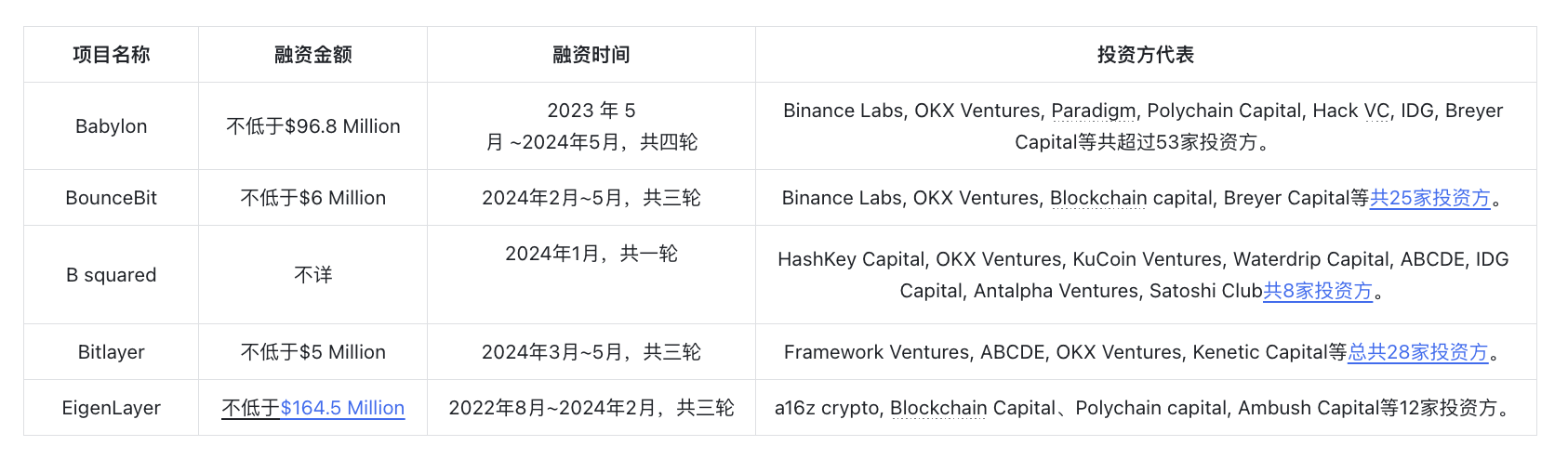
Table 1: Funding Comparison of Related Projects
Notably, compared to Ethereum L2s, many Bitcoin L2 projects lack transparent funding disclosures—some reveal only investor names but hide amounts. For example, neither Binance Labs’ nor B Square’s investment figures were disclosed. This raises concerns about possible collusion between projects and investors to inflate valuations or offer preferential token allocations to big-name backers for credibility, facilitating easier exits.
Another notable trend is the deep involvement of Chinese or ethnically Chinese teams and capital in many Bitcoin ecosystem projects, especially Bitcoin L2s. Projects with Chinese co-founders include Babylon and Merlin Chain. Prominent Chinese-backed investors include Binance Labs, ABCDE, OKX Ventures, HashKey Capital, HTX Ventures, MEXC Ventures, Bixin Venture, IDG Capital, and Waterdrip Capital.
4. Technical Principles
4.1 Project Logic
Babylon aims to build a Bitcoin staking protocol that leverages Bitcoin’s network security to share economic security with PoS networks, reducing the time and cost for PoS chains to establish trust from scratch.
A trustworthy Bitcoin staking protocol should possess several characteristics:
1. Secure, decentralized, censorship-resistant. The protocol must offer “trustless” staking, support delegation, and enable restaking.
2. Slashable. If a staker behaves maliciously, their locked Bitcoin should be subject to slashing penalties.
3. Freely redeemable. As long as stakers comply with protocol rules, they must be able to freely withdraw (unbond) Bitcoin—even if all other stakers on the PoS chain are dishonest. Withdrawals must not be censorable.
To achieve these goals, Babylon created a Cosmos IBC-compatible blockchain network connecting Bitcoin and IBC-enabled PoS chains, providing Bitcoin-based timestamping services. It implements “remote staking” to lock Bitcoin on the Bitcoin chain while distributing rewards via the Babylon chain. Bitcoin contract emulation enables staking, redemption, and slashing functions. Mechanisms like accountable assertions and finality gadgets enforce slashing on malicious actors. The Bitcoin timestamping protocol ensures withdrawal capability. Babylon also provides a platform for building Bitcoin restaking protocols on top.
4.2 Protocol Architecture
The primary goal of Babylon’s architectural design is to enhance scalability for connected networks and protocols. The architecture is divided into three layers: 1. Bitcoin Network Layer; 2. Control Layer; 3. Data Layer.
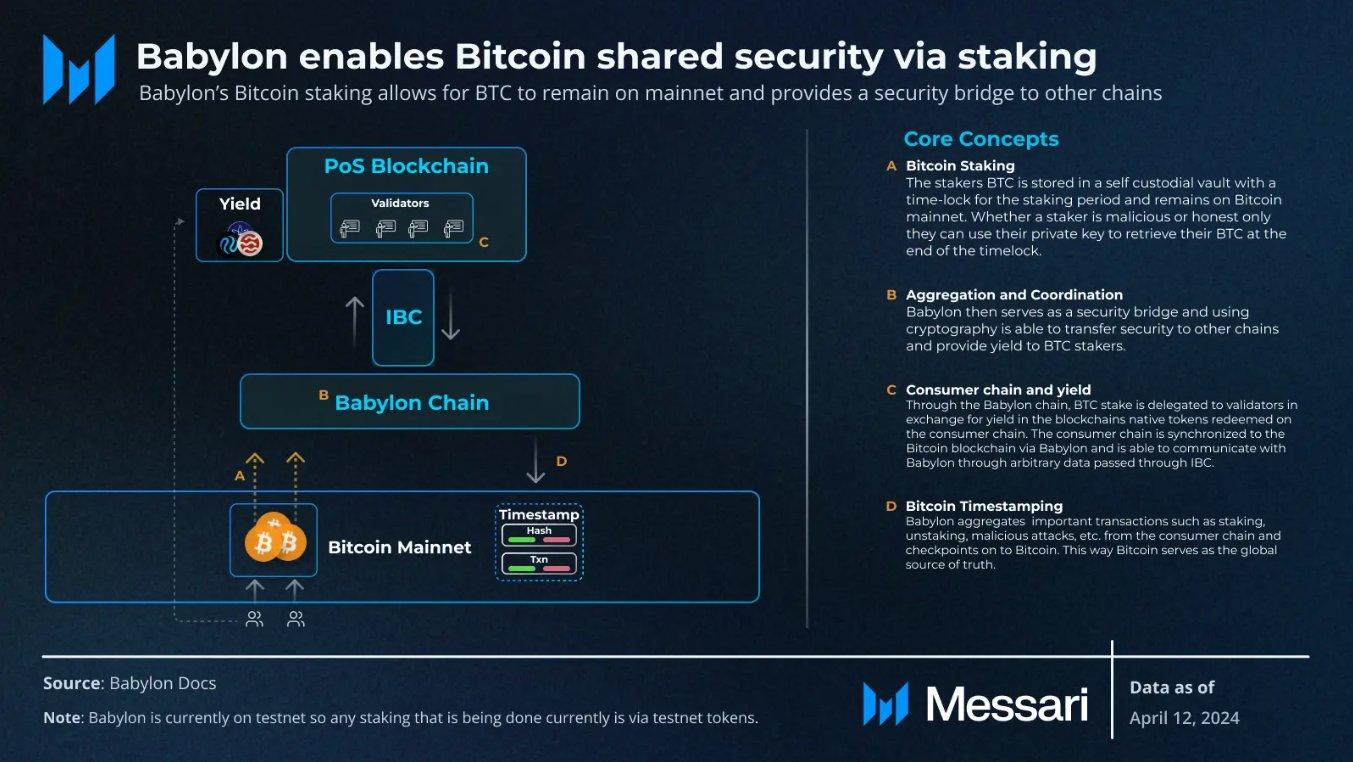
Figure 2: Babylon Protocol Architecture Diagram
The Bitcoin network layer forms the base, providing timestamping services to all connected PoS consumer chains. Bitcoin has four key traits: 1. High degree of decentralization; 2. High system robustness (simplicity), with a script language lacking Turing completeness and unable to execute complex smart contracts; 3. Uses UTXO model instead of account-based; 4. Network security does not rely on staking Bitcoin.
The control layer acts as middleware, composed of the Babylon blockchain network, linking Bitcoin, Cosmos Hub, and the data layer. The Babylon blockchain is the core of the entire architecture, using PoS (specifically DPoS) consensus. Its main functions include: providing Bitcoin-based timestamping for PoS chains, synchronizing state between PoS and Bitcoin chains, operating a marketplace matching Bitcoin staking rights with PoS chains, tracking staking and validator information, and recording finality signatures from PoS chains.
The project has not yet disclosed the maximum number of mainnet validator nodes, which directly impacts decentralization levels. Babylon acts as an intermediary between additional-security-seeking PoS networks and the Bitcoin network, writing PoS consumer chain block headers onto the Bitcoin blockchain to confirm transaction finality, thereby enhancing security.
Built on Cosmos SDK and IBC-compatible, the Babylon blockchain efficiently aggregates timestamps from any number of Cosmos SDK chains, enabling seamless data aggregation and communication between Bitcoin and Cosmos application chains. The project hints at future compatibility with arbitrary PoS chains.
An IBC message-passing layer exists between the Babylon mainnet and PoS consumer chains, consisting of IBC relayer nodes (IBC Relayer). These are computer nodes running relayer clients that provide cross-chain messaging, enabling communication between the control layer (Babylon chain) and data layer (PoS application chains).
The data layer comprises various PoS consumer chains seeking to utilize (consume) Bitcoin’s economic security via Babylon. Currently, these chains must meet two conditions: open IBC connection with Babylon, and validators must run the corresponding Babylon protocol module.
Comparing with EigenLayer’s architecture reveals that Babylon plays a similar role—an intermediary between base and upper layers. PoS consumer chains in Babylon’s ecosystem correspond to AVSs in EigenLayer.
To better understand Babylon and EigenLayer, consider an analogy: if Bitcoin and Ethereum mainnets are like Android operating systems, then Babylon and EigenLayer are akin to WeChat or Alipay, and PoS consumer chains on Babylon or AVSs on EigenLayer resemble mini-programs within those apps. Just as Android and WeChat jointly secure mini-programs, Bitcoin and Babylon jointly secure PoS consumer chains.
4.3 Technical Implementation of Staking Contracts
4.3.1 Babylon’s Staking Mechanism
Staking refers to the act or process of locking a certain amount of tokens as a validator in a PoS or its variant blockchain network to participate in transaction validation, block production, consensus, and network security maintenance, ultimately earning rewards. More broadly, staking also refers to locking tokens to earn rewards, equivalent to “yield farming” in DeFi. This report uses “staking” in the former sense for PoS networks. Since Bitcoin uses PoW consensus, it lacks native staking; thus, “staking” in Bitcoin context refers to the latter meaning. Because ordinary users cannot operate PoS validator nodes independently, they typically participate via liquid staking or delegation.
The Babylon protocol allows Bitcoin holders to lock Bitcoin at a Bitcoin mainnet address controlled by a multi-signature contract managed by Babylon, while providing staking validation services for other networks. The protocol slashes misbehaving users on the Bitcoin network and distributes rewards on the Babylon chain or PoS consumer chains. This mechanism is known as “remote staking.”
This remote staking method closely resembles EigenLayer’s approach and can be contrasted with it.
Unlike cross-chain bridge models that use “lock-map-mint,” Babylon avoids bridging Bitcoin to its own chain for staking. Instead, it employs remote staking to eliminate additional trust assumptions introduced by bridges. While remote staking removes bridge-related trust, it still isn’t fully “trustless,” because the security of locked Bitcoin depends on the security of the staking contract on the Babylon chain. Since both staking and bridge contracts operate at the same contract-layer security level and introduce similar assumptions, there’s no fundamental difference.
On the other hand, Bitcoin clients verify transactions by executing scripts written in Bitcoin’s scripting language—a stack-based, non-Turing-complete language nearly incapable of handling complex smart contracts. Thus, staking contracts and other smart contracts on Bitcoin must be expressed through Bitcoin scripts. This requires a device to translate high-level smart contract languages into Bitcoin scripts, ultimately outputting UTXOs readable by Bitcoin clients and recordable on-chain.
Babylon uses the Bitcoin covenant emulator to execute staking contracts. Bitcoin covenants are a series of Bitcoin scripts capable of implementing simple smart contract functions like staking, redemption, and slashing. The covenant emulator is a daemon program functioning like a virtual machine (VM), providing an execution environment for Bitcoin contracts and hardware. It translates contract code into Bitcoin scripts for execution and outputs UTXOs for on-chain recording, thereby introducing smart contracts to Bitcoin and enhancing programmability. The emulator is operated by members of the covenant committee. The emulator’s code is open-sourced, released and updated on February 8 and April 2, 2024, respectively.
The Bitcoin covenant emulator shares similarities with Ethereum Virtual Machine (EVM) and BitVM developed by Bitlayer (Bitcoin Virtual Machine). All three serve similar basic purposes, but differ fundamentally: the covenant emulator is simpler, primarily restricting Bitcoin spending via predefined rules and supporting only basic functions like staking, redemption, and slashing; whereas BitVM and EVM are far more powerful, supporting complex smart contracts.
The committee protects the Babylon PoS system from attacks by Bitcoin stakers and validators through joint multi-signature signing of transactions. Public keys used by committee members for multisig are recorded in the genesis file of the Babylon blockchain.
Currently, the project has not disclosed the identities or number of committee members. Their identity and count will tightly correlate with governance design, while actual permissions and quantity raise questions about overall decentralization.
4.3.2 Babylon’s Slashing Mechanism
For shared security systems to ensure safety, misbehavior on base or consumer chains must be punishable—typically through slashing staked tokens on the underlying chain. Slashing is a penalty mechanism in PoS blockchains or protocols where validators or stakers lose part of their staked tokens upon misconduct. Common offenses include double-signing, downtime, invalid block proposals, etc. Slashing is crucial for maintaining network security, ensuring validators act in the protocol’s best interest rather than maliciously.
Babylon implements automatic slashing of Bitcoin through mechanisms like accountable assertions and finality gadgets.
Accountable assertions is a cryptographic concept using EOTS (Extractable One-Time Signatures) to penalize malicious signers. EOTS means that if a signer uses the same private key to sign two different messages, the private key gets revealed. EOTS can be implemented using Bitcoin’s Schnorr signatures. Finality gadgets are a consensus-layer concept—a layered consensus protocol atop Bitcoin’s own consensus, offering enhanced security. When a staker misbehaves (e.g., double-spends), Babylon sends a proof causing the staker’s private key to leak, resulting in partial or full confiscation of their Bitcoin by the protocol—this is called “automatic slashing.”
4.3.3 Babylon’s Redemption Mechanism
Babylon uses the Bitcoin timestamping protocol to enable Bitcoin redemption (unbonding) while resisting long-range attacks. The Bitcoin timestamping protocol is a proof-of-time technique allowing arbitrary data to be sent to Babylon to generate Bitcoin timestamps, enhancing integrity and security of PoS chains—for instance, defending against long-range attacks. It uses Bitcoin as the timestamp layer, Babylon as the checkpoint aggregation and data availability (DA) layer, and other PoS chains as the security-consuming layer.
Through this protocol, Babylon supports fast redemption, maximizing Bitcoin liquidity—one of its advantages over other staking protocols. Bitcoin redemption on Babylon will take around one day. While long compared to Bitcoin’s 10-minute block time, this is significantly faster than Optimism’s 7-day challenge period, Ethereum’s ~10-day withdrawal window, or the typical 21-day unbonding period in most Cosmos PoS networks.
A long-range attack is a potential threat to PoS chains where an attacker creates a longer chain starting from genesis, replacing the original main chain and altering (part of) transaction history.
4.3.4 Babylon’s Finality Mechanism
Finality refers to the state where a blockchain transaction becomes irreversible. Bitcoin, as a PoW-based network, achieves probabilistic finality, requiring multiple block confirmations and thus longer finalization times. Most PoS-based networks—including Babylon’s mainnet—use economic finality, achieving much faster confirmation. To prevent Babylon’s transaction speed and finality from being constrained by Bitcoin’s slower finality, the protocol introduces finality provider (FP) nodes for rapid finality and protection against fork attacks. FP nodes function similarly to sequencers in Ethereum Layer 2s—they validate transactions, bundle blocks, and sign each L2 block before submitting them to the Bitcoin mainnet. Thanks to FP nodes, finality on the Babylon mainnet takes only seconds. FP nodes are operated by an FP node committee running the FP Daemon program.
Whether FP nodes can achieve decentralization and censorship resistance, and how they avoid the centralization pitfalls common in Ethereum L2 sequencers, remains to be proven. Like the covenant committee, the identity and size of the FP node committee will determine the protocol’s decentralization and anti-censorship properties.
4.4 Summary
From Babylon’s system architecture and technical principles, it’s clear the protocol introduces no true innovation—it essentially replicates Ethereum rollups and EigenLayer on the Bitcoin network.
While Babylon employs various techniques to minimize trust assumptions, the overall security, decentralization, censorship resistance, and scalability of the protocol depend on its weakest link—constrained by Babylon’s consensus mechanism, the security of staking/redemption/slashing contracts, multisig permissions and count, identities and numbers of covenant and FP committees, and IBC relayer node security. Clearly, attacking the Babylon network is easier than attacking Bitcoin. Moreover, the security of PoS consumer chains ultimately depends on their own resilience, not Bitcoin or Babylon. Therefore, Babylon’s claim of “trustlessness” still carries many implicit assumptions.
5. Ecosystem
A blockchain ecosystem refers to the collective elements related to a blockchain project, including the project itself and all stakeholders—developers (project teams), maintainers (miners and validators), investors, partners, users, media, exchanges, etc. The number and scale of ecosystem applications are key to a project’s success; a complete and thriving ecosystem helps achieve positive network effects for the project and the broader ecosystem.
As of April 27, 2024, Babylon has partnered with over 60 Cosmos application chains, which will connect via IBC once Babylon’s mainnet launches. Additionally, Babylon has established collaborations with numerous wallet providers, Bitcoin L2s, DeFi protocols, Bitcoin restaking protocols, and Rollup service providers—as listed on its website—providing strong support for its development. Notable ecosystem partners include Cosmos Hub, Osmosis, Talus, Akash Network, Injective, Sei, Stride, B Squared Network, and Nubit.
Bitcoin staking and restaking partners include StakeStone, Uniport, Chakra, Lorenzo, and Bedrock. StakeStone is a multi-chain liquid staking/restaking protocol building Bitcoin restaking functionality on Babylon. UniPort Network, a zk-Rollup appchain built on Cosmos SDK, is a Bitcoin asset restaking protocol in the Cosmos ecosystem supporting cross-chain interoperability for assets like BRC20, Ordinals-NFT, ARC20, Runes, and RGB++. It is integrating Bitcoin restaking with Babylon. Chakra is a ZK-based Bitcoin restaking protocol integrating Babylon to allow mapping Bitcoin from Babylon to other ecosystems. Lorenzo is a Bitcoin restaking protocol built on Cosmos Ethermint, with a core component being a Cosmos appchain. Bedrock is a multi-asset restaking protocol on Ethereum allowing users to lock WBTC on Ethereum, mint uniBTC, and map an equal amount to the Babylon chain to earn staking rewards.
It’s evident that Babylon’s ecosystem extends beyond Cosmos, continuously expanding horizontally. Once fully deployed, this could form a “sky garden” of Bitcoin-based applications.
By integrating into the Cosmos ecosystem instead of building an Ethereum L2, Polkadot parachain, or Avalanche subnet, Babylon benefits from IBC’s ability to securely and efficiently pass arbitrary messages between different PoS networks and nodes. Additionally, Cosmos already hosts over 90 ready-made appchains for collaboration, unlike EigenLayer, which must build consumer chains (AVSs) and upper-layer apps from scratch. Furthermore, Babylon can share liquidity with other Cosmos apps via IBC while retaining protocol autonomy—something harder to achieve in other ecosystems where some autonomy must be sacrificed.
Babylon suggests future support for Bitcoin restaking on any PoS chain, but this would require new cross-chain messaging protocols to connect external PoS chains to IBC, introducing new trust assumptions. Fortunately, such protocols are under development: Composable aims to connect Ethereum, Polkadot, Solana, NEAR, and TRON with Cosmos. Another project, LandslideAVAX, seeks to extend IBC to subnets within the Avalanche ecosystem. These developments could expand Babylon’s ecosystem footprint.
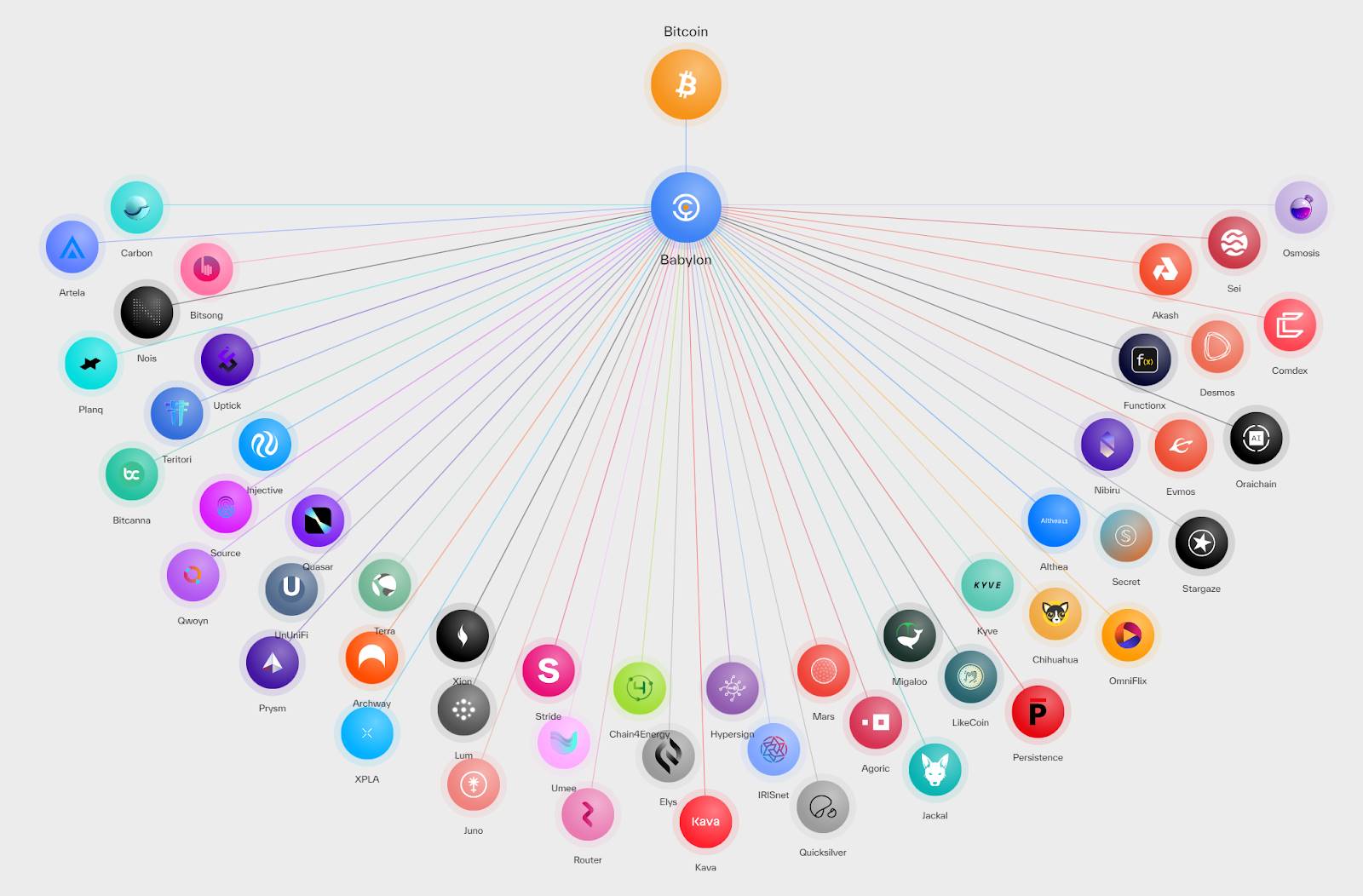
Figure 3: Babylon Ecosystem Map
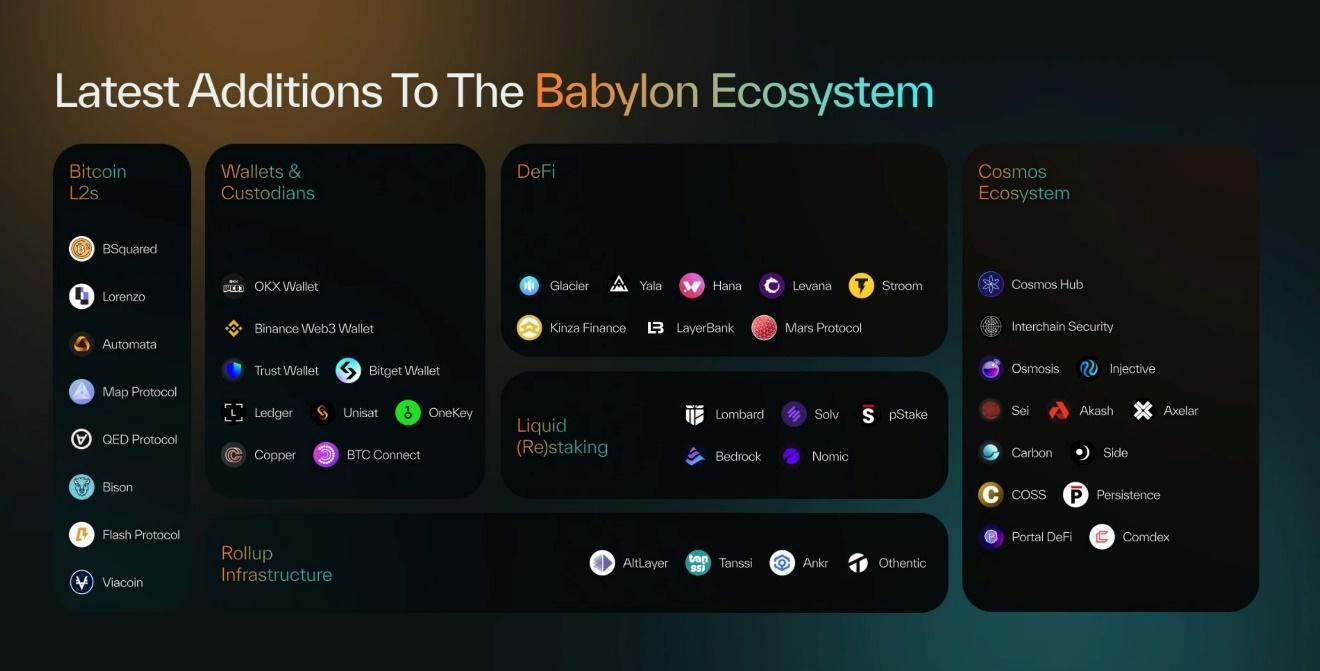
Figure 3: Babylon Ecosystem Map 2
6. Economic Issues
Babylon has not issued a token nor disclosed its tokenomics. Future economic models should focus on the utility, supply, distribution (whether “low circulation, high inflation”), and incentive schemes of Babylon’s native token $BBN. This section avoids discussing token economics and instead focuses on Bitcoin staking yields, protocol demand, and leverage-related economic issues.
6.1 Babylon’s Staking Yield Issue
Babylon allows Bitcoin holders to lock Bitcoin on the Bitcoin chain to secure PoS consumer chains. In return, PoS consumer chains pay a “protection fee,” typically funded by partial native token inflation as rewards. Babylon also rewards stakers. Thus, stakers earn from both Babylon’s native token ($BBN) rewards and inflationary rewards from PoS consumer chains—similar to EigenLayer. Bitcoin’s staking yield will depend on the total locked Bitcoin volume and the number of PoS consumer chains renting Bitcoin’s security via Babylon. The more PoS chains integrated with Babylon, the higher the Bitcoin staking yield.
Join TechFlow official community to stay tuned Telegram:https://t.me/TechFlowDaily X (Twitter):https://x.com/TechFlowPost X (Twitter) EN:https://x.com/BlockFlow_News
 @Webi_Tree