








Storj executive team turns to AI: What is Prodia?
TechFlow Selected TechFlow Selected
Storj executive team turns to AI: What is Prodia?
15 million seed round: from image generation to AI inference solutions, a three-minute read on Prodia.
 Navigating Web3 tides with focused insights
By Chandler, Foresight News
Recently, Prodia, a distributed GPU network for AI inference solutions, raised $15 million in funding led by Dragonfly Capital, with participation from HashKey, Web3.com, Index Ventures, Symbolic Capital, OKX Ventures, and angel investors including Balaji Srinivasan, Sandeep Nailwal (co-founder of Polygon), and Matthew Roszak (co-founder of Bloq).
Most of Prodia’s core team members come from the cloud storage platform Storj. Founder Monty Anderson previously served as Head of R&D at Storj Labs, CEO Shawn Wilkinson is the founder and CSO of Storj, and Chief Engineer Monty Anderson was formerly a senior software engineer and Head of R&D at Storj. So how has Prodia managed to win favor from multiple institutions and investors amid fierce competition?
What is Prodia?
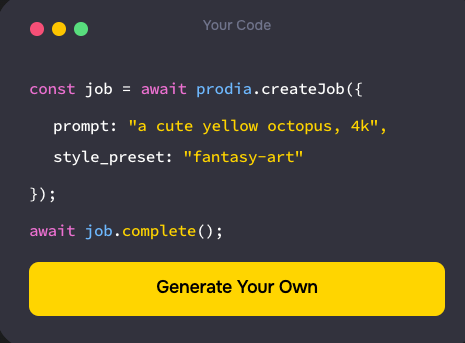
Prodia is an artificial intelligence platform specializing in image and music generation via its API. The company has developed Stable Diffusion API tools featuring multiple models that convert text into high-quality images, including SD1.5, SDXL, and SD3, each offering different resolutions and capabilities. With infrastructure powered by over 10,000 GPUs, Prodia can process image generation requests within two seconds. Since its inception, Prodia has generated more than 400 million images.
Prodia was founded in 2022 by Shawn Wilkinson, Mikhail Avady, and Monty Anderson. CEO Shawn Wilkinson brings extensive experience in distributed systems and cloud storage, having previously founded the decentralized cloud storage company Storj. In 2012, Shawn mined half a bitcoin per day from his dorm room but eventually shut it down due to rising room temperatures. However, this sparked his passion for blockchain technology and later led him to participate in several early-stage distributed computing projects. Mikhail Avady and Monty Anderson also have backgrounds in AI and blockchain.
In 2020, Shawn and co-founder Mikhail Avady became early adopters of GPT-3 and developed a music-generation application. However, the high cost of GPU usage became a bottleneck. They then built a distributed computing layer that reduced costs by 50%–90%, improved performance by two to four times, and made scaling significantly easier. This success laid the foundation for Prodia, which now focuses on providing scalable AI infrastructure for applications and enterprises—especially for compute-intensive tasks such as image and video generation.
From Image Generation to AI Inference Solutions
Currently, Prodia primarily serves businesses ranging from small to large enterprises, particularly those requiring substantial inference computing power. While the main focus today remains on image generation, Prodia is expanding its capabilities to include video, text, and other formats. The project aims to simplify the scaling process for AI applications, viewing AI as the core driving force behind technological advancement—but one that must become simpler, faster, and more cost-effective. Prodia’s solution eliminates the burden of infrastructure management, allowing developers to focus on product features without worrying about capacity constraints or relying on major cloud providers like Amazon. At present, Prodia’s primary business centers on image generation, with plans to expand into video generation next. Prodia specifically targets high-demand areas, evidenced by the widespread use of platforms like MidJourney and Stable Diffusion, which it sees as ideal entry points for users into AI-powered applications.
Shawn Wilkinson believes that “over the next decade, we will see a trend toward full integration—from software to hardware, from artificial intelligence to blockchain—where these technologies seamlessly converge. AI will become as essential to daily life as smartphones, benefiting everyone and improving every aspect of our lives.”
Future Development Focus
Following the launch of new APIs and recent funding, Prodia’s primary focus through year-end will be further expanding its AI models and solutions, with particular emphasis on entering the video generation space. Video generation requires 300 to 500 times more computational power than image generation. Prodia’s distributed system approach distributes some of the computational workload across a broader GPU cloud, addressing key needs for developers and scalers. Prodia’s vision is to create a community-driven system controlled by users rather than large cloud providers. Users will be able to run AI generation tasks and contribute their own computing power to the GPU cloud. Such a system not only offers flexibility and robust computational power but also reduces costs.
However, achieving this goal requires optimization in performance, scalability, user experience, and usability. Optimizing task allocation and execution ensures the system efficiently utilizes computing resources from all participating nodes. The system architecture must support strong scalability to flexibly adapt to changes in node count and workload. From a user experience perspective, developing intuitive interfaces and tools, along with comprehensive technical support and documentation, will help users easily join and operate AI generation tasks within the system.
Conclusion
As an emerging player in the AI sector, Prodia is expanding rapidly through its innovative distributed computing technology and powerful generative capabilities. However, rapid technological iteration and dynamic market shifts mean Prodia must remain flexible and forward-thinking to navigate future uncertainties. Overall, while large cloud providers remain a solid choice when massive GPU resources are needed for training, Prodia offers a more sustainable and economically efficient model for long-running applications. Whether it can maintain a stable position in the fiercely competitive AI market remains to be seen.
Join TechFlow official community to stay tuned
Telegram:https://t.me/TechFlowDaily
X (Twitter):https://x.com/TechFlowPost
X (Twitter) EN:https://x.com/BlockFlow_News
 Foresight News







