How to survive the dead time in the crypto circle?
TechFlow Selected TechFlow Selected
How to survive the dead time in the crypto circle?
History may have garbage time, but individuals don't.
 Navigating Web3 tides with focused insights
By TechFlow

A recent article titled "How to Survive History's Garbage Time" has gone viral.
What is “historical garbage time”?
In short, it refers to a period when history defies economic principles, individuals are powerless to reverse the tide, and the overall trajectory appears destined for failure.
For example, Japan’s three-decade economic stagnation following the bubble burst in the 1990s, during which young people had little opportunity and both national and personal development hit a ceiling.
For example, the U.S. period of stagflation from 1970 to 1982, marked by high inflation, high unemployment, and low growth.
For example, the Soviet Union from 1979 to 1989—or even Russia continuing into the present day.
A speck of dust in the eye of history becomes a mountain on an individual’s shoulders.
Faced with overwhelming trends, individuals always seem insignificant. Warren Buffett became the “Oracle of Omaha” because he was born in America and invested in U.S. stocks; China’s rising affluent class rode the wave of the country’s 40 years of reform and opening-up; some people earned tens or even hundreds of times returns through investing in scam coins or meme coins, thanks to Bitcoin’s bull run driving market sentiment and bringing in new capital…
But if the entire market or nation is facing headwinds, no amount of individual effort can make a difference.
In investment markets, “garbage time” is especially vivid.
Take Bitcoin as an example: most of its gains are concentrated in just a few months—and within those months, the biggest moves happen in only a handful of days.
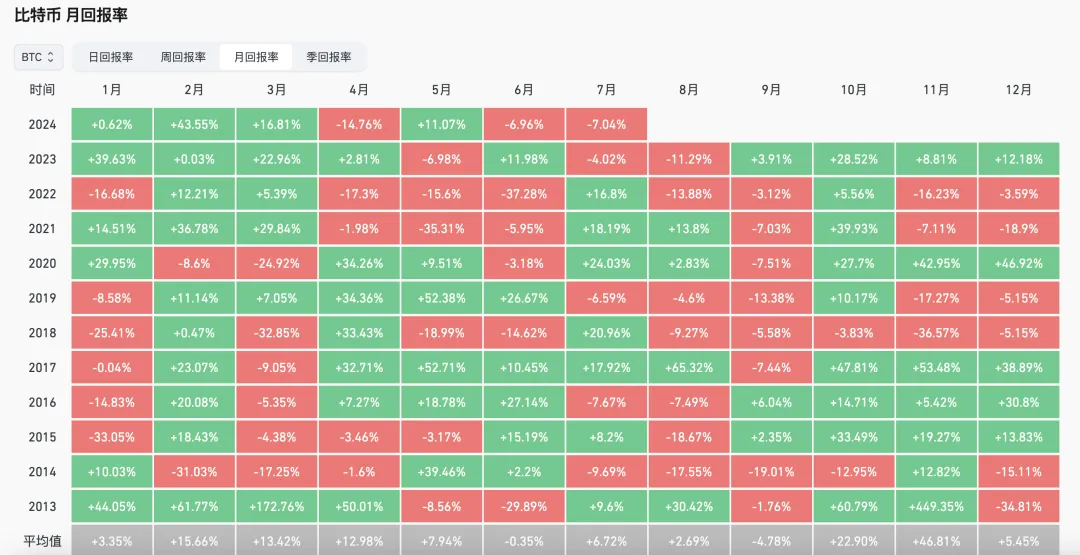
Recently, Fundstrat Global Advisors’ Tom Lee noted that most of Bitcoin’s annual gains occur within just 10 days each year—“If you exclude the 10 best-performing days each year, Bitcoin actually delivers negative returns.”
All the waiting is for these crucial dozen-odd days.
So how should individuals respond when caught in the garbage time of financial markets?
In this regard, A-share investors may have considerable experience.
The first method: Lie flat.
This is the path most Japanese chose after the economic bubble burst. Under the weight of history, individual efforts seem negligible. If resistance is futile, then embrace passivity—since reality cannot be changed, change yourself.
In the words of crypto community members: go out and get rained on, return to real life—stop being chained to candlestick charts, go hiking, date attractive people, hang out with friends…
See? Even exchanges like Binance and OKX now constantly remind users: “Touch Grass” (go outside, stop living in online echo chambers, and reconnect with the real world).
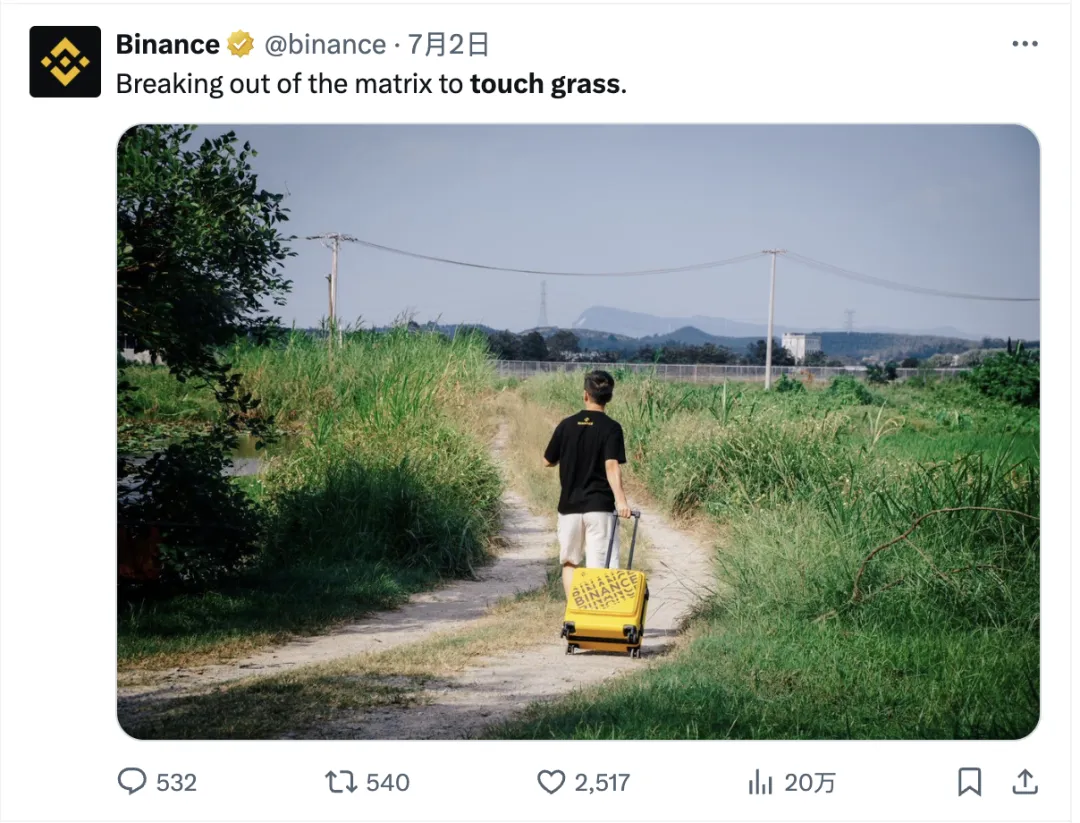
At such times, staying away from frequent trading, dollar-cost averaging into core assets like Bitcoin, and holding cash-like USDT for steady wealth management become blessings in life.
The second method: Run.
For instance, during Japan’s 1990s stagnation, many companies went overseas, building a “second Japan” abroad, while many individuals sought fortune in China—finding new opportunities in markets not stuck in garbage time.
Investing is no different. When the A-share market entered garbage time, many Chinese investors turned to U.S. stocks and crypto markets.
In 2024, as the crypto market itself entered garbage time, investors shifted attention and liquidity toward U.S. equities.
This isn’t speculation—it’s reality. This year, U.S. stocks have siphoned massive liquidity from crypto markets. Numerous crypto billionaires, worth billions of dollars, have made large-scale investments in Nvidia and Tesla, reaping substantial rewards. This also reflects another truth: this year, the overall wealth effect in crypto pales in comparison to U.S. stocks.
The third method: Grind.
When the pie isn’t growing, the only way to get more is to snatch it from others—that’s grinding. Be ruthless to others, and even more so to yourself.
Crypto grinding typically means on-chain PvP (player versus player) and farming (exploiting incentives).
For retail investors, there are greater opportunities on-chain. After all, on centralized exchanges, your counterparty might be market makers, exchanges, or project teams—but on-chain, where token distribution is relatively transparent, anyone could become a major player through early participation, then exit by convincing others to buy in.
But as on-chain competition intensifies, the lifespan of every “shitcoin” grows shorter—from one week to one day, even one hour. It’s an increasingly brutal battle, not to mention MEV bots and professional rug-pull teams lurking everywhere.
Friends in the group are live-dropping new projects—only the truly hardcore need apply.
Finally, I must say: history may have garbage time, but individuals don’t.
According to data from *Millennium of World Economic Growth*, Western Europe saw virtually no per capita GDP growth during the first millennium AD; improvement began only between 1000 and 1500 AD, with explosive growth only after the 18th century. China’s per capita GDP slightly exceeded Western Europe’s in the first millennium, yet also remained stagnant for a thousand years; similarly, little progress occurred in the first 900 years of the second millennium, with rapid catch-up happening only in the past century.
Viewed from a higher perspective, humanity spent thousands of years in “historical garbage time”—productivity barely improved, assets didn’t appreciate, and the efforts of each generation seemed “in vain,” like enduring a long winter.
Historic opportunities often arise for only one or two generations—but everyone still has to live, and live well.
Perhaps we’ve already missed Bitcoin’s optimal investment window. But in a situation we cannot change, it may still be among the least bad—and most cost-effective—choices available.
Finally, a poem by Zhang Yuan'gan of the Southern Song Dynasty feels particularly fitting:
White clouds shift like dogs chasing the sky,
All glory and fame reduced to a heap of dust.
Better to sing a sorrowful song with wine in hand,
And still recite verses cherishing spring’s last light.
Scenery mirrors the golden days of old,
Kinship found in kindred spirits of our time.
Who knows how many blossoms fly after rain?
Drunk, I win back my freedom once again.
Join TechFlow official community to stay tuned
Telegram:https://t.me/TechFlowDaily
X (Twitter):https://x.com/TechFlowPost
X (Twitter) EN:https://x.com/BlockFlow_News
 深潮TechFlow