One Article to Understand Sentient, the AI Project That Raised $85 Million
TechFlow Selected TechFlow Selected
One Article to Understand Sentient, the AI Project That Raised $85 Million
Recently, the open-source artificial intelligence development platform Sentient announced an $85 million seed funding round, aiming to challenge the dominance of centralized AI model development in the industry. This substantial financing has drawn significant market attention.
 Navigating Web3 tides with focused insights
Author: Viee, Core Contributor at Biteye
Editor: Crush, Core Contributor at Biteye
Community: @BiteyeCN
*Approximately 3,700 words, estimated reading time: 8 minutes
Recently, Sentient—an open-source AI development platform—announced it has secured an $85 million seed funding round aimed at challenging the dominance of centralized AI model development in the industry. This substantial financing has drawn significant market attention.
According to disclosures, the round was co-led by Peter Thiel’s Founders Fund, Pantera Capital, and Framework Ventures, with participation from Ethereal Ventures, Robot Ventures, Symbolic Capital, Delphi Ventures, and others.
01 $85 Million Seed Round—What's Behind Sentient?
1. Top-tier Team: One of Sentient’s core contributors is Sandeep Nailwal, co-founder of Polygon. Sentient’s advisor is Sreeram Kannan, founder and CEO of EigenLayer.
2. Backed by Ethereum: The Sentient platform will be built on Polygon, signaling Ethereum’s expansion into the AI domain.
3. Disruptive Technological Vision: Competing directly with OpenAI, Sentient aims to create a decentralized Artificial General Intelligence (AGI) platform that leverages blockchain technology to incentivize collaboration, construction, replication, and scaling of AI models, rewarding contributors accordingly.
These three compelling strengths are progressively revealing Sentient’s growing value.
02 Highlight One: Spearheaded by Tech Titan Sandeep Nailwal
One of Sentient’s key figures is Sandeep Nailwal, co-founder of Polygon.
Those who experienced the last bull market will surely recognize this "millionaire from the slums" of Web3. Emerging from the slums of Madrid, he rose to lead Polygon—a multi-billion-dollar Web3 company—transforming the so-called “Matic horse” into an Ethereum Layer 2 aggregator, becoming one of the biggest dark horses in the crypto market and achieving a valuation of tens of billions of dollars.
This is a truly inspiring story. Polygon’s current position among the top public blockchains owes much to Sandeep Nailwal’s values.
Born in an Indian slum, Sandeep saw many classmates drop out early, some falling into alcoholism or gambling. Throughout his upbringing, he was strongly driven to escape such a life. He wanted to become someone great, refused to play small games, and deeply disliked failure.
These values stayed with Sandeep as he co-founded MATIC Network. It was 2017—the height of ICO mania.
Back then, anyone with a whitepaper could raise funds—even without a product—and many projects failed after fundraising.
After launching MATIC Network in India with JD Kanani and Anurag Arjun, the team could have easily raised $20 million—but they chose not to. Taking shortcuts and chasing quick profits contradicted Sandeep’s vision of greatness.

Sandeep responded: “Matic is solving a long-term problem, so we had to choose slower growth.
Early access to large capital might restrict our development and vision.” Ultimately, they raised only a limited amount—$5 million from Binance—allowing more time to refine their product.
In short, beyond the team’s sharp entrepreneurial instincts and strong technical capabilities, Sandeep’s personal drive served as a crucial stabilizing force in building Polygon—and will likely bring essential soul and vision to Sentient beyond just technology.
03 Highlight Two: Leading Ethereum Into the Hottest AI Narrative
Polygon is open and powerful, with a mission to scale Ethereum and bring more users into crypto.
Functionally, Polygon aims to create a multi-chain ecosystem compatible with Ethereum, using a Proof-of-Stake consensus mechanism for transaction processing while deriving security from Ethereum.
This enables interconnected and scalable blockchain networks, earning it the nickname “the internet of blockchains.” Simply put, Polygon makes Ethereum faster, easier, and cheaper to use.
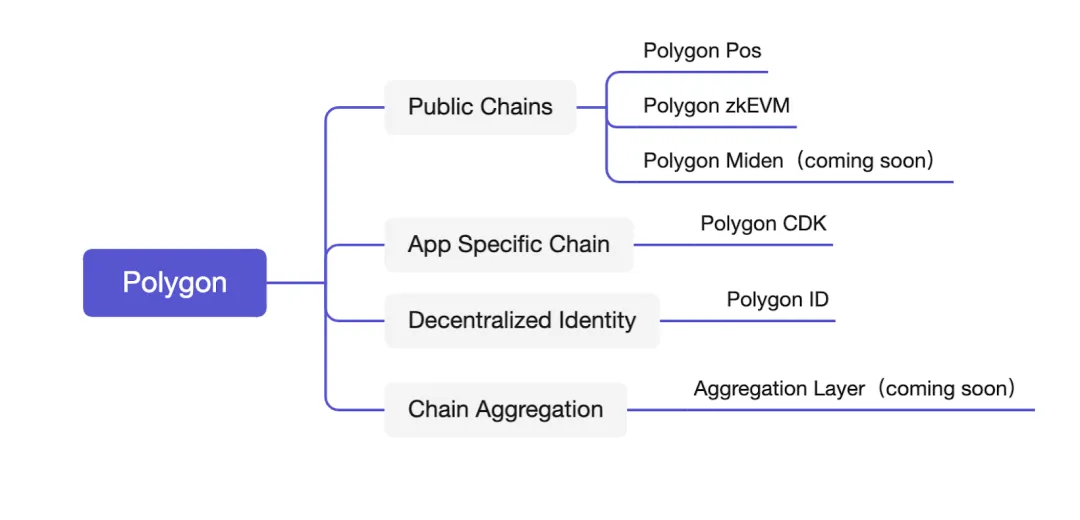
Polygon began as Matic Network—a PoS chain—that evolved into a comprehensive scaling solution and was later rebranded as Polygon. Subsequently, Polygon acquired multiple zk technologies and now focuses on unified liquidity and infinite scalability for Ethereum via AggLayer and the Chain Development Kit (CDK).
As this bull market unfolds, AI has emerged as one of the most discussed topics and a new narrative opportunity for established public chains.
With Sentient announcing its deployment on Polygon, Ethereum is poised to shine brightly in the AI space. In fact, Polygon demonstrated early sensitivity to AI, launching Polygon Copilot in June 2023, followed by another AI tool called Brain.
Compared to Copilot, Brain offers broader functionality, including AI-powered smart contract deployment. On April 19, 2024, the highly anticipated AI project Ora Protocol announced its integration of an on-chain AI oracle with Polygon PoS, enabling developers to build AI-driven dApps using Ora’s oracle and leverage richer data sources to break through traditional smart contract limitations.
Can Polygon carry the massive AI narrative? The answer appears to be yes. Built on Polygon’s aggregation architecture, it can support hundreds of thousands of chains—all connected to a single layer and inheriting Ethereum’s security—with the goal of achieving infinitely scalable blockchain networks.
These chains will focus on different domains such as DeFi, gaming NFTs, and AI projects. For example, Sentient itself is a project built on a Polygon CDK chain. Specialized chains and ecosystems will concentrate on developing applications for specific industries—this is Polygon’s blueprint for the decentralized world.
A major barrier to open AI is cost—specifically training costs and data collection expenses.
Sandeep has publicly shared his views on this: cryptographic incentives can help open-source solutions overcome these cost barriers—for instance, through tokenizing models. Polygon plans to experiment with various approaches in this area.
Additionally, decentralized computing infrastructure—such as DePIN for AI computation—is already seeing multiple initiatives.
AI demand is high but supply remains limited. While decentralized solutions may help address supply constraints, they may not fully replace centralized providers, who often maintain advantages in coordination and performance.
04 Highlight Three: Open-Source AI Competing Against Tech Giants Like Google With a Disruptive Vision
Finding a long-term decentralized alternative to current AI service providers like OpenAI is a critical pain point in the AI era.
First, why does AI need to be open source? We all know AI is advancing rapidly, with transformative potential across many aspects of human life. But if this technology is controlled by only a few companies, significant risks arise.
Second, why do we need decentralized alternatives? Today, AGI development is largely conducted in secret by large corporations due to their vast resources.
This closed approach means all model parameters and variables remain inaccessible to external inspection, verification, or distribution—entirely under corporate control.
This concern drove Sandeep’s vision: creating a decentralized open platform for AGI development to ensure AI benefits are fairly distributed and its development aligns with the interests of all humanity.

To address these issues, Sentient was born.
Imagine an AI platform that is open and open-source, where people collaborate, and blockchain technology incentivizes individuals to build and expand AI models, rewarding them for their contributions.
That’s exactly what Sentient aims to do—building open-source AI models through community contributions to counteract centralization and ethical concerns in today’s AI landscape.
Moreover, Sentient intends to compete directly with OpenAI while differentiating itself through its community-driven approach.
Unlike OpenAI, which restricts direct user access to its models, Sentient will allow users to access models, contribute improvements, and earn rewards for doing so.
Sentient’s reward mechanism operates through “campaigns,” each with specific metrics to evaluate contributions and distribute rewards accordingly.
If successful, Sentient would solve a core obstacle hindering open-source AI: incentive alignment.
Currently, on open-source AI platforms, anyone can freely copy models without compensation.
Sentient plans to enter testnet phase this quarter and intends to use the funding to grow its team and hire experts.
05 Risk Notice
Sentient’s token incentive model has not yet been finalized—this is a core component of the project. If the incentive mechanism proves inadequate, the fundamental challenges facing open-source AI may remain unresolved.
The project is still in its early stages, with no mature product yet available. The testnet has not launched, and the community size remains small, indicating high uncertainty. Users are advised to wait for further disclosures or tangible progress before engaging.
Given the current lack of information and absence of project milestones, exercise caution when clicking website or Discord links posted on Twitter, and safeguard your funds.
06 Conclusion
The rapid advancement of AI has brought humanity to a crossroads between two possible futures. One path leads to a closed world dominated by a few large corporations and proprietary models. The other leads to an open world where models are inherently open-source, and inference is transparent and verifiable.
The open world represents our ideal future—one that can only be realized through blockchain technology, making artificial intelligence fairer and more transparent.
Each bull market sees a wave of public chains rise to prominence, while others quietly fade away when the cycle ends. We look forward to Sentient leading Polygon and Ethereum toward a deeper, more expansive future.
Join TechFlow official community to stay tuned
Telegram:https://t.me/TechFlowDaily
X (Twitter):https://x.com/TechFlowPost
X (Twitter) EN:https://x.com/BlockFlow_News
 @BiteyeCN