








Unlocking BTC's earning potential, Master Protocol aims for user onboarding
TechFlow Selected TechFlow Selected
Unlocking BTC's earning potential, Master Protocol aims for user onboarding
Compared to ETH yield, the BTC yield赛道 is still a blue ocean. Master aims to pioneer user adoption by integrating yields and simplifying operations.
 Navigating Web3 tides with focused insights
Author: Alex Liu, Foresight News
BTC is the asset with the strongest consensus and largest market cap in the crypto industry, having taken decentralized value storage to the extreme. But nothing is perfect—does such an asset have flaws today?
Yes! Most liquidity is locked on-chain and cannot generate yield, failing to create returns for holders. Consider this simple example:
Both Zhang and Li enter the crypto space at the same time. On the recommendation of a seasoned expert, Zhang heavily invests in Bitcoin and stores it in a cold wallet without further action. Li, however, buys Ethereum and actively engages with various DeFi protocols on-chain. They frequently communicate, and over time Zhang realizes: Li has staked his ETH in LST protocols, deposited into EigenLayer for "restaking," purchased Pendle's PT tokens locking in over 20% annualized yield, and deposited funds into Blast to accumulate points and eventually receive airdropped tokens. Despite varying returns and fluctuating ETH prices, the number of ETH tokens in Li’s wallet steadily increases.
But Zhang still holds the same amount of BTC. Because Bitcoin itself does not support smart contracts, he cannot find a native, convenient way to "utilize" his BTC.
Zhang feels anxious. He thinks: "In an environment full of opportunities, leaving assets idle and unproductive is practically a crime." Just like owning real estate—while idleness doesn’t affect its intrinsic value, it “loses” rental income. How can Zhang make his BTC generate yield?
BTC Yield Generation: A Mismatch Between Market Potential and Infrastructure
Compared to ETH yield generation, the BTC yield space remains largely untapped.
Bitcoin’s Proof-of-Work (PoW) mechanism prevents holders from earning rewards through direct staking. Although Bitcoin dominates in market capitalization, a large portion of BTC remains underutilized. This contrast becomes especially evident when compared to Ethereum—despite Ethereum’s total market cap being far smaller than Bitcoin’s (Ethereum valued at $400 billion, roughly one-third of BTC’s), its Total Value Locked (TVL) in decentralized finance (DeFi) exceeds BTC’s by dozens of times.
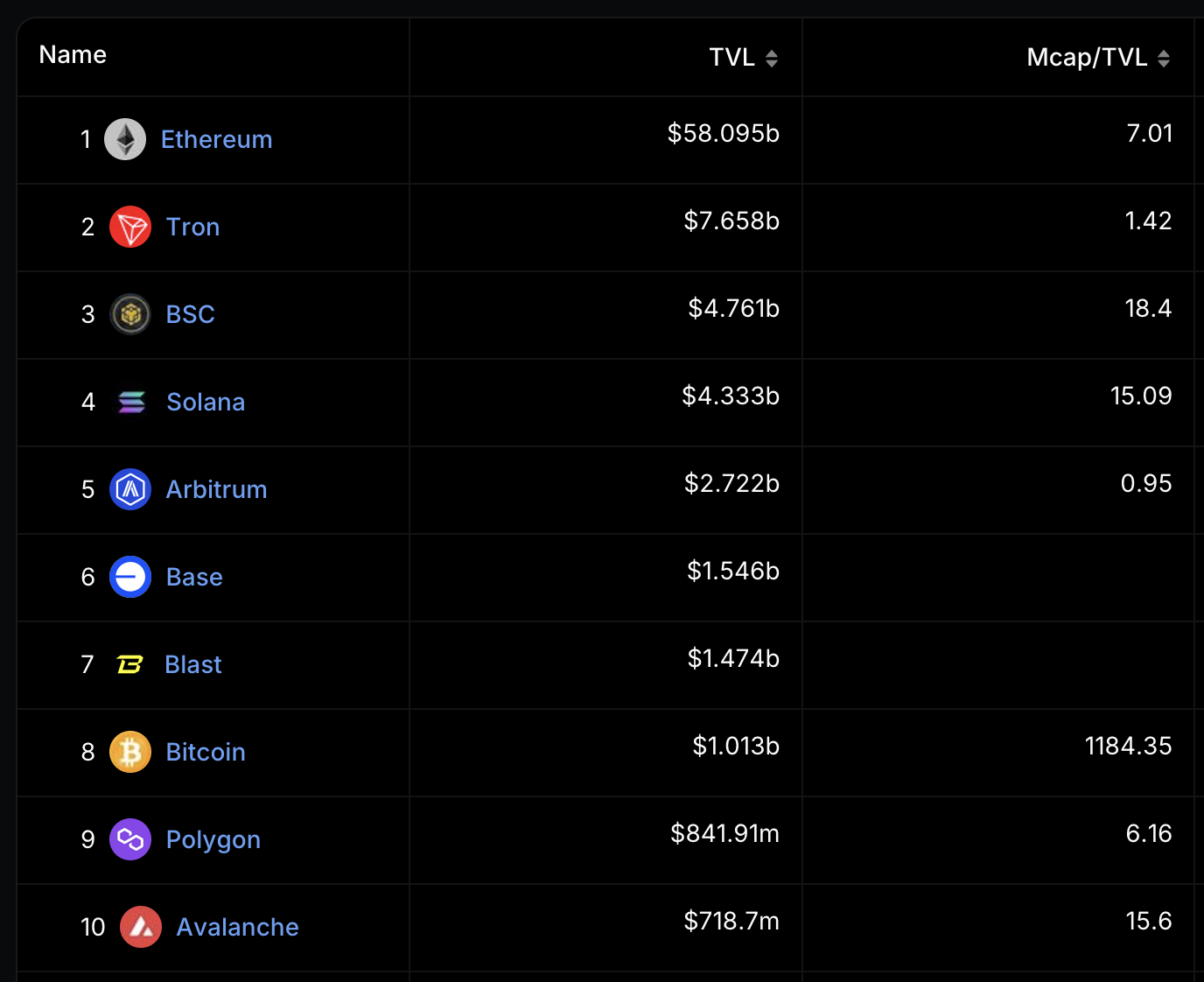
Total Value Locked across chains, and TVL-to-market-cap ratio. Data source: DeFiLlama
According to the data above, if just 5% of BTC entered the yield-generating ecosystem, its TVL would surpass that of Ethereum’s mainnet. If the TVL-to-market-cap ratio reached Ethereum’s level, it could unlock a market exceeding $150 billion in locked value! This highlights the immense potential of the sector. However, current infrastructure for BTC yield generation remains immature—an obvious mismatch between market potential and technical readiness. How can we reverse this situation, attract users, and expand the market?
The development of Layer 2 (L2) solutions for Bitcoin presents new opportunities for BTC yield generation. Yet, these solutions are currently not user-friendly enough for retail investors. Master Protocol aims to solve this issue through product innovation, positioning itself as the gateway for users entering this space.
What Can Master Protocol Bring to Bitcoin?
Current State of Bitcoin Yield Generation
As previously mentioned, vast amounts of Bitcoin liquidity remain locked on-chain, with their yield potential largely untapped. To address this inefficiency and unlock massive BTC liquidity, the industry has developed multiple Bitcoin Layer 2 (L2) solutions using different technical approaches to enable BTC staking and yield generation.
Prominent L2 solutions such as Babylon, Botanix’s Spiderchain, Bitlayer, BounceBit, B², and Merlin have created various methods to support Bitcoin staking. Except for Babylon, which uses remote staking, most L2 solutions employ bridging or mirroring techniques to transfer native Bitcoin onto Proof-of-Stake (PoS) chains.
Through liquid staking protocols (LST protocols) like Master Protocol, pStake, Bedrock, Pell, and Lorenzo, users can stake their Bitcoin on various L2s and receive LSTs (Liquid Staking Tokens) as proof of their stake. This allows users to reinvest their LSTs in multiple scenarios while maintaining liquidity and earning yield. Furthermore, by leveraging restaking protocols, users can further stake their LSTs to obtain LRTs (Liquid Restaking Tokens), enhancing both investment capacity and asset liquidity.
Staking and restaking provide users with network and protocol rewards, making these LSTs and LRTs yield-bearing assets. We categorize them as single-layer or dual-layer yield tokens. Looking ahead, with the development of new AVSs (Active Validating Services) on Babylon, broader recognition of app-chain value, and growth in DApps and Memes across other L2s, more novel yield-generating tokens will emerge within the Bitcoin ecosystem.
Product Positioning of Master
The Bitcoin ecosystem already hosts various L2 solutions and liquid staking protocols (LST protocols), including Botanix Spiderchain. These protocols aim to improve Bitcoin’s scalability and liquidity, but their complexity—such as requiring frequent network switching and multiple asset bridging—makes participation difficult for average users. Master Protocol seeks to simplify this process and increase user engagement through its product suite, particularly the Master Yield Market and its LST protocol on Botanix Spiderchain.
The two core products of Master Protocol:
-
Master Yield Market: Offers yield trading opportunities by aggregating Bitcoin ecosystem assets, packaging them into MSY, then splitting them into MPT (principal) and MYT (yield) for user trading.
-
LST Protocol on Botanix Spiderchain: Enhances Bitcoin’s liquidity and yield through liquid staking.
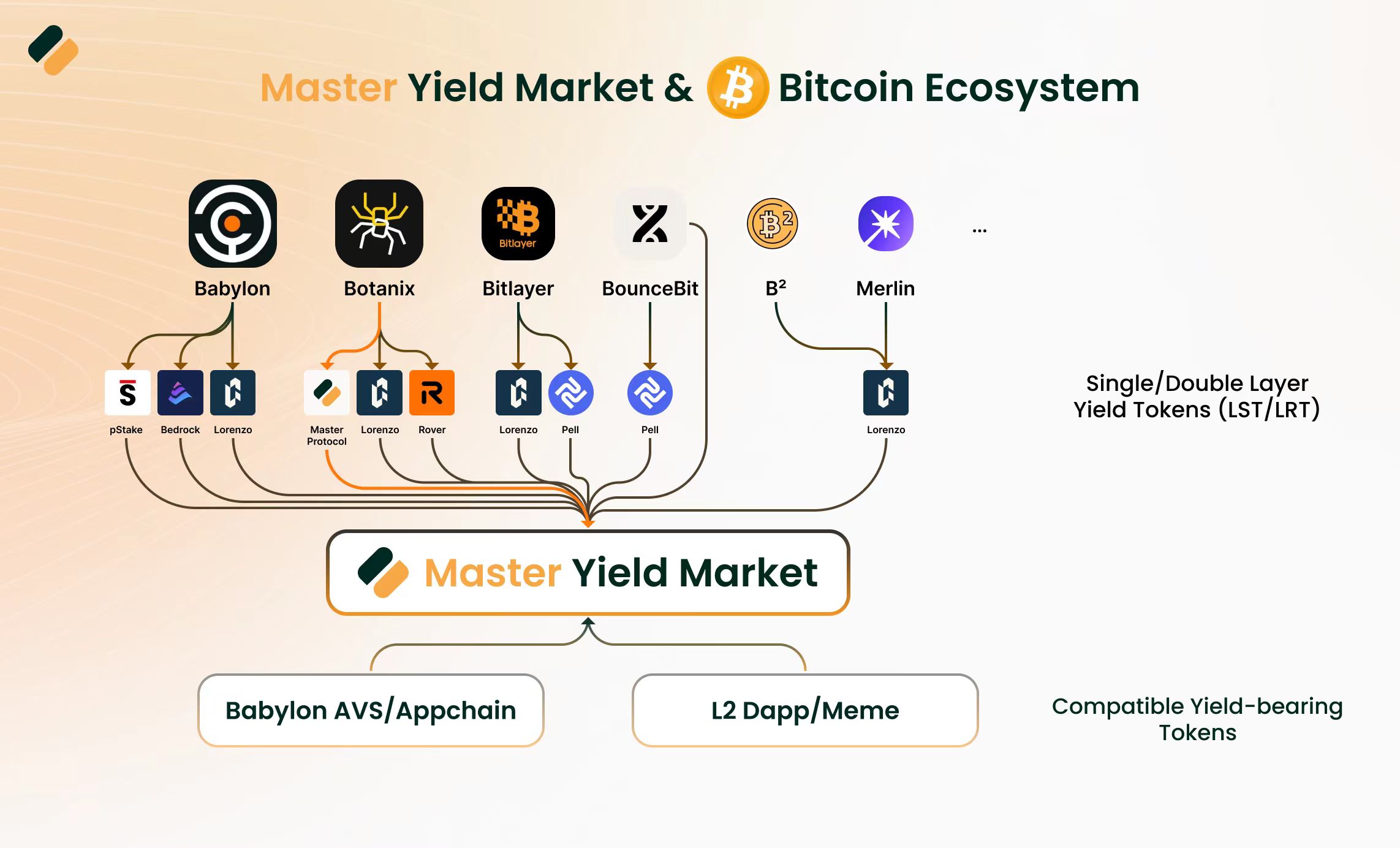
Bitcoin ecosystem and Master Protocol’s product positioning
Thus, Master Protocol creates synergies among multiple protocols in the Bitcoin ecosystem, benefiting overall ecosystem development. By packaging and aggregating yield-generating assets issued by various protocols, Master Protocol acts as a one-stop yield trading hub. Users can access diverse yield opportunities across the ecosystem through this “gateway,” eliminating the need to constantly compare and switch between numerous protocols. As a user entry point, not only does Master Protocol gain adoption, but its partner Bitcoin ecosystem protocols also benefit from increased traffic.
All of this is built upon Master Protocol’s flagship product: the Master Yield Market.
Master Yield Market
The core function of Master Yield Market is to aggregate Bitcoin ecosystem assets, package them into MSY, and split them into MPT and MYT for user trading. Its mechanism resembles that of Pendle Protocol:
-
MPT (Master Principal Token): Represents principal. Buying MPT locks in future gains from underlying assets, functioning like a fixed-income product.
-
MYT (Master Yield Token): Represents yield. With lower unit price, MYT improves capital efficiency, effectively allowing leveraged speculation on expected yield.
Master Yield Market can be simply understood as a Pendle built on BTC—a high compliment indicating immense potential. Pendle was the only DeFi protocol this year to achieve mainstream breakout success, experiencing strong growth in both platform activity and token price, significantly driving the development of on-chain interest rate derivatives. In traditional finance (TradeFi), interest rate derivatives dominate the derivatives market. As of June 2023, total derivative positions reached $714.7 trillion, with interest rate derivatives accounting for $573.7 trillion—80.2% of the total. This makes it the most attractive segment for institutional participation. With BTC ETFs now officially approved by the SEC, interest rate trading platforms on BTC may follow Ethereum’s lead in attracting institutional adoption, opening up even greater possibilities.
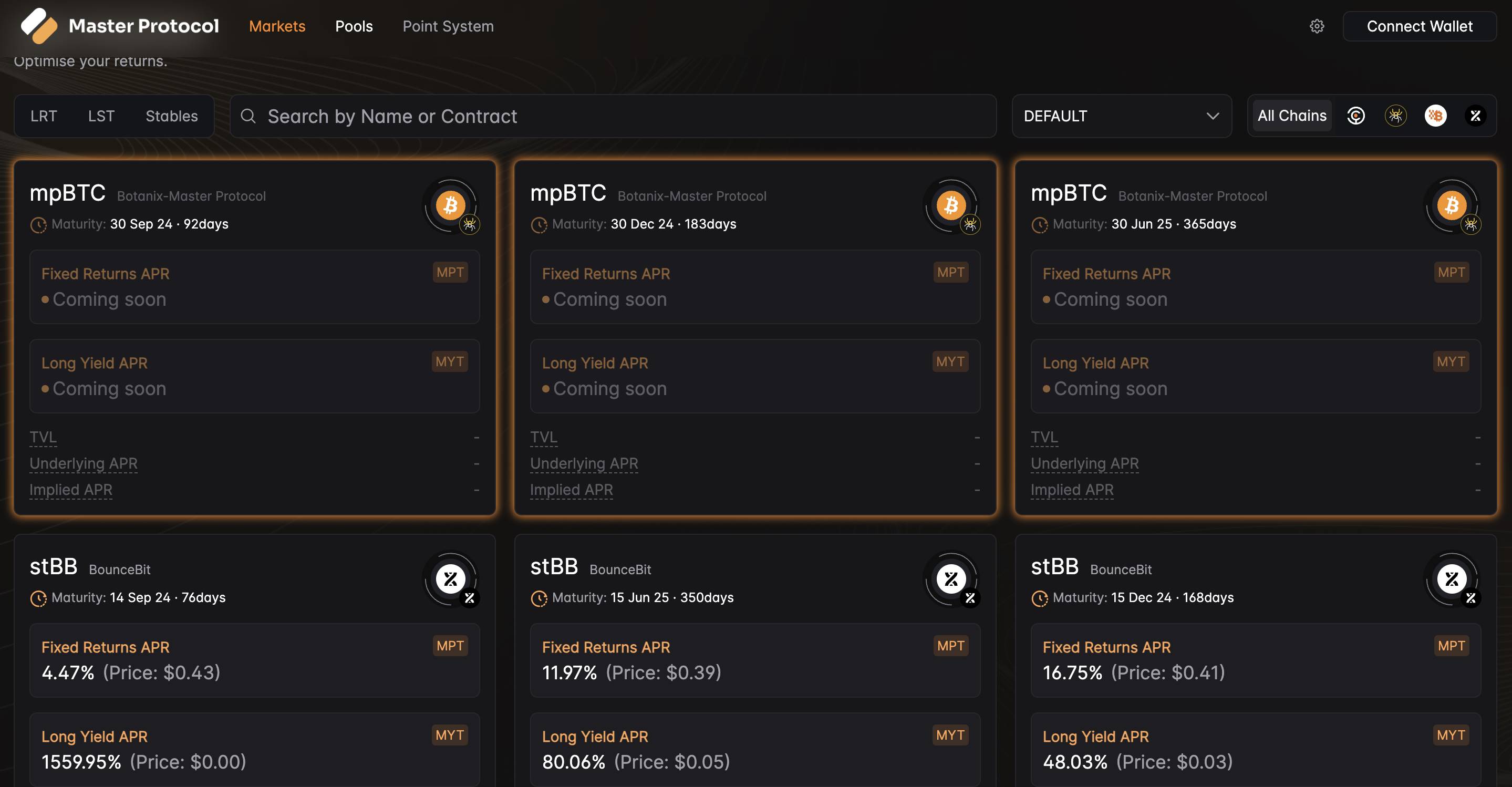
Master Yield Market interface
Currently, Master Yield Market has partnered with several projects including Botanix, BounceBit, and Bitlayer, supporting assets such as BounceBit’s native stBB and stBBTC. Upcoming listings include Pell protocol assets on BounceBit and Bitlayer, Bedrock (uniBTC) and pSTAKE (yBTC) assets on Babylon, Lorenzo protocol assets across multiple BTC L2s, and Master Protocol’s own mpBTC asset on Botanix Spiderchain.
Master Yield Market will integrate these diverse assets, offering them to users in MPT and MYT forms. These strategic integrations will enhance accessibility within the Bitcoin ecosystem, significantly boosting Bitcoin’s liquidity and capital utilization, and driving the ecosystem toward prosperity.
In the future, Master Yield Market will also support USDT and other BTC-related assets (ETH, BSC, etc.) across multiple chains—for example, enabling direct purchase of MPT/MYT representing underlying project assets using wBTC. Effectively, Master Protocol performs asset routing for these projects to facilitate seamless cross-chain transactions, delivering smooth, frictionless user experiences.
This gives retail investors simple access to yield trading within the Bitcoin ecosystem—the core advantage of Master Protocol. However, even the best protocol depends on user adoption. To achieve this, Master Protocol introduces the Master Yield Pass to incentivize participation.
Master Yield Pass
The Master Yield Pass is an incentive initiative launched by Master Protocol, with only 10,000 available. It was freely mintable on Base starting June 24. All NFTs have now been claimed, but they can still be purchased on secondary NFT marketplaces like OpenSea. The current secondary market price is just 0.001 ETH (~$3), making entry extremely low-cost. For those bullish on the BTC yield space, buying now could position them well for future airdrops or trading gains.
Benefits of staking the Master Yield Pass include:
-
Earn points from Trading Pool and Referral Pool, redeemable for future token airdrops.
-
Share of platform fee revenue. If total trading volume reaches $200 million and fees reach seven figures, each NFT could earn over $100 in dividends. (For comparison, Pendle on Ethereum has accumulated billions in trading volume.)
-
Future perks: whitelist access for NFTs, events, IDOs, etc.
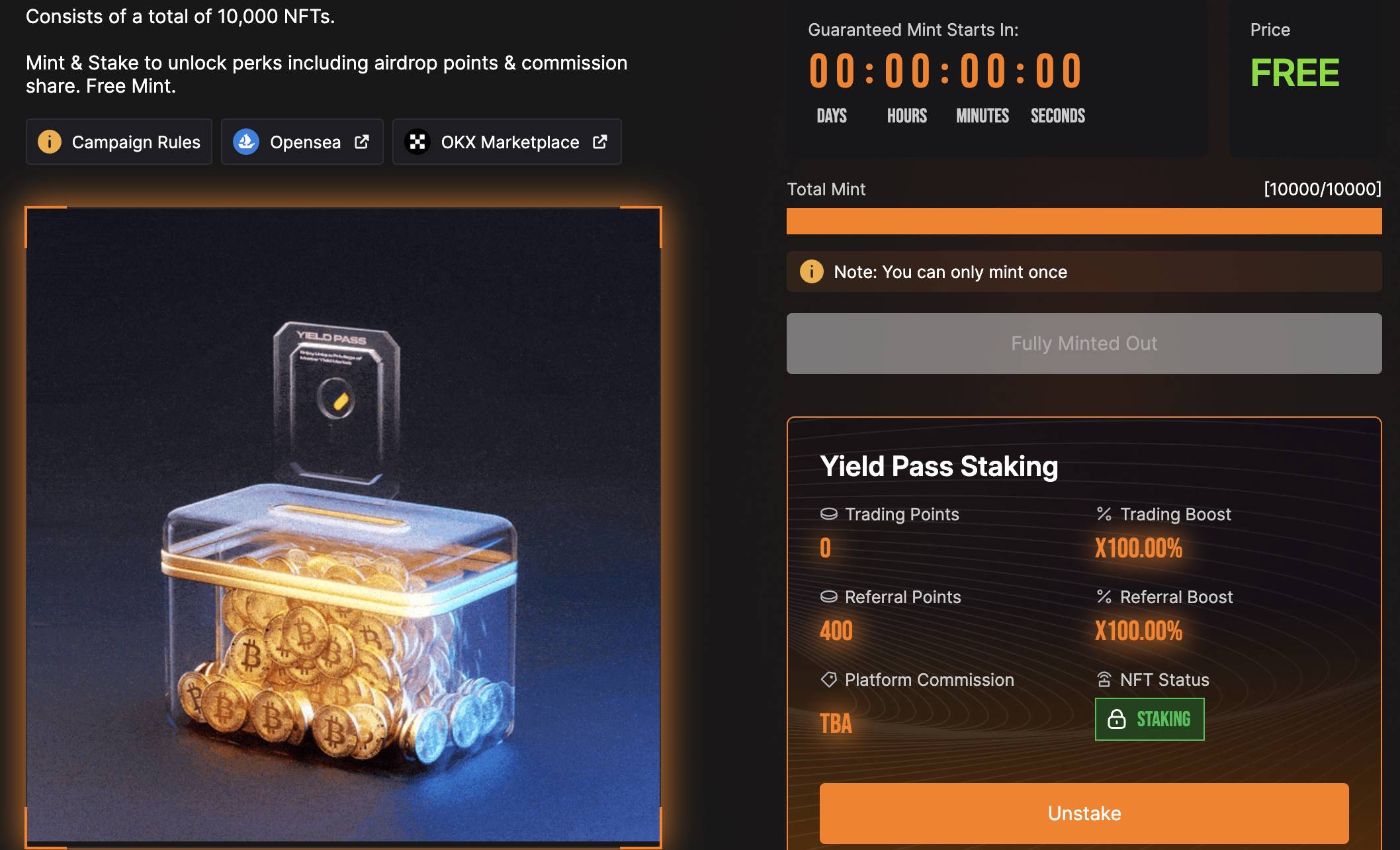
Master Yield Pass minting and staking page
Trading mining (Trading Pool) and referral mining (Referral Pool) are the primary activities. Note, however, that they use separate point calculation systems—point multipliers do not carry over between the two.
Trading Mining - Trading Pool
Points are earned based on trading volume; staking the Yield Pass grants a 3x multiplier.
Point Calculation Rules
-
Individual Total Points = Individual Total Trading Volume × Multiplier Coefficient;
-
Airdrop Allocation = (Individual Total Points During Campaign / Total Network Points During Campaign) × Total Airdrop Supply
-
1 - Pass Holders Who Have Staked
-
Holders who stake their Yield Pass receive a 3x points boost
-
For example, if a user trades 1,000 USDT, their points = 1,000 (trading volume) × 3 (Yield Pass bonus) = 3,000 Points
-
2 - Unstaked Pass Holders and Non-Holders
-
Only eligible for base trading points
-
For example, if a user trades 1,000 USDT, their points = 1,000 (trading volume) × 1 (no bonus) = 1,000 Points
Referral Mining - Referral Pool
Points are earned based on number of referrals; staking the Yield Pass provides bonuses.
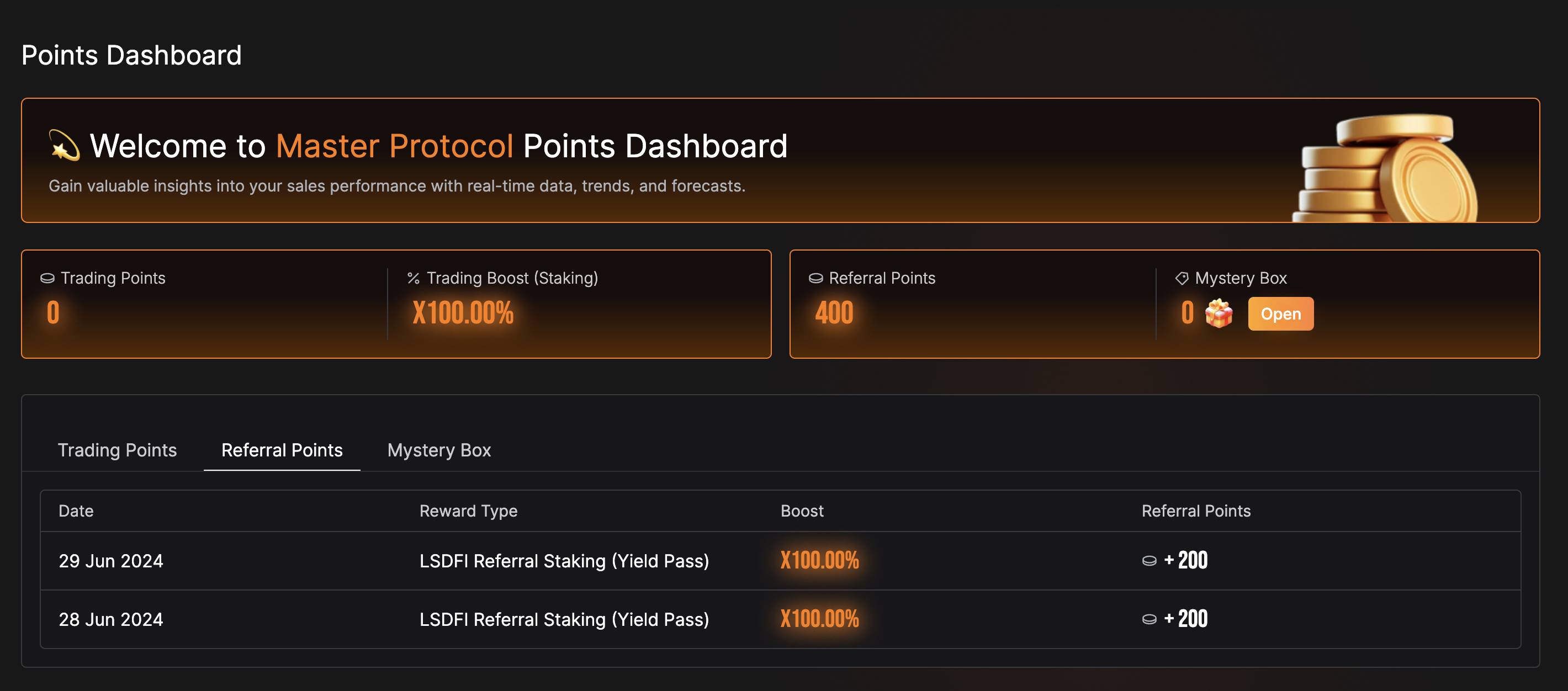
Referral Pool score dashboard
-
1- Point Calculation Rules
-
Staked Pass Holder: Automatically earns 200 points daily. Actual points earned are calculated by applying buff multipliers: Points = 200 (daily base) × [100% (base) + 2% (each Holder buff) × Number of Holder referrals + 1% (each non-Holder buff) × Number of non-Holder referrals + 50% × referrer’s bonus percentage]
-
Example: A stakes the NFT, invites 50 staked Holders and 100 verified non-Holders (each completing $100 in trading volume), and joins Team B (which has a 50% bonus). A’s daily points = 200 × (100% + 50×2% + 100×1% + 50%×50%) = 650 points
-
Unstaked Pass Holders and Non-Holders: No automatic mining points, no buff bonuses
-
2 - As Inviter
-
Only staked Pass Holders can act as inviters
-
If invitee is a staked Pass Holder: Each referral provides a 2% buff bonus, and both parties receive a random point red packet
-
If invitee is an unstaked Pass Holder or non-Pass Holder: Each referral provides a 1% buff bonus (invitee must complete at least $100 in trading volume for validation; upon completion, both parties receive a random point red packet)
-
3 - As Invitee
-
If invitee is a staked Pass Holder, they gain 50% of the inviter’s buff bonus upon joining the team (e.g., if inviter has a 50% bonus, invitee receives 25%)
-
If invitee is an unstaked Pass Holder or non-Pass Holder, they receive no bonus; however, upon completing verification ($100 trading volume), they receive a participation reward (random red packet of 10–200 points)
Genesis Master Pass
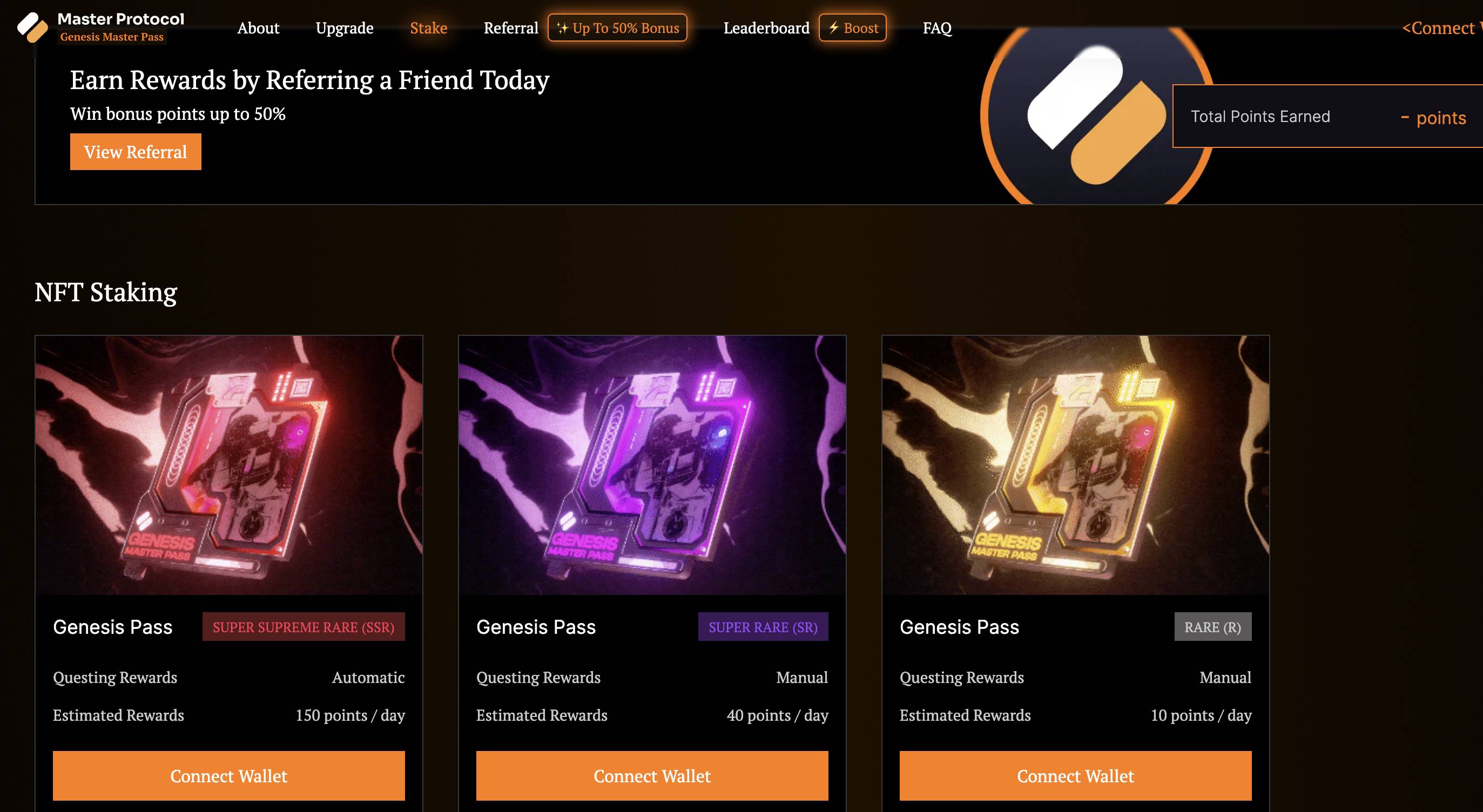
Genesis Master Pass staking page
In addition to the Master Yield Pass, Master Protocol’s first NFT series, the Genesis Master Pass, is also active. Participating in staking tasks earns airdrop points. This collection can currently be acquired via secondary markets like OpenSea. Interested readers can refer to the official guide for details and participation.
Participating in the BTC Ecosystem via Master Protocol
In summary, Master Protocol’s Master Yield Market simplifies BTC yield generation, enabling retail investors to directly use USDT, ETH, or WBTC to trade Bitcoin’s LST and LRT assets, unlocking significant yield opportunities in a simple and efficient manner. Alongside innovative products, the platform incentivizes users through multiple utility NFT series, promoting trading activity and user acquisition, accelerating its own adoption. The BTC yield space—long suffering from a mismatch between market potential and infrastructure—is finally gaining its “user gateway.” Once true Product-Market Fit is achieved, the unleashed potential of this sleeping giant may astonish us all.
Now, Zhang can use Master Protocol—the one-stop Bitcoin yield gateway—to liquid-stake his Bitcoin on Botanix Spiderchain, buy PT tokens backed by BounceBit’s stBBTC to lock in yield, purchase uniBTC YT issued by Bedrock on Babylon, and position himself for token airdrops from both Bedrock and Babylon—all through multiple strategies to generate yield on his BTC, no longer needing to envy Li.
To learn more about Master Protocol, visit its official website, Twitter, Discord, and Telegram.
Join TechFlow official community to stay tuned
Telegram:https://t.me/TechFlowDaily
X (Twitter):https://x.com/TechFlowPost
X (Twitter) EN:https://x.com/BlockFlow_News
 Foresight News







