Opinion: These limitations of TON may make it difficult to become the next SOL or ETH
TechFlow Selected TechFlow Selected
Opinion: These limitations of TON may make it difficult to become the next SOL or ETH
The market has overestimated Telegram's user stickiness.
 Navigating Web3 tides with focused insights
Translation: Felix, PANews
Recently, narratives around TON and Telegram have gained significant momentum, with many believing TON could be the next SOL or ETH. However, Blockworks Research published an analysis arguing that TON's future growth may be lackluster and it could ultimately disappoint expectations.
Low Telegram User Engagement
Telegram has global reach and a substantial number of daily active users (DAU), which could theoretically drive user traffic to TON. By this metric, Telegram ranks among the most widely used applications globally.
According to data provided by Telegram, it is one of the world’s most popular apps, with 900 million total users—ranking eighth among global applications.

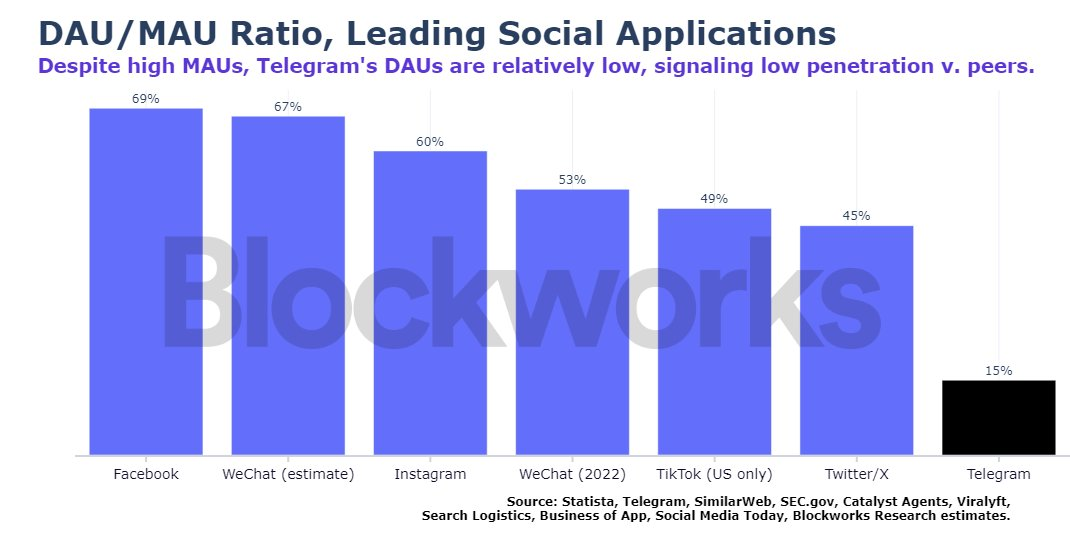
However, when measured by DAU, Telegram's user engagement appears overstated.
The chart below shows the DAU/MAU ratios across various social platforms. Despite Telegram’s high MAU (monthly active users), its DAU is relatively low—between 55 million and 200 million—which is notably weak compared to competing apps. Its DAU/MAU ratio stands at just 15%.
In contrast, Facebook’s ratio is 69%, WeChat approximately 67%, Instagram 60%, TikTok (U.S. only) 49%, and Twitter (X) 45%. This indicates Telegram has lower market penetration and a less monetizable user base than commonly expected.
PANews note: The DAU/MAU ratio measures user stickiness for networks or applications.
Lack of EVM Compatibility and Limited Programming Language Adoption
TON ecosystem developers face challenges due to the lack of EVM compatibility and the limited adoption of FunC—the blockchain’s native programming language.
The TON Virtual Machine (TVM) is incompatible with the Ethereum Virtual Machine (EVM), as TON uses a completely different architecture (asynchronous vs. Ethereum’s synchronous model). As a result, the TON ecosystem does not support development in Solidity, Ethereum’s primary programming language.
According to a 2023 developer survey involving over 90,000 developers, Rust was the most loved programming language, with more than 80% of respondents saying they would use it again next year. Meanwhile, 46.4% expressed interest in using Solidity.
On TON, the three available programming languages are Fift, FunC, and Tact. Among them, FunC is currently the most widely used. Although FunC resembles C in syntax, it is generally unfamiliar and unpopular among mainstream developers.
Limited Reach in Target Markets
A major part of the TON narrative is that Telegram will become the next WeChat. However, WeChat is blocked in the U.S. market and serves only China.
In stark contrast, today’s application markets are dominated by well-funded tech giants with strong network effects. Telegram’s largest user bases are scattered across fragmented markets in Asia-Pacific (excluding China) and Eastern Europe, adding complexity for startups relying on Telegram for distribution.
Below is Telegram’s full-year download distribution in 2022:
-
India: 104 million downloads.
-
Russia: 34 million downloads.
-
Indonesia: 27 million downloads.
-
United States: 26 million downloads.
-
Brazil: 21.94 million downloads.
-
Egypt: 14.85 million downloads.
-
Vietnam: 11.84 million downloads.
-
Mexico: 11.61 million downloads.
-
Ukraine: 10.76 million downloads.
-
Turkey: 9.79 million downloads.
Overvalued FDV
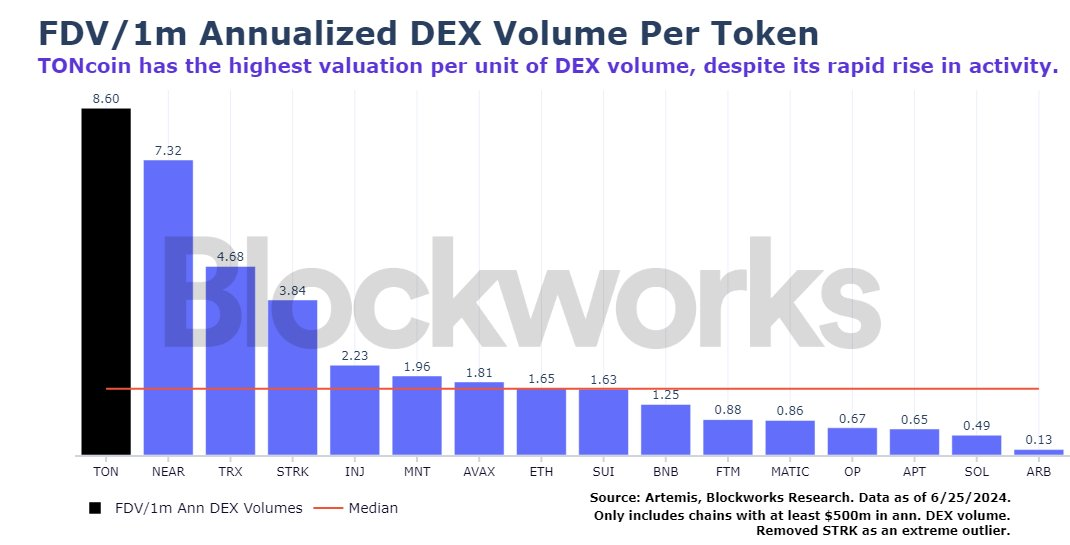
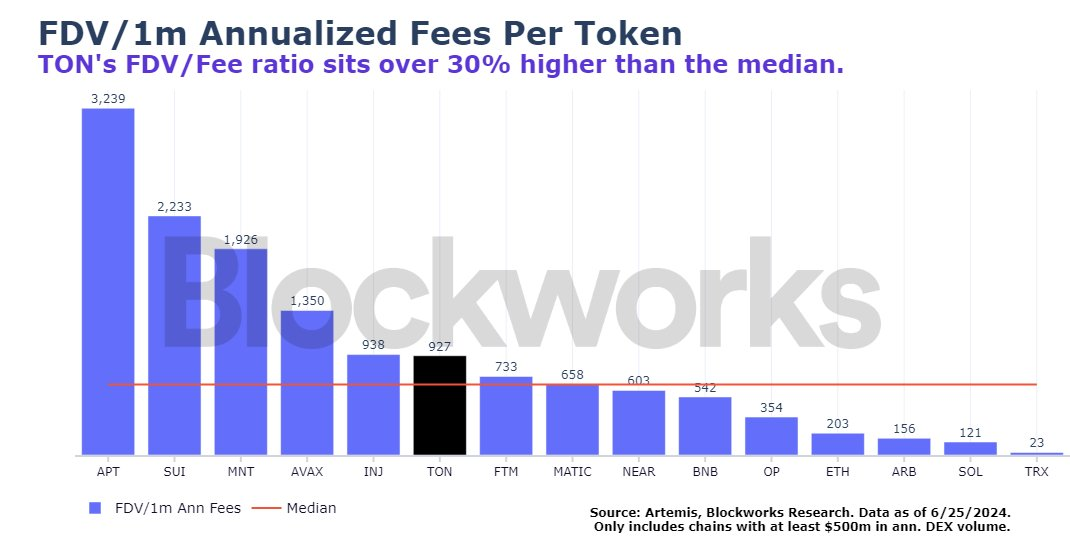
Despite these realities, TON still carries immense growth expectations, leaving little margin of safety for new investors.
As shown in the chart below, among all public blockchains, TON has the highest FDV-to-annualized DEX trading volume ratio—8.6 times—ranking first and at the highest level.
Additionally, TON’s FDV is 927 times its annualized network fees—one of the highest ratios among all public blockchains.
Join TechFlow official community to stay tuned
Telegram:https://t.me/TechFlowDaily
X (Twitter):https://x.com/TechFlowPost
X (Twitter) EN:https://x.com/BlockFlow_News
 @blockworksres