What is BC-404? A Comprehensive Guide to the Latest Deflationary NFT Standard
TechFlow Selected TechFlow Selected
What is BC-404? A Comprehensive Guide to the Latest Deflationary NFT Standard
BC-404 is an improvement on ERC-404, the first deflationary NFT contract in cryptocurrency.
 Navigating Web3 tides with focused insights
Text: NFTScan
In today's rapidly advancing blockchain landscape, innovation never ceases. Following the emergence of the ERC-404 standard, a new standard called BC-404 has emerged, bringing fresh possibilities to the NFT market. BC-404 (Bonding Curve 404)—an improvement upon ERC-404—is the first deflationary NFT contract in cryptocurrency. This article will delve into the BC-404 standard, which integrates the strengths of ERC-404 while introducing innovative enhancements.
The ERC-404 Protocol Standard:
Looking back over the past six months, ERC-404 stands out as one of the most exciting innovations in asset issuance within the Ethereum ecosystem. Introduced in early February by the Pandora team as an open-source experimental token standard for creators and developers, ERC-404 combines ERC-20 and ERC-721 functionalities, featuring native liquidity and fractionalization. This is achieved through a quantity-correspondence logic between fungible tokens (FTs) and NFTs—specifically via mechanisms of NFT "minting and burning."
Put simply, certain blue-chip NFT projects—especially those with rare traits—often carry such high prices that they become expensive yet illiquid. The introduction of ERC-404 represents a significant improvement for these otherwise illiquid NFTs, allowing high-priced NFTs to be split and traded on major marketplaces with the same ease and speed as purchasing token assets like BTC or ETH.
The BC-404 Token Standard:
Initially, Color Protocol launched an ERC-404 conversion platform for Memecoins, enabling meme artists and communities to create their Meme NFT collections under the ERC-404 framework, allowing holders to convert their Memecoins into NFTs.
By integrating the Bonding Curve model, COLOR proposed the BC-404 standard based on ERC-404. It stipulates that the number of tokens required to generate an NFT continuously increases until reaching a predefined cap, giving early participants a cost advantage.
-
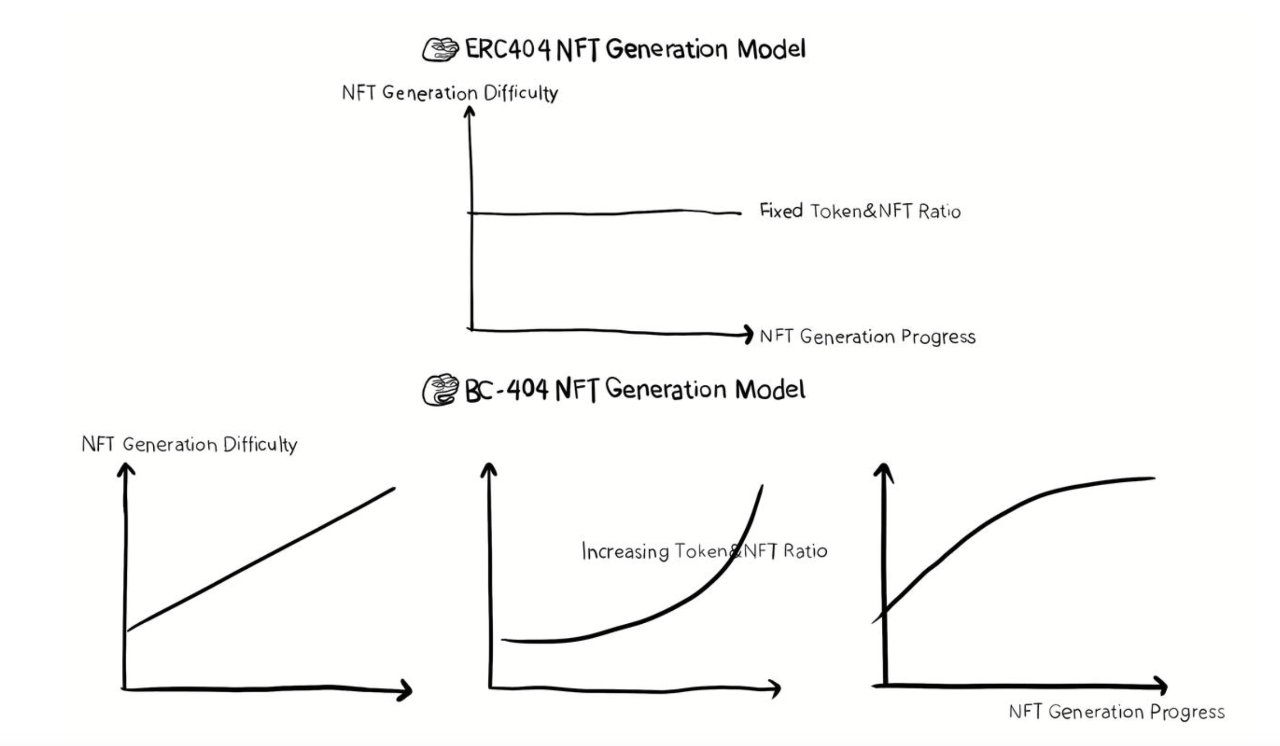
In an ERC-404 contract, the ratio between tokens and NFTs is fixed. The contract deployer initially defines how many ERC-404 tokens are needed per address to generate one ERC-404 NFT—for example, 1 $Pandora token generates 1 Pandora NFT. However, if your address holds only 0.9 $Pandora, you cannot generate a Pandora NFT.
-
BC-404 integrates the Bonding Curve model, changing the required number of BC-404 tokens from a fixed amount to an ever-increasing value. With each new BC-404 NFT generated, this threshold rises, meaning each subsequent NFT becomes progressively harder to mint.
-
When deploying a BC-404 contract, the deployer can set both the initial difficulty (i.e., how many BC-404 tokens are required to generate the first NFT) and the incremental increase in difficulty for generating each subsequent NFT.
1. Bonding Curve Model of the BC-404 Standard:
Overall, BC-404 can be designed using three different difficulty models. Color defines the NFT generation difficulty as "BC Count": linear increase, accelerating slope curve increase, and rising curve with gradually decreasing slope.
2. Token Content of BC-404 NFTs:
Since the number of BC-404 tokens required to generate each BC-404 NFT varies, the token content embedded in different NFTs also differs—meaning the quantity held corresponds directly to the number of NFTs generated. In contrast, every ERC-404 NFT carries the same fixed number of tokens.
3. BC-404 NFT IDs:
Due to differences in token content among BC-404 NFTs, their values vary accordingly. To reflect this characteristic in NFT markets, the BC-404 contract links the NFT ID to its token content (the BC count at time of generation):
-
For example, when a user purchases a BC-404 NFT with ID #1868, they receive 1868 BC-404 tokens along with the NFT.
-
Holders and traders can clearly determine each NFT’s token content via the wallet or NFT marketplace using the NFT ID.
-
NFT IDs do not need to start from #1 and may depend on the initial BC count value set by the BC-404 contract deployer.
-
NFT IDs do not need to be sequential and can follow the BC count increment pattern defined by the deployer.
-
Each NFT ID is unique, and generating a new NFT always requires a higher BC count than any previous one, endowing each BC-404 NFT with its own unique history.
4. NFT Burning Mechanism and Deflation:
BC-404 NFT transfers: Similar to ERC-404, during transfer the NFT remains unchanged, and an equivalent amount of tokens moves with it.
BC-404 token transfers: May trigger the destruction of a BC-404 NFT, depending on whether the remaining tokens are sufficient to support the NFT holdings after transfer—similar to ERC-404 V1.
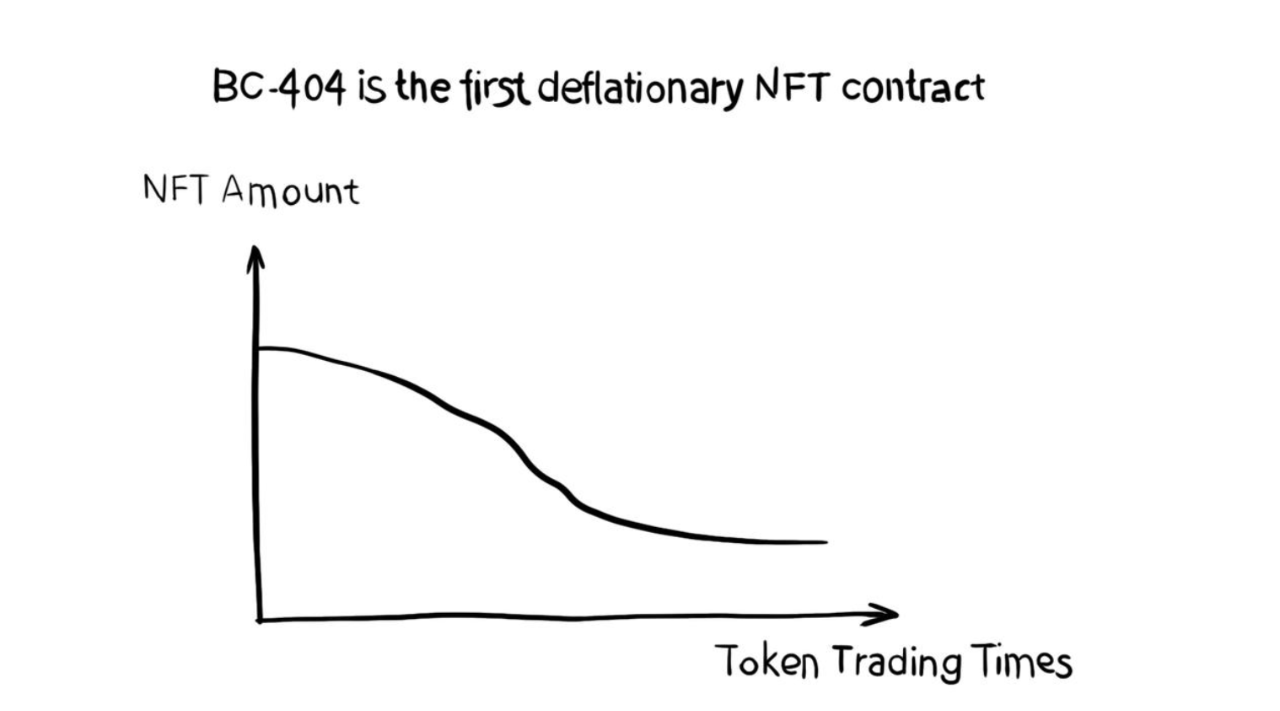
Each BC-404 NFT ID appears only once. Once destroyed, the ID cannot be regenerated; thus, the destruction of a BC-404 NFT results in a reduction of the overall BC-404 NFT collection, assuming the contract sets a fixed total token supply.
This makes BC-404 the first deflationary NFT contract in cryptocurrency.
Colorpepe:
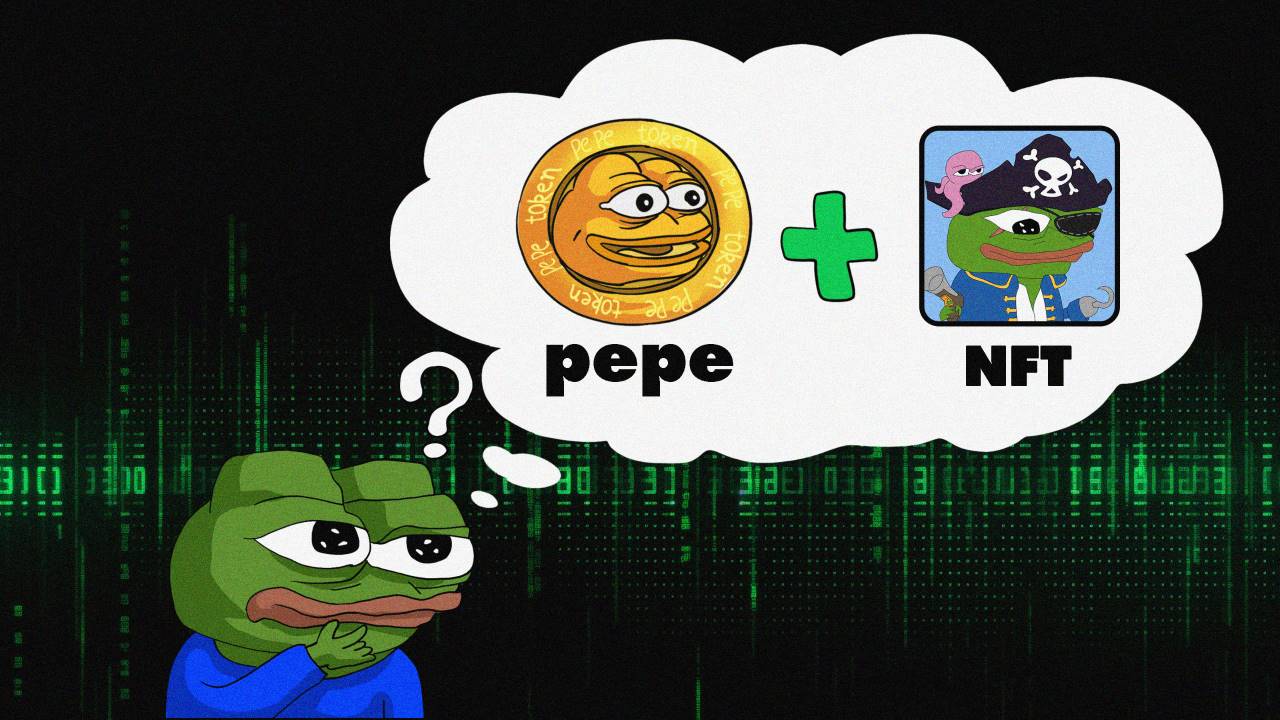
$colorpepe is the first BC-404 asset and generates the inaugural pepe PFP series from $PEPE, deployed on Base. It combines the uniqueness and scarcity of NFTs with the popularity and liquidity of Memecoins. Through a conversion pool, users can transform $PEPE into the BC-404 standard (with cross-chain bridging available if needed), granting native Memecoin assets NFT characteristics.
Conversion details:
-
Free conversion: Only gas fees apply, no additional costs.
-
Reversible conversion: $colorpepe can be converted back to $PEPE at any time, with the corresponding amount of $colorpepe burned.
-
Limited supply: Total $colorpepe token supply is capped, and conversion is available only within a specific time window.
-
Whitelist priority: Conversion occurs in two phases—the first limited to whitelisted addresses, the second open to the public.
Note: Ensure your wallet contains some $PEPE (on the Ethereum mainnet) and sufficient $ETH to cover gas fees.
Features of BC-404:
1. Decentralized Value Consensus
BC-404 endows NFTs with inherent unique value through variable token content. Unlike traditional methods, BC-404 does not predetermine rarity rules for NFTs but instead allows markets and community members to autonomously determine aesthetic value. BC-404 only establishes numerical uniqueness (ID equals token content, determined by code and generation history). This approach better aligns with the decentralized spirit of blockchain and opens up more possibilities for NFT valuation. For a BC-404 NFT series, issuance is just the beginning—their final form will be shaped collectively by the market and community.
2. Increased NFT Scarcity
Under the new mint-and-burn mechanism, the scarcity of BC-404 NFT collections rises in tandem with token trading volume. The deflationary mechanism of NFTs offsets the issue where token liquidity in DEXs (AMMs) exceeds NFT liquidity in peer-to-peer order books, maintaining transaction vitality and profitability in the NFT market (as NFT circulation decreases, acquiring NFTs via tokens becomes increasingly difficult).
3. Improved Reset Mechanism
Unlike the ERC-404 standard, where transferring tokens to reset an NFT incurs only gas fees (negligible on low-cost networks), under BC-404, transferring tokens requires facing a higher BC count to generate a new NFT. This design effectively raises reset costs, reducing low-cost arbitrage opportunities and contributing to the long-term healthy development of the NFT market.
4. Rich Trading Strategies
BC-404 offers market participants more strategic options, increasing the depth and engagement of trading. When seeking to acquire more NFTs, investors must weigh multiple factors: (1) the market premium of existing NFTs relative to their token content, (2) the rising cost of tokens required to generate new NFTs, and (3) the randomness involved in minting new NFTs.
This complex decision-making process not only enhances market engagement but also encourages participants to think more deeply about and analyze market dynamics, enabling smarter investment decisions.

Potential Challenges and Outlook
Despite its many innovations, BC-404’s complex mechanics may require time for market participants to fully understand and adopt. Effectively communicating the advantages and operational mechanics of BC-404 to users will be a major challenge during initial project rollout. Additionally, while BC-404 uniquely balances token and NFT liquidity, maintaining this equilibrium in practice and avoiding extreme scenarios will remain an ongoing concern.
Conclusion
BC-404 introduces a new dimension of value to the NFT market—the concept of token content—which will become a key metric in assessing individual NFT value. Looking ahead, BC-404 not only brings new possibilities to the NFT space but also offers a novel framework for evaluating digital assets. Its emergence marks a step toward greater complexity and diversification in NFTs, integrating tokenomics, deflationary mechanisms, and dynamic pricing models. As the technology matures and gains market acceptance, we can expect to see more innovative applications built on BC-404, expanding the 404 ecosystem’s reach and driving it toward prosperity.
Join TechFlow official community to stay tuned
Telegram:https://t.me/TechFlowDaily
X (Twitter):https://x.com/TechFlowPost
X (Twitter) EN:https://x.com/BlockFlow_News