Particle Network: Introducing the Chain Abstraction Multi-Layer Framework to Build a More User-Friendly Web3 Ecosystem
TechFlow Selected TechFlow Selected
Particle Network: Introducing the Chain Abstraction Multi-Layer Framework to Build a More User-Friendly Web3 Ecosystem
The multi-layered framework offers a new perspective on chain abstraction by categorizing solutions based on their impact on user experience within the Web3 ecosystem.
 Navigating Web3 tides with focused insights
Authors: Carlos Maximiliano Cano, Ethan Francis
Translation: TechFlow
Chain abstraction can only be achieved through a multi-layered technological approach.
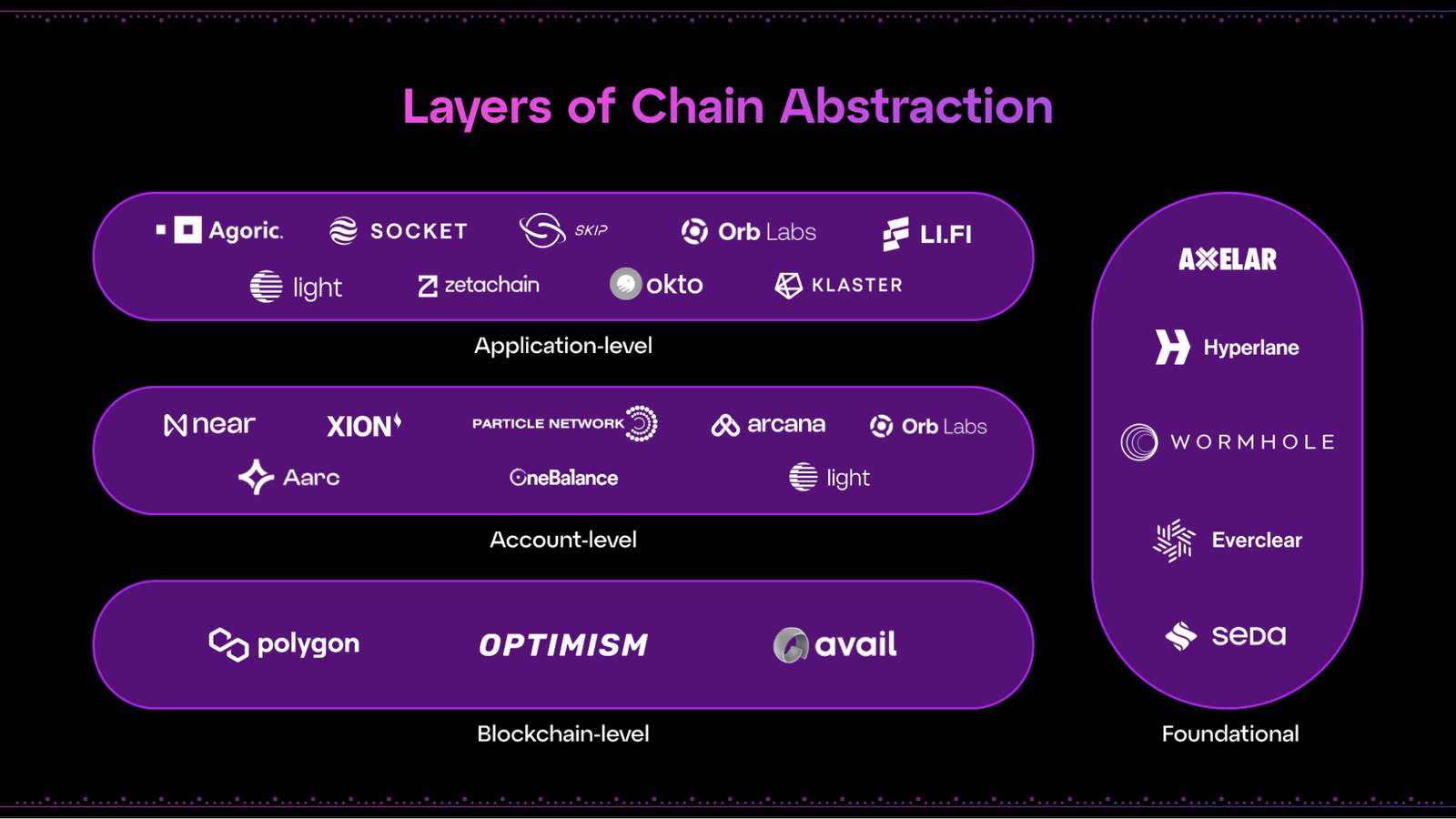
As the field evolves, it has become increasingly clear that chain abstraction is not just a single technology, but a multifaceted approach aimed at simplifying the user experience across decentralized ecosystems. This is clearly reflected in multiple projects striving to implement chain abstraction across various Web3 applications and infrastructure components.
Within this emerging domain's theoretical framework, several approaches have emerged to understand the roles and participation models of actors in chain abstraction. This article formally introduces a multi-layer framework. First proposed in the article "Multi-Level Chain Abstraction: Diversified User Experiences in Web3 Evolution", this framework aims to make sense of the chain abstraction ecosystem by examining the role different services and products play in shaping user experience.
The Multi-Layer Framework: Objectives and Significance
The goal of establishing a multi-layer framework for chain abstraction is to provide a structured and comprehensive method for understanding the various pathways to achieving a chain-abstracted experience. It also aims to demonstrate how chain abstraction functions as a stack of layered technologies that together enable "full implementation" of chain abstraction—covering all possible experiences a user may encounter in Web3.
Importantly, the multi-layer framework relies on the previously established formal definition of chain abstraction (ChA), which describes ChA as “the user experience of being freed from manually interacting with multiple chains.” This definition is crucial to the framework itself, as understanding chain abstraction as an experience—one that may or may not manifest across different Web3 interactions—is essential for properly categorizing participants. Various solutions work collaboratively toward full implementation.
Thus, this framework takes into account the following aspects:
-
How various solutions abstract away the complexity of interacting with multiple chains from the user experience.
-
How different components and solutions work together in a modular and complementary way to create a seamless, unified chain-abstracted experience across multiple blockchains.
-
The organic evolution of diverse chain abstraction solutions, each addressing distinct practical needs of users and developers.
Introduction to the Multi-Layer Framework
This framework consists of three layers, each enabling a chain-abstracted experience through various potential user activities and existing experiences. To be classified within this multi-layer chain abstraction framework, a project or solution must aim to address one or more aspects of the cross-chain user experience. The specific inclusion criteria are as follows:
-
The solution should aim to simplify user and developer interactions and workflows across different chains.
-
The solution must deliver tangible benefits to the user experience, regardless of its target layer. Therefore, solutions that partially achieve chain abstraction but contribute value toward its realization might better fit other frameworks, which will be discussed later.
With these foundational rules clarified, the framework classifies projects as follows:
Application-Layer Chain Abstraction (Orchestration)
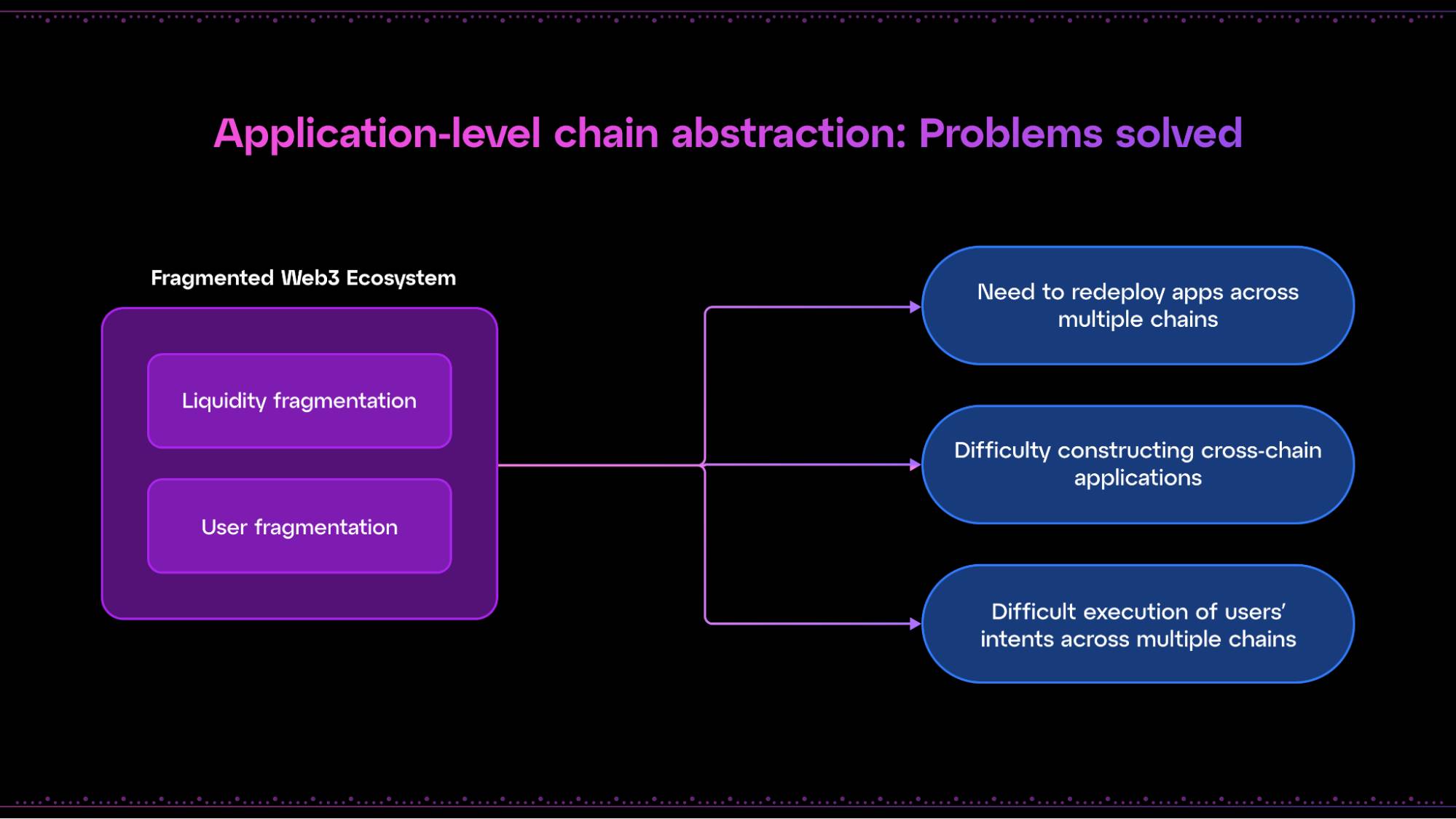
The application layer, also known as the orchestration layer, focuses on empowering developers to build decentralized applications (dApps) that can operate and interact seamlessly across multiple blockchains. This layer includes:
-
Low-level software development kits (SDKs) and application programming interfaces (APIs) for orchestrating cross-chain workflows and operations within dApps.
-
Frameworks for building chain-agnostic applications.
-
Solvers and intent networks that translate user goals into multi-chain paths, implemented via application-layer SDKs.
By providing these developer-centric tools and abstractions, the application layer enables:
-
Creation of applications that can coordinate and execute transactions across different chains using a single user-level signature.
-
Implementation of asynchronous, long-running business logic across multiple blockchains, enhancing dApp interoperability and flexibility.
-
Abstraction of underlying multi-chain complexities, allowing developers to focus on application-specific functionality.
The application layer is considered essential for achieving a complete chain abstraction experience, as it complements account-layer solutions focused on users by extending abstraction capabilities at the application level.
Projects such as Agoric, Skip, and Socket are at the forefront of application-layer chain abstraction, offering developers the tools and frameworks needed to build truly chain-agnostic applications. For example:
-
Agoric’s Orchestration API provides contracts and APIs for executing multi-chain transaction flows, simplifying complex interoperability operations through a single user signature.
-
Skip offers an API to facilitate seamless cross-chain transactions (swaps, transfers, etc.), aggregating messaging protocols like IBC, Hyperlane, and Axelar.
-
Socket provides an open market for intent execution and settlement, enabling developers to compose with any application and asset.
By leveraging these solutions, developers can focus on creating innovative user experiences without being constrained by the limitations of multiple blockchain networks, thereby contributing to the broader goal of chain abstraction at the application layer.
Account-Layer Chain Abstraction
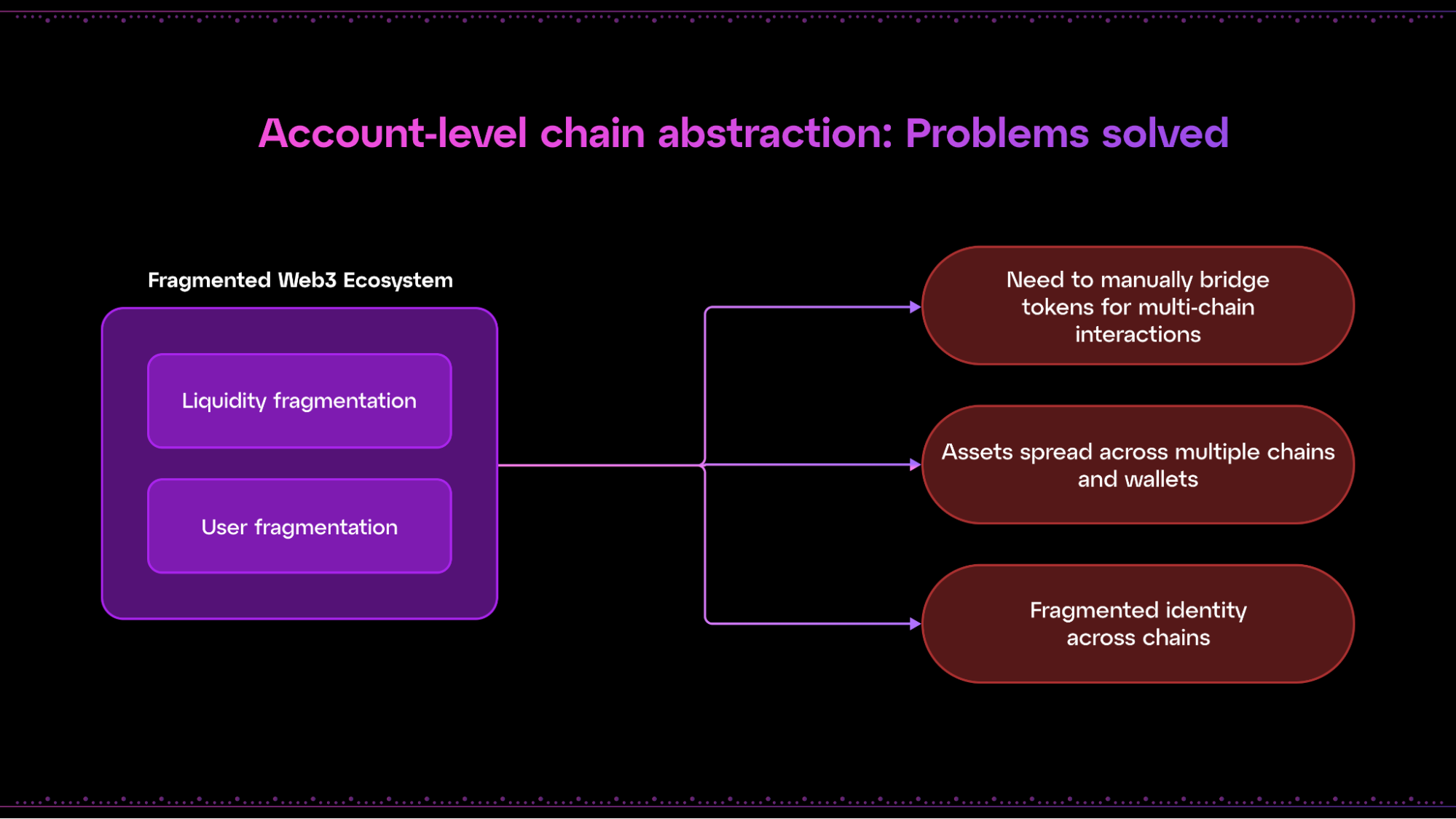
The account layer aims to provide users with a universal mechanism for seamless interaction across multiple chains, addressing fragmentation at the user level. It involves directly offering users a way to maintain a single balance across multiple chains, enabling them to deploy assets throughout the Web3 ecosystem without manually managing separate chains. This layer includes:
-
Universal methods for unifying cross-chain and cross-application balances.
-
Automation of multi-chain challenges related to gas payment and account interaction at the account layer.
-
Account unification technologies that provide a single identity or access point across multiple chains.
By unifying the account experience, the account layer achieves:
-
Consistent identity and balance maintenance across participating chains.
-
Transparent and seamless movement of assets across different blockchains.
-
A chain-agnostic user experience where the underlying blockchain becomes an irrelevant, optional detail.
This layer is critical to achieving full chain abstraction implementation, as it significantly enhances the user experience by abstracting away the need to manage separate accounts and asset pools on each individual chain. This seamless account-layer integration complements the infrastructure foundations provided by the other two layers, further promoting efficient and user-friendly interactions within the Web3 ecosystem.
Examples of account-layer chain abstraction solutions include:
-
Particle Network’s Universal Accounts, which provide users with a unified address and balance across chains.
-
XION’s chain abstraction solution, designed to eliminate all end-user complexities through various abstractions (account, signature, gas, device, etc.). This is extended via Meta Accounts, enabling centralized control over assets and accounts on external chains using XION L1.
-
NEAR’s chain signatures, allowing centralized cross-chain account control on NEAR.
-
OneBalance, a low-level primitive using trusted accounts to enable “resource locking,” supporting features like balance consolidation and gas abstraction.
By delivering a consistent and unified account experience, the account layer represents a crucial step toward full chain abstraction implementation, enabling all users to engage with Web3 applications and services without concern for underlying blockchain infrastructure.
Blockchain-Layer Chain Abstraction
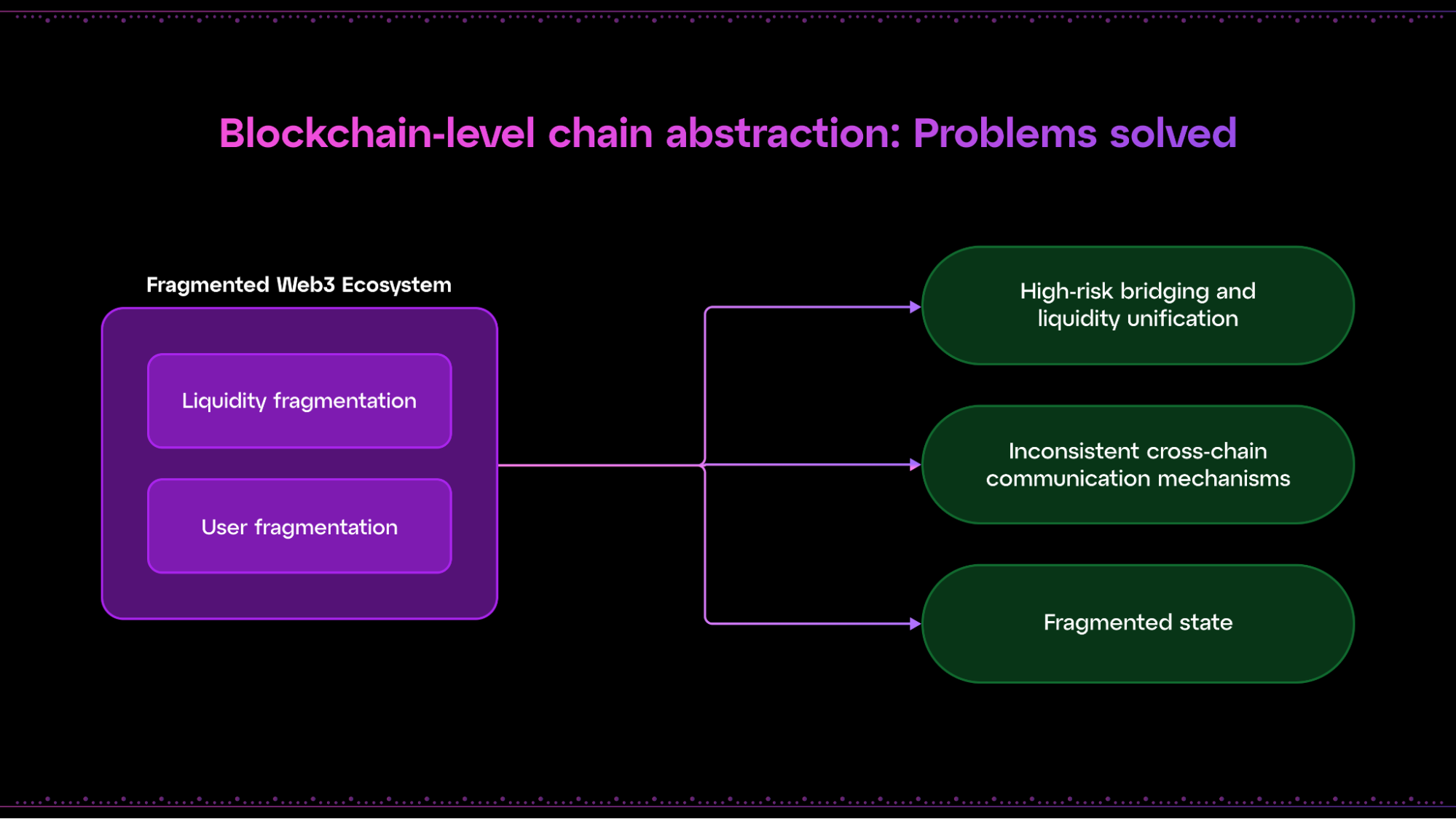
The blockchain layer primarily addresses the lack of infrastructural parity between individual blockchains, providing interoperability among them to create a chain-abstracted experience that minimizes risk, latency, and cost. It thus involves networks or collectives of blockchains that agree to share certain properties, including:
-
Security mechanisms.
-
Cross-chain messaging and bridging capabilities.
-
Direct compatibility with the same stack, enabling high interoperability.
By sharing these characteristics, the blockchain layer enables:
-
Effortless state migration or sharing among participating blockchains.
-
Provision of shared security guarantees across the collective.
-
Efficient cross-chain message passing and communication.
While not strictly required for chain abstraction, the blockchain layer can significantly enhance the user experience by providing a shared foundation of security, communication, and state management for participating chains. This, in turn, facilitates more efficient and seamless interactions at the account and application layers, augmenting their functionality and user experience.
Examples of blockchain-layer implementations include Polygon’s AggLayer, which aggregates zk-proofs from a set of chains deployed via the Polygon stack and submits them to Ethereum for settlement. It also partially encompasses the Cosmos ecosystem, which uses the Inter-Blockchain Communication (IBC) protocol for cross-chain messaging and interoperability. Optimism’s Superchain is also included in this layer.
Non-Applicability
As mentioned above, projects or solutions that do not meet the initially specified criteria or do not explicitly attempt to implement any aspect of chain abstraction from a user experience perspective can still hold value for the overall goal of chain abstraction.
Such solutions may be better categorized under Frontier Research’s CAKE framework or Everclear’s “Chain Abstraction Stack” as low-level foundational solutions. These frameworks aim to cover the technologies, protocols, and primitives that constitute chain abstraction solutions but do not directly target user experience aspects. Examples include cross-chain messaging protocols, account abstraction primitives, settlement layers (such as Everclear), or intent-based oracles (such as SEDA).
Specifically, the two frameworks function as follows:
-
CAKE Framework: Developed by Frontier Research, this is a low-level framework that organizes and unifies the various technologies and solutions comprising chain abstraction. It includes the permission layer (account abstraction, intent, key management), solver layer (cross-chain logic execution), and settlement layer (data availability layers, bridges, oracles).
-
Everclear’s “Chain Abstraction Stack”: Provides a low-level framework specifically tailored to intent-centric implementations of chain abstraction. It outlines the technology stack involved in enabling users to seamlessly execute cross-chain intents through a single interaction.
Both frameworks aim to provide a structured, fine-grained understanding of the components and layers involved in achieving chain abstraction, though they differ in focus and scope. The CAKE framework takes a broader view of the technologies involved, while Everclear’s stack focuses more narrowly on intent-centric solutions. The multi-layer framework operates at a higher level of granularity than these, exclusively covering chain abstraction solutions rather than the constituent technologies themselves.

Conclusion
The multi-layer framework offers a new perspective on chain abstraction by classifying solutions based on their impact on user experience within the Web3 ecosystem. By distinguishing abstraction at the blockchain, account, and application layers, it provides a structured approach to understanding the diverse and complementary roles of various chain abstraction technologies in achieving full implementation.
Industry participants can leverage this framework to strategically position their projects, identify potential collaboration opportunities, and guide product development. By understanding where their solution fits within the multi-layer structure, teams can focus on enhancing specific aspects of chain abstraction while identifying integration opportunities with complementary technologies.
The framework also provides investors and researchers with a roadmap to evaluate the completeness and potential impact of chain abstraction initiatives, ultimately driving progress toward a more unified and user-friendly Web3 ecosystem.
Join the official TechFlow community
Telegram subscription group:
Twitter official account:
Twitter English account:
Join TechFlow official community to stay tuned
Telegram:https://t.me/TechFlowDaily
X (Twitter):https://x.com/TechFlowPost
X (Twitter) EN:https://x.com/BlockFlow_News
 @ParticleNtwrk