









BTC and ETH are experiencing high-level volatility—why are altcoins turning bearish?
TechFlow Selected TechFlow Selected
BTC and ETH are experiencing high-level volatility—why are altcoins turning bearish?
Continuous token unlocks diluting supply, venture capital selling pressure, lack of new capital inflows, and seasonal trends have all contributed to the sharp decline in altcoin prices.
 Navigating Web3 tides with focused insights
By Krisztian Sandor, CoinDesk
Translated by Felix, PANews
Key Takeaways:
-
Over the past few months, altcoins such as SOL, AVAX, APT, and SUI have seen pullbacks of 40%-70%, dampening market sentiment, while BTC and ETH are down only around 15% from their yearly highs.
-
Markus Thielen notes that venture capital funds face pressure to sell tokens to realize profits from investments made over the past few years.
-
David Shuttleworth, partner at Anagram, said the lack of inflows into crypto markets "has been particularly detrimental to tokens facing large upcoming unlocks, new token launches, and airdrop programs."
After a strong rally from October last year through March this year, the crypto market is undergoing a healthy correction—at least for those invested in BTC and ETH. However, for holders of altcoins, it has been a brutal adjustment, with market sentiment in the crypto community resembling bearish despair.
While BTC and ETH are only about 15% below their annual highs, altcoins like SOL and AVAX have fallen 40% to 50% from their March peaks, and SUI and APT have dropped 60% to 70%.
The weakness in altcoins stems from a combination of selling pressure from venture capital funds, increasing token unlock schedules, lack of fresh capital inflows into crypto, and seasonal trends.
High Dilution Due to Token Unlocks
Many altcoins are experiencing ongoing supply dilution due to token unlocks and distributions, as most tokens were purchased by early investors or allocated for ecosystem development and grants and thus locked initially.
For example, Arbitrum’s token ARB, despite its market cap rising from $1 billion to $2.5 billion, is now trading near its lowest price since September last year due to a significant increase in supply.
Another example is Solana, whose supply increases by 75,000 tokens daily—worth approximately $10 million at current prices.
Quinn Thomson, founder of crypto hedge fund Lekker Capital, pointed out on X: "Unlike ETF inflows and bond buybacks leading to passive stock buying, cryptocurrencies—especially altcoins—face the opposite: constant selling pressure."
A major source of this selling pressure comes from venture capital funds seeking to realize returns on projects they invested in during the previous bull cycle.
Markus Thielen, founder of 10x Research, noted in a report last week: "VC funds invested $13 billion in Q1 2022, just before the market swiftly entered a bear phase. Now, with AI becoming a hotter sector, these funds face investor pressure to return capital."
When interest in smaller, more speculative crypto assets wanes and trading volumes decline—as has been the case over the past months—there isn't sufficient demand to absorb the impact of this dilution.
Lack of Fresh Capital Inflows
In recent weeks, capital inflows into the crypto market have stalled or even reversed, as reflected in stablecoin market capitalization.
According to TradingView data, the combined market cap of the four largest stablecoins (Tether's USDT, Circle's USDC, First Digital's FDUSD, and Maker's DAI) rose $30 billion earlier this year but has remained flat since April.
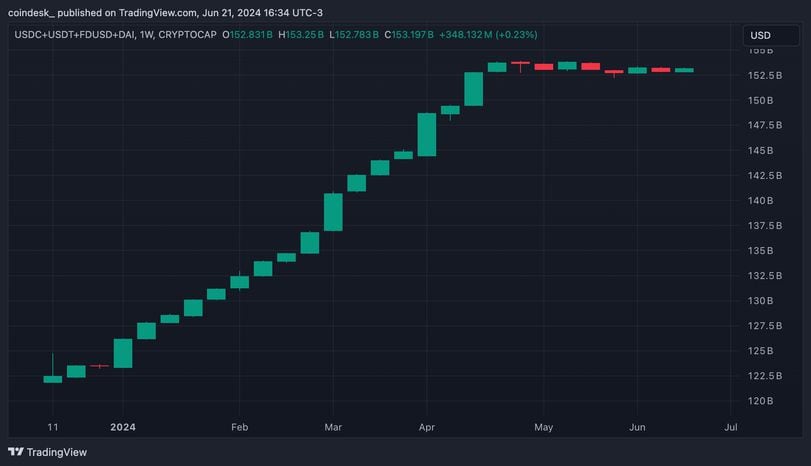
Total market cap of USDT, USDC, FDUSD, and DAI (TradingView)
David Shuttleworth, partner at Anagram, pointed out in an X post citing Nansen data that stablecoin balances on exchanges have decreased by $4 billion, reaching their lowest level since February. "This has been particularly detrimental to tokens facing large upcoming unlocks, new token launches, and airdrop programs," Shuttleworth said.
Recently launched tokens such as Wormhole (W), Ethena (ENA), and Starknet (STRK) have all seen their prices plunge roughly 60% to 70% from their respective highs and face multi-billion-dollar token distributions over the coming years.
For smaller-cap tokens, seasonal trends also point downward—June is typically a weak month for altcoins.
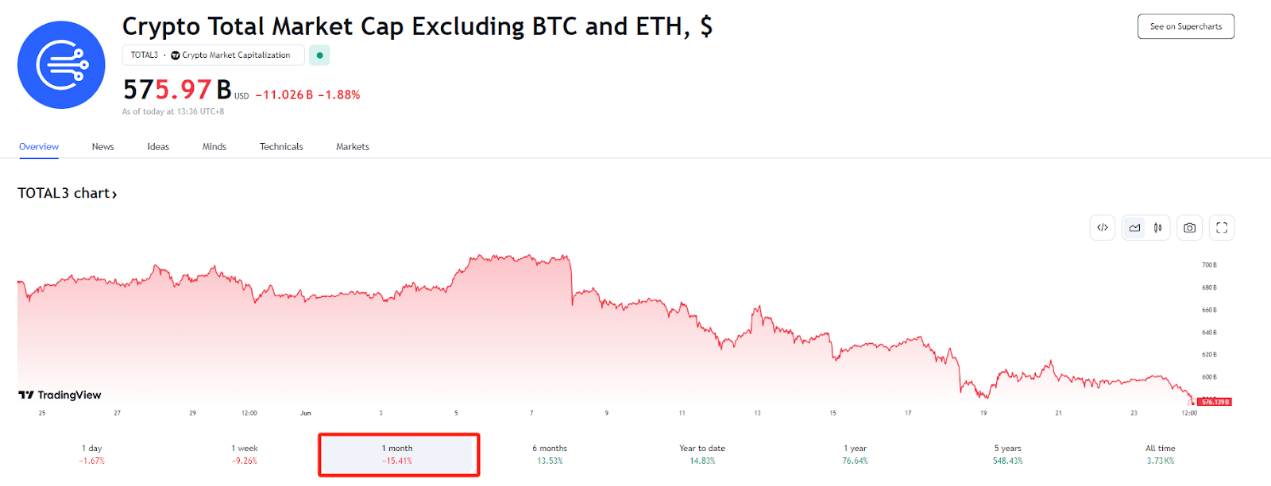
This year is no exception: so far in June, TOTAL3—the metric tracking total market cap of all crypto assets excluding BTC and ETH—has declined over 15%.
Join TechFlow official community to stay tuned
Telegram:https://t.me/TechFlowDaily
X (Twitter):https://x.com/TechFlowPost
X (Twitter) EN:https://x.com/BlockFlow_News
 CoinDesk










