








How can AO build a decentralized computing network suitable for AI Agents?
TechFlow Selected TechFlow Selected
How can AO build a decentralized computing network suitable for AI Agents?
This article interprets how AO builds a decentralized computing network suitable for AI Agents from the perspectives of network architecture and features.
 Navigating Web3 tides with focused insights
Author: Trustless Labs
The dream of a "world computer"—executing arbitrary code in a trustless manner and making it accessible globally—is deeply rooted in decentralized networks. After Ethereum, many infrastructure projects have attempted to realize this vision, and Arweave's upcoming AO network is one such effort.
A "world computer" can be roughly divided into three components: computation, access, and storage. Arweave has long served as the "world's hard drive," while the AO network (Actor-Oriented) introduces general-purpose computing capabilities and supports smart contracts.
AO: A General-Purpose Computing Network Based on Actors
Current mainstream decentralized computing platforms fall into two categories: smart contract platforms and general-purpose computing platforms. Smart contract platforms, represented by Ethereum, maintain shared global state memory and reach consensus on state-changing computations. Because consensus requires extensive redundant computation, these systems are costly and thus limited to high-value applications. In contrast, general-purpose computing networks do not achieve consensus on the computation process itself but instead verify results based on specific tasks and sequence requests without shared state memory. This reduces costs and allows scalability across broader computational domains—exemplified by compute networks like Akash.
Some projects combine general-purpose computing with smart contracts under assumptions of virtual machine security. These networks only reach consensus on transaction ordering and validate final results, processing multiple state transitions in parallel across nodes. The virtual machine ensures deterministic outputs, so as long as transaction order is consistent, final states will converge.
Such networks avoid shared state memory, enabling low-cost scaling where multiple tasks can run in parallel without interference. Often built upon the Actor programming model, representative examples include ICP, and AO belongs to this category as well. Under the Actor model, each computational unit acts as an independent intelligent agent handling transactions autonomously, interacting via message passing—an architecture commonly used in traditional Web2 services. AO standardizes Actor message communication, forming a decentralized computing network.
Unlike traditionally passive smart contracts (e.g., those on Ethereum or Solana), AO’s general-purpose Actors enable proactive execution through time-based triggers ("cron"-like scheduling). For example, a trading bot could continuously monitor arbitrage opportunities.
With scalable decentralized computing power, Arweave’s massive data storage capacity, the Actor programming model, and proactive transaction triggering, AO is particularly well-suited for hosting AI Agents. AO also supports running large AI models directly within blockchain smart contracts.
AO Network Features
As previously discussed, AO differs from traditional smart contract networks by not achieving consensus on computation processes. Instead, it reaches consensus only on transaction order and assumes deterministic outcomes from the virtual machine, thereby ensuring eventual state consistency.
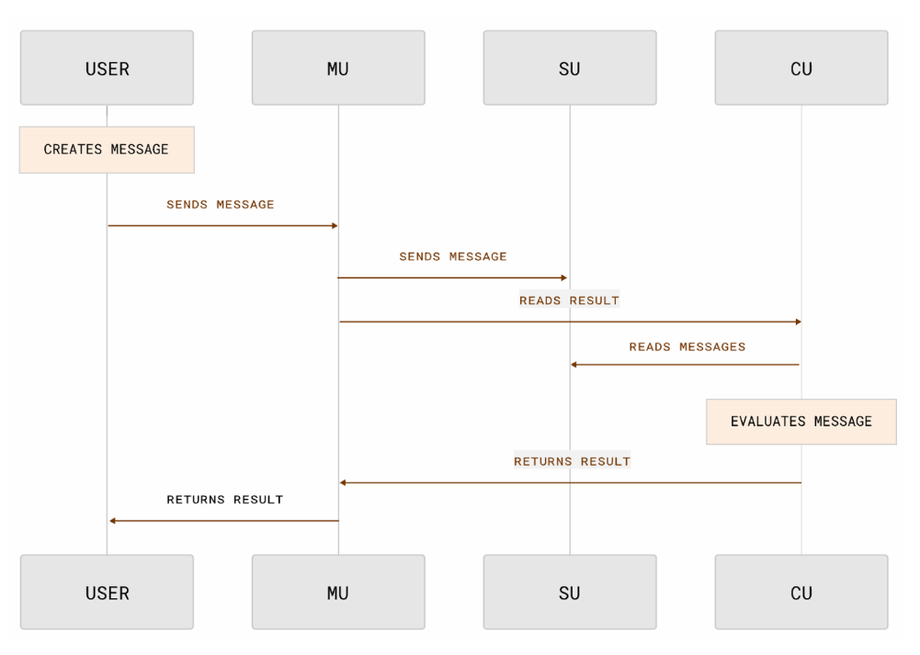
AO also offers flexibility through modular design. The network comprises three fundamental units: Scheduler Units (SU), Compute Units (CU), and Messenger Units (MU).
When a transaction is initiated, the MU (acting as the communication layer) receives it, verifies the signature, and forwards it to the SU. The SU serves as the bridge between AO and the AR chain, helping to sequence transactions before uploading them onto the AR chain for consensus—currently achieved via Proof-of-Authority (PoA). Once transaction order is finalized, tasks are assigned to CUs, which execute the actual computations and return results via the MU to users.
The CU pool functions as a decentralized compute network. Under its full economic model, CU nodes must stake assets and compete based on computing performance and pricing to provide computational resources and earn rewards. Nodes that produce incorrect results face slashing penalties—a standard economic security mechanism.
Differences Between AO and Other Networks
As a general-purpose computing platform, AO's distinction from smart contract platforms like Ethereum is clear. Filecoin, another "world hard drive" alongside Arweave, has launched its own smart contract platform FVM—an architecture equivalent to EVM—but lags behind Ethereum and other established platforms in user experience.
Unlike decentralized compute networks such as Akash or io.net, AO retains smart contract functionality and ultimately maintains a global state on AR storage.
In fact, ICP is architecturally the most similar to AO. ICP pioneered the paradigm of asynchronous computing blockchains, and AO inherits much of ICP’s design: consensus only on transaction order, reliance on deterministic VM execution, and asynchronous processing using the Actor model.
The key difference lies in state management: ICP uses containers where each smart contract container maintains its private state or sets conditional read permissions. In contrast, AO features a shared state layer—the AR chain—where anyone can reconstruct the entire network state using transaction order and state proofs. This enhances decentralization but eliminates possibilities for certain privacy-centric use cases available on ICP (e.g., users needing to hide arbitrage paths).
From economic and design perspectives, ICP imposes high hardware requirements on participating nodes to ensure performance, creating significant entry barriers. AO, by comparison, operates more fairly and openly—nodes participate through staking without准入 restrictions. ICP adopts a monolithic stack approach, sacrificing flexibility for performance, whereas AO embraces modularity with separated MU, CU, and SU components. Developers can even choose their preferred VM implementation, lowering the barrier for developer adoption.
However, AO may share some of ICP’s systemic limitations. For instance, under the Actor asynchronous model, cross-contract transactions lack atomicity, hindering DeFi application development and making AgentFi visions difficult to realize in the short term. Additionally, departing from traditional smart contract paradigms raises the bar for developers. The 4GB limit on WASM VMs in AO also prevents some complex models from running. Thus, AO’s strategic focus on AI Agents appears to be a pragmatic choice to leverage strengths and mitigate weaknesses. Interestingly, ICP also announced in early 2024 its strategic shift toward AI.
Compared to ICP’s $5 billion market cap, Arweave currently holds a $2.2 billion valuation, indicating considerable room for growth. Against the backdrop of rapid AI advancement, AO still possesses significant potential.
Join TechFlow official community to stay tuned
Telegram:https://t.me/TechFlowDaily
X (Twitter):https://x.com/TechFlowPost
X (Twitter) EN:https://x.com/BlockFlow_News
 @TrustlessLabs











