Exclusive Interview with Particle Network: Chain abstraction is an inevitable product against the backdrop of chain explosion—we're committed to solving the ultimate UX problems in Web3
TechFlow Selected TechFlow Selected
Exclusive Interview with Particle Network: Chain abstraction is an inevitable product against the backdrop of chain explosion—we're committed to solving the ultimate UX problems in Web3
Cryptocurrency projects have never been about delivering standardized services to a single, specific group.
 Navigating Web3 tides with focused insights
Reporter: TechFlow
Interviewee: Pengyu, CEO of Particle Network
Introduction
On June 20, Particle Network announced the completion of a $15 million Series A funding round co-led by Spartan Group and Gumi Cryptos Capital, with participation from SevenX Ventures, Morningstar Ventures, Flow Traders, HashKey Capital, and others.
Currently, Particle Network is still in Phase One of its testnet. It reportedly already has around 1.3 million Universal Accounts registered. The second phase of the testnet is expected to launch this week, while the mainnet is scheduled to go live in Q3 this year.
This time, unlike before, we noticed that Particle Network placed greater emphasis on describing its positioning around "chain abstraction." Compared to two years ago when Particle started with wallet abstraction, "chain abstraction" represents another leap forward. Recently, Particle Network has also launched new products such as the People's Launchpad.
Driven by curiosity about Particle’s latest narrative and the logic behind the various products it has rolled out over the past few years, in this article we dive deep into a conversation with Pengyu, CEO of Particle Network. We aim to understand, from the inside out, how the Particle Network team thinks about their own narrative, the industry, and the product and business logic they follow.
Key Takeaways
-
Since its inception, Particle's mission has always been to empower developers and solve the ultimate UX problems in Web3. Our product evolution consists of three phases: wallet abstraction, account abstraction, and chain abstraction.
-
User experience across different interaction layers multiplies rather than adds—any UX issue at any stage impacts the entire system.
-
The underlying logic of our products is: horizontal expansion across all chains, vertical coverage across the full lifecycle, supported internally by three product lines: core products, growth products, and operational products.
-
We are fundamentally a crypto project, not an internet company. Running a crypto project means never serving just one single group through standardized operations.
-
Our design is rooted in the full lifecycle perspective of users and developers, and each technical phase fully leverages the technological advancements from the previous stage.
-
Chain abstraction isn't artificially created—it's an inevitable outcome in the context of chain explosion.
-
Our chain acts as a supporter, coordinator, and enabler—not a new chain competing against others. We do not compete with other chains in terms of TVL or developer attraction, nor do we exacerbate liquidity fragmentation.
-
A good token is a meme with utility.
-
The idea that customer acquisition cost in crypto projects is much lower than in mobile internet is false—long-term debt carries costs unless you assume you won’t repay it.
-
The entire evolution of Web3 technology follows a cyclical pattern of unity leading to fragmentation, and fragmentation eventually leading back to unity. L2 proliferation and modularization mark the era of fragmentation; chain abstraction is the core of re-unification.
-
The current infrastructure problem isn't too many chains, but too low overall penetration. The application problem isn't too few apps, but incorrect directions.
Underlying Thinking: Building Technical Advantages and Iterating Across the Full Lifecycle of Users and Developers
TechFlow: First, congratulations on your new round of funding. I noticed you’re heavily emphasizing “chain abstraction” this time. While many reports on chain abstraction include Particle for research and comparison, most people still recognize you primarily as a wallet infrastructure provider. Can you explain how you transitioned from being a wallet infrastructure project into the chain abstraction space?
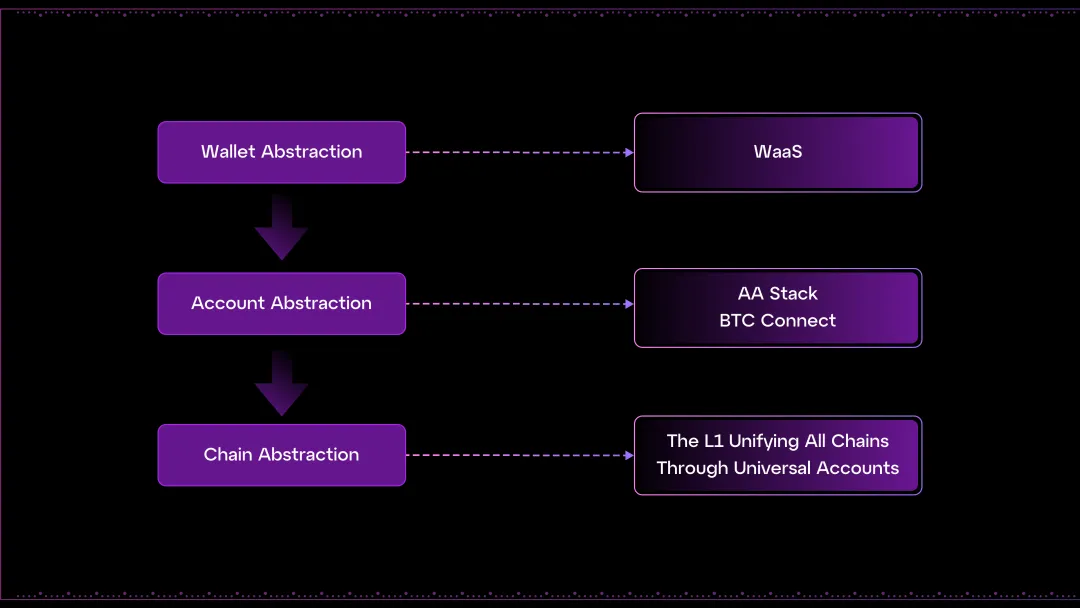
Pengyu: From day one, Particle's mission has always been empowering developers and solving Web3 UX issues. Our product roadmap includes three stages: wallet abstraction, account abstraction, and chain abstraction.
-
Wallet Abstraction: Providing developers with social login and wallet kits to reduce friction for users entering blockchains;
-
Account Abstraction: Upgrading the underlying account structure on-chain to improve interaction efficiency;
-
Chain Abstraction: Reducing fragmented experiences caused by multi-chain ecosystems in terms of accounts and liquidity.
These stages correspond respectively to the full lifecycle challenges of developers and users: onboarding onto chains → interacting within a single chain → cross-chain interactions.
Our understanding of UX optimization is that only end-to-end UX improvements have real meaning. User experience across different interaction layers multiplies rather than adds—any single UX flaw affects the whole system.
TechFlow: My second question might be more direct. As you mentioned, you've gone through several product iterations and launched initiatives like People's Alliance and People's Launchpad, and seem deeply involved in the BTC ecosystem. Externally, this might appear unfocused or driven by trends. Could you share the underlying logic behind launching these diverse products?
Pengyu: The core logic behind our products is: horizontally spanning all chain ecosystems, vertically covering the full lifecycle.
It’s not that we lack focus or blindly pursue scale—it’s because we're solving UX problems, which require a holistic approach.
From an industry development standpoint, the trend toward multi-chain and cross-chain interoperability is irreversible. Users will have accounts and liquidity across multiple ecosystems. How can we ensure a unified and efficient user experience throughout their lifecycle and across all chains? That is the ultimate challenge in Web3 UX.
To give a rough analogy: in the internet era, it wouldn’t make sense if websites loaded fast in Japan but slowly in the U.S., or if registering for a game was smooth but payment processing was stuck.
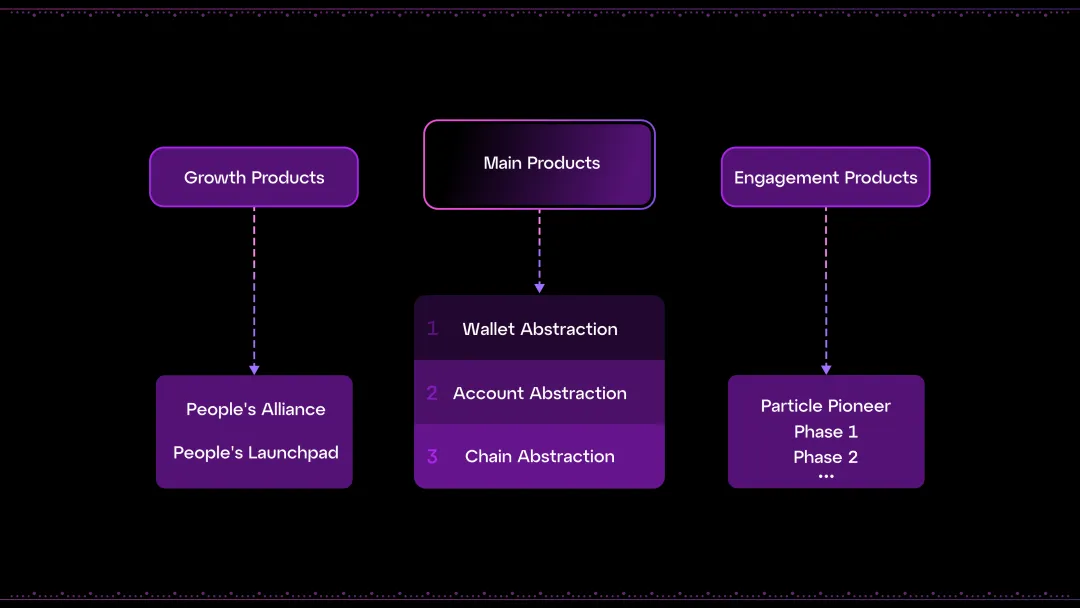
With that mindset, returning to your question, internally we maintain three product lines: core products, growth products, and operational products.
Core products form our main offering, targeting developers, structured around the three stages mentioned earlier.
Growth products refer to tools like People's Launchpad and People's Alliance, aimed at community growth.
Operational products include platforms like our testnet portal, Particle Pioneer.
Why do we need separate growth and operational product lines beyond our core offerings?
Because we are fundamentally a cryptocurrency project, not an internet company, and we understand that managing a crypto project involves satisfying multiple stakeholders—not just one standardized group. We must keep customers, investors, communities, and end-users all engaged and satisfied. Growth products serve our community by aligning with trending assets to maintain excitement and interaction frequency.
Operational products target end-users. Even though we’re developer-focused infrastructure, our solutions are highly innovative and unique. Operational products help us quickly demonstrate what distinctive features we offer to the broader industry.
As for why we don’t rely solely on marketing campaigns or content-driven approaches for growth and operations, that reflects our team culture—we prefer product-driven solutions, favoring standardization and data-driven results. So even in areas like marketing and growth, we often build complex-looking products to achieve our goals. This naturally leads to us appearing to offer more products than typical.
Our active involvement in the Bitcoin ecosystem is simply an execution of our “horizontal expansion across all chains” strategy. We aren’t only focused on Bitcoin—we’ve also made strong progress in the Cosmos ecosystem.
I think the perception of being unfocused may stem from doing certain things well—each product line generates significant buzz and recognition. Where we’ve fallen short is in clearly communicating our overarching strategy, product iteration logic, and the rationale behind our multiple product lines. I’m glad today offers a chance to clarify our overall thinking.
TechFlow: This iterative model makes commercial sense, but continuous product evolution could risk reducing support for partners using earlier versions of your products. How do you address this?
Pengyu: That’s a great question. If your product iterations lack continuity in technology, functionality, or user base, this issue would indeed arise. But our design avoids this. As I mentioned earlier, we build from the full lifecycle perspective of users and developers, and each technical phase fully leverages the accumulated advances from the prior stage.
Let me give concrete examples. Our first-stage wallet abstraction and second-stage account abstraction products can be used independently or together. Developers can use third-party wallets like MetaMask to power our account abstraction protocol, or they can use our wallet abstraction suite (social login + built-in wallet) to drive account abstraction—effectively upgrading dApp-embedded wallets from regular EOA accounts to smart accounts.
Our third-stage chain abstraction relies on three core modules: Master Keystore Hub, Decentralized Bundler, and Messaging Network.
The Master Keystore Hub and Decentralized Bundler are both evolved from our account abstraction stage—essentially decentralized and cross-chain extensions of account abstraction. From a developer’s point of view, they see us continuously adding new features they can adopt or choose from: beyond wallet abstraction, they can upgrade existing accounts via account abstraction; with chain abstraction, they can easily extend a single account abstraction setup across all chains.
We’re also constantly improving how we support partners. We currently have over 1,800 dApps (excluding experimental hackathon projects) integrated with our various products, with around 1,000 still active (DAU > 0). Last month, our SDK downloads for developers (various npm packages) surpassed 500,000 per month—and continue to grow rapidly.
But we aim to maintain a lean operations team with heavy R&D focus. Under this model, we use a layered and automated support strategy. We prioritize projects with genuine traffic and on-chain activity, while projects merely increasing EOA account counts receive automated support without dedicated human resources.
TechFlow: I’ve observed that all three of your product lines attract many collaborators right after launch, avoiding the common struggle Web3 projects face with traction. How do you achieve this? Do you have any special strategies?
Pengyu: Mainly due to three reasons:
-
Although our product lines keep evolving, our target partners haven’t changed: blockchains and dApps, allowing us to accumulate relationships steadily.
-
We only pursue actionable collaborations, ensuring trust is authentic. Regarding public chain partnerships, we directly collaborate with nearly 80 chains and explore various integration angles. For example, we co-hosted a large-scale Consumer Crypto hackathon with Avalanche, ran NFT campaigns with Linea under People’s Alliance, received grants from Near and Sei, have a mutual airdrop plan with Avail, will launch Co-Testnets soon with Berachain and Arbitrum, co-hosted offline events with Citrea and BOB, and Merlin listed on our People’s Launchpad. Even niche chains—like Peaq for DePIN, or Xter.io for gaming—have their entire ecosystems largely adopting our tech stack.
-
We have a systematic internal management process ensuring partnerships are not only implemented but explored from multiple angles. This includes a custom-built CRM system. We regularly review key partner projects to maintain consistent communication, understanding their needs beyond just product integration.
New Narrative: Chain Abstraction Is Inevitable Amid Chain Explosion—and Our Most Exciting Direction
TechFlow: Particle now positions itself externally as “The L1 Unifying All Chains Through Universal Accounts,” focusing on chain abstraction. Some say there are already too many types of abstractions in the industry. Is chain abstraction just a fabricated narrative? Why does the industry need another “abstraction”?
Pengyu: Chains will inevitably multiply. Both the cost and benefits of launching chains encourage this. The rise of modular infrastructures like RaaS and DA, along with EIP-4844 implementation, has drastically reduced the cost of launching and maintaining chains. Meanwhile, launching a chain brings clear advantages to almost any project: simpler and more efficient value capture for tokens, expanded product and operational boundaries, etc.
There are currently about 400 trackable chains, expected to reach nearly 1,000 by year-end and over 3,000 by the end of 2025. Such volume doesn’t just raise the learning curve for so-called Web2.5 users—it’s already causing fragmentation pain even for professional users.
Everyone experiences scattered USDT balances across chains, often losing purchasing power due to transfer delays or insufficient gas. Therefore, in a landscape of thousands of chains, providing a unified interaction and development environment for end-users and developers is a necessity that demands a solution.
I believe the key to judging whether a narrative is artificial lies in: Does it solve a real problem? How high is the ceiling of that problem? And is there a feasible way to actually solve it? Chain abstraction isn’t invented—it’s an inevitable result of chain explosion.
TechFlow: There are many other compelling narratives in the industry that are viable and can ship real products. Why did you choose chain abstraction over AI or DePIN?
Pengyu: Narratives are undoubtedly among the most important aspects of any Web3 project. A narrative combines product direction, technical roadmap, and investor/community valuation frameworks. Especially in an industry lacking standardized valuation metrics (like traditional PE ratios), narrative equals pricing range. The biggest challenge, however, is choosing the right narrative for Particle.
I see narratives falling into broad categories: mature, open-secret, elite, and pioneer narratives:
-
Mature narratives include oracles, cross-chain bridges, etc.;
-
Open-secret narratives are newly popularized ones, like AI or DePIN this cycle;
-
Elite narratives follow Ethereum Foundation closely—ZK, privacy, reputation systems, etc.
Each has pros and cons. Open-secret narratives save education effort but make proving leadership extremely hard. Elite narratives guarantee some demand but are hard to access (requiring top-tier team pedigree), and delivering traction is uncertain. Pioneer narratives risk being quickly invalidated.
We want a direction where we can deliver products, gain traction, and leverage our existing product, user, and technical advantages.
After weighing all factors, chain abstraction is our most exciting evolutionary path.
TechFlow: Within the chain abstraction space, other projects like Near, Polygon, and Everclear (formerly Connext) are also active. How does Particle’s approach differ? What unique advantages do you have?
Pengyu: In terms of entry points: Particle starts from universal accounts, Near from decentralized signature computation, Polygon offers shared liquidity bridges for CDK-based L2s, and Everclear focuses on transaction settlement.
Particle’s key product advantage in chain abstraction is:
1. Zero migration cost for users and developers, accelerating adoption.
2. Our solution includes a Decentralized Bundler network that batches multiple UserOps into a single transaction, saving gas costs on complex multi-chain, multi-step operations.
From a business perspective, our biggest edge is that all users and developers from our wallet and account abstraction products can seamlessly migrate to our chain abstraction infrastructure. In a sense, we’ve already accumulated users and liquidity for our chain abstraction solution before its official launch.
TechFlow: Your chain abstraction solution involves “building a new chain.” Doesn’t that contradict the original purpose of chain abstraction—solving the problem of “too many chains”?
Pengyu: Our chain is positioned as an enabler, coordinator, and supporter—not a new chain competing with others.
When designing our chain abstraction solution, we considered security, transparency, marginal cost of services, and sustainable value capture. After evaluation, hosting it on a standalone Layer-1 proved optimal.
Behind every transaction initiated via our Universal Account, from a value flow perspective, we don’t reduce gas consumption on other chains. Instead, all chain abstraction transactions are first sent to our chain, which then coordinates external chains to execute corresponding actions—shielding users from the complexity of multi-chain interactions. Crucially, users don’t need to pre-transfer assets to our Layer-1. Thus, we don’t compete with other chains in TVL or developer attraction, nor do we worsen liquidity fragmentation.
TechFlow: Particle consistently delivers strong products. But commercially, how does this chain abstraction solution achieve a sustainable business loop?
Pengyu: In the entire Web3 space, only two business models have proven scalable: native gas tokens on public chains, and transaction fees (on-chain or off-chain).
Our chain abstraction infrastructure is built on a Cosmos SDK-based Layer-1. Any transaction initiated via Universal Accounts—whether complex cross-chain or single-chain—is first packaged into a UserOp and sent to our chain. Particle L1 nodes then unpack, execute, and coordinate the required operations.
Thus, every transaction on Universal Accounts indirectly or directly consumes our L1 token. Value capture is therefore natural and ongoing.
Token and Future: Token Launch Will Bring Multifaceted Benefits—We Hope Particle Becomes the Industry’s Lubricant
TechFlow: Let’s move to the topic users care most about—the token. Many are eagerly awaiting Particle’s token design. Could you define what makes a good token in one sentence?
Pengyu: I believe a good token is a meme with utility. SOL might be the best example.
TechFlow: Why do you need to issue a token at all? What’s the significance, and how will it benefit the project’s development?
Pengyu: Internally, we view tokens as serving four roles: igniter, booster, filter, and revenue generator.
-
Igniter: In early stages, token incentives can cold-start the project and attract users and community members who align with our vision. However, the popular claim that crypto projects have far lower customer acquisition costs than mobile internet is false—long-term debt has costs unless you assume you won’t repay, or that the token has no future liquidity or value. So even early token use as an igniter requires careful design.
-
Booster: Once scaled, tokens help bind core ecosystem partners—like zkSync’s recent collaboration with Lens.
-
Filter: Buying and holding tokens incurs cost, which helps filter out long-term supporters. The real challenge is ensuring those long-term supporters get outsized returns—otherwise, they’re just being exploited.
-
Sustainable Revenue Generator: With a token-centric business model, you’re essentially trading business growth for profit—the manifestation being healthy token liquidity and price appreciation.
Overall, if a token can provide these four benefits, it’s worth launching.
TechFlow: A sharp question: some teams go idle after launching their token. What’s your take on that?
Pengyu: “Going idle” comes in two forms: passive and active.
Many Web3 teams intend to keep working post-token launch, but fail to gain further traction due to passive idling. Possible reasons:
-
Technical designs detached from engineering reality, making delivery impossible.
-
Product-market fit missing—no one uses it.
-
Token lacks value capture—continuing development feels pointless.
Meanwhile, active idling happens when the team believes the project’s potential is limited. No one refuses wealth creation—choosing to idle reflects a belief that investing personal energy and capital elsewhere yields higher returns, while expectations for the current project are low.
For us, we don’t face passive idling—we design every product considering its target audience and ensure timely delivery while maintaining technical leadership. Our token, as a native gas token on a public chain, leverages one of the few proven scalable value capture mechanisms.
Our bigger challenge lies in continuously expanding Particle’s ceiling. The entire evolution of Web3 technology cycles between unification and fragmentation.
L2 emergence and modularity mark the fragmentation era; chain abstraction is the core of re-unification.
This sector sits at the heart of industry evolution. Beyond ideals, purely from the efficiency of wealth creation, we have no reason to slow down.
TechFlow: Web3 evolves rapidly and embraces open-source culture. Do you worry that your groundbreaking innovation in chain abstraction could become a standard feature elsewhere tomorrow, eroding your technical edge?
Pengyu: That’s really two questions: Can open-source products lose technical leadership? And what’s the moat for Particle’s chain abstraction infrastructure?
The open-source topic is vast, so I’ll summarize briefly. Contrary to intuition, open-source companies often sustain leadership. Companies that frequently fork or modify tend to lose momentum amid too many available options. Uniswap is a great example—most on-chain DEXs are based on Uniswap, yet Uniswap V4 remains a driving force in advancing on-chain trading.
At its core, chain abstraction aims to establish an interoperability standard across the industry as a coordinator.
Standards are never achieved by product or technical superiority alone. They emerge from initial product leadership leading to market penetration, snowballing into scale effects, eventually forming a de facto standard—which must then evolve openly to remain relevant.
Regarding Particle’s chain abstraction infrastructure, we’re currently ahead in product and timing, and can effectively leverage our existing user base. From day one, our solution launches with strong account and liquidity scale. Our approach is fully open and empowering—no competition for TVL or developers.
TechFlow: If I recall correctly, you founded in May 2022—right at the start of the bear market—and lived through the entire downturn. What was your biggest challenge during that period?
Pengyu: The biggest challenge was the tension from “balancing.”
Small team, big ambitions: Web3 teams are small but must handle innovation, user acquisition, branding, global expansion, listing management, investor relations—functions typically found in giant corporations.
One project, four roles: Stakeholders—partners, community, investors, exchanges—have misaligned interests. Balancing narrative flexibility with product depth, Asian traffic with Western communities—all while requiring both execution rigor and adaptability, short-term pragmatism and long-term vision. This constant tension was the hardest part.
TechFlow: How do you see the future of the industry? What role do you hope Particle Network ultimately plays?
Pengyu: My ideal Web3 industry is a mass consumer sector driven by edge innovation and technology. But today’s reality is still a “pseudo” tech industry—leveraged financially and monetizing attention. “Pseudo” doesn’t mean no real tech progress, but that innovations lack standardized value discovery logic.
I believe the infrastructure problem isn’t too many chains, but too low overall penetration; the app problem isn’t too few apps, but wrong directions.
Right now, I can’t predict the final state of the industry—perhaps we’ll redefine mass adoption, abandoning content-heavy or entertainment-focused Consumer Crypto, refocusing on pure efficiency in on-chain asset issuance and trading. Or perhaps the industry will overcome its lack of standardized business models and evolve into a massive consumer sector rivaling AI x mobile internet. Regardless, everyone will still interact with chains. Improving that experience is an endless pursuit.
We hope Particle becomes the industry’s lubricant—a coordinator and enabler that reduces friction for everyone interacting with chains.
Join TechFlow official community to stay tuned
Telegram:https://t.me/TechFlowDaily
X (Twitter):https://x.com/TechFlowPost
X (Twitter) EN:https://x.com/BlockFlow_News
 深潮TechFlow