









Tiger Brokers officially obtains license—does this mean virtual currency trading is gradually opening up to Chinese mainland users?
TechFlow Selected TechFlow Selected
Tiger Brokers officially obtains license—does this mean virtual currency trading is gradually opening up to Chinese mainland users?
Currently, securities firms can only offer BTC and ETH as tradable assets to retail investors in Hong Kong.
 Navigating Web3 tides with focused insights
By ManQin Blockchain Law Firm
Since the Hong Kong Securities and Futures Commission (SFC) held a briefing session on June 12 for virtual asset trading platform applicants, every move made by crypto exchanges—those that have successfully applied, been deemed licensed, or withdrawn their applications—has drawn significant attention. Numerous crypto media outlets and analysts have shared their views and analyses on this matter. Liu Honglin, managing partner at ManQin Law Firm, was also recently interviewed by Web3.0 media outlet DeThings. For details, see “ManQin Updates | DeThings Interviews Lawyer Liu Honglin: Is Hong Kong’s Crypto Exchange ‘Clearing Without Exiting’?”.
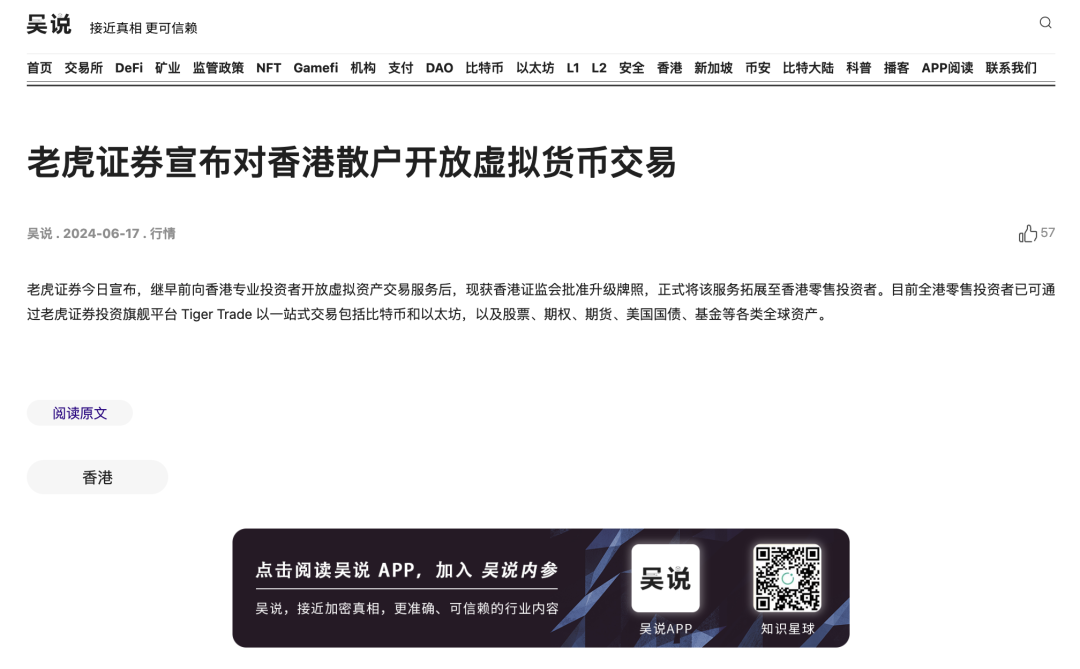
On June 17, according to breaking news from Wu Shuo, a well-known domestic Web3 media outlet, Tiger Brokers announced it has obtained an upgraded license, officially enabling it to provide cryptocurrency trading services to retail investors across Hong Kong. In response, ManQin Law Firm gathered insights from several senior Web3.0 lawyers regarding “developments in SFC licensing” and whether Tiger Brokers’ new license signifies a gradual opening of cryptocurrency trading in mainland China, which we share below.
Liu Honglin
Founder, ManQin Law Firm
According to regulations set by the Hong Kong SFC, after June 1, 2024, any virtual asset trading platform operating in Hong Kong must either obtain an SFC license or be considered a "deemed licensed" applicant. Otherwise, such operation would constitute a criminal offense. Additionally, platforms deemed licensed are restricted in marketing activities targeting individual clients, as they remain under close SFC supervision, which could impact their chances of obtaining full formal approval.
Currently, Tiger Brokers has transitioned from being "deemed licensed" to fully licensed, hence its official announcement to offer crypto trading services to Hong Kong retail investors. However, it is important to note that under existing Chinese regulatory policies, cryptocurrency exchanges are prohibited from operating in mainland China or serving Chinese citizens. According to the Notice on Further Preventing and Managing Risks Associated with Cryptocurrency Trading and Speculation issued on September 15, 2021, by ten government agencies (Yinfa [2021] No. 237), foreign cryptocurrency exchanges providing services via the internet to residents within mainland China are engaging in illegal financial activities. Legal liability will be pursued against local personnel working for such overseas exchanges, as well as any individuals or entities knowingly providing marketing, payment settlement, technical support, or other services to these businesses. Therefore, even though Tiger Brokers has now obtained an official license from the Hong Kong SFC, it still cannot provide virtual asset trading services to users in mainland China.
Meanwhile, other platforms that have withdrawn their applications or failed to secure licenses—even if they hold compliant licenses issued by specific countries or regions—can only operate legally within the jurisdiction of those licenses. Holding a license in one country does not grant global operational rights. Thus, merely possessing a foreign compliant license does not permit a cryptocurrency exchange to conduct business in mainland China or Hong Kong.
Jin Jianzhi
International Practice Team, ManQin Law Firm
Compared to traditional Hong Kong-based brokers like Victory Securities, mainland investors are more familiar with internet brokers such as Tiger Brokers, since many use Tiger Brokers to trade U.S. and Hong Kong stocks. However, the legality of Tiger Brokers offering U.S. and Hong Kong stock investment services to mainland residents has long been questioned. Under rules set by China's securities regulator, any institution providing securities trading services to residents within mainland China must obtain the appropriate license. Yet, clearly, Tiger Brokers and similar online brokers do not hold financial licenses in mainland China, placing their operations in a gray regulatory zone. While this model currently functions, the underlying compliance risks cannot be ignored.
Now that Tiger Brokers has obtained a license from the Hong Kong SFC and can officially offer crypto investment services to Hong Kong users, the question arises: Will it follow its previous high-wire approach of serving mainland residents with U.S. and Hong Kong stock trading, potentially creating a backdoor channel for mainland individuals to trade cryptocurrencies (currently limited to BTC and ETH for retail investors)? This remains unknown—for now, we can only wait and see.
Gu Jiening
International Practice Team, ManQin Law Firm
Tiger Brokers recently announced it has officially obtained an upgraded license, allowing it to open virtual asset trading to Hong Kong retail investors. The typical process involves the broker opening an omnibus account (a pooled client account) with a licensed exchange (currently only OSL and HashKey), then executing virtual asset trades on behalf of each client based on their instructions through that licensed exchange.
In fact, as early as November last year, Victory Securities and Interactive Brokers were already approved to provide retail investors with virtual asset trading and advisory services. As brokers, they already held Hong Kong SFC Type 1 (Securities Trading) and Type 4 (Advising on Securities) licenses; this recent development represents a so-called "license upgrade."
Compared to dedicated virtual asset exchanges, brokers receive less public attention, yet they are actually closer to retail investors, especially traditional ones. Ordinary investors can access a one-stop trading platform via a single broker app to trade stocks, bonds, futures, options, funds, and now virtual assets.
Notably, regulatory requirements stipulate that licensed exchanges may only offer trading in "qualified major virtual assets" (currently only BTC and ETH) to Hong Kong retail investors—significantly fewer types than what qualified investors can trade. As a result, the tradable assets currently available to retail investors through these brokers are also limited to BTC and ETH. We look forward to Hong Kong expanding the range of virtual assets available for trading in the future.
Join TechFlow official community to stay tuned
Telegram:https://t.me/TechFlowDaily
X (Twitter):https://x.com/TechFlowPost
X (Twitter) EN:https://x.com/BlockFlow_News











