








Mind Network exclusive interview with Zama founder Rand Hindi: Building the Fully Homomorphic Encryption era with HTTPZ
TechFlow Selected TechFlow Selected
Mind Network exclusive interview with Zama founder Rand Hindi: Building the Fully Homomorphic Encryption era with HTTPZ
Let's take another step toward our ultimate vision of an HTTPZ fully encrypted internet!
 Navigating Web3 tides with focused insights
On the evening of June 17, Mind Network hosted an exclusive conversation with Rand Hindi, founder of open-source cryptography company Zama, to discuss FHE technology, applications, comparisons, and decentralized AI. Participating guests also included Christian and Mason, co-founders of Mind Network, and Ashley, Research Lead—all fellows at the Ethereum Foundation.
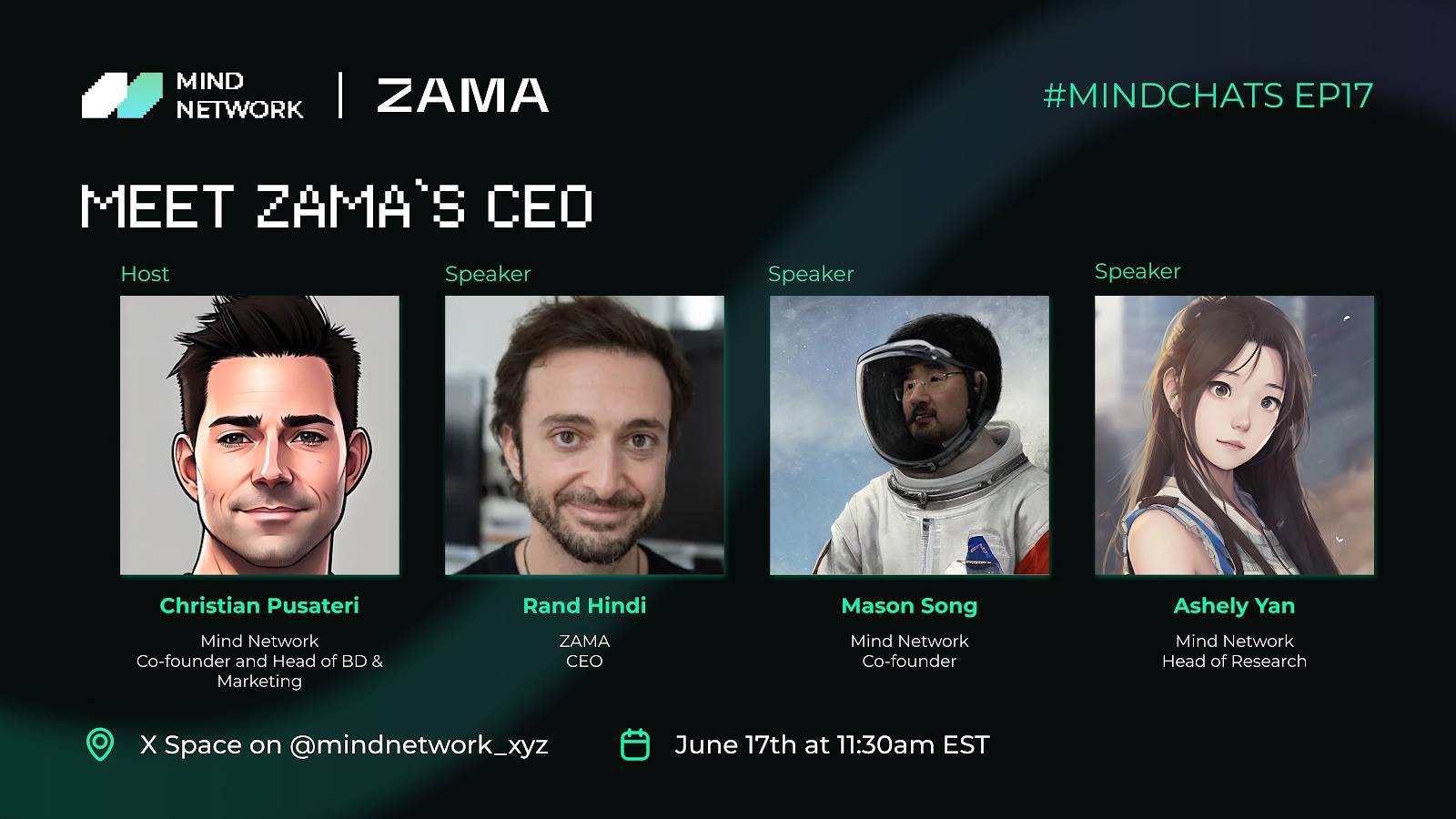
Zama is an open-source cryptography company co-founded in early 2020 by Hindi and Pascal Paillier. Paillier is a renowned cryptographer and one of the inventors of Fully Homomorphic Encryption (FHE), and the company previously raised $73 million in Series A funding.
Mind Network is the first fully homomorphic encryption (FHE) restaking layer for AI and POS networks. It accepts restaked tokens from ETH, BTC, and AI blue-chips, operating as an FHE validation network that provides consensus, data, and crypto-economic security for decentralized AI, DePIN, EigenLayer and Symbiotic AVS, and many critical POS networks.
AMA recap link: https://x.com/mindnetwork_xyz/status/1802725269867757743
FHE AI Network: A decentralized AI network using FHE technology that enables more secure consensus and greater privacy for AI data.
HTTPZ: The Fully Homomorphic Encrypted Internet, achieving end-to-end full encryption via FHE to ensure data remains encrypted throughout transmission and processing.
What are the issues with current Web2 AI frameworks that need improvement?
Rand:
There are two main problems with centralized AI:
Computational integrity and correctness: In centralized AI systems, the integrity and correctness of computation are questionable. Because the computational process and model parameters are opaque, we cannot fully trust the results obtained.
Confidentiality and privacy: Personal data privacy is especially problematic. For example, when using software, your activity logs are visible to the company, making enterprises a single point of failure for privacy and data. An attacker only needs to target one entity to access all information.
The advantage of decentralization lies in public verifiability and data security. If you don’t trust the result, you can verify it yourself—this is particularly important in AI, especially in sensitive scenarios. Blockchain’s decentralized nature eliminates single points of failure; attackers cannot obtain all information by compromising just one target.
Blockchain can solve the computational integrity problem in AI, while Fully Homomorphic Encryption (FHE) can address AI's data privacy issue—this is one of the directions we’re collaborating on with Mind Network. Therefore, decentralized encrypted AI will be the future path forward.
Differences between FHE, ZK, and MPC
Rand:
In cryptography, there are many applied technologies, especially in privacy—FHE, ZK, and MPC are widely used.
- Zero-Knowledge Proofs (ZK): ZK is a very interesting technology, but its limitation lies in being unable to combine with other techniques under encryption or compute encrypted results. It only allows proving certain computations were performed on values without disclosing the actual values. On blockchains, ZK cannot achieve interoperability between multiple contracts or users because the prover must perform calculations in plaintext, thereby gaining access to all data. This doesn’t actually solve the problem. However, ZK excels in other areas such as scalability—for example, zkRollups.
- Multi-Party Computation (MPC): MPC is actually a general term rather than a single technology. It refers to how secure computation can be conducted among multiple parties, and there are various technical approaches to implement MPC schemes.
- Fully Homomorphic Encryption (FHE): FHE allows direct computation on encrypted data without decryption, preserving both data privacy and ensuring computational accuracy and integrity.
By combining these technologies, we can achieve higher levels of privacy protection. For instance, Zama is developing FHEVM and encrypted smart contracts, using FHE for computation and data encryption, combined with MPC to distribute data and enable selective decryption, thus protecting data privacy in multi-user environments.
Mason:
Rand gave a great explanation of how Fully Homomorphic Encryption (FHE), Zero-Knowledge Proofs (ZK), Multi-Party Computation (MPC), and decentralized AI can solve unresolved security and privacy issues in Web2. To add, FHE not only addresses data privacy but also solves fairness issues in decentralized networks.
FHE enables encrypted voting within decentralized networks to be computed securely, ensuring both the safety of the consensus process and fairness of outcomes. Even if nodes distrust each other, encrypted computation prevents cheating. This is something ZK cannot fully achieve—as Rand mentioned, ZK still requires trust in the prover. In privacy-sensitive cryptographic applications involving multiple users and requiring private computation results, FHE is better suited—especially for decentralized AI networks.
Just like Zama’s open-source Concrete ML library, which provides the foundation for encrypting AI network data, Mind Network leverages FHE technology to support the consensus layer of decentralized AI networks. Combining data encryption with consensus security represents the foreseeable future form of AI networks.
Introduction to Zama’s Products
Rand:
We do not have our own token, nor do we operate like a blockchain. Our goal is to build technology so others can create decentralized protocols. Our main library is called TFHE-rs, a Fully Homomorphic Encryption (FHE) library written in Rust, containing all cryptographic algorithms implemented by Zama.
Additionally, we’ve developed FHEVM, an encrypted smart contract platform allowing Solidity smart contracts to run directly on encrypted data. We also offer Concrete ML, which enables developers to create encrypted machine learning models directly in Python. Developers can use scikit-learn (an open-source machine learning library), PyTorch (an open-source deep learning framework), and NumPy (a foundational scientific computing library supporting large-scale multi-dimensional arrays and matrix operations), and our system automatically converts them into FHE-compatible protocols.
Zama’s primary focus is enabling developers to easily build FHE applications without needing to learn complex cryptography.
Another key issue has been that, historically, encrypted computations couldn’t guarantee identical results compared to unencrypted ones. Some approximation might be tolerable, but for blockchain applications—such as million-dollar transfers based on smart contracts—the results must be exactly consistent, not approximately correct.
Zama’s technology, known as threshold FHE (tfhe), enables computation on encrypted data while guaranteeing that the encrypted result is exactly identical to what would be obtained from unencrypted data. As a developer, you no longer need to worry about approximation errors.
Mind Network and Zama Collaboration and Architecture
Ashley:
In decentralized AI networks, consensus mechanisms are crucial for ensuring agreement among nodes, typically facing two major challenges:
Consensus security and fairness: Validators may copy from other nodes instead of independently validating, undermining consensus integrity.
Data privacy and security: Data and computation results leaking across decentralized nodes threaten the security of the consensus process.
To enhance the security and integrity of the consensus process, Mind Network introduced an FHE Validation Network. By encrypting validators’ data, it ensures validators cannot copy from others and must independently perform computations, preventing collusion and enhancing computational independence and data privacy. Moreover, since results remain encrypted, only those with the decryption key can access them. Even if attackers obtain stored data, they cannot tamper with it because they cannot decrypt it.
For example, in an FHE AI subnet, the validation process works as follows:
- Model validation and ranking: Each node independently validates AI models and ranks them. Since data is encrypted, nodes cannot see each other’s results, ensuring independence.
- Consensus formation: Nodes reach consensus through encrypted computation using FHE-based encrypted voting, ensuring accuracy and fairness of outcomes.
The value of our collaboration with Zama: For broad decentralized AI networks, FHE ensures independent validation, identifying the most valuable models and delivering real-world use cases the market truly needs. At the same time, FHE computation guarantees data security and privacy across decentralized nodes.
This means the FHE AI network we are jointly building with Zama can support more high-value applications—such as investment strategy computation and bioinformatics analysis—truly empowering data and model owners with ownership and economic benefits.
Introduction and Applications of FHE AI Network
Rand:
Concrete ML is one of our most impressive products.
A few years ago, I told my team: “Guys, do you think we could write a non-scikit-learn or non-PyTorch program and run it on FHE?” They looked at me and said it was nearly impossible—we were essentially asking to convert Python into FHE equivalents. But we did it.
We have a special compiler that converts Python code into equivalent FHE operation circuits, optimized for performance and security. The final output is essentially an executable file that can run on any machine processing encrypted data.
You can do many things with it. We have some demos on Hugging Face, such as image processing using Concrete ML.
For instance, suppose you have an image that needs resizing, applying filters, or blurring parts you don’t want to reveal. All of this can be done directly without ever seeing the actual image content.
Another example involves medical data—you can upload encrypted medical records for automated diagnosis based on selected AI models, without revealing any information about the data itself.
FHE is a revolutionary technology with immense potential in decentralization and AI. I’m very excited to collaborate with Mind Network to explore even more use cases for FHE AI.
Christian: Let me summarize: Zama offers many plug-and-play open-source products, making significant contributions to FHE. ConcreteML solves AI data privacy and ease-of-development issues, while Mind Network’s FHE Validation Network addresses security and fairness in decentralized AI networks. The integration of FHE technology with AI networks represents the foreseeable future of AI infrastructure.
The collaboration between Zama and Mind Network will bring a revolutionary decentralized FHE AI computing paradigm, bringing us one step closer to our ultimate vision: HTTPZ, the Fully Encrypted Internet!
Both teams will further deepen their collaboration by hosting a "How to Build FHE AI" workshop during ETH CC on July 9.
Event registration link: https://lu.ma/zxmz7vzb
Join TechFlow official community to stay tuned
Telegram:https://t.me/TechFlowDaily
X (Twitter):https://x.com/TechFlowPost
X (Twitter) EN:https://x.com/BlockFlow_News
 @mindnetwork_xyz


