








Spontaneous Combustion, Violence, Full Nudity? Meme Coin Live Streams Unleash a Carnival of Air
TechFlow Selected TechFlow Selected
Spontaneous Combustion, Violence, Full Nudity? Meme Coin Live Streams Unleash a Carnival of Air
Meme coins have started live-streaming trading calls.
 Navigating Web3 tides with focused insights
By Tuoluo Financial
For the general public, live-stream e-commerce has become an extremely common shopping channel. A more intuitive and immersive way of conveying information begins from tiny screens, quickly igniting users' purchasing desires and ultimately transforming into a powerful money-making tool that drives transactions.
But have you ever imagined what would happen if “321, link up!” entered the crypto world? After all, even cryptocurrencies can be seen as investment products in some sense. If insurance policies can be sold through live streams, why not virtual currencies?
Not long ago, Pump.fun turned this idea into reality. On May 29, meme coin platform Pump.fun announced on X the launch of its live streaming (LIVE STREAMING) feature.
To date, the live streaming function has been operational for half a month. In just these two short weeks, the live stream effect has brought not only surging traffic to the crypto space but also exaggerated hype that surpasses human limitations.
Although mainstream institutions generally look down upon MEMEs, it's undeniable that MEMEs represent a cultural landscape embodying Web3 spirit. During this year’s MEME craze, Solana stood out among public blockchains thanks to its low cost and high efficiency, becoming the most concentrated ecosystem for popular MEME culture—and Pump.fun was built precisely for this environment.
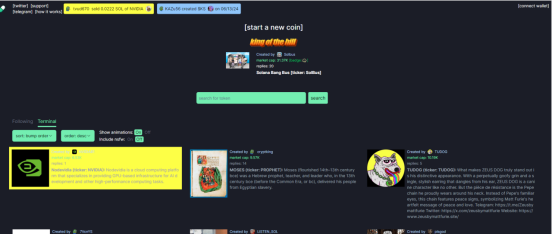
In short, Pump.fun is a meme token issuance platform specifically built for Solana. Users can deploy and issue tokens at a cost as low as $2, freeing them from the liquidity arrangements and high costs associated with traditional token launches. In terms of issuance models, Pump.fun offers two paths: one where issuers relinquish minting rights and establish liquidity on DEXs like Raydium, and another via presale mode.
Overall, Pump.fun is nearly a completely fair launchpad—simple to operate, with no team allocations or insider advantages. Aside from potential sell pressure caused by presales, it remains relatively fair for users. Before Pump.fun, there was no dedicated website for distributing memes; early meme tokens couldn’t even be purchased directly through wallets. As such, the site gained rapid popularity upon launch.
Data shows that according to Dune, as of June 4, Pump.fun has generated nearly 203,000 SOL in total revenue since its February launch—worth approximately $33.47 million at current prices. It has deployed over 832,000 meme tokens, accounting for more than 70% of Solana's historical token issuance (over 1.1 million), launching over 6,300 new tokens per day on average, making it unquestionably the king of meme launches.
Thanks to its inherent virality, Pump.fun has also become wildly popular across overseas social media platforms, making it the go-to choice for many international KOLs and even celebrities entering crypto. From the above description, it's clear that the unregulated nature of Pump.fun naturally fosters an environment conducive to scams. Unsurprisingly, various malpractices have spread rapidly—impersonating celebrities, fraudulent token launches, and countless deceptive projects.
Last month, Tuoluo reported on the Kardashian family member Caitlyn Jenner’s controversial "Jenner" token stunt on Pump.fun. At that time, celebrity impersonation scams were rampant on the platform, so much so that even when someone appeared in person, viewers still claimed it was a "deepfake." Perhaps due to security concerns—or simply to add marketing flair—Pump.fun officially launched its live streaming feature on May 29.
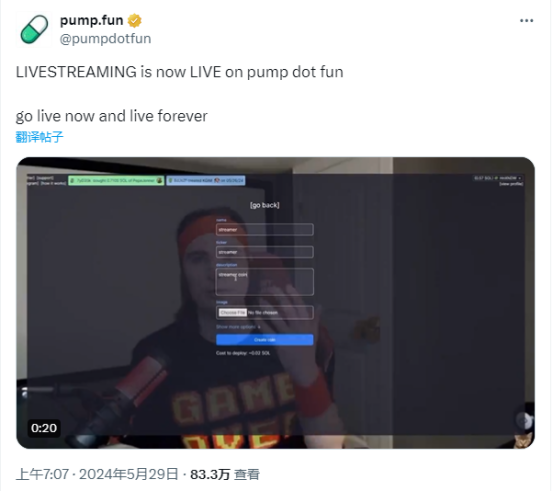
From a user experience perspective, the process is incredibly smooth. Once a token goes live, a “Create Live Stream” button appears in the top right corner, allowing creators to start shouting buy calls instantly. Thus, the winds of Web2 finally blew into Web3. Compared to static page descriptions, live streaming carries far greater persuasive power—it allows people to more vividly feel the trumpet call of sudden wealth: "Spend one more SOL, and you could become the next millionaire."
After launch, meme live streams quickly proliferated. The effects were obvious: although hard to quantify, most tokens experienced higher price volatility during live sessions. Some users noted that Pump.fun streams attract larger crowds and generate more real investment compared to other platforms. But when retail investors jump excitedly, problems inevitably follow.
Behind traditional short-video platforms lie robust moderation and operations teams. Streams violating mainstream values get flagged or taken down. Yet even under such oversight, many streamers still resort to outrageous stunts for attention—sexual innuendo, exaggeration, and misinformation abound.
Now imagine a completely unmoderated, unrestricted live streaming platform located within the already hedonistic crypto world—and layered with the notoriously risk-seeking overseas youth demographic. All of this transforms Pump.fun’s live streams into a playground of pornography and violence.
In fact, before Pump.fun introduced official live streaming, many had already resorted to extreme behaviors to promote their memes. For instance, Mikol, developer of the DARE meme coin, once poured alcohol over his body and set himself on fire with fireworks during a stream, resulting in third-degree burns. Another stream featured a man and woman claiming to be mother and son, with the son hinting that reaching certain funding milestones would unlock views of the mother’s private body parts—an utterly disgraceful spectacle.
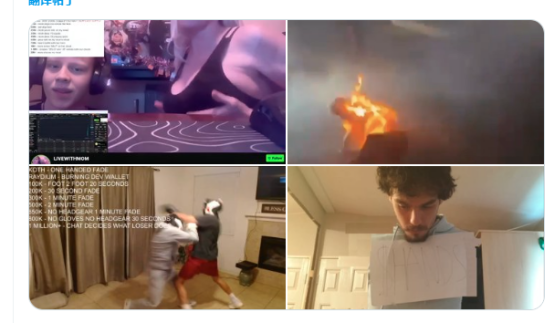
Meme live stream chaos, source: X platform
After Pump.fun opened live streaming, similar issues emerged. Sleeping on camera was just the beginning. On the second day after launch, female streamers appeared fully naked. More shockingly, the token price surged rapidly during full nudity—only to drop again once the stream mysteriously cut off. To this day, entering Pump.fun reveals pornographic images everywhere. One netizen joked: “While others are still analyzing macro fundamentals, Pump.fun has already fast-forwarded to porn live streams.”
Violent content is also widespread. One streamer held a hostage, declaring the person would be released only after the token reached a certain market cap. Teenagers performed live boxing matches, promising increased violence as market value rose. Scammers openly defrauded viewers—one man claimed he had no hands to operate his wallet, then moments later used his hands to withdraw liquidity.
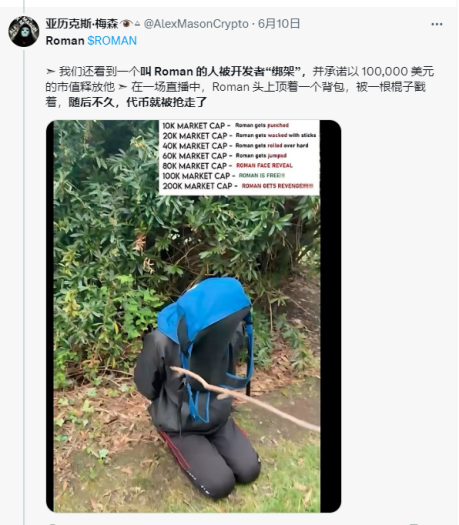
All these antics have drawn criticism from insiders who argue that while MEME culture represents freedom and openness, it should not equate to violence and vulgarity. Many have urged Pump.fun to implement basic content restrictions, but the platform has yet to respond.
As a platform launching thousands of tokens daily, introducing content moderation would be highly complex and costly—clearly contradicting its lightweight, high-freedom positioning. So silence is perhaps expected. Yet in reality, as mentioned earlier, Pump.fun itself is extremely profitable. Its monthly revenue once surpassed that of Uniswap Labs, the largest decentralized exchange, with single-day earnings peaking at $1.48 million.
However, for Pump.fun, the chaos of live streaming clearly hasn't reached top-priority status, as deeper challenges remain. First, the platform imposes no restrictions on token creation, leading to meme token oversaturation, low trading activity, and weak wealth-generation effects. Second, presales enable significant PVP (player-vs-player) dynamics—early buyers dump tokens immediately upon listing, increasing bot frontrunning and eroding ordinary users’ gains, while project teams maintain heavy control. Finally, celebrity “scythe” exploitation thrives: as KOLs flood in, they easily profit from fame without delivering ongoing value, turning celebrity memes into pure retail harvesting schemes. Take Caitlyn Jenner of the Kardashian family, who recently launched 12 different tokens, earning a total of 2,381 SOL—approximately $405,000.
Returning to the live streaming dilemma, freedom versus boundaries remains an inescapable challenge across the internet. On traditional short-video platforms, many complain about excessive censorship and suppression. But can truly boundary-less freedom actually work? Pump.fun may serve as a telling example.
Take social platforms: before Pump.fun, the Web3 world saw several decentralized alternatives—like the once-hyped “Twitter killer” Damus and earlier Mastodon. Yet almost all descended into chaotic content landscapes due to lack of moderation, fading into obscurity shortly after launch. Even on X, blue-check spam and violent messages continue to surge.
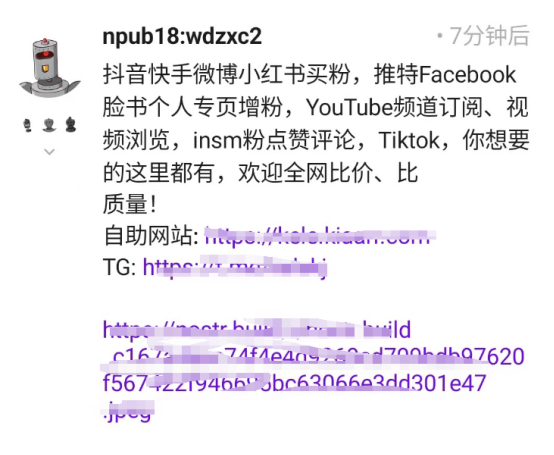
Spam on Damus, source: public network
Unfortunately, the effectiveness of such violent marketing tactics is evident. In the casino of human nature, grabbing attention means traffic, and traffic means profit—the crypto world simply pushes this principle to the extreme. Whether such methods should exist in Web3, however, remains questionable.
In terms of information dissemination patterns, the evolution from text and images to audio and video is inevitable, driven by communication efficiency. Therefore, the arrival of live streaming in Web3 was foreseeable—even though Web3 once proudly wore anonymity as a badge. However, decentralized platforms’ inherent limitations in supporting social interaction and public discourse remain a major obstacle to building large-scale public networks. The core issue lies in human nature: while some use platforms effectively, others misuse them or act maliciously. People become the hardest variable to control. Web2 spent decades researching this problem and arrived only at crude restriction methods. Clearly, Web3 hasn’t found better solutions either.
In discussions around live streaming and celebrity memes, community members widely agree that these trends do not benefit Web3’s mass adoption. Instead, they further tarnish Web3’s reputation, linking it more closely with financial fraud and toxic behavior. Ethereum co-founder Vitalik Buterin expressed dissatisfaction with celebrity memes, stating publicly: “So far, I’m very unsatisfied with this cycle’s celebrity experiments. Financialization is a means to an end—if the goal is worthwhile (healthcare, open-source software, art, etc.), I can respect financialization as a final product.”
Yet for the meme casino, live streaming might still count as an innovative mechanism. Compared to previous faceless, exaggerated promotions, real human presence adds credibility and deepens the surreal euphoria unique to memes. On the flip side, live streaming also makes price manipulation easier—audiences are more directly influenced, and the amplified price swings during streams will inevitably attract more tech-driven and extreme tactics.
Once again: memes are thrilling—but if you dare to gamble, remember to accept your losses too.
Join TechFlow official community to stay tuned
Telegram:https://t.me/TechFlowDaily
X (Twitter):https://x.com/TechFlowPost
X (Twitter) EN:https://x.com/BlockFlow_News











