









A "routine" move to withdraw cryptocurrency liquidity turns out to be a scam
TechFlow Selected TechFlow Selected
A "routine" move to withdraw cryptocurrency liquidity turns out to be a scam
It is a highly controversial practice when cryptocurrency issuers conduct a "liquidity withdrawal," also known as a "rug pull."
 Navigating Web3 tides with focused insights
Authors: Huang Peng, Mao Jiehao, Senior Lawyers at Shanghai Manqin Law Firm
According to The Paper, Yang, a post-00s college student, launched a cryptocurrency abbreviated as BFF on an overseas blockchain and became embroiled in a legal controversy after withdrawing liquidity. Prosecutors accused him of issuing a false cryptocurrency and misleading others into depositing 50,000 USDT, then quickly "withdrawing funds," causing losses. On February 20, 2024, the High-tech Industrial Development Zone People's Court of Nanyang, Henan Province sentenced Yang to four years and six months in prison for fraud, along with a fine of 30,000 RMB. On May 20, 2024, the case was heard in the second instance at the Intermediate People's Court of Nanyang City.
As the first case involving liquidity withdrawal entering judicial proceedings, this incident has drawn significant attention from both the crypto and legal industries. Why does "withdrawing liquidity" constitute "fraud"? First, let’s review the incident with Manqin lawyers.
01 Incident Review
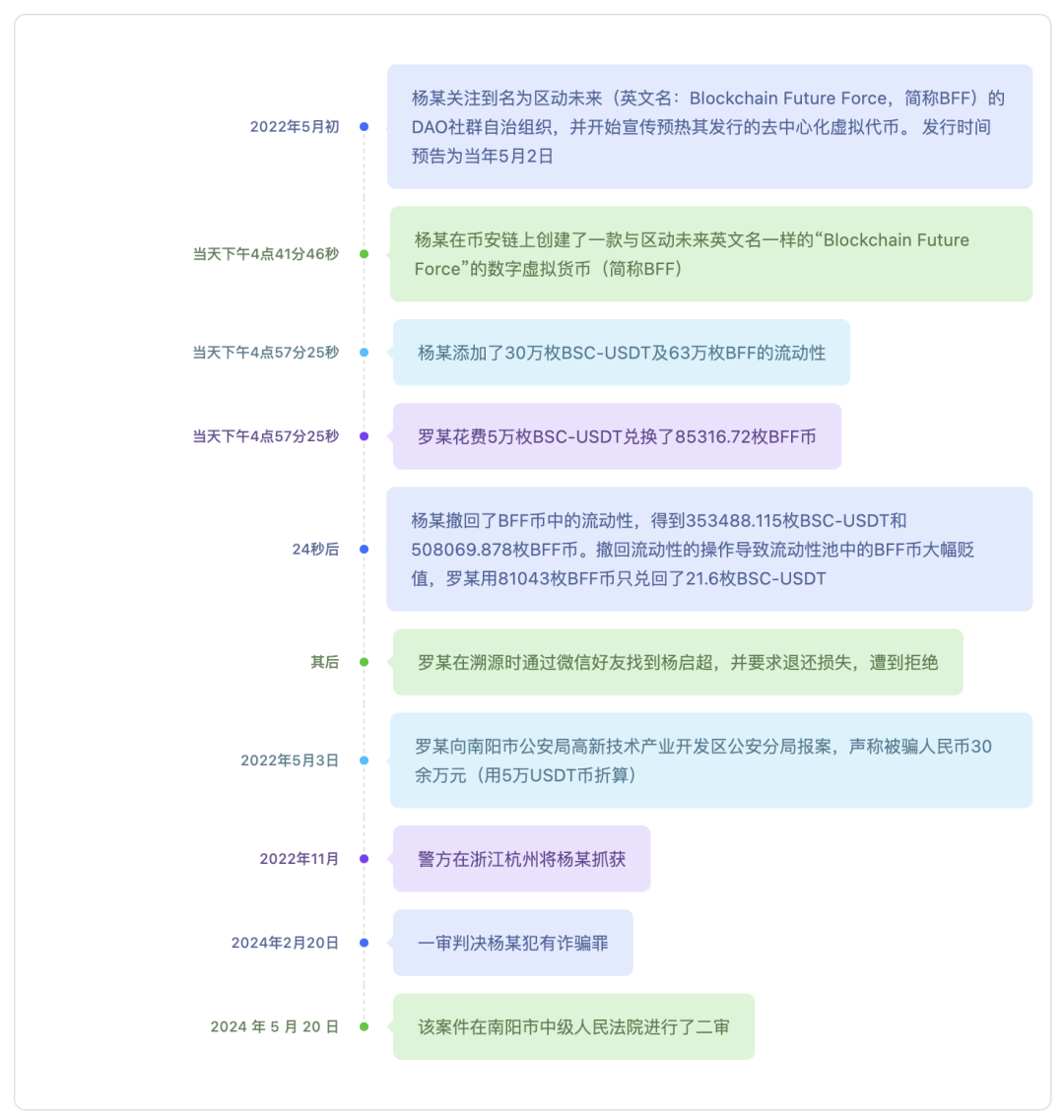
* Chart based on reporting by The Paper
The incident was triggered when Luo deposited liquidity into the pool and exchanged a large amount of BFF tokens, after which Yang withdrew the liquidity, causing the token price to plummet and resulting in losses for Luo. What exactly is "liquidity withdrawal"?
02 Liquidity Withdrawal in Cryptocurrency Trading
Liquidity Pools and Their Operating Principles
Liquidity pools are one of the core mechanisms in decentralized finance (DeFi) platforms. They allow users to provide liquidity by depositing crypto assets into a pool, supporting the smooth operation of decentralized exchanges (DEXs) and other DeFi applications. The foundation of liquidity pools lies in the Automated Market Maker (AMM) model, which uses smart contracts to automatically execute trades. This allows users to trade directly within the pool without relying on traditional order books, ensuring sufficient buyers and sellers and reducing friction inherent in traditional models. Assets in liquidity pools typically exist in pairs; for example, in this case, Yang added both his issued BFF token and BSC-USDT into the pool, forming a trading pair. Since anyone can become a liquidity provider, AMMs have made market making significantly easier.
A liquidity reserve refers to a set of funds deposited by liquidity providers into a smart contract. When investors execute trades on an AMM, they no longer require a counterparty in the traditional sense. Instead, trades are executed based on the available liquidity in the pool. Buyers do not need corresponding sellers as long as sufficient liquidity exists in the reserve.
When trading activity based on a certain liquidity pool becomes active, price fluctuations may be substantial depending on whether the pool is “deep” or “shallow.” In such cases, setting appropriate slippage tolerance can help facilitate better trading execution.
Characteristics of Liquidity Pools
-
Efficient Trading: The AMM model ensures smooth transactions without requiring order book matching.
-
Decentralized Management: All transactions are executed via smart contracts, reducing reliance on centralized institutions.
-
Earning Opportunities: Liquidity providers earn income through transaction fees and liquidity mining.
-
Impermanent Loss Risk: LPs may face impermanent loss during asset price volatility.
-
Widespread Participation: Anyone can become a liquidity provider, lowering entry barriers.
Role of Liquidity Providers
Liquidity providers (LPs) are users who deposit assets into liquidity pools. In return, they receive LP tokens representing their share, which can be used to claim a portion of transaction fees. Whenever someone trades within the pool, the fees paid are distributed proportionally among all LPs. Therefore, healthy liquidity pools usually involve multiple users contributing funds.
In this particular case, however, the entire liquidity for BFF was provided solely by Yang himself. As the issuer, his primary purpose in providing liquidity was to ensure sufficient market depth and tradability for his cryptocurrency, thereby attracting more traders and investors. However, if liquidity is provided exclusively—or predominantly—by the token issuer or a small number of individuals, risks associated with sudden liquidity withdrawal must be carefully considered.
Liquidity Withdrawal
In cryptocurrency trading, "liquidity withdrawal" refers to the process of retrieving your contributed digital assets from a decentralized exchange (DEX) or other liquidity pools. Some projects lock liquidity pools for a fixed period or make them permanently non-withdrawable. However, according to the rules of the platform involved in this case, the relevant liquidity pool allowed liquidity to be removed at any time, enabling scenarios where users inject funds into the pool only for the issuer to immediately withdraw liquidity.
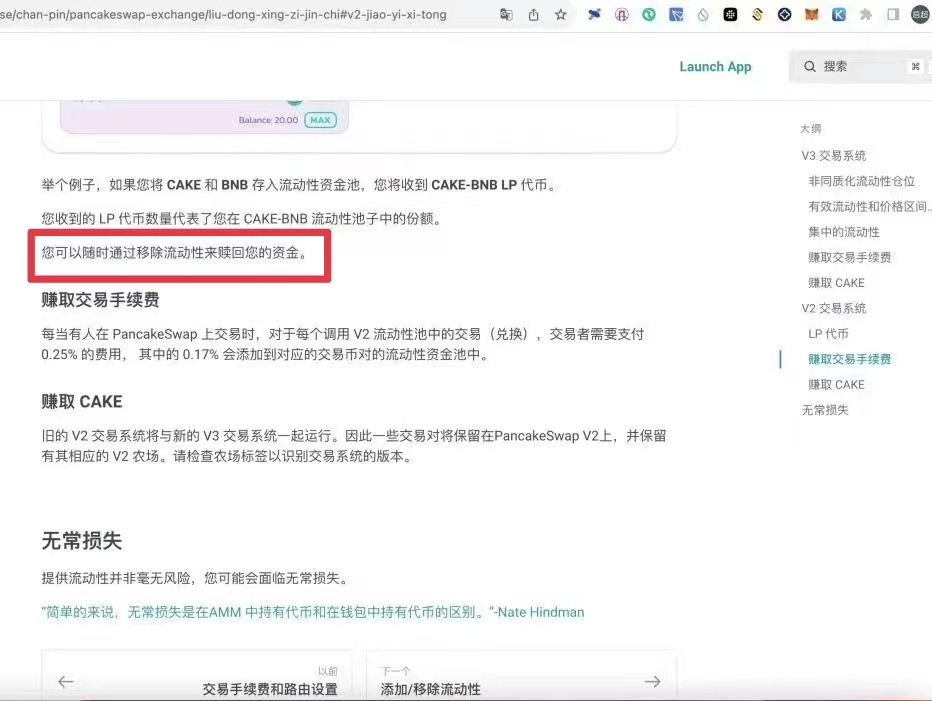
* Image source: The Paper
Notably, when cryptocurrency issuers perform a "liquidity withdrawal"—commonly known as a "Rug Pull"—it is considered highly controversial.

* Image source: TabTrader Team
When an issuer withdraws liquidity, it typically involves the sudden removal of funds from the liquidity pool by the issuer or major liquidity provider, leading to a sharp decline in remaining liquidity, a crash in price, and potentially rendering large trades impossible. This often results in severe financial losses for other LPs and traders. In this case, Yang’s withdrawal caused a dramatic price drop, leaving Luo able to redeem only 21.6 BSC-USDT tokens.
Some jurisdictions may view "Rug Pulls" as market manipulation or fraudulent acts, exposing issuers to litigation and penalties. However, there have been no prior reports of legal action specifically targeting liquidity withdrawals. In China, this is also the first known case where a liquidity withdrawal has led to criminal investigation. Consequently, during the first trial, prosecutors and defense attorneys engaged in intense debate.
03 Controversial Focus: Fraud or “Normal” Operation?
In normal DeFi practices, individual participants withdrawing liquidity can be seen as exiting a position—an ordinary operational move. However, in this case, Yang, as both the token issuer and creator of the liquidity pool—and its main liquidity provider—acted differently from typical participants.
Was his behavior fraudulent? Let’s start by reviewing the definition of fraud: typically refers to acts that deceive victims through fabrication or concealment of facts, inducing them to misunderstand and hand over significant property. Based on this definition, both prosecution and defense vigorously debated whether fraud had occurred during the first trial.
The Nanyang High-tech Industrial Development Zone People's Procuratorate alleged:
-
Defendant Yang created a virtual currency with the same name and promotional materials as one issued by Qudong Future.
-
He deposited 300,000 USDT as bait, luring victim Luo to deposit 50,000 USDT. Afterward, Yang withdrew all funds—including his own 300,000 USDT—for a total withdrawal exceeding 350,000 USDT.
-
Luo’s loss amounted to 50,000 USDT. After multiple conversions between BSC-USD, USDT, USD, and RMB, prosecutors claimed Yang defrauded Luo of 330,000 RMB.
Defense attorneys argued:
-
Although the issued cryptocurrency shared the same English name as Qudong Future’s, this does not prove it was fake, since Yang’s BFF token had a unique, immutable contract address and could be normally exchanged.
-
On cryptocurrency platforms, many tokens share identical names. Prior to Yang issuing his BFF, several entities had already released similarly named BFF tokens.
-
Qudong Future did not issue a BFF coin but rather BFFT and BFFA coins.
-
Luo is an experienced player who should clearly understand the speculative nature and risks of cryptocurrency trading.
-
Cryptocurrency investment activities are not protected by law. Both parties were engaged in illegal financial activities, and even if investors suffer losses, they should not be legally protected. The court’s ruling amounts to “indirectly endorsing redemption transactions between cryptocurrencies and fiat currencies.”
-
Transaction records show that less than seven minutes after redeeming 21.6 BSC-USD tokens, Luo divided his funds into three parts to “buy the dip” on Yang’s BFF token. Yet he later reported being defrauded to police. At the time of trial, due to increased liquidity, the value of Yang’s BFF token had risen sharply. Luo’s wallet ending in 3A22 still held 72,381.7198 BFF tokens, which could be redeemed for 64,065.7134 USDT. “Regardless of whether cryptocurrencies qualify as property, simply in terms of USDT quantity, Luo suffered no loss.”
The first-instance court ruled:
-
“Under current Chinese policy, this virtual currency does not possess monetary attributes. However, in real life, due to its stability, it can be traded on many international platforms and generate economic benefits. Its property characteristics cannot be denied.” Therefore, the court accepted converting the 50,000 USDT involved into RMB value as a sentencing factor.
-
Whether the victim later bought or sold the BFF token, or what current value the token holds under trading platform rules, does not affect the determination that Yang’s fraud was completed.
As an emerging industry, virtual currencies have long sparked debates within judicial and regulatory circles. Due to the inherent lag of laws, clear legal frameworks for the rapidly evolving crypto sector remain lacking. Thus, balancing citizen property rights protection with existing cryptocurrency regulations under the current criminal law system tests the wisdom of judicial authorities.
04 Manqin Lawyers’ Perspective
Despite China banning domestic cryptocurrency trading markets and classifying related financial activities as illegal, a large number of Chinese users continue participating in overseas markets. In such circumstances, when Chinese citizens suffer losses due to improper actions like "liquidity withdrawal," should their interests be protected? If so, would that imply indirect recognition of cryptocurrencies as legitimate property? Would it mean tacitly endorsing cryptocurrency-to-fiat conversion? Could it encourage further crypto trading?
Such dilemmas challenge not only Chinese regulators but also regulatory bodies worldwide. A cryptocurrency market built on the ideal of "decentralization" cannot entirely escape real-world, centralized regulatory systems. Without governance, "decentralization" will only turn the crypto market into a lawless frontier governed by jungle rules.
Join TechFlow official community to stay tuned
Telegram:https://t.me/TechFlowDaily
X (Twitter):https://x.com/TechFlowPost
X (Twitter) EN:https://x.com/BlockFlow_News











