Berachain Proof of Liquidity: A points mechanism encouraging long-term growth
TechFlow Selected TechFlow Selected
Berachain Proof of Liquidity: A points mechanism encouraging long-term growth
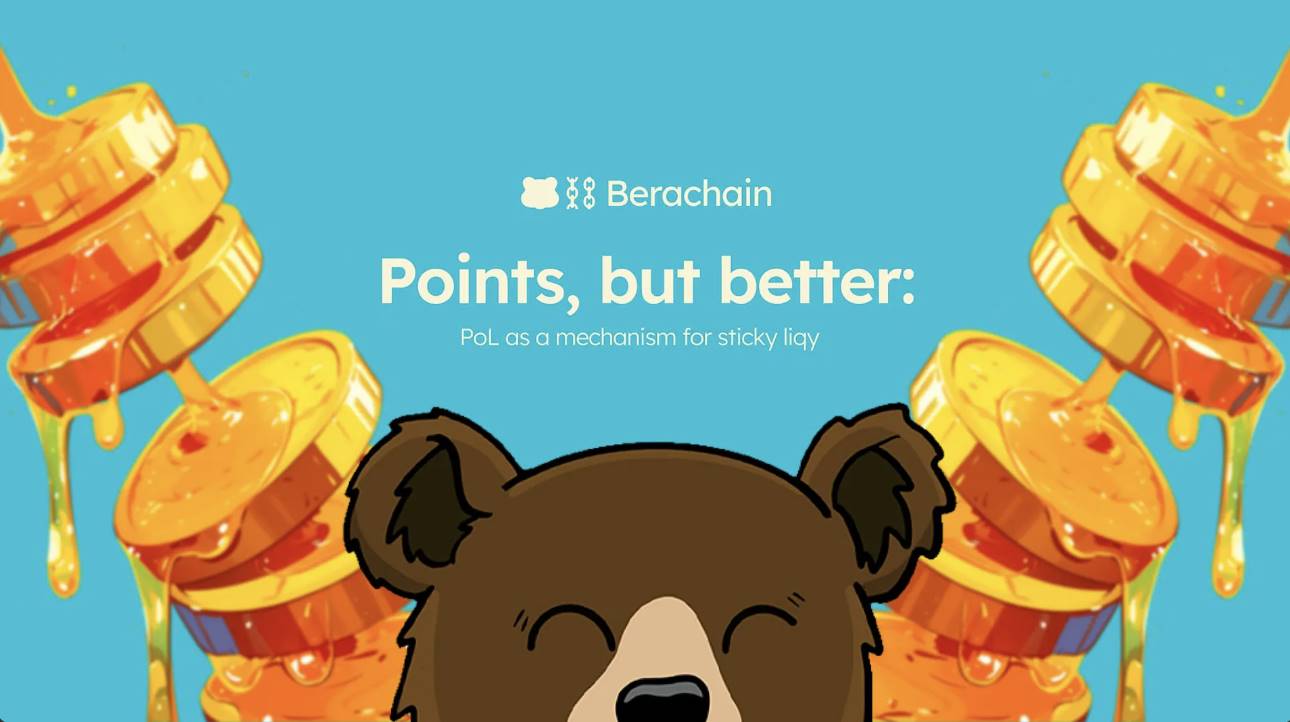
Berachain's Proof-of-Liquidity paradigm incentivizes participants to play the long game by creating an environment that allocates value to contributors.
 Navigating Web3 tides with focused insights
Author: Camila Ramos
Compiled by: TechFlow
The Long Game
Liquidity is the lifeblood of on-chain activity. In past cycles, we've seen numerous short-term approaches to acquiring liquidity, many revolving around points and grants. Sometimes, this liquidity was effectively used within ecosystems, but more often than not, it served merely to meet listing criteria at centralized exchanges (CEX) or spark brief waves of on-chain activity in hopes of influencing token prices. The industry has largely been dominated by mercenary actors and incentive designs that cater to them. Berachain believes that to build an ecosystem that stands the test of time, we must optimize for the long game from day one.
Recent token generation events (TGEs) have highlighted the asymmetric relationship between liquidity providers and the protocols rewarding them—especially evident in recent LRT launches. Protocols lock up liquidity, benefit from it, and unilaterally decide how to reward liquidity providers (LPs). Some teams may dismiss user frustration as mere complaints from entitled airdrop farmers, while others recognize that protocols leverage deposit data to showcase appeal for private fundraising and partnerships, yet fail to truly enable users to capture value in return.
Beyond alienating users and souring public sentiment—which often impacts price movements—one of the biggest issues with the current model is that after launch, mercenary users simply withdraw their capital and move liquidity to the next farm. When a new protocol emerges, liquidity gets siphoned from existing ecosystems as users rush to extract newly available value—a phenomenon sometimes aptly described as “new coin good, old coin bad.” Few protocols manage to retain liquidity and users over the long term, because the opportunity cost of locking mercenary capital without ongoing rewards is too high. Clearly, this is a great strategy for rapid user acquisition, but a terrible one for user retention.
So, how do we finally solve this?
Berachain sees this as a two-part equation. First, give users and liquidity providers as much flexibility and influence as possible to reduce their need to leave the protocol. Second, ensure alignment across the stack—users, applications, and validators—so each party benefits from the effort and/or capital they put into the chain. This is where Proof of Liquidity (PoL) comes in—Berachain’s PoL makes liquidity liquid again, systematically rewarding those who contribute most to the ecosystem and rebalancing the flow of value within the network.
Proof of Liquidity 101
Proof of Liquidity is a mechanism that incentivizes and rewards productive capital via BGT (Berachain’s governance and issuance token). Below is a brief overview of how the three key stakeholder groups participate in PoL:
-
Validators: Earn block rewards based on the amount of BGT delegated to them, and can earn application tokens by directing BGT emissions into application reward treasuries through "incentives."
-
Applications: Can set BGT reward bounties in the validator market to incentivize validators to route BGT emissions into their reward treasuries, typically offering their native protocol tokens in return. Applications and validators work together to bootstrap liquidity for the app or its token.
-
Users: Provide liquidity to eligible venues (pools, vaults, etc.) to accumulate BGT rewards and earn applicable LP fees. Users can also delegate their BGT to validators to earn a share of incentives from apps receiving emissions from those validators.
As a user in Proof of Liquidity, you’re no longer just locking capital for network security—you're providing capital to the ecosystem to earn block rewards (BGT), which can then be further delegated to validators contributing to network security. Validators are incentivized to maximize BGT delegated to them, since their block-building rewards (and commissions) scale with BGT. As such, various strategies will emerge to optimize the attractiveness of delegation—this could be social (delivering value via community and/or incubation) or economic (offering revenue-sharing incentives to delegators).
With greater BGT delegation, validators can also collaborate with more protocols via the bounty market described above. This allows them to access new revenue streams while helping new dApps on the chain bootstrap liquidity and user bases. Users will seek out validators aligned with their own incentives. For instance, if a user is invested in Protocol X, they might prefer to delegate to a validator that routes part of its emissions to that protocol’s treasury or LP pool.
Stakeholder Game Theory
-
Validators: Win by maximizing BGT delegation and participating in protocol liquidity bounties, creating profitability through efficient collaboration with applications.
-
Applications: Win by partnering with validators to direct liquidity and directly incentivizing users with BGT emissions, achieving higher capital efficiency compared to standard liquidity mining programs.
-
Users: Win by providing liquidity to the applications they use and delegating BGT emissions to aligned validators, earning incentives and maximizing their returns.
Berachain has been described as a “playground for infinite economic games.” The alignment described above aims to make Berachain exactly that—an infinite economic game—same but different.
PoL Is a Better Points Mechanism
Viktor Bunin said on May 20, 2024: “The fee cash flows earned by tokens through their respective protocols will be one of the biggest unlocks in the crypto ecosystem. The only reason most tokens don’t do this is fear of being mislabeled as securities.”
Why do points work in the short term?
-
They offer an additional speculative layer before the actual token (the primary asset) exists.
-
They are typically non-transferable and illiquid, making them hard to price correctly.
-
Protocols retroactively determine the “cost” of these points—in the form of token allocations—after value has already been extracted through boosted metrics and point farming.
On the other hand,
-
Users have no control over how points are allocated.
-
Points lack any intrinsic underlying value or ability to proxy the potential value of their corresponding token.
-
The allocation schedule for points is often unknown or highly variable, making it impossible to effectively track ownership of the “cake” at any given time.
What if there were a way to systematically reward those who contribute most to a protocol? Instead of playing a lopsided game where the protocol holds all the cards, users engage in a transparent system where they can weigh the true opportunity cost of their capital. Berachain’s Proof of Liquidity is a better points mechanism.
Proof of Liquidity is a mechanism that incentivizes sticky liquidity by systematically rewarding users who provide productive capital to the ecosystem. No party can extract value for free. Any capital provided to the ecosystem is put to work, creating deeper liquidity and thus better execution prices and outcomes for both users and dApps. Proof of Liquidity is a dance—validators, applications, and users interact through BGT (the governance token issuance of the Berachain network) to align financial and social incentives. To earn BGT, users provide liquidity to ecosystem applications. As a user, BGT grants holders rights to a portion of fees generated from native dApp usage, influence over which reward treasuries are incentivized through governance, and the ability to delegate to validators to earn a share of their incentives. BGT enables users who contribute value to the system to decide who should receive the most rewards.
PoL is a more efficient method of distributing issuance/liquidity because it is a recursive outcome of on-chain activity driven by real users and product growth—not the result of Sybil attacks. BGT is also dynamically adjustable in real-time, governed by users, dApps, and validators—all seeking optimal game-theoretic alignment. New projects can be added via governance as eligible recipients of BGT issuance, creating a perpetually cycling wave of volatile incentives.
Berachain: Incentive Alignment at the Protocol Level
At its core, crypto is a game of aligning incentives and finding ways to maximize capital. In other ecosystems, the relationships among users, validators, and applications are fragmented at best. At the heart of Proof of Liquidity is making it easier for applications to access users and liquidity, while giving validators differentiated revenue streams through collaboration with these protocols.
Points are the most popular method for bootstrapping on-chain activity and growth, designed to assign value to a potentially future token in exchange for certain behaviors or liquidity provided to the network. However, point distribution and value are entirely determined by a single centralized entity and are inherently short-term, leading to sudden liquidity vacuums and imbalances between protocol security and economic activity. This can trigger a snowball effect—eventually resulting in no new users, no new applications, and declining validator participation. Ultimately, Berachain’s Proof of Liquidity paradigm shifts the focus from short-term gains to sustainable, long-term growth. By creating an environment that distributes value to contributors, it incentivizes participants to play the long game.
Join TechFlow official community to stay tuned
Telegram:https://t.me/TechFlowDaily
X (Twitter):https://x.com/TechFlowPost
X (Twitter) EN:https://x.com/BlockFlow_News
 @berachain