








A Deep Dive into the TabiChain Ecosystem: The Ultimate Answer for the Next-Generation Gaming Chain
TechFlow Selected TechFlow Selected
A Deep Dive into the TabiChain Ecosystem: The Ultimate Answer for the Next-Generation Gaming Chain
TabiChain leverages its deep understanding of Asian-Pacific gaming culture to reshape the relationship between players, the gaming chain, and the on-chain gaming ecosystem.
 Navigating Web3 tides with focused insights
Introduction
With Binance launching a growing number of GameFi-related projects during this bull market, the market's preference for GameFi products has become increasingly evident. Blockchain gaming has emerged as one of the most promising sectors expected to unlock mass adoption in this cycle.
New-generation blockchain games such as Bigtime, Matr1x Fire, and Space Notion have demonstrated significantly improved gameplay in this cycle. After FOCG (Fully On-Chain Games) gained attention, their reliance on high-performance infrastructure has also become apparent. The market is gradually recognizing the importance of GameChains within the GameFi ecosystem, making GamingChain a key driver shaping the future of the GameFi sector.
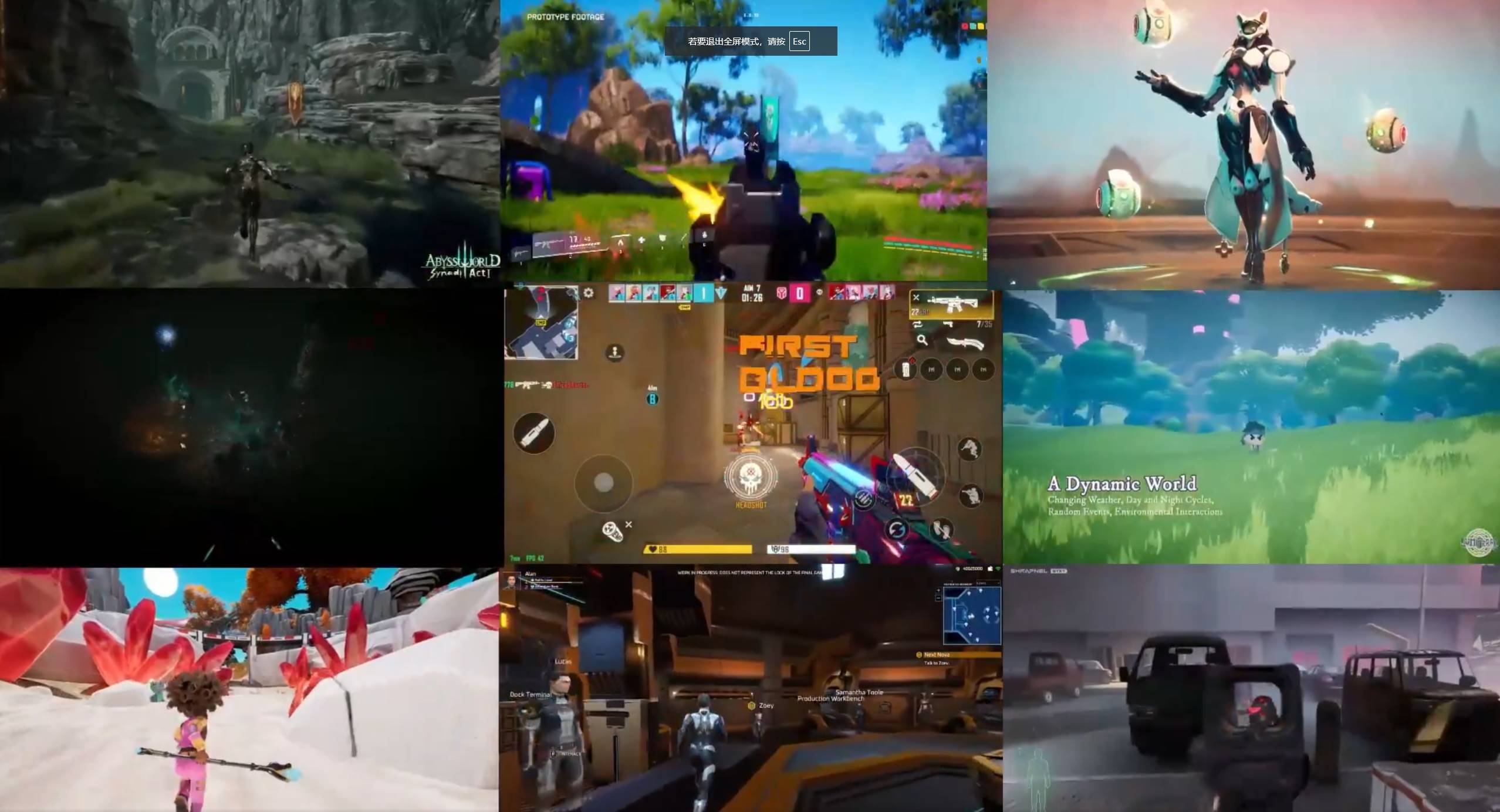
Although some gaming chain solutions like Ronin (a game sidechain) and Immutable X (an Ethereum Layer2) already exist in the market with multi-billion dollar FDVs, they have yet to overcome prior perception challenges. They haven't achieved breakout success or driven a bull market across the broader GameFi sector, and many games built on these chains remain isolated within the blockchain ecosystem, struggling to gain traction. TabiChain, a high-performance EVM-compatible GamingChain built on Cosmos SDK, was designed from the ground up to address these existing pain points in the GameFi space and establish a new paradigm for GamingChains.
About TabiChain
Tabi (formerly Treasureland) is an NFT marketplace based on BNB Chain that previously received support from prominent investors including Binance Labs, Animoca Brands, IVC, Feng Bo (Dragonfly), and others. In January 2024, Tabi officially announced the launch of TabiChain, aiming to set new standards for mass adoption in blockchain gaming. TabiChain’s design focuses on the relationship between gaming chains, players, and blockchain games, addressing current challenges faced by gaming chains through carefully crafted ecological models and technical implementations.
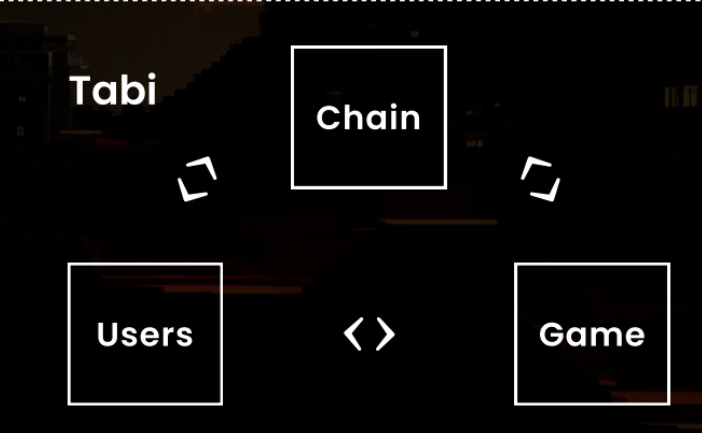
Tabi Technical Architecture
As a Gaming Chain面向 all game developers, TabiChain prioritizes developer ecosystems and has introduced OmniComputing, a core Web3 gaming architecture stack.
Omni Execution Layer
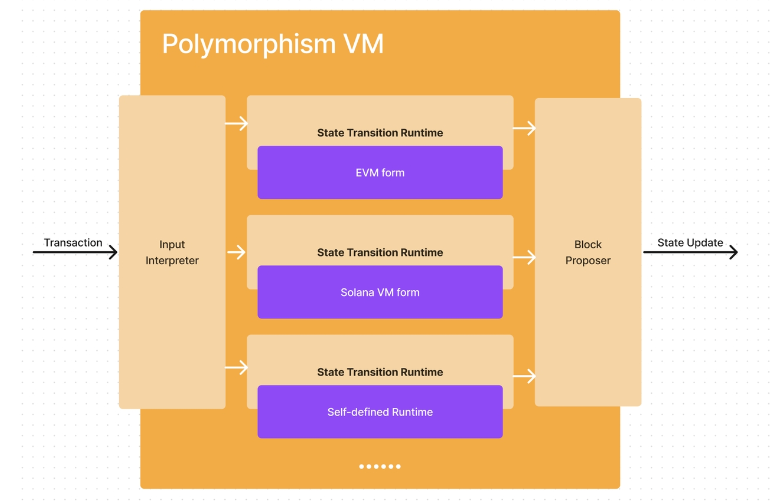
At the design level, the execution layer maximizes compatibility with developers' runtime environments (supporting multiple VMs). This polymorphic-capable VM is named Polymorphism VM. With high customizability, Polymorphism VM supports any framework and programming language used by Web2 game developers, enabling seamless porting and integration while offering game developers a freestyle development and deployment experience.
In collaboration with DeFi public chain BeraChain, TabiChain further strengthens the OmniComputing architecture using the Polaris EVM module. Trusted and multi-Gas designs deliver lossless user experiences, allowing users to enjoy immersive gameplay without complex interaction processes.
Consensus Design
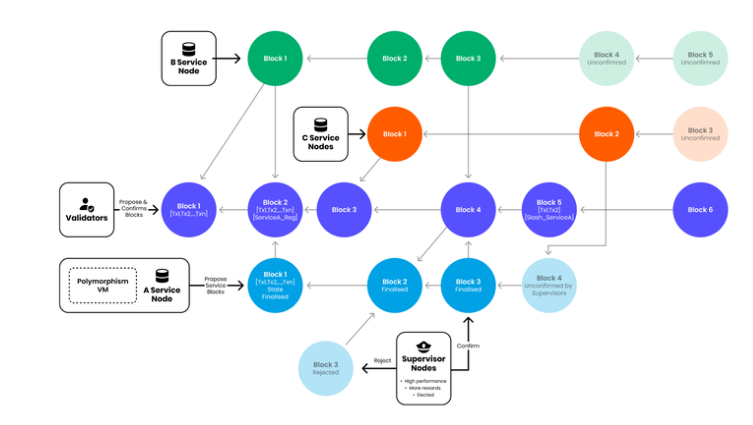
TabiChain introduces the ParallelBFT consensus mechanism, where blocks from different service processes do not interfere with each other. Block submissions within each service can be processed in parallel according to resource partitioning. By default, services use the Parallel HotStuff consensus scheme, increasing block production efficiency fourfold.
Modular Security
TabiChain’s modular design enables leveraging shared security from Ethereum or Bitcoin via EigenLayer or Babylon.
TabiChain Governance Model
Captain Node Design
TabiChain introduces the Tabi Captain node into its ecosystem, allocating 40% of token emissions to mining via Tabi nodes. If the entire TabiChain were a large ship sailing toward GameFi's One Piece, the Tabi nodes would be its captains.
Captain Node Functions
1. Mining $veTABI:
Node computing power dynamically mines convertible $veTABI based on global node uptime / $veTABI staking rate / halving cycles / base computing power, executed on cloud servers or PCs.
2. Governance Rights:
As the most important role in the ecosystem, the CaptainNode group will decide on various governance matters:
a) Electing validators and supervisors
b) Governance decisions regarding games on TabiChain (incentives / launches)
c) Voting on various community resolutions for TabiChain's future
This gives rise to additional Captain Node benefits: game developers on TabiChain may compete by bribing nodes or increasing airdrop allocations, while nodes can vote for games that offer them greater value.
3. Electing validators and supervisors
4. Enabling modular security on EigenLayer and Babylon
5. Deep participation of Node operators in TabiChain’s gaming ecosystem allows gradual accumulation of Node-EXP for upgrades. The large user base of Node operators will attract numerous game developers seeking to capture this high-quality, targeted audience.
Captain Node Sales Mechanism
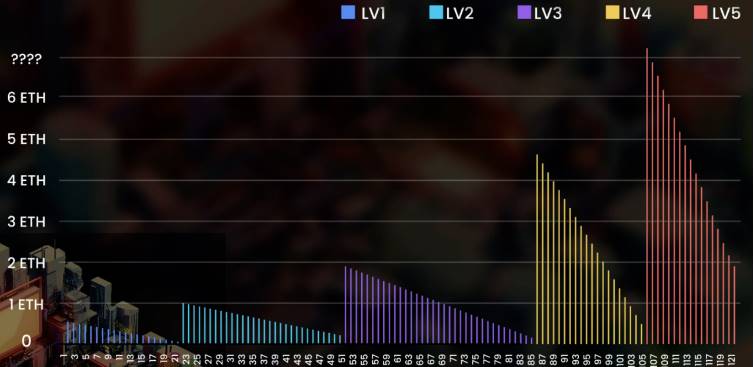
To balance value distribution and meet diverse investor needs, Tabi has designed an intricate node sales structure.
-
Multi-tiered Design: Five levels of Captain Nodes are offered, with significant price differences between tiers, ensuring fairness and accessibility for investors of all capital sizes who wish to join the Tabi ecosystem.
-
Purchase Limitation: To prevent early computational power inflation and avoid over-concentration of initial allocations, Tabi limits the number of nodes activated per day and controls delivery speed, ensuring steady expansion of TabiChain.
-
Time-weighted Pricing: For nodes at the same level, earlier activation comes at a higher price. To balance long-term rewards for node holders, those enjoying early mining benefits pay a premium.
Through these three multidimensional constraints, TabiChain demonstrates its emphasis on the critical role of Captain Nodes within the ecosystem. Compared to other node sale models in the crypto industry, Tabi places greater importance on long-term sustainability, healthy ecosystem development, and a fair launch commitment to participants—rather than staging a centralized fundraising spectacle that quickly rises and collapses.
$TABI’s Three-State Model
$TABI serves as TabiChain’s governance token. Through its circulation across the ecosystem, $TABI completes the final piece of TabiChain’s vision as an ideal GamingChain. TabiChain has designed three distinct states for $TABI, each providing crucial roles for different ecosystem participants based on unique token characteristics.
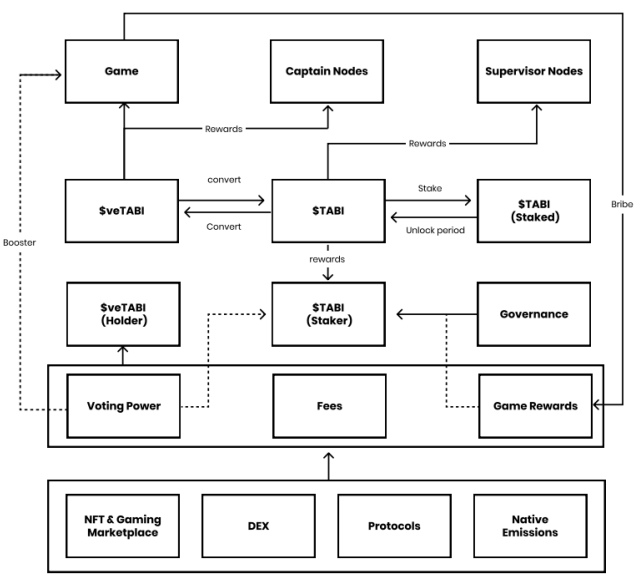
$TABI
$TABI is the foundational token and base form within the TabiChain ecosystem, operating across three primary markets:
-
Game Projects: Serves as the standard transaction and interaction currency across all games on TabiChain
-
NFT Marketplace: Acts as the primary purchase token on Tabi’s NFT marketplace
-
Ecosystem DEX: Used as the gas payment token within TabiChain’s native decentralized exchange
TabiChain captures protocol revenue through the circulation of $TABI within these ecosystem markets.
$TABI (Staked)
Users can stake $TABI to obtain $TABI (Staked):
-
Stakers receive rewards distributed from the protocol revenue captured by TabiChain
-
Stakers can participate in network governance and resource allocation decisions on TabiChain
$veTABI
-
$veTABI is obtained by further converting $TABI (Staked)
-
$veTABI retains the governance voting rights and eligibility for protocol revenue distributions enjoyed by $TABI (Staked)
-
$veTABI holds stronger voting power and gains access to enhanced reward opportunities such as game airdrops and exclusive in-game privileges
-
The design of $veTABI draws inspiration from the "Curve War" bribery mechanism in DeFi. As the saying goes: with great power comes great responsibility. $veTABI profoundly influences collective interests—voters must responsibly select high-quality games to onboard to maximize TabiChain’s value, while also considering bribe incentives offered by games seeking community support. This deeply integrates accountability with voting rights, driving the healthy evolution of TabiChain.
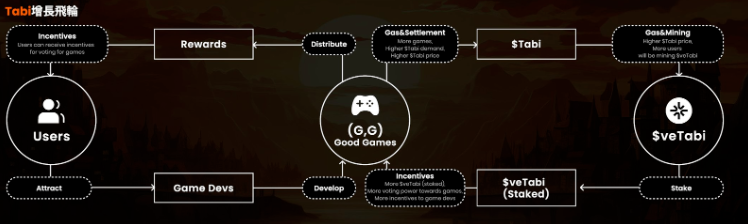
Token Conversion Mechanism:
$TABI → $TABI (Staked): Upon staking $TABI, users receive $TABI (Staked) at a 1:1 ratio
$TABI → $veTABI: Users can directly convert $TABI to $veTABI at a 1:1 ratio
$TABI (Staked) → $TABI: After unlocking $TABI (Staked), users reclaim their original $TABI 1:1 following the lock-up period
Outlook: TabiChain’s New GameFi Paradigm
Asian gaming culture is increasingly taking center stage in the global gaming landscape. GameFi, too, has undergone comprehensive sector upgrades during this bull market. Leveraging its deep understanding of Asia-Pacific gaming culture, TabiChain is reshaping the relationships among players, gaming chains, and blockchain games, focusing on building next-generation GamingChains as crypto-native gaming infrastructure. We look forward to TabiChain establishing a new GamingChain paradigm in this cycle, creating the ideal foundation for GameFi’s full-scale expansion.
Join TechFlow official community to stay tuned
Telegram:https://t.me/TechFlowDaily
X (Twitter):https://x.com/TechFlowPost
X (Twitter) EN:https://x.com/BlockFlow_News
 @BlockFocus11







