Babylon: How to Unlock the Security Value of Bitcoin?
TechFlow Selected TechFlow Selected
Babylon: How to Unlock the Security Value of Bitcoin?
Eigenlayer and Babylon are gaining momentum, and based on current trends, both are poised to secure massive blockchain core assets in the future.
 Navigating Web3 tides with focused insights
Author: YBB Capital Researcher Zeke
Preface
In the modular era led by Ethereum, leveraging a Data Availability (DA) layer to provide security services is nothing new. However, the current concept of Staking—bringing shared security—is introducing a new dimension to the modular landscape: harnessing the potential of "digital gold and silver" to deliver Bitcoin- or Ethereum-backed security to numerous blockchain protocols and public chains. Narratively, this vision is grand. It unlocks trillions of dollars in market value liquidity and stands at the core of future scalability. Take recent examples such as the Bitcoin staking protocol Babylon and Ethereum’s re-staking protocol EigenLayer, which raised $70 million and $100 million respectively—clear evidence that top-tier VCs strongly endorse this track.
Yet skepticism remains widespread. If modularity represents the endgame of scaling, then these protocols, as key players, will inevitably lock up massive amounts of BTC and ETH. Can their own security truly be trusted? And will the resulting complex nesting with various LSD and LRT protocols become the biggest black swan event in blockchain’s future? Is their business logic sound? Since we’ve already analyzed EigenLayer in previous articles, this piece will focus on Babylon to explore these questions.
Extending Security Consensus
To date, the most valuable public chains in the blockchain world are undoubtedly Bitcoin and Ethereum. Their long-standing security, decentralization, and value consensus form the essential core enabling them to remain atop the public chain hierarchy. These are also the rarest traits that heterogeneous chains struggle to replicate. The essence of modularity lies in "renting" these attributes to those in need. Current modular approaches mainly fall into two camps:
● First, using a sufficiently secure Layer 1 (typically Ethereum) as the lower three layers or partial functional layer for Rollups. This approach offers maximum security and legitimacy while tapping into the mainnet ecosystem's resources. However, for specific Rollups (app-chains, long-tail chains, etc.), throughput and cost-efficiency may not be ideal;
● Second, creating a new alternative comparable in security to Bitcoin or Ethereum but with better performance and lower costs. For example, Celestia achieves this through a pure DA architecture, minimal node hardware requirements, and low gas fees—stripping down complexity to rapidly build a DA layer competitive with Ethereum in both security and decentralization. The downside? It still needs time to mature in terms of security and decentralization, lacks legitimacy, competes directly with Ethereum, and faces resistance from the Ethereum community.
Another category within this space includes Babylon and EigenLayer, which apply the core idea of PoS (Proof-of-Stake) to create shared security services using the asset value of Bitcoin or Ethereum. Compared to the above models, they occupy a more neutral position. Their advantage lies in inheriting legitimacy and security while unlocking greater utility for native assets, offering increased flexibility.
The Potential of Digital Gold
Regardless of the underlying consensus mechanism, blockchain security largely depends on the amount of resources supporting it. PoW chains require vast amounts of hardware and electricity; PoS relies on the value of staked assets. Bitcoin itself is secured by an enormous PoW hashrate network, making it arguably the most secure entity in the entire blockchain ecosystem. Yet despite having a circulating market cap of $1.39 trillion—accounting for half the blockchain industry—its primary use cases remain limited to transfers and gas payments.
On the other hand, especially since Ethereum’s Shanghai upgrade transitioned it to PoS, most public chains now default to some variant of PoS for consensus. However, newer heterogeneous chains often fail to attract significant capital for staking, raising serious concerns about their security. In today’s modular era, Cosmos zones and various Layer 2s can mitigate this via DA layers, but at the expense of autonomy. Most established PoS chains or consortium chains cannot practically adopt Ethereum or Celestia as DA solutions. This is where Babylon steps in—filling the gap by allowing BTC staking to secure PoS chains. Just as humanity once used gold to back fiat currency, BTC is indeed well-suited to play this role in the blockchain world.
From Zero to One
Unlocking "digital gold" has always been one of the grandest—and most difficult—to achieve narratives in blockchain. From early sidechains, Lightning Network, bridged wrapped tokens, to today’s Runes and BTC Layer 2s, every solution so far comes with inherent flaws. To uphold Bitcoin’s security, Babylon must first rule out any centralized third-party trust assumptions. Among remaining options, Runes and Lightning Network (limited by slow development progress) currently only enable asset issuance. Thus, Babylon must design its own “scaling solution” to bootstrap native Bitcoin staking from zero to one.
Breaking down Bitcoin’s available building blocks reveals just a few basic elements: 1. UTXO model, 2. Timestamps, 3. Multiple signature schemes, 4. Basic opcodes. Babylon’s solution, considering Bitcoin’s weak programmability and data capacity, adheres to the principle of minimality—implementing only essential functions for staking contracts directly on Bitcoin. That means BTC staking, slashing, rewards, and withdrawals all occur on the mainchain. Once this foundational layer is built, complex operations are offloaded to Cosmos zones. But a critical challenge remains: how to record PoS chain data onto the Bitcoin mainchain?
Remote Staking
UTXO (Unspent Transaction Output), designed by Satoshi Nakamoto for Bitcoin, follows a remarkably simple logic: transactions are merely inflows and outflows of funds, requiring only Inputs and Outputs to represent the entire system. A UTXO refers to leftover funds after spending less than the input amount—the unspent portion of a transaction (i.e., unspent bitcoins). Bitcoin’s ledger is essentially a collection of UTXOs, tracking ownership and circulation by recording each UTXO state. Every transaction consumes old UTXOs and creates new ones. Due to certain extensibility potentials, UTXO naturally becomes the starting point for many native scaling proposals. Examples include Lightning Network’s penalty mechanisms and state channels using UTXO and multisig, or inscriptions and Runes binding UTXOs to implement SFTs (semi-fungible tokens).
Babylon similarly leverages UTXO to implement staking contracts (which Babylon calls remote staking—BTC security transmitted remotely via an intermediate layer to PoS chains), cleverly combining existing opcodes. The implementation can be broken down into four steps:
● Fund Locking
Users send funds to a multi-signature-controlled address. Using OP_CTV (OP_CHECKTEMPLATEVERIFY), which allows predefined transaction templates ensuring execution only under specified conditions, the contract ensures these funds can only be spent when certain criteria are met. Once locked, a new UTXO is generated, indicating the funds have been staked;
● Condition Verification
OP_CSV (OP_CHECKSEQUENCEVERIFY) enables relative timelocks based on transaction sequence numbers, preventing UTXO spending until a certain time or block height. Combined with OP_CTV, this enables staking, unstaking (allowing spend of locked UTXOs after minimum staking duration), and slashing (if validators act maliciously, the UTXO is forcibly sent to a locked address, rendered unspendable—akin to a black hole address);
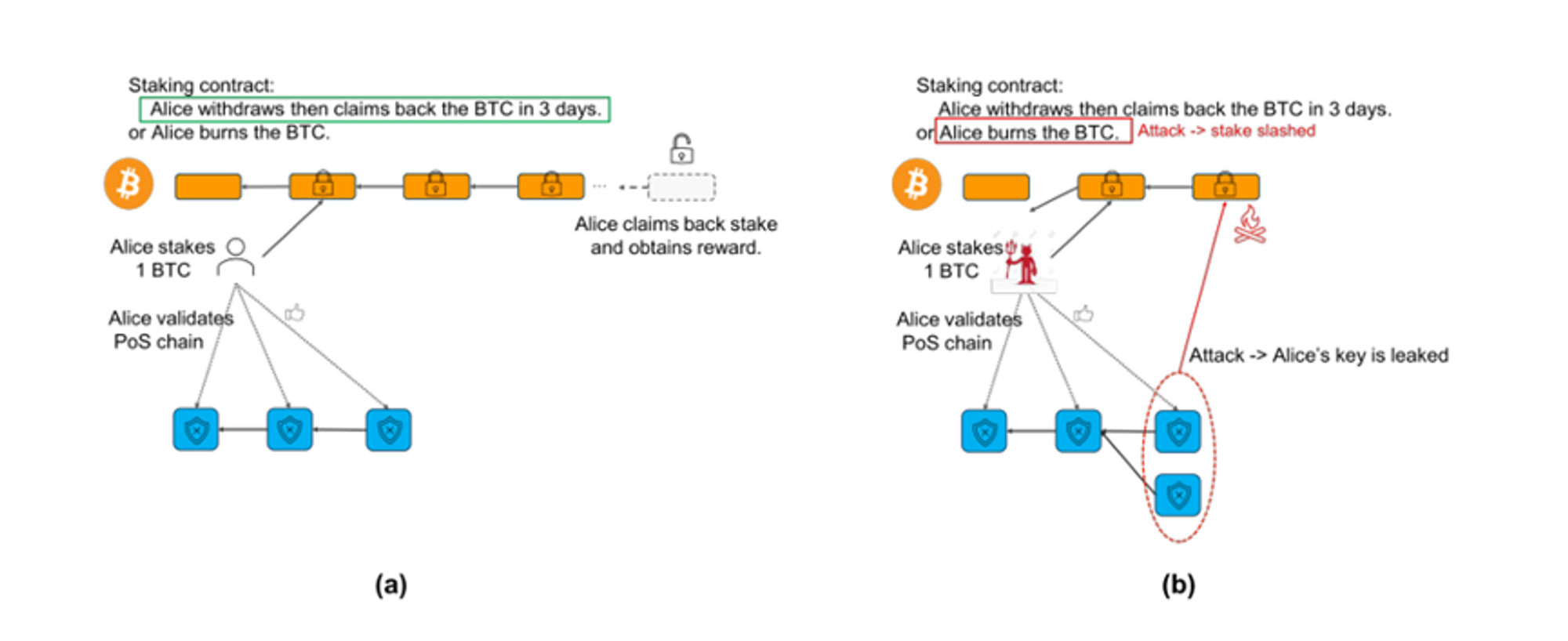
● State Updates
Each staking or unstaking action involves creating and consuming UTXOs. New transaction outputs generate new UTXOs, while old ones are marked as spent. This accurately records every transaction and fund flow on-chain, ensuring transparency and security;
● Reward Distribution
Rewards are calculated based on staked amount and duration, then distributed via new UTXOs. These rewards can later be unlocked and spent once script-defined conditions are satisfied.
Timestamps
With native staking contracts in place, the next step is addressing external chain historical event recording. In Satoshi’s whitepaper, Bitcoin introduced a PoW-backed timestamp mechanism providing irreversible chronological ordering. In Bitcoin’s native context, these events refer to various ledger transactions. Now, to enhance security for other PoS chains, Bitcoin can also timestamp events occurring on external blockchains. Each such event triggers a miner-directed transaction, which miners then insert into the Bitcoin ledger, effectively timestamping the event. These timestamps help resolve various blockchain security issues. The general concept of timestamping sub-chain events on a parent chain is known as “checkpointing,” and the corresponding transactions are called checkpoint transactions. Specifically, Bitcoin’s timestamps exhibit several important characteristics:
1. Time Format: Timestamps record seconds since January 1, 1970, 00:00:00 UTC—commonly known as Unix or POSIX time;
2. Purpose: Primarily identifies block creation time, helps nodes determine block order, and supports network difficulty adjustment;
3. Timestamp and Difficulty Adjustment: Every 2016 blocks (~two weeks), Bitcoin adjusts mining difficulty. Timestamps are crucial here—the network uses total generation time of the last 2016 blocks to adjust difficulty, maintaining an average block time of ~10 minutes;
4. Validity Check: Upon receiving a new block, nodes validate its timestamp. A valid timestamp must exceed the median time of prior blocks and must not be more than 120 minutes ahead of network time (i.e., no more than two hours into the future).
The timestamp server is a new primitive defined by Babylon. It assigns Bitcoin timestamps to PoS blocks via Babylon checkpoints, ensuring temporal accuracy and tamper resistance. Positioned at the top of Babylon’s architecture, it serves as the core source of trust.
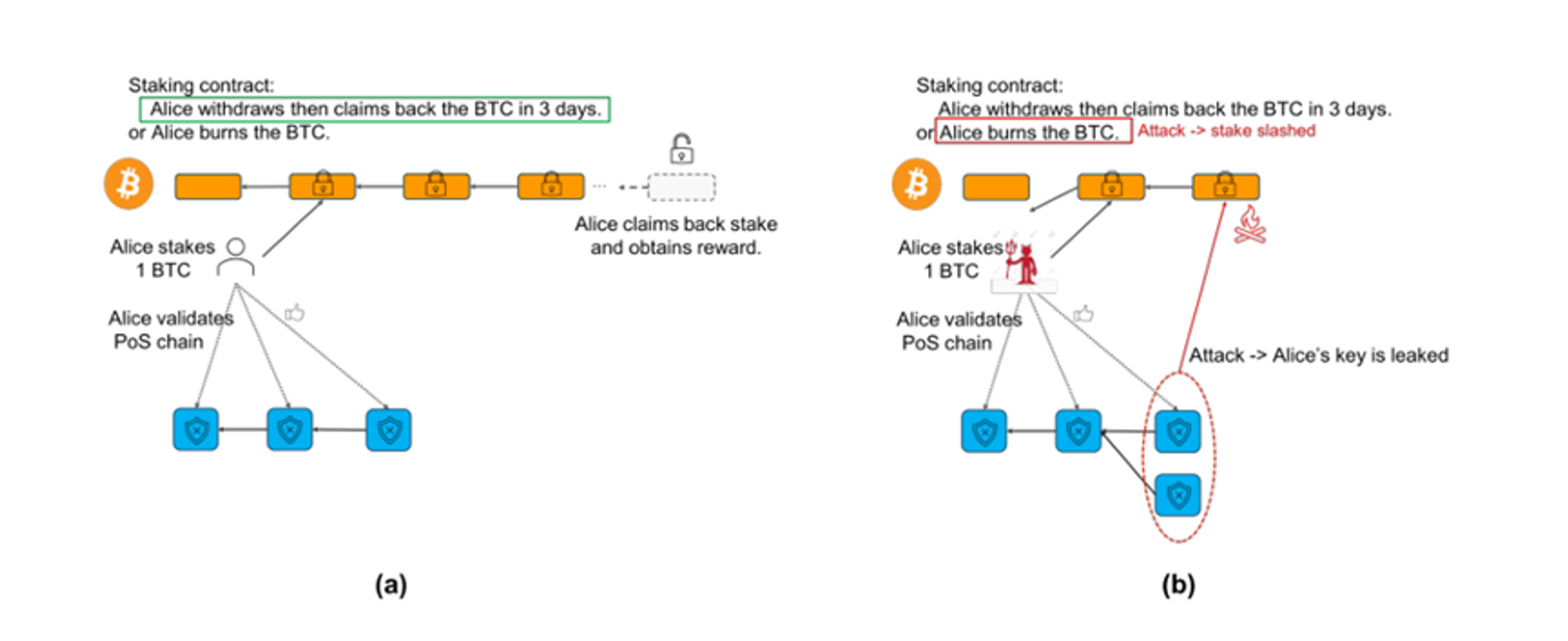
Babylon’s Three-Layer Architecture
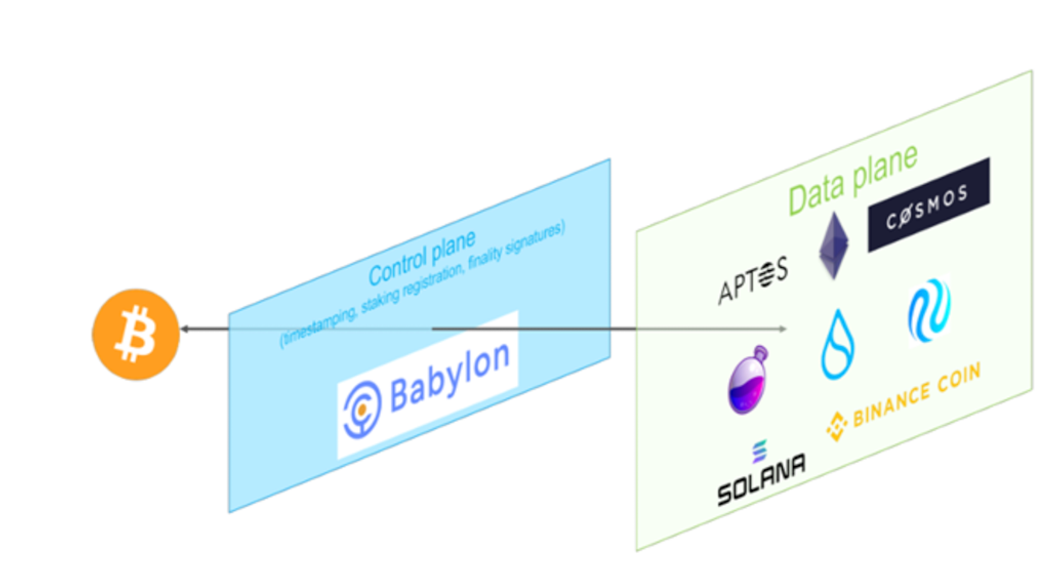
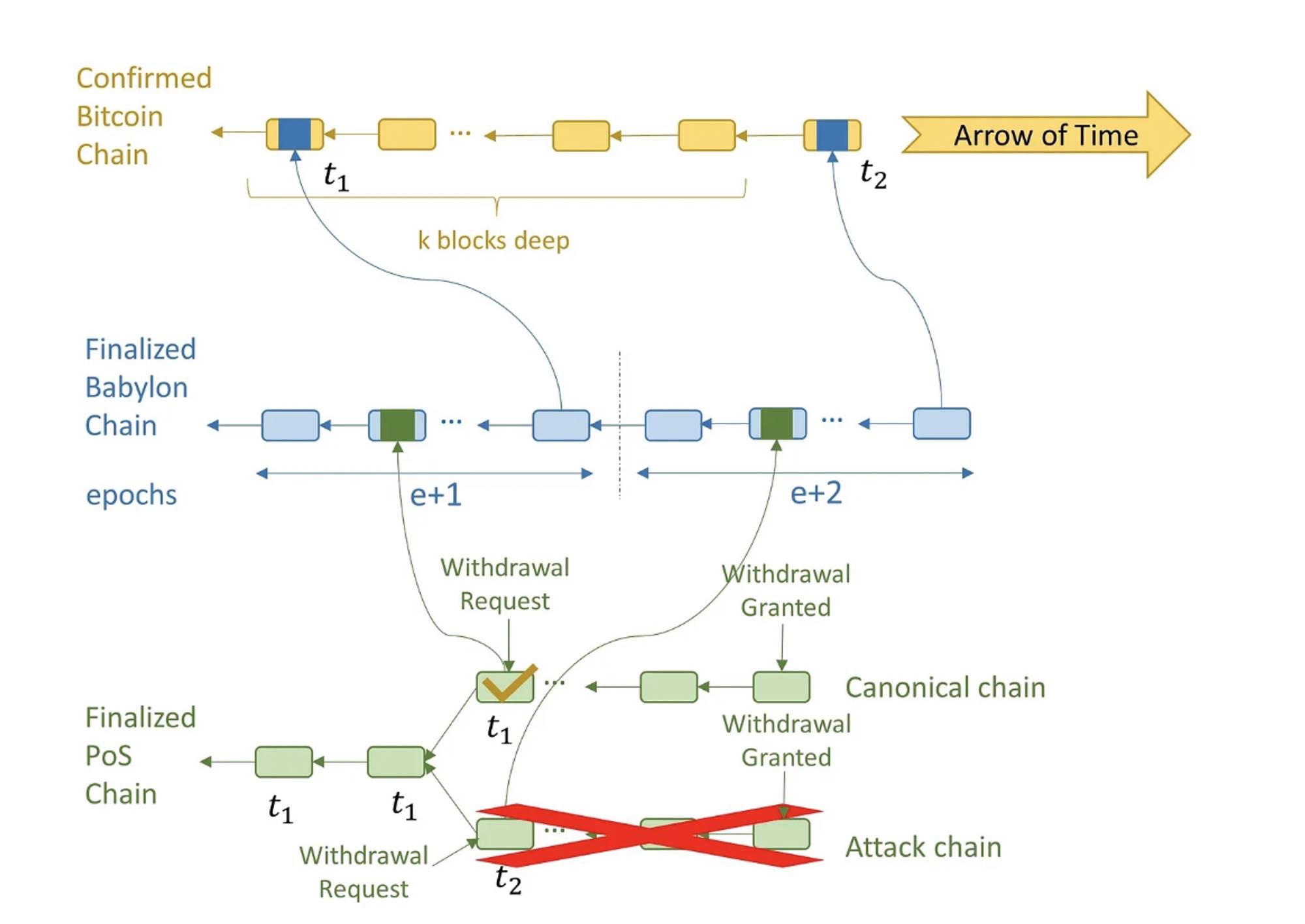
As shown in the diagram above, Babylon’s overall architecture consists of three layers: Bitcoin (acting as timestamp server), Babylon (a Cosmos Zone serving as middleware), and the PoS demand layer. Babylon refers to the latter two as Control Plane (the Babylon chain itself) and Data Plane (various PoS consumer chains).
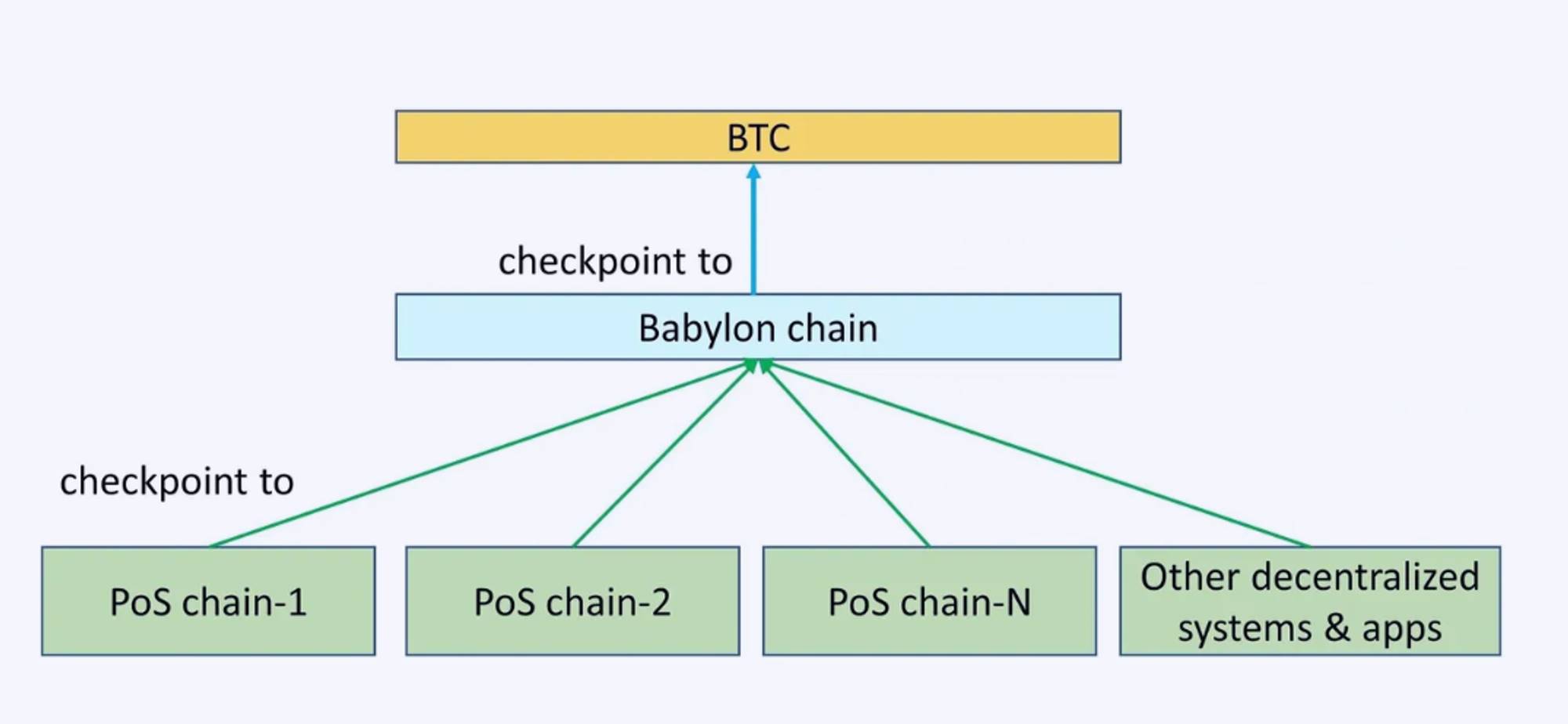
After understanding the trustless fundamentals, let’s examine how Babylon uses the Cosmos zone to bridge both ends. According to Stanford Tse Lab’s detailed explanation of Babylon1, Babylon receives checkpoint streams from multiple PoS chains, merges them, and posts them to Bitcoin. By using aggregated BLS signatures from Babylon validators, checkpoint size is minimized. Checkpoint frequency is controlled by allowing Babylon validators to update only once per Epoch.
Validators on each PoS chain download Babylon blocks and verify whether their PoS checkpoints appear within the Bitcoin-confirmed Babylon blocks. This enables detection of discrepancies—for instance, if Babylon validators produce an unavailable block and falsely claim inclusion of certain PoS checkpoints. Key components of the protocol include:
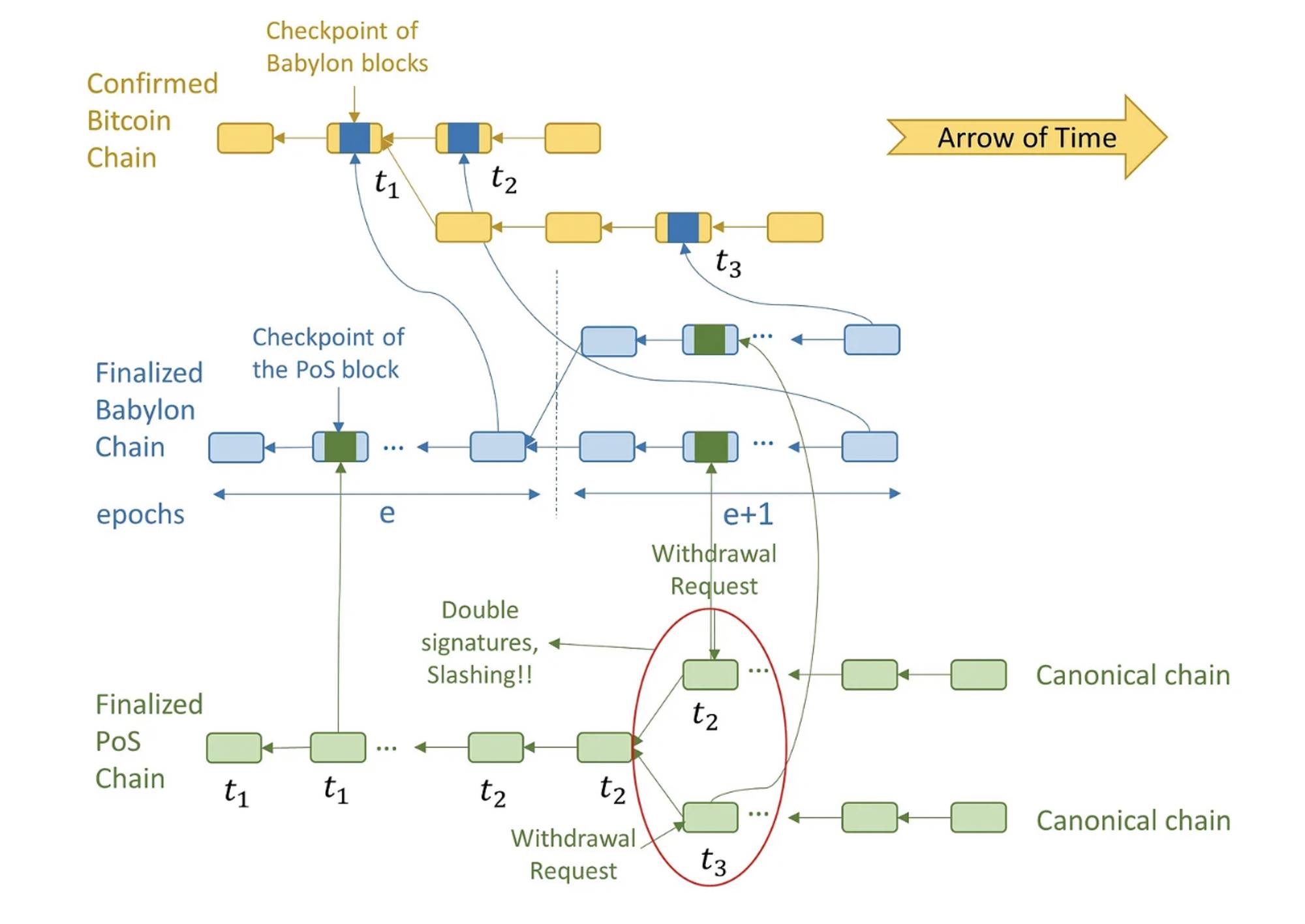
● Checkpoints: Only the final block of each Babylon Epoch is verified by Bitcoin. A checkpoint consists of the block hash and a single aggregated BLS signature from the 2/3 validator set that finalized the block. Babylon checkpoints also include the Epoch number. PoS blocks receive Bitcoin timestamps via Babylon checkpoints. For example, the first two PoS blocks are checkpointed by a Babylon block, which is itself timestamped by a Bitcoin block with timestamp t_3—thus assigning t_3 to those PoS blocks.
● Canonical PoS Chain Selection: When a fork occurs on a PoS chain, the chain with the earlier timestamp is considered canonical. If both forks share the same timestamp, the tie is broken in favor of the PoS block with the earlier checkpoint on Babylon.
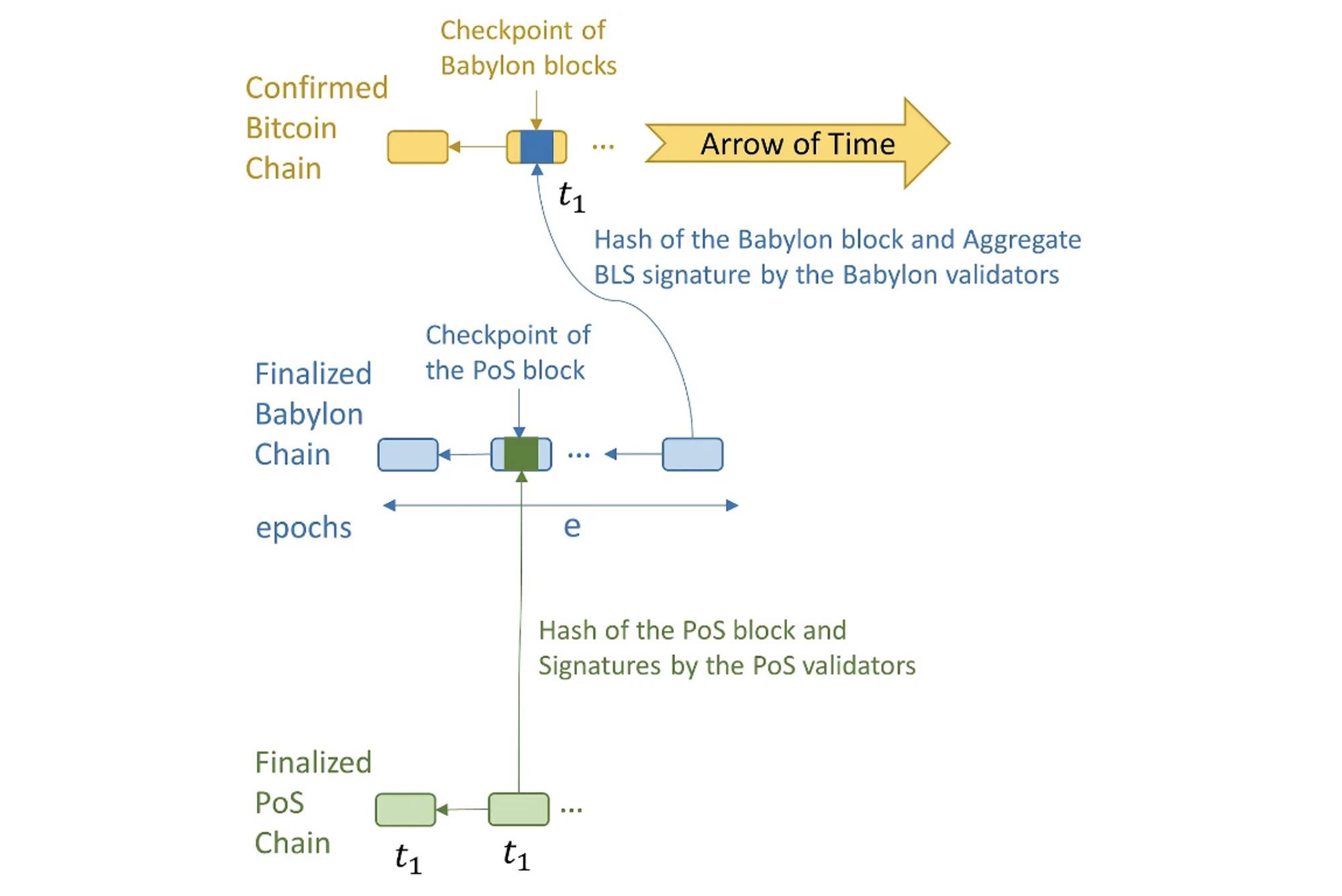
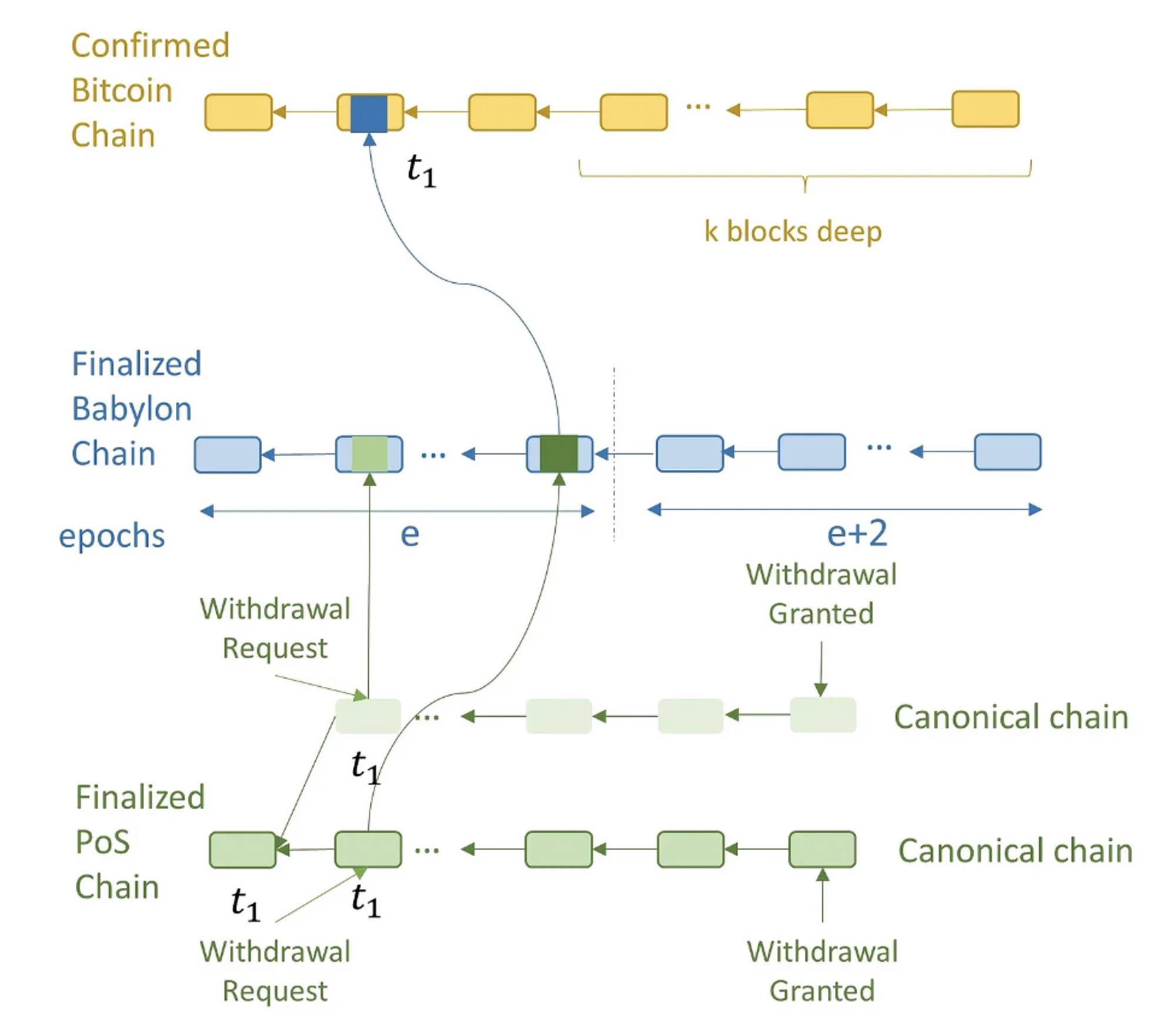
● Withdrawal Rules: To withdraw, a validator sends a withdrawal request on the PoS chain. The PoS block containing this request is checkpointed by Babylon, then confirmed by Bitcoin, receiving timestamp t_1. Once the Bitcoin block with timestamp t_1 reaches depth k, the withdrawal is approved on the PoS chain. If a withdrawn validator attempts a long-range attack afterward, blocks on the attack chain can only receive a Bitcoin timestamp later than t_1, because the t_1 block at depth k cannot be rolled back. By observing the checkpoint sequence on Bitcoin, PoS clients can distinguish between canonical and attack chains, discarding the latter.
● Slashing Rules: Validators who sign conflicting PoS blocks (double-signing) can be slashed if detected before withdrawing. Malicious PoS validators know that launching a long-range attack after withdrawal approval won’t fool clients—they can check Bitcoin to identify the canonical chain. So instead, they might fork the PoS chain precisely when canonical blocks are being timestamped. Collaborating with malicious Babylon validators and Bitcoin miners, they could reorganize Babylon and Bitcoin, replacing a Bitcoin block with timestamp t_2 with another carrying t_3. Later PoS clients would then perceive the bottom chain as canonical. While this constitutes a successful security breach, it results in the attacker’s stake being slashed due to double-signing, provided they haven’t yet withdrawn.
● Halt Rule for Unavailable PoS Checkpoints: PoS validators must halt their chain upon detecting an unavailable PoS checkpoint on Babylon. An unavailable PoS checkpoint is a hash signed by 2/3 of PoS validators, supposedly corresponding to an unseen PoS block. If PoS validators don’t halt upon detecting such a checkpoint, attackers could later reveal a previously hidden attack chain, changing the canonical chain in later client views—because the shadow chain’s checkpoint appears earlier in Babylon. This halting rule explains why we require PoS block hashes sent as checkpoints to be signed by the PoS validator set. Without signatures, any attacker could submit arbitrary hashes claiming them as unavailable checkpoints, forcing PoS validators to halt. Creating an unavailable PoS chain is hard—it requires compromising at least 2/3 of PoS validators so they sign blocks but withhold data from honest nodes. Yet in the hypothetical attack described, adversaries halt the PoS chain without corrupting any validator. To prevent this, we require PoS checkpoints to be validated by 2/3 of PoS validators. Thus, unavailable PoS checkpoints only arise if 2/3 of PoS validators are actually compromised—a highly improbable scenario due to high attack cost, and one that doesn’t affect other PoS chains or Babylon itself.
● Halt Rule for Unavailable Babylon Checkpoints: Both PoS and Babylon validators must pause their respective chains upon detecting an unavailable Babylon checkpoint on Bitcoin. Such a checkpoint is a hash bearing an aggregated BLS signature from 2/3 of Babylon validators, allegedly linked to an unseen Babylon block. If Babylon validators don’t halt, attackers could reveal a previously hidden Babylon chain, altering the canonical Babylon chain in later views. Similarly, if PoS validators don’t halt, attackers could expose both hidden Babylon and PoS attack chains, reshaping canonical PoS chain perception. This happens because the revealed dark Babylon chain carries an earlier Bitcoin timestamp and contains checkpoints of the revealed PoS attack chain. As with the PoS checkpoint rule, this highlights why Babylon requires checkpoints to carry aggregated BLS signatures proving 2/3 validator endorsement. Without such signatures, any adversary could spoof hashes, claiming them as unavailable checkpoints, forcing validators into indefinite waiting. Creating an unavailable Babylon chain requires corrupting at least 2/3 of Babylon validators. But in the above attack, the system-wide halt occurs without compromising even one validator. To prevent this, Babylon checkpoints must be cryptographically proven—making such data availability attacks extremely unlikely due to high cost. Still, in extreme cases, it could force all PoS chains to halt.
EigenLayer for BTC
Though similar in goal to EigenLayer, Babylon is far from a mere fork. Given Bitcoin’s lack of native DA usability, Babylon holds significant meaning. Beyond securing external PoS chains, Babylon plays a vital role in revitalizing the internal BTC ecosystem.
Use Cases
Babylon enables numerous potential use cases, including the following realized or upcoming examples:
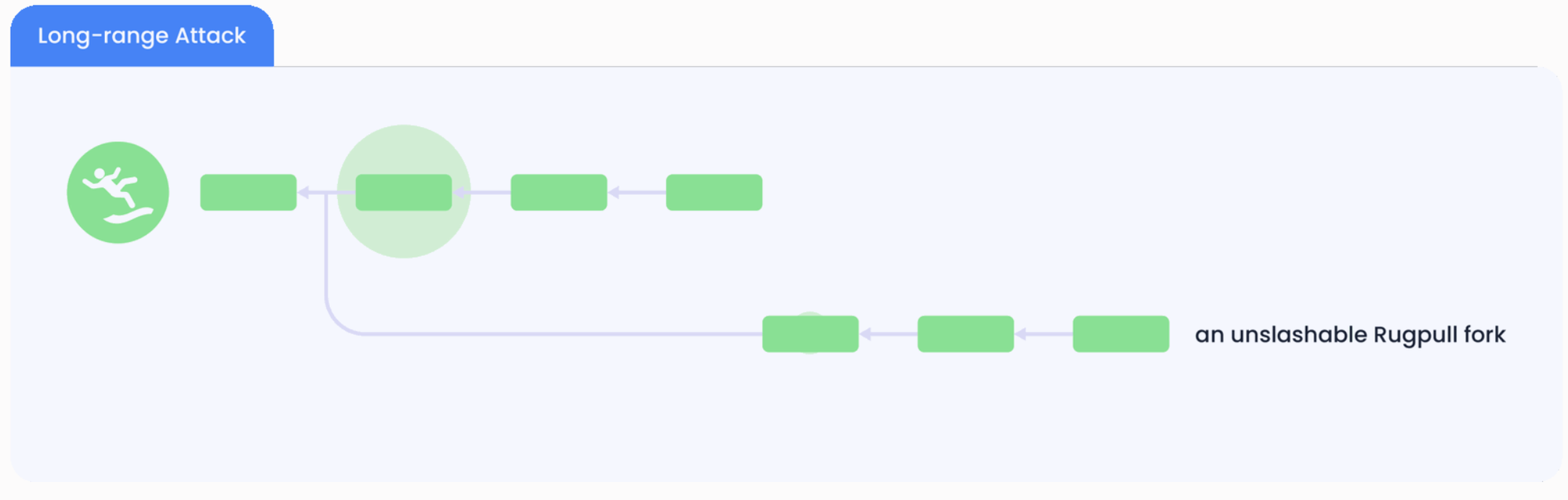
1. Shortened Staking Periods and Enhanced Security: PoS chains typically rely on social consensus (among communities, node operators, and validators) to resist long-range attacks—attacks that rewrite blockchain history to alter transactions or seize control. These are particularly dangerous in PoS systems, where consensus participants don’t expend large computational resources like in PoW. Attackers could exploit early staker keys to rewrite history. Hence, long staking/unstaking periods (e.g., Cosmos’ 21-day unbonding period) are usually required for stability. With Babylon, PoS chain events can be timestamped via Bitcoin, replacing social consensus with Bitcoin-based trust. This reduces unstaking time to just one day (after ~100 Bitcoin blocks). Moreover, PoS chains gain dual protection—native token staking plus BTC-backed security;
2. Cross-Chain Interoperability: Through the IBC protocol, Babylon can accept checkpoints from multiple PoS chains, enabling cross-chain interoperability. This seamless communication and data sharing enhance efficiency and functionality across the broader blockchain ecosystem;
3. Integration with BTC Ecosystem: Most current BTC ecosystem projects lack strong security—whether Layer 2s, LRTs, or DeFi applications, they mostly depend on third-party trust assumptions. These protocols hold substantial BTC value. Future integration with Babylon could yield powerful synergies, creating a robust ecosystem akin to EigenLayer’s role in Ethereum;
4. Cross-Chain Asset Management: Babylon can securely manage cross-chain assets. By timestamping cross-chain transactions, it ensures safety and transparency during asset transfers across blockchains, helping prevent double-spending and other cross-chain attacks.
Tower of Babel
The Tower of Babel originates from Genesis 11:1–9 in the Bible—a classic tale of humanity attempting to build a tower to heaven, ultimately thwarted by divine intervention. Symbolically, it represents human unity and shared ambition. This also reflects Babylon protocol’s deeper meaning: aiming to construct a Tower of Babel for numerous PoS chains, uniting them. Narratively, it rivals EigenLayer’s “Ethereum defender” story. But how does reality measure up?
To date, Babylon’s testnet has provided security for 50 Cosmos zones via IBC. Beyond Cosmos, Babylon has partnered with several LSD (liquid staking), omnichain interoperability, and Bitcoin ecosystem protocols for integration. On the staking front, however, Babylon currently lags behind EigenLayer, which reuses existing ETH staking and LSD positions. Long-term, though, the vast amount of BTC dormant in wallets and protocols remains untapped—only a fraction of the $1.3 trillion iceberg. Babylon must actively complement the broader BTC ecosystem to unlock its full potential.
The Only Way Out of the Ponzi Matryoshka
As mentioned in the preface, EigenLayer and Babylon are gaining momentum. Trends suggest they’ll soon lock up massive volumes of core blockchain assets. Even if the protocols themselves are secure, could this deep nesting push the staking ecosystem into a death spiral, triggering a market crash rivaling a major Fed rate hike? Indeed, since Ethereum’s shift to PoS and EigenLayer’s emergence, the staking sector has experienced prolonged irrational exuberance. Projects chase higher TVL by dangling generous airdrop incentives and layered yield stacking—enabling a single ETH to be restaked up to five or six times, from native staking to LSD to LRT. This naturally amplifies systemic risk: failure in any single protocol cascades across the entire stack—especially affecting downstream staking protocols. The BTC ecosystem already hosts many centralized solutions; mimicking this structure would only increase risks. However, it’s crucial to recognize that EigenLayer and Babylon aim to steer the staking flywheel toward real utility. At their core, they create genuine supply-demand dynamics to counterbalance these risks. While “shared security” protocols indirectly fuel unhealthy speculation, they also represent the only viable escape from Ponzi-like yield stacking. The bigger question now is whether their business models are fundamentally sustainable.
Real Supply and Demand Are Key
In Web3, whether public chains or protocols, the underlying logic often revolves around matching supply and demand. Those who do it well capture the ecosystem. Blockchain simply makes this matching fair, truthful, and trustworthy. In theory, shared security protocols can complement today’s vibrant staking and modular ecosystems. But upon closer inspection, could supply vastly exceed demand? On the supply side, numerous projects and chains offer modular security. Meanwhile, established PoS chains may neither need nor be willing (due to pride) to rent such security. Can emerging PoS chains afford the interest costs of locking up massive BTC and ETH? For EigenLayer and Babylon to achieve economic sustainability, their revenue must at least offset the interest paid to stakers. Even if revenues surpass costs, there’s a risk of draining value from new PoS chains and protocols. Therefore, striking the right balance in economic design—avoiding bubbles driven by airdrop expectations—and fostering healthy, balanced growth between supply and demand will be paramount.
References
1. Deep Dive: How Babylon Brings Bitcoin Security to the Cosmos Ecosystem: https://www.chaincatcher.com/article/2079486
2. Understanding EigenLayer: Can It Break Ethereum’s “Matryoshka” Trap?: https://haotiancryptoinsight.substack.com/p/eigenlayer?utm_source=publication-search
3. Interview with Babylon Co-Founder Fisher Yu: Unlocking Liquidity for 21 Million BTC via Staking: https://www.chaincatcher.com/article/2120653
4. Circular Debt or Mild Inflation: An Alternative View on Restaking: https://mp.weixin.qq.com/s/dMc_WzndAZXRjnEgD2hcew
5. A Look at What I've Been Seeing in Crypto Lately: https://theknower.substack.com/p/a-look-at-what-ive-been-seeing-in
Join TechFlow official community to stay tuned
Telegram:https://t.me/TechFlowDaily
X (Twitter):https://x.com/TechFlowPost
X (Twitter) EN:https://x.com/BlockFlow_News
 @YBBCapital