How Aligned Is Building a ZK Verification Layer with $20M in Funding Led by Hack VC
TechFlow Selected TechFlow Selected
How Aligned Is Building a ZK Verification Layer with $20M in Funding Led by Hack VC
Aligned launched a simple testnet based on Cosmos SDK in March and will migrate to the EigenLayer testnet.
 Navigating Web3 tides with focused insights
Written by: 1912212.eth, Foresight News
ZK infrastructure continues to attract strong interest from venture capital. Aligned Layer, which raised $2.6 million in a seed round just this past April, has now secured a $20 million Series A round in less than two months—an exceptionally rare pace. The seed round was led by Lemniscap, with participation from StarkWare and O(1) Labs, among others, while the Series A was led by Hack VC, with dao5 and other investors joining.
What exactly makes Aligned so compelling to top-tier VCs?
Overview of Aligned
In Aligned's view, the biggest bottleneck in the future won't be proof generation within the industry, but on-chain proof verification. Currently, due to high verification costs, ZK-based applications still cannot operate efficiently on Ethereum.
Aligned is a verification and aggregation layer built on top of EigenLayer that leverages Ethereum validators' security to enable cost-effective verification of any SNARK proof. It allows for more applications beyond Ethereum itself and helps other chains verify data. Aligned Layer is developed by Yet Another Company, an Ethereum infrastructure startup that raised $1 million in January.
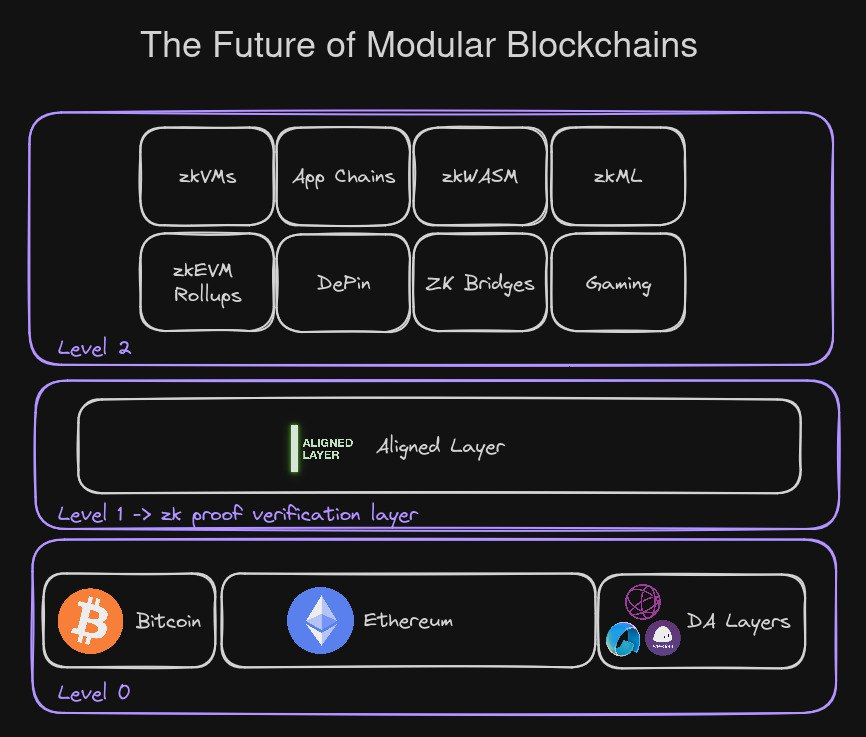
As shown in the overview diagram, Layer 0 consists of Bitcoin, Ethereum, and the data availability (DA) layer. Aligned serves as Layer 1—the verification layer—while Layer 2 includes various application-specific chains such as appchains, zkML, and zkEVM rollups.
How Aligned Works
Within the wave of modular design, splitting processes into dedicated layers has become standard practice. Moving away from monolithic layers handling execution, settlement, consensus, and DA, modular architectures improve efficiency and reduce costs.
Aligned primarily consists of four core components. It receives proofs from different proof systems, verifies them—regardless of the system used to generate them—and supports proofs with varying sizes, verification times, and logic. However, all these proofs share one key trait: they are fast to verify.
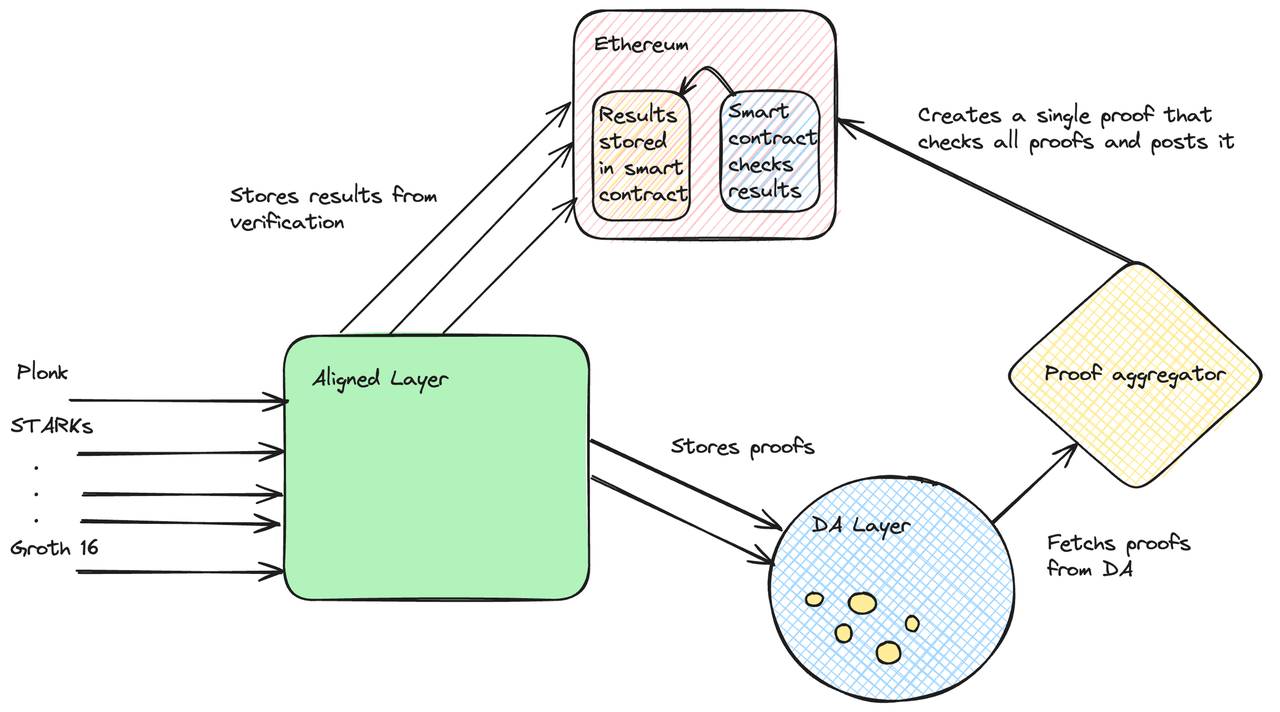
Aligned employs dedicated validators to check the validity of each proof and publish results to Ethereum. Proofs are stored in a data availability layer, which offers an economically efficient storage solution. Operators within Aligned retrieve proof data from this layer.
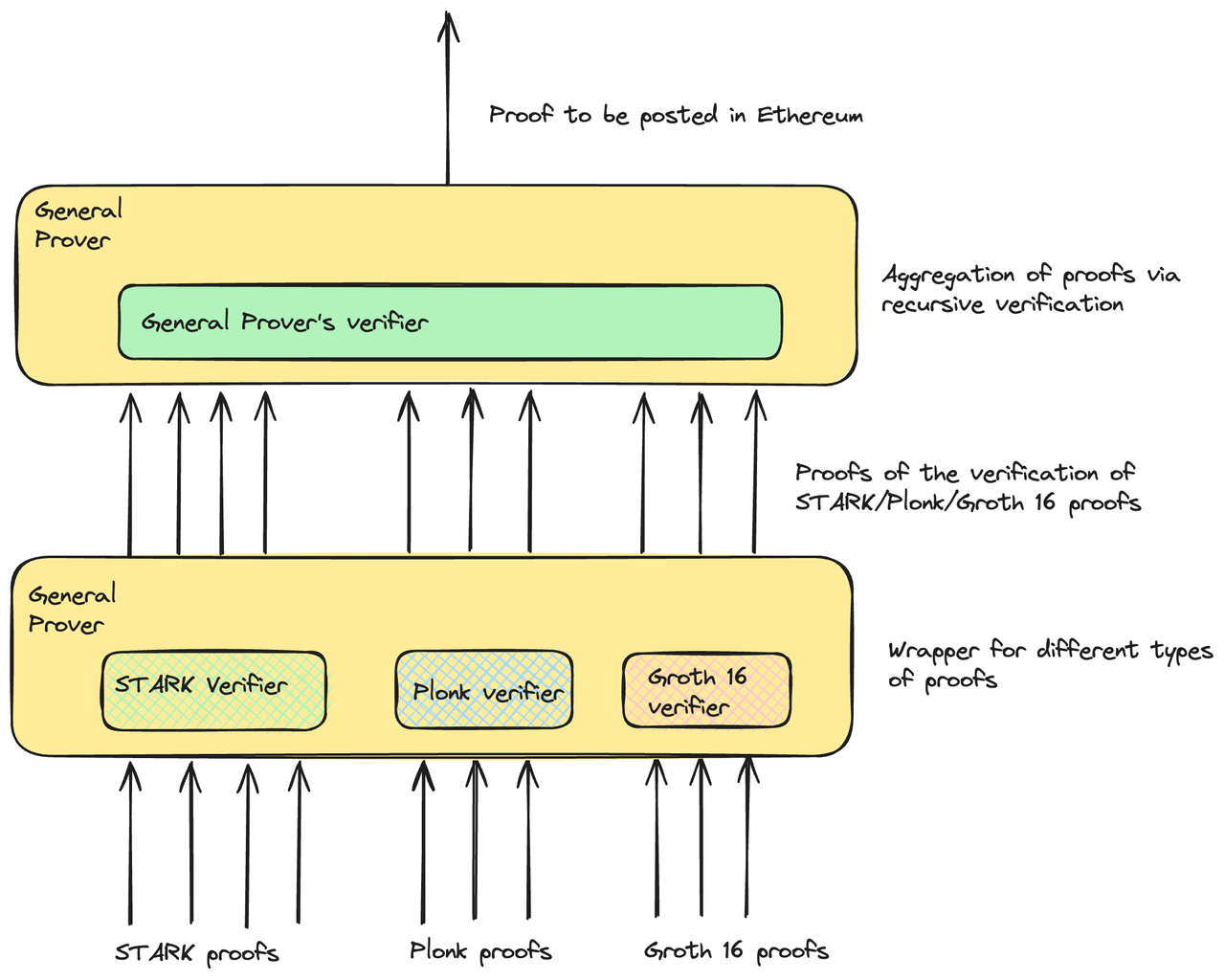
Ethereum receives verification results from Aligned. However, Ethereum itself does not directly verify these proofs due to high costs. Instead, a general-purpose Rust prover generates a single verification proof for all individual proofs included within a given time period.
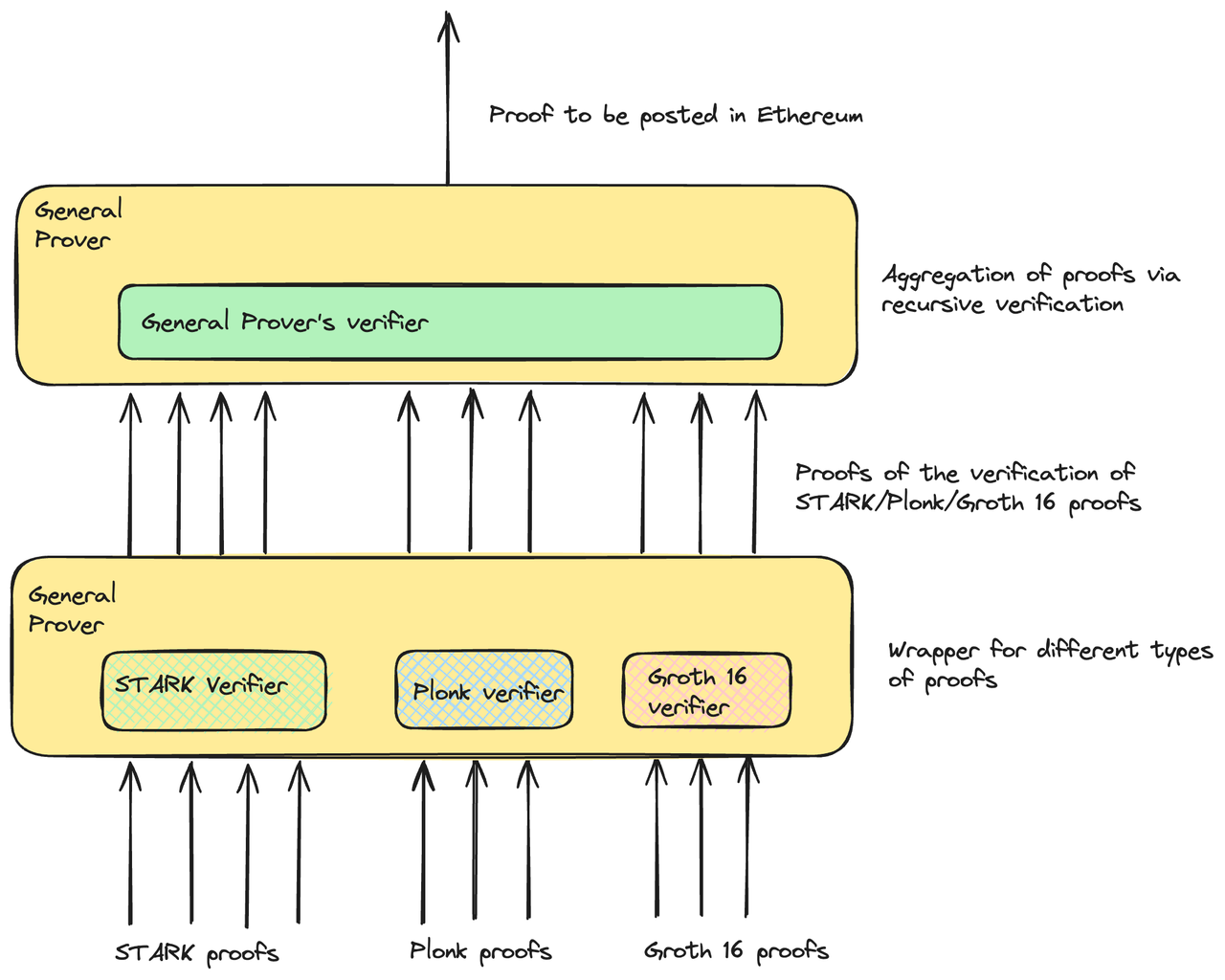
To aggregate all proofs, the first step involves converting all incoming proofs into proofs executable within a virtual machine, ensuring uniformity. Then, recursive proofs are used to compress the overall proof size, as illustrated in the tree diagram:
Use Cases
Aligned highlights several potential application categories, including soft finality for rollups and appchains, fast bridging, SNARK-based peer-to-peer protocols such as payment systems and social networks, public blockchains interoperable with Ethereum, machine learning, ZK oracles, identity verification protocols, and on-chain gaming.
Currently, Aligned supports Cairo STARK’s Platinum Prover, gnark’s Plonk, Mina’s Kimchi, SuccinctLabs’ SP1, and a16z’s Jolt. Verification costs vary depending on the type and size of the proof.
Additionally, Aligned launched a simple testnet based on the Cosmos SDK in March and plans to migrate to the EigenLayer testnet soon.
Join TechFlow official community to stay tuned
Telegram:https://t.me/TechFlowDaily
X (Twitter):https://x.com/TechFlowPost
X (Twitter) EN:https://x.com/BlockFlow_News
 Foresight News