The Decentralized Identity Trust Challenge: Can On-Chain Reputation Become the "Gold Standard"?
TechFlow Selected TechFlow Selected
The Decentralized Identity Trust Challenge: Can On-Chain Reputation Become the "Gold Standard"?
This article introduces the concept of on-chain reputation and its importance.
 Navigating Web3 tides with focused insights
Author: FRANCESCO
Translation: TechFlow

Discussions around on-chain reputation have intensified in recent years. Since 2017, multiple projects have attempted to solve this challenging problem, aiming to empower users on-chain by introducing a reputation layer that reveals who they are interacting with. Today, this seems more important than ever, especially as various SocialFi projects and celebrities frequently launch so-called shitcoins. This article introduces the concept and significance of on-chain reputation, highlighting key players in the space such as Debank and Ethos Network.
On-Chain Reputation
On-chain reputation answers a simple question: How do we assess the credibility of individuals we interact with in decentralized systems?
In centralized systems, third parties typically ensure this kind of reputation (e.g., credit scores, Interpol red notices, bank accounts).
Is there a way to replicate this trust guarantee within distributed systems?
These efforts extend beyond individual protocols and represent broader innovation across the ecosystem. For such a reputation system to be applicable, it must transcend any single protocol and establish a unique set of standards recognizable across both Web2 and Web3 platforms—ultimately forming a universal, cross-chain reputation framework.
Any attempt that fails to become a new standard will render the entire process meaningless.
According to a16z, “To make decentralized identity mainstream, we first need to build systems that map people’s relevant off-chain experiences and affiliations on-chain,” then “we need to build mechanisms to standardize, process, and prioritize data streams added to the chain,” and finally “address inherent challenges of decentralized identity, including lack of context in on-chain records and access to decentralized networks.”
Currently, even block explorers only record very basic inputs. Without additional transaction context, mapping and assigning reputation scores becomes significantly harder.
For example, receiving an NFT as part of an exchange should carry different weight than receiving one for outstanding community contributions to a project.
Moreover, in crypto, reputation takes many forms, such as protocol trustworthiness, lending credit scores, and founders’ track records.
Only after considering all these factors can the system serve numerous use cases, incorporating on-chain reputation metrics into “offline activities” based on the public query nature of decentralized identities.
Three Steps:
-
Record data on-chain
-
Map and interpret the data
-
Convert into a “reputation score”
Truly Standardized Reputation
In their Request for Builders, the Base team outlined how they view on-chain reputation as foundational to success. They liken “on-chain” to the next “online,” where reputation within each on-chain account plays a crucial role.
Within this context, a “reputation protocol” could foster greater trust on-chain. They suggest this might resemble something like FICO (the most well-known credit scoring name) or Google PageRank.
Wallets could implement these standards as anti-fraud mechanisms, issuing warnings about risky addresses. We’ve already seen Rabby lead the way by introducing alerts for suspicious contracts or scam tokens.
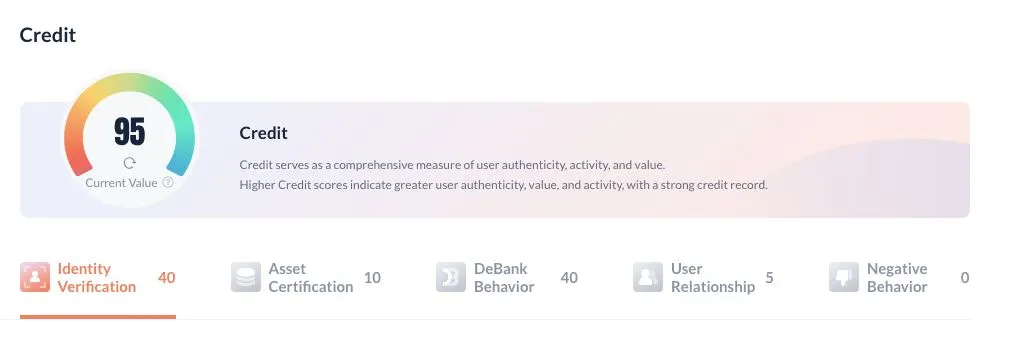
Others introducing some form of reputation include blockchain analytics firms based on on-chain behavior, such as Chainalysis, and DeBank, which created the DeBank Credit Score.
The credit score is described as “a composite measure of user authenticity, activity, and value.” A higher score indicates greater activity and authenticity, but in its current state, the DeBank Credit Score does not serve as a proxy for reputation.
Additionally, we’re seeing growing emphasis on formal identity verification—an area still controversial in crypto.
A successful example of a reputation mechanism is Gitcoin Passport. Gitcoin Passport describes itself as an “identity attestation aggregation app.”
Like a physical passport, users collect stamps by verifying past activities or completing tasks and verifications from various Web2 and Web3 validators:
-
Holonym (KYC)
-
Civic (biometric)
-
Google and LinkedIn (Web2)
-
Guild and Snapshot (Web3)
These stamps increase the default Human Score, a proxy for each user’s credibility. A higher Human Score unlocks more opportunities, with a minimum of 20 required to be considered human.
Below are examples of stamps that can be collected:
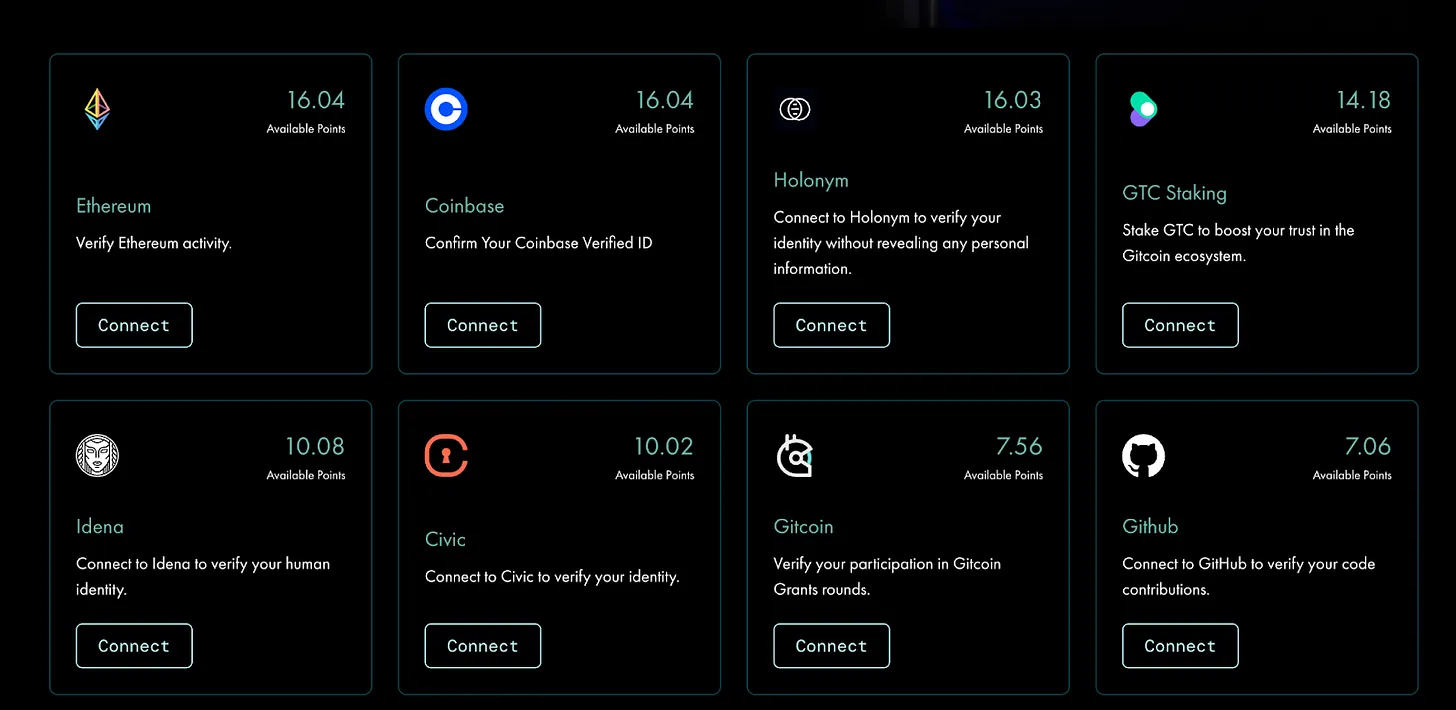
The brilliance of Passport lies in its privacy preservation, using zero-knowledge methods to “create a verifiable credential proving a user performed a specific action, without collecting any personally identifiable information.”
Another interesting effort to create “verifiable proof of validation” is underway at Ethos Network.
Ethos is developing a “credibility platform” integrated across the broader ecosystem, rather than limited to a single dApp. The platform can integrate into existing interfaces (Chrome extensions, MetaMask Snaps) and dApps.
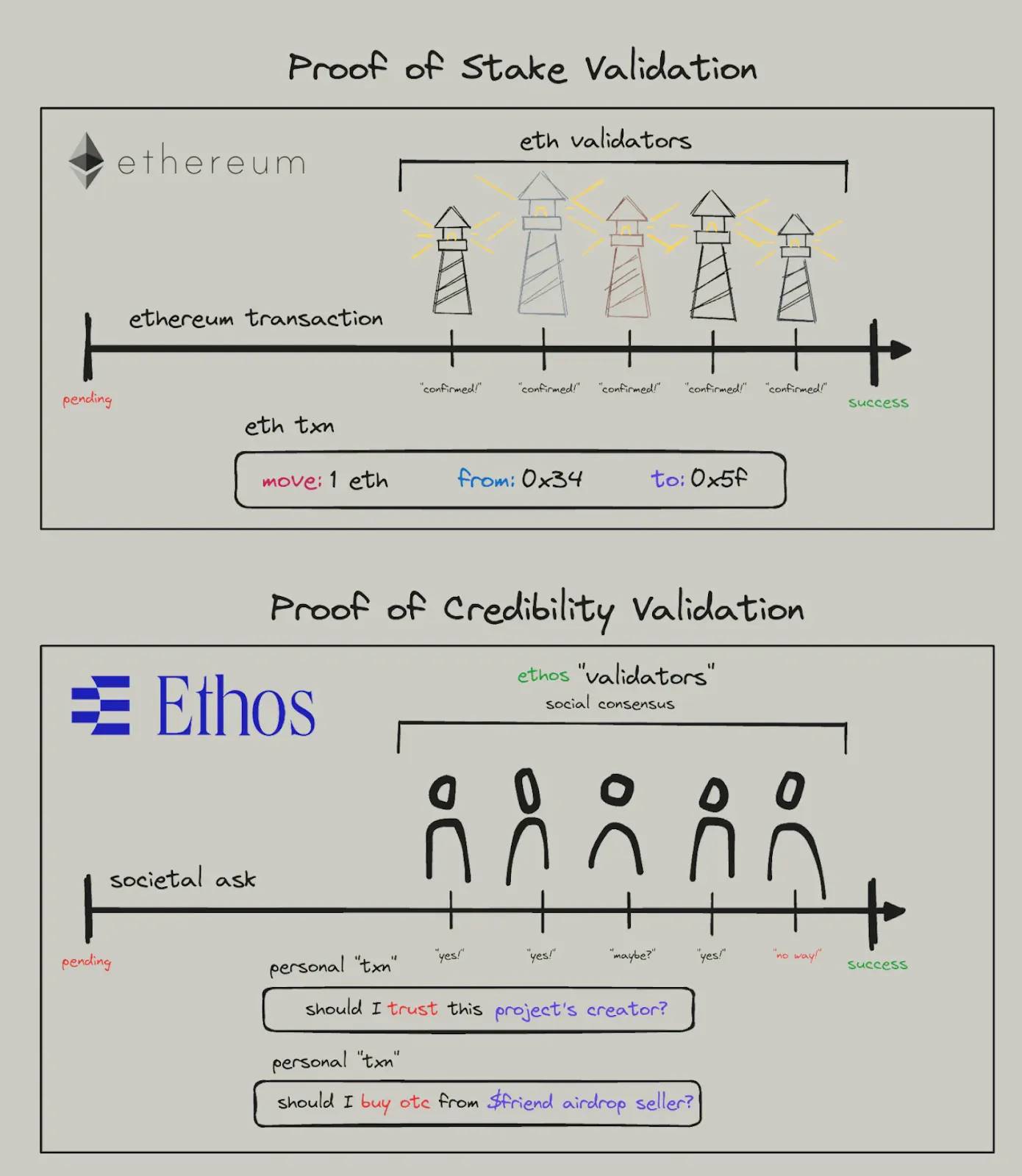
The blueprint for this new social consensus resembles Proof-of-Stake, with users acting as “social validators.”
-
Users can stake on others, signaling trust
-
Bad actors can be slashed
-
Social consensus providers can earn rewards
Ethos introduces financial incentives and penalties to ensure:
-
Reputation is financially secured, making fake reputation expensive to forge
-
Reputation has tangible value
-
Social interactions become easier to observe
At the same time, a balance must be struck so that reputation cannot simply be bought.
On Ethos Network, users will be able to:
-
Review: Build reputation beyond just financial staking
-
Guarantee: Similar to staking, users can stake their ETH on others and earn staking yields. Those being guaranteed receive 10% of the yield, incentivizing both validators and referrers.
-
Slash: If a validator misbehaves, those who staked ETH on them can propose slashing up to 10% of the offending validator’s staked ETH from the Ethos contract. Users submitting rejected slashing proposals face penalties.
-
Prove: Reflect authority, reputation, and influence from external sources
All these mechanisms will be consolidated into a single credibility score.
Other notable mentions in the space, though less focused on on-chain reputation, include:
-
Worldcoin: This VC-backed giant promises to scan your iris and airdrop some WLD tokens as compensation for the inconvenience.
Whether their intentions are noble or utopian is debatable. Nevertheless, they achieve proof-of-humanity through biometric iris scans. While this opens new risk vectors, it remains an exciting experiment.
-
ENS: Converts cryptographic addresses into human-readable names, enabling “on-chain messaging”
The Road Ahead Is Long
Developing a truly standardized and universal on-chain reputation system will be a long and challenging journey filled with obstacles.
-
Centralization risks: The main challenge is ensuring these systems remain truly decentralized rather than controlled by centralized entities, such as Worldcoin or Gitcoin Passport.
-
How can we achieve on-chain reputation in a decentralized manner? Anything less undermines the trustless foundation of the system.
-
-
Reputation in crypto may be manipulable or purchasable
-
Privacy must be protected
-
Must go beyond single-wallet attachments and achieve universal applicability
Implementation will require collaboration among all stakeholders—wallets, block explorers, dApps, and networks.
A Vision with Real-World Use Cases
What is the ultimate vision for on-chain reputation?
Here are some practical scenarios where on-chain identity could prove valuable:
-
Open CVs: Anyone could evaluate other participants’ reputations via a unified reputation score. Additionally, every article, contribution, or community engagement would be recorded and serve as proof of reputation.
-
Celebrity token launches: As celebrity tokens become a trend, data from these launches could help establish trust profiles for each celebrity. We’ve already seen many engage in serial scams. Quick risk assessments could partially mitigate this by warning users to proceed cautiously with such tokens.
-
Meme coin developers: It’s the golden age of meme coins. Yet, many abuse this power through pump-and-dumps or outright fraud. We’ve seen repeat offenders consistently scamming the community. Identifying token deployers with prior scam histories would greatly aid user risk assessment.
-
KOL dumping: A significant portion of crypto Twitter involves KOLs shilling their bags while dumping on their followers. Imagine being able to rank your favorite KOLs’ reputations—or simply knowing who are outright dumpers and scammers.
-
Loyalty programs: Developing an on-chain reputation system would allow dApps deeper insights into user interactions, enabling customized programs targeting high-quality engagement and rewarding valuable contributors.
Other Existing Reputation Tools
Beyond those previously mentioned, various tools are already contributing to trust and accountability.
Reputation Building & Tracking
-
Collab.Land: An NFT-gated bot that verifies ownership and DAO contributions
-
Karma: Visibility for DAO contributions
-
PNTHN: Tracks DAO member reputation
-
SOURC3: On-chain reputation management platform
Reputation & Identity Verification
-
Pentacle: Helps users navigate protocols
-
ONT ID: Identity framework for decentralized identifiers and verifiable credentials
-
Krebit: Allows users to prove identity without revealing personal details, preserving privacy
-
Orange Protocol: Multi-chain reputation system for verifiable credentials
-
OutDID: ZK proofs for private authentication
Reputation & Governance
-
Metopia: Reputation system for governance
-
Astraly: On-chain reputation and reputation-based token distribution platform
-
Spect: No-code tool helping DAO contributors create subDAOs
-
SourceCred: Helps incentivize contributors by rewarding high-quality participation
Join TechFlow official community to stay tuned
Telegram:https://t.me/TechFlowDaily
X (Twitter):https://x.com/TechFlowPost
X (Twitter) EN:https://x.com/BlockFlow_News
 @francescoweb3