








Interpreting the Allora Whitepaper: A Self-Improving Decentralized AI Network
TechFlow Selected TechFlow Selected
Interpreting the Allora Whitepaper: A Self-Improving Decentralized AI Network
Allora's goal is to enable nodes in a decentralized AI network to collaborate more effectively through a better incentive structure.
 Navigating Web3 tides with focused insights
Written by: TechFlow
The current market is dominated by memes, and the AI sector has entered a brief lull.
However, with NVIDIA's strong earnings growth and more AI-related events expected in the second half of the year, crypto-based AI projects remain noteworthy investments.
A new trend is now emerging — the integration of zkML (zero-knowledge machine learning) with AI agents. The former ensures privacy and security while verifying the correctness of AI computations; the latter enables automated task execution and decision-making through smart contracts and decentralized networks.
Some established crypto projects are leveraging this new trend to pivot their business strategies, aiming to capture greater value in the next market cycle.
Allora Network is one such example.
Yesterday, Allora officially released its latest technical whitepaper, positioning itself as a "self-improving decentralized AI network," signaling a strategic alignment with current narrative trends.
Additionally, the project announced an incentive points program in May, making it worth watching for both airdrop farmers and alpha seekers.
In an already crowded AI space, what unique advantages does Allora offer? Given the complexity of its whitepaper, we’ve broken it down and analyzed the key value propositions, presenting them in a more accessible way.
The Longstanding Problem of AI Resource Monopolization
According to Allora’s whitepaper, the project primarily addresses a longstanding issue in AI: computing power, algorithms, and data are concentrated in the hands of a few tech giants, leading to resource monopolization that hinders optimal machine learning (ML) performance.
Allora argues that the key to building optimal machine intelligence lies in maximizing connectivity across the network, allowing diverse datasets and algorithms to freely combine and generate the most relevant insights.
Therefore, a form of collective intelligence is needed—one capable of connecting vast datasets and inference algorithms.
In short, existing crypto-AI projects suffer from poor collaboration between models and flawed incentive mechanisms. Models are either isolated or insufficiently interconnected, resulting in subpar inference outcomes.
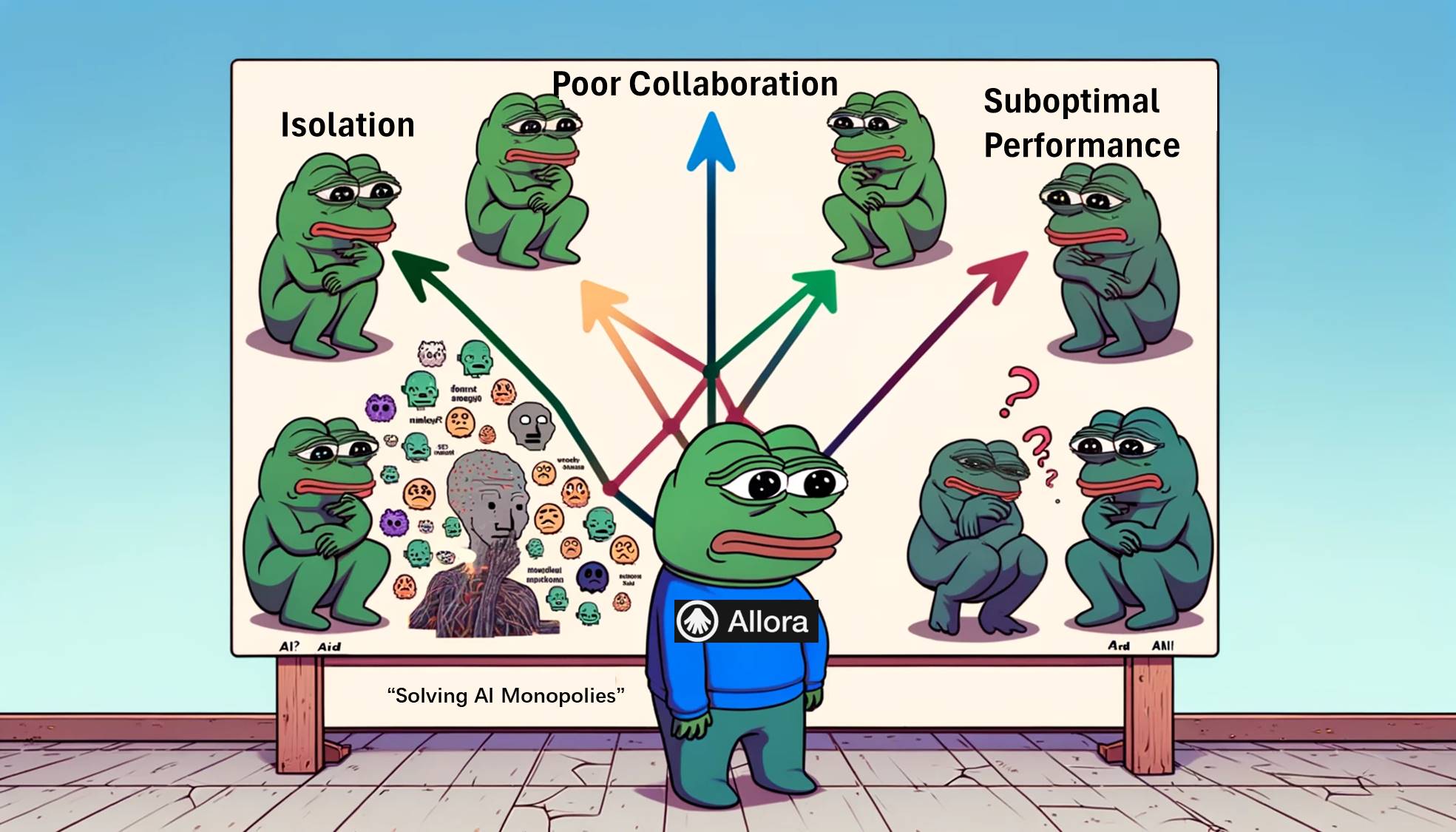
Vitalik previously noted, “We need a higher-level mechanism to evaluate different AIs’ performance so that AIs can participate as players.”
Allora aims to enhance node collaboration within a decentralized AI network through improved incentive structures, while introducing smarter, context-aware methods to boost ML model effectiveness—enabling more efficient and intelligent inference.
Allora: Enhancing Model Performance via Context Awareness and Differentiated Incentives
So how exactly does Allora build a “more effective decentralized AI network”?
The key innovations lie in context awareness and differentiated incentives. These advancements enable the network to deliver optimal inference results in any environment while fairly rewarding each participant’s unique contributions.
While these terms may sound abstract, understanding them becomes easier once we examine the roles within the Allora network.
Participants in the Allora network include Workers, Reputers, and Consumers, each fulfilling distinct responsibilities:
-
Workers: Provide AI inference results and predict the loss values of other workers’ inferences.
-
Reputers: Evaluate the quality of inference results and predicted loss values provided by workers.
-
Consumers: Request inference results from the network and pay fees to access them.
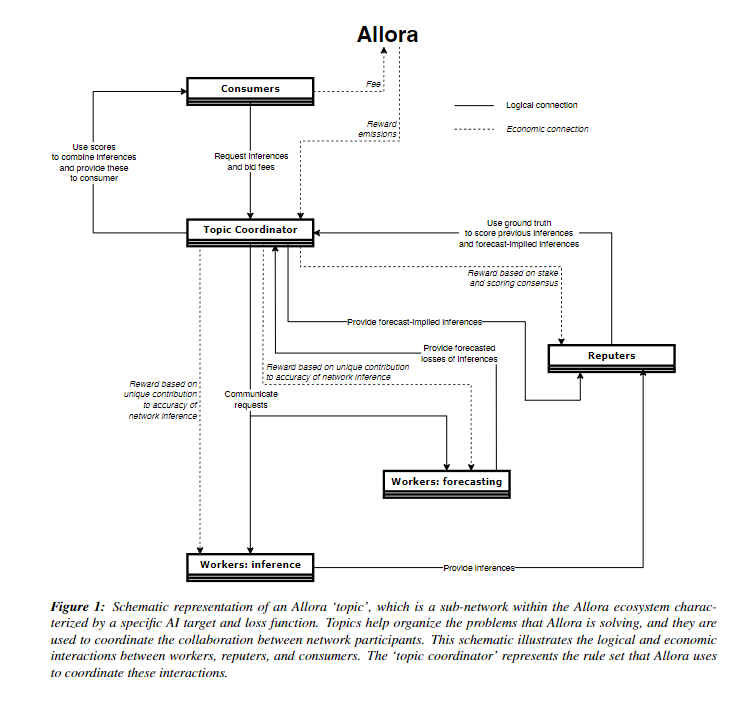
As shown in the diagram, the three main participants interact via a coordinator (Topic Coordinator):
-
Consumers request inference results and pay fees to obtain them.
-
Workers submit inference results and predictions of others’ loss values. The coordinator synthesizes this information to generate more accurate final inferences.
-
Reputers assess the accuracy of workers’ outputs using real-world data, ensuring fairness. They earn rewards based on consensus with other reputers.
This role-based design enables an efficient decentralized machine intelligence network, optimizing resource utilization and improving inference accuracy—an inherently self-improving and equitable system driven by division of labor and incentives.
With these three roles clarified, Allora’s context-awareness and differentiated incentive mechanisms become much clearer.
Inference Synthesis Mechanism
Allora’s inference synthesis mechanism is central to its decentralized machine intelligence. It operates in four steps:
-
Inference Task: Each worker generates inference results using their own dataset and model.
-
Forecasting Task: Each worker predicts the loss values of others’ inference results—these represent expected performance under current conditions.
-
Context-Aware Inference: The network uses predicted loss values to generate a context-aware forecast via weighted averaging, incorporating historical and contextual accuracy dependencies.
-
Network Inference: The final network inference combines individual worker outputs with the context-aware prediction.
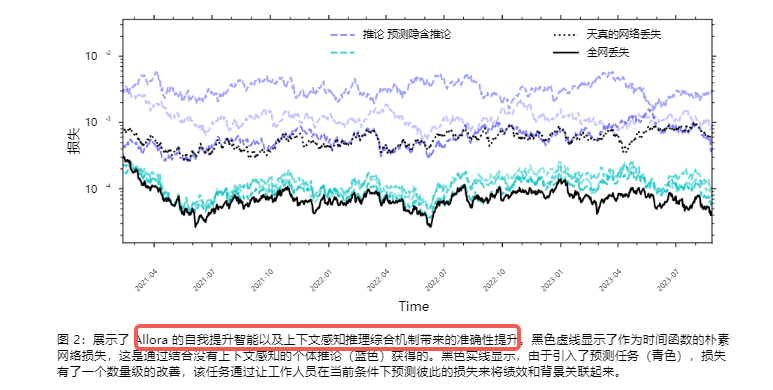
The key innovation here is that unlike other crypto-AI projects which only consider historical model accuracy, Allora also factors in current context—enabling optimal inference combinations and elevating overall network intelligence.
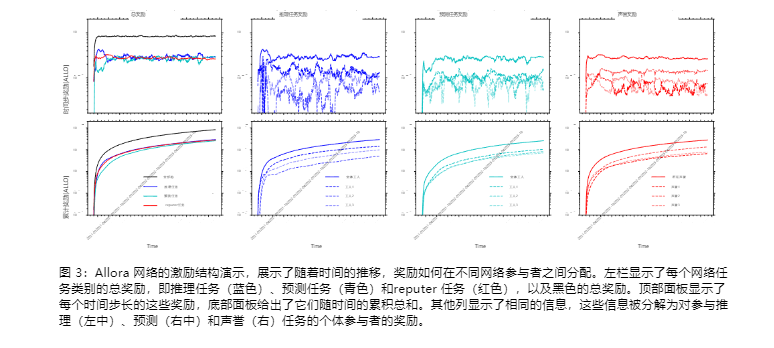
Differentiated Reward Mechanism
Simultaneously, Allora introduces a differentiated reward system to ensure fair recognition of each participant’s contribution:
-
Worker Rewards: Distributed based on contributions to inference and forecasting tasks, incentivizing high-quality data and predictions.
-
Reputer Rewards: Allocated based on proximity to consensus and staked holdings, ensuring evaluation accuracy and fairness.
-
Overall Reward Distribution: Encourages active participation while preventing over-concentration among single actors through decentralized design.
Current use cases being explored on Allora include:
-
AI Price Prediction: Delivering precise, real-time asset pricing critical for advanced financial primitives.
-
AI-Powered Vaults: Enabling developers to implement advanced DeFi strategies and boost yield potential.
-
AI Risk Modeling: Helping protocols build safer systems to mitigate external risks.
-
AnyML: Enables easy integration of any machine learning model, empowering non-ML experts to build powerful products using decentralized AI.
Tokenomics
Allora uses its native token ALLO to facilitate value exchange among network participants. Key uses of the ALLO token include:
-
Purchasing Inference Results: Users can buy network-generated inferences using ALLO. Allora adopts a “Pay What You Want” (PWYW) model, letting users set their own fee.
-
Participation Fees: ALLO pays for creating topics or joining the network (as a worker, reputer, or validator). Fees are variable.
-
Staking: Reputers and validators can stake ALLO, and holders can delegate tokens to them. Stakers and delegators earn ALLO rewards.
-
Reward Payments: The network distributes ALLO rewards proportionally—workers based on unique accuracy contributions, reputers and validators based on stake and consensus alignment.
Token Value Mechanics
Allora’s token economy is designed to ensure intrinsic value and stability:
-
Fees Revenue: All network fees go into the treasury to fund rewards. This means the treasury depletes slower than simple exponential decay, helping sustain high APY.
-
Token Recycling: The network first uses collected fees to pay rewards before minting new tokens. As a result, ALLO’s circulating supply can increase (inflationary) or decrease (deflationary) depending on market dynamics.
-
Smooth Emission: Using exponential moving averages, token emissions are smoothed to prevent sharp APY drops during major unlock events, encouraging continued staking.
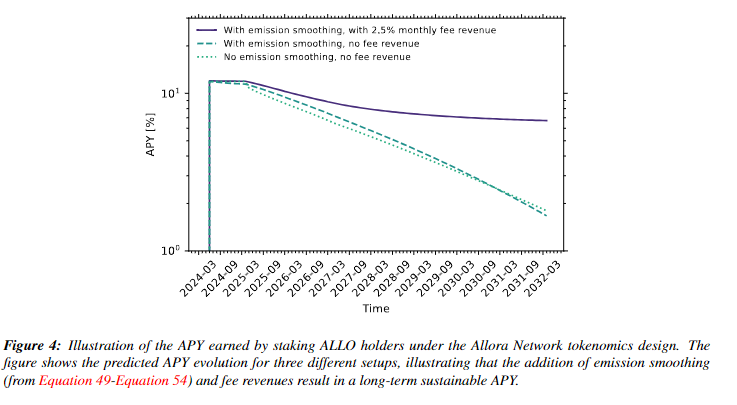
However, the whitepaper does not specify the token launch date or details—more updates are expected via official social channels.
Allora’s Backing Resources
So far, we haven’t mentioned zkML—the technology highlighted at the beginning. At first glance, Allora seems unrelated.
However, behind Allora is Upshot—one of the core contributors to its development.
Upshot enhances Allora by deploying its flagship price prediction model on the network, delivering AI-driven pricing data for over 400 million assets. Historically, the most accurate predictions from this model have shown confidence levels of 95–99%.
Moreover, the model’s outputs can be delivered via zkPredictor (the largest on-chain zkML application to date), enabling apps to use these results in a cryptographically verifiable manner.
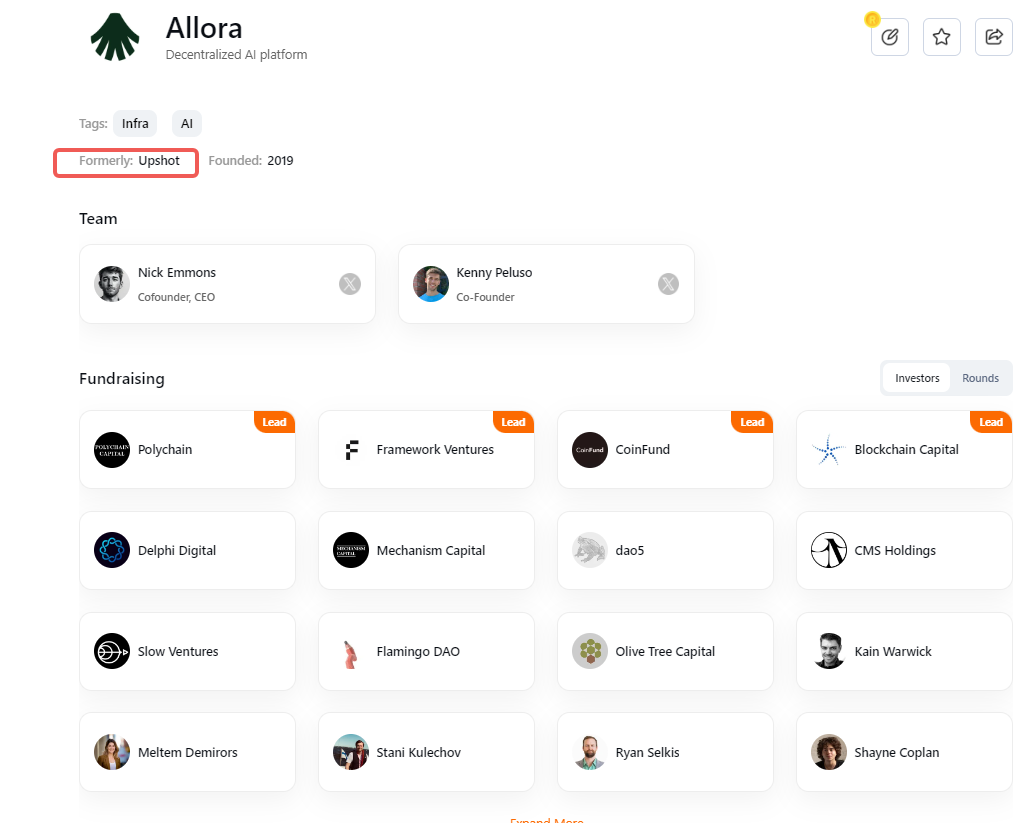
Additionally, Upshot raised $22 million in 2022 from top investors including Polychain, Framework, CoinFund, and Blockchain Capital. Initially focused on real-time NFT valuation, it pivoted toward AI as the landscape evolved—repurposing earlier technical achievements for Allora.
Roadmap and Testnet Incentives
According to previous announcements from Allora’s official blog, the rollout consists of three phases:
-
Testnet Phase 1: Mid-February 2024
-
Testnet Phase 2: Mid-March 2024
-
Mainnet Launch: Early Q2 2024
At present, the timeline appears slightly delayed but still within the pre-mainnet phase.
To drive engagement and adoption, Allora launched its first testnet incentive program on May 17. Participants can earn points by completing on-chain activities, boosting their chances for future airdrops.
Eligible point-earning activities include:
On-Chain Activities
-
Create a Topic: Identify and define specific problems or areas of interest within the network, attracting others to develop solutions.
-
Introduce Machine Learning Models: Add ML models to the network for others to use.
-
Use Allora-Supported Applications: Engage with apps and services powered by Allora’s machine intelligence.
Off-Chain Activities
-
Community Engagement: Follow Allora on Twitter, join Discord and Telegram groups.
-
Participate in Community Events: Join selected campaigns and initiatives supporting the Allora network.
Currently, all accessible activities for regular users are available on the Galxe quest page. Interested participants can click here to join.
Overall, Allora stands out as a technically innovative crypto project backed by strong resources and reusable capabilities. By adapting to shifting AI narratives, it effectively leverages its strengths to expand into new business directions—ensuring it stays competitive in the race for attention.
As for how high it can go, that depends on two factors: when the AI wave returns, and how creatively the team executes future operational strategies.
Join TechFlow official community to stay tuned
Telegram:https://t.me/TechFlowDaily
X (Twitter):https://x.com/TechFlowPost
X (Twitter) EN:https://x.com/BlockFlow_News
 深潮TechFlow


