Nasdaq Stalls While Power Stocks Hit Repeated All-Time Highs? In-Depth Analysis of U.S. Grid Modernization Investment Landscape for 2026 in the Second Half of the AI Era
TechFlow Selected TechFlow Selected
Nasdaq Stalls While Power Stocks Hit Repeated All-Time Highs? In-Depth Analysis of U.S. Grid Modernization Investment Landscape for 2026 in the Second Half of the AI Era
The endpoint of computing power has now become electricity.
 Navigating Web3 tides with focused insights
As we enter 2026, the U.S. stock market is exhibiting an extreme bifurcation: the Nasdaq has failed to reach a new high for four consecutive months, and AI leaders’ valuations are under severe pressure amid anxious anticipation of the next round of rate cuts. Yet on the other side of the market, industrial, energy, and utility stocks are breaking out first—amid the rumbling of the “old world.”
This divergence sends a clear signal: the AI race has shifted entirely from algorithmic competition to competition over physical resources. If 2024 was the “Year of Chips,” then 2026 is the “Inception Year of Grid Modernization.”
Today, the revaluation of power assets is unstoppable. In 2023–2024, markets bought the “brain” (chips); in 2025–2026, capital is flowing into the “heart and blood vessels” (power generation and grid infrastructure).
This article provides investors with a comprehensive review of structural changes, competitive dynamics, and embedded opportunities across the U.S. power and grid industry.
The RockFlow Research Team believes investors should focus on three tiers: high-margin software and automation players represented by GEV; highly predictable equipment manufacturers led by Eaton and Schneider Electric; and infrastructure dividend beneficiaries led by PWR.
1. AI Demand Shock and the U.S. Grid’s “Aging Disease”
For decades, Americans have almost forgotten what “electricity shortages” mean. In the early 2000s, thanks to the widespread adoption of LED lighting and the EPA’s mandatory Energy Star certification, U.S. energy consumption stabilized—even as the population grew.
But that stagnation ended abruptly in 2025. With the exponential growth of large-scale data centers and AI applications, the energy demand curve has undergone an almost vertical inflection:
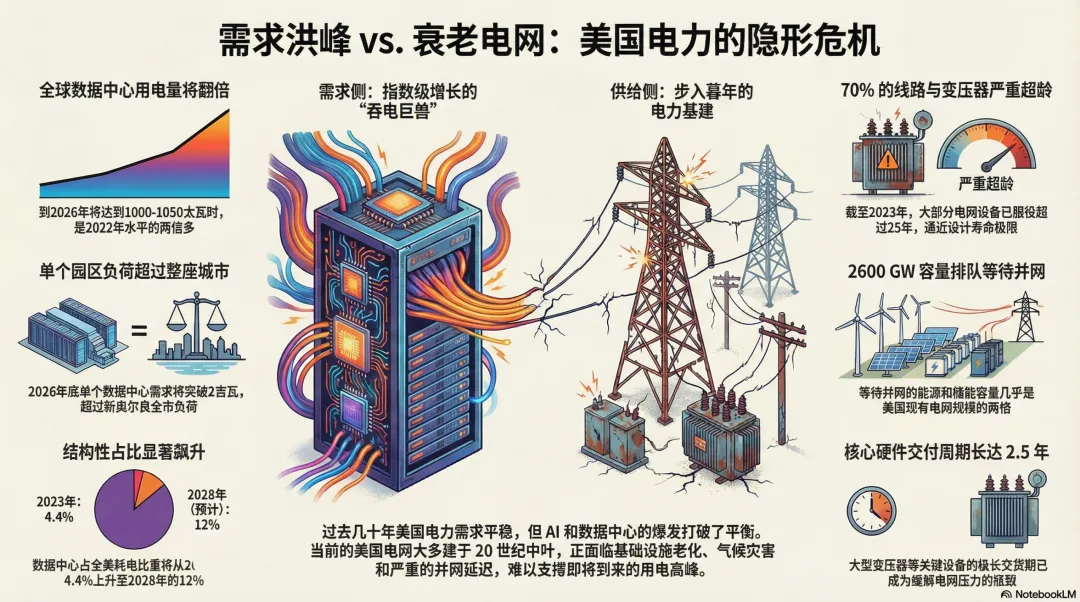
- Doubled consumption: Global data center electricity use is projected to reach 1,000–1,050 terawatt-hours (TWh) by 2026—more than double the 2022 level.
- City-scale demand: By the end of 2026, a single standalone data center campus will require over 2 gigawatts (GW) of power—equivalent to the electricity load of a mid-sized city.
- Structural share: Data centers accounted for only 4.4% of U.S. electricity consumption in 2023; by 2028, this figure is expected to surge to 12%.
Beyond AI—the “electricity-guzzling behemoth”—manufacturing reshoring and broad-based electrification (EVs, heat pumps, etc.) are also pushing up demand. The power sector is shifting from a “zero-growth,” unexciting industry into a new phase of rapid expansion.
In stark contrast stands the U.S. grid’s “aging disease.”
Today’s U.S. grid was not designed for the AI era. It resembles more of a “Frankenstein” stitched together from mid-20th-century technologies.
The grid comprises three main components: generation, transmission, and distribution. Current problems include:
- Aged infrastructure: As of 2023, 70% of U.S. transmission lines and transformers had been in service for over 25 years. Most were built in the 1960s and 1970s—and are now approaching their design life limits of 50–80 years.
- Climate change—the “final straw”: In the first half of 2025 alone, dozens of billion-dollar weather disasters occurred. Power line sag from extreme heat and grid collapse from hurricanes have become routine causes of regional blackouts.
On the other side lies a despairing “queue crisis.” Nearly 2,600 GW of energy and storage capacity—nearly twice the size of the current U.S. grid—is currently waiting for interconnection.
Reportedly, lead times for large power transformers have stretched to 2.5 years. In the 2026/27 delivery year alone, PJM Interconnection’s customers will incur an additional $3.5 billion in capacity costs due to interconnection bottlenecks.
2. Redefining the Smart Grid
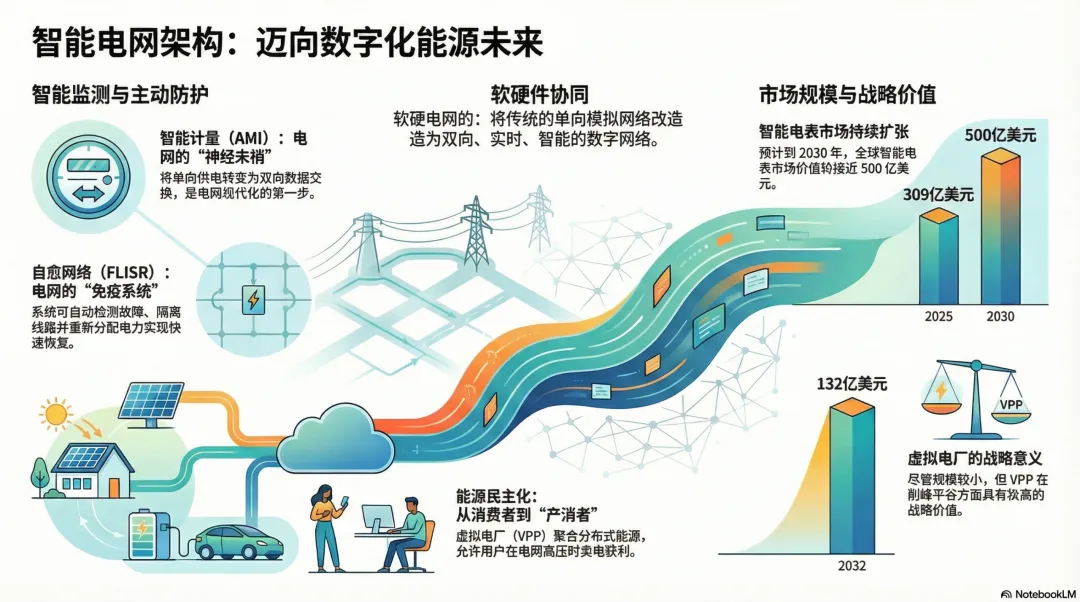
Grid modernization is not simply about adding more wires—it means transforming the traditional, one-way analog network into a two-way, real-time, intelligent digital network.
Nerve Endings: Advanced Metering Infrastructure (AMI)
AMI is the first step toward modernization. It converts one-way power delivery into two-way data exchange. Its core lies in smart meters transmitting data back to the system via RF or cellular networks.
According to statistics, the global smart meter market was valued at approximately $30.9 billion in 2025 and is expected to approach $50 billion by 2030.
Immune System: Automation and Self-Healing Networks (FLISR)
This represents the shift of infrastructure from passive to active. Leveraging software developed by companies such as GE Vernova, upgraded power systems can:
1. Automatically detect: Precisely locate fallen trees or transformer explosions.
2. Automatically isolate: Instantly cut off faulty lines.
3. Automatically restore: Re-route power from adjacent feeders to unaffected areas—achieving “self-healing.”
Energy Democratization: Virtual Power Plants (VPPs)
VPPs aggregate residential solar panels and EV batteries using cloud-based software. Consumers no longer merely buy electricity—they become “prosumers,” selling power back to the grid during peak-demand periods to earn revenue.
Though its niche market size remains in the low tens of billions of dollars, its strategic value for peak shaving and load leveling is immense.
3. Who Is Sharing This Massive Pie?
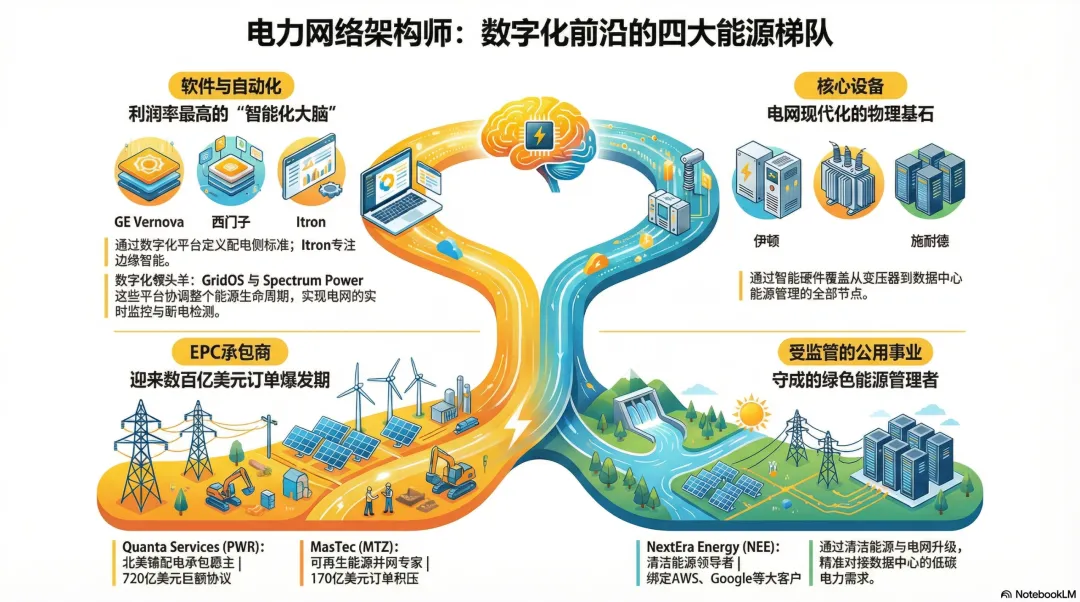
Based on the current industry characteristics and profit structure of the U.S. power and grid sector, the RockFlow Research Team classifies beneficiary companies into four tiers:
Software & Automation: The Intelligent “Brain”
This tier boasts the highest margins and deepest moats.
- GE Vernova (GEV): Coordinates the entire energy lifecycle via its GridOS platform. As the pure-play spinoff from GE, it is the undisputed leader in grid digitization.
- Siemens (SIEGY): Offers the industry-leading Spectrum Power system. Its latest Gridscale X platform is setting the digital standard for distribution networks.
- Itron (ITRI): The dominant player in advanced metering. Its “edge intelligence” products detect outages in real time without relying on centralized processing—acting as “guardians” at the distribution network’s edge.
Equipment Manufacturing & Power Electronics: Critical Foundations
- Eaton (ETN): A giant in distribution equipment. From circuit breakers to transformers, Eaton’s product portfolio covers nearly every physical node required for grid modernization.
- ABB: A global expert in high-voltage products and automation. Its record-high order backlog is primarily driven by grid modernization projects.
- Schneider Electric (SBGSY): Specializes in smart grid technologies and microgrid solutions, delivering end-to-end energy management solutions that maximize energy efficiency for data centers. Its EcoStruxure platform deeply integrates hardware with digital management—dominating especially in data centers and microgrids.
Engineering, Procurement & Construction (EPC): The Builders
- Quanta Services (PWR): The dominant North American contractor in transmission and distribution. Its recent $72-billion agreement with American Electric Power (AEP) best illustrates the grid upgrade trend.
- MasTec (MTZ): Focuses on renewable energy interconnection. Its $17-billion order backlog signals explosive performance over the next two years.
Regulated Utilities: The Steady “Managers”
- NextEra Energy (NEE): The largest clean energy company in the U.S., focused on wind and solar generation. It owns extensive renewable assets and secures stable revenues through long-term power purchase agreements (PPAs) with major customers.
- Duke Energy (DUK): Owns extensive grid infrastructure covering multiple data center clusters. Through modernization of its transmission and distribution networks, DUK delivers efficient, low-loss power to data centers. Additionally, DUK is investing in clean energy generation to meet data centers’ growing demand for green power.
Conclusion: The “Revaluation” of Power Assets Has Begun
In 2026, the power grid is no longer the forgotten “utility”—it is a core national asset critical to both national security and AI supremacy.
The RockFlow Research Team believes that for investors, software-driven automation companies (GEV, ITRI) offer the highest premium potential; equipment manufacturers (ETN, ABB) provide the most visible and certain order visibility; and EPC giants (PWR) are the direct beneficiaries of infrastructure dividends.
Over the next five years, alpha in U.S. equities will no longer reside solely in lines of code—but also in the hum of every intelligent transformer.
Join TechFlow official community to stay tuned
Telegram:https://t.me/TechFlowDaily
X (Twitter):https://x.com/TechFlowPost
X (Twitter) EN:https://x.com/BlockFlow_News