Rune hits new market cap high, but why are my friends and I losing money?
TechFlow Selected TechFlow Selected
Rune hits new market cap high, but why are my friends and I losing money?
The Matthew effect intensifies—buying big is better than buying new.
 Navigating Web3 tides with focused insights
Author: Golem, Odaily Planet Daily
The overall market capitalization of Runes has today reached a new high of $1.92 billion. Alongside the recent recovery in the Runes market, on-chain Rune minting (initial offerings) has become increasingly active, with many users focusing on the primary market in hopes of securing the next "golden dog" Rune. However, reality may differ from expectations. Despite the apparent boom in primary market minting, secondary market demand for newly launched assets remains weak, with the majority of capital concentrated in just a few top-tier Rune projects.
Below, Odaily Planet Daily analyzes current conditions in the Rune sector from a data-driven perspective—covering overall market trends, performance of newly minted assets, and strategic recommendations based on these observations.
Matthew Effect: The Strong Get Stronger
According to Geniidata, in terms of market cap, the top three Runes—DOG•GO•TO•THE•MOON, RSIC•GENESIS•RUNE, and PUPS•WORLD•PEACE—have market caps of approximately $920 million, $230 million, and $160 million respectively, collectively accounting for 70% of the total Rune market cap.
In terms of 24-hour trading volume, the total 24H volume across all Runes is currently around $14.58 million. DOG•GO•TO•THE•MOON alone accounts for about $7.64 million, representing over 50% of the entire Rune ecosystem’s 24H trading volume.
Overall, despite the Rune market cap reaching $1.92 billion and over 72,764 Runes having been deployed, we are not seeing broad-based growth across the sector. Instead, the Matthew effect is intensifying—the leading Rune projects continue to dominate, capturing most of the capital and liquidity. No new Rune assets have emerged that outperform the current leaders or disrupt the existing hierarchy.
How About Rune Minting? Performance Is Underwhelming
When a leading token within a Bitcoin ecosystem protocol starts rallying, it typically boosts user enthusiasm for on-chain minting. For example, in June last year, ORDI’s surge sparked the BRC-20 craze, and during that market recovery, many early minters saw their assets multiply several times shortly after launch.
Currently, DOG•GO•TO•THE•MOON—a Rune distributed via the Runestone airdrop—is undoubtedly the flagship token of the Runes protocol. Its recent price surge has naturally reignited interest in on-chain Rune minting. However, this current wave of Rune minting differs significantly from the BRC-20 era. The performance of newly minted Rune assets has been disappointing. The table below shows the returns of the top 10 Runes ranked by minting fees over the past seven days.
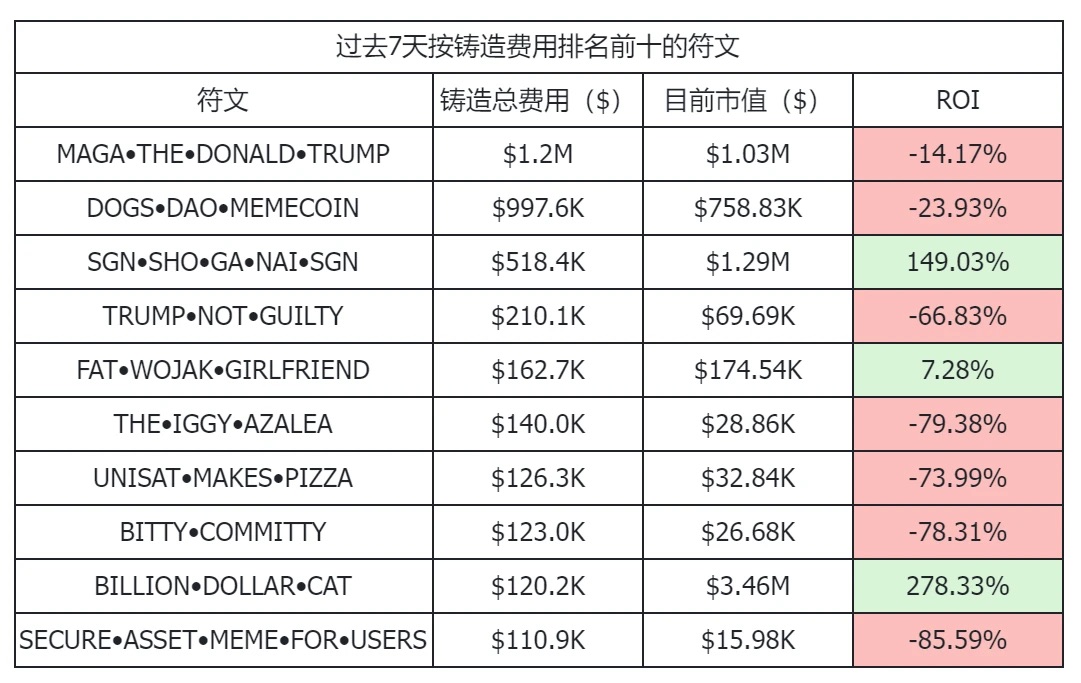
Chart reference: @satosea_xyz
Overall, among the top 10 Runes by minting cost over the past week, only three delivered solid returns. The remaining seven underperformed significantly, with some experiencing losses exceeding 70%.
Furthermore, from a liquidity standpoint, as shown in the Geniidata chart below, over the past 30 days, the number of transactions involving Rune creation on the Bitcoin chain has far exceeded those involving buying, selling, or transferring Runes. This further indicates that most newly minted Rune assets face severe liquidity challenges post-launch. With little secondary market demand, the ecosystem remains largely a PVP (player-versus-player) environment where existing participants trade among themselves.
Strategy: Buying Big Outperforms Chasing New
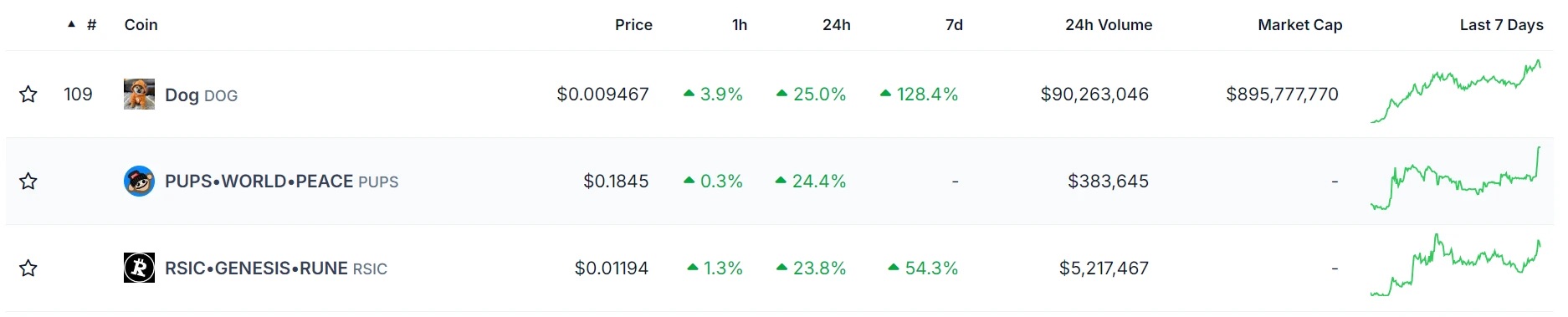
Over the past week, even though the market caps of top Runes have already surpassed hundreds of millions, they’ve still posted strong gains. According to CoinGecko data, DOG•GO•TO•THE•MOON rose 118.6% over the past seven days, while RSIC•GENESIS•RUNE gained 55.9%.
Although the potential payout from minting new Runes on-chain can be high, it's extremely difficult to identify the rare 30% that become “golden dogs” without sharp insight, robust analytical skills, and constant monitoring of on-chain activity. Moreover, as previously analyzed, the Rune ecosystem remains predominantly a PVP market. Even when new users and capital enter, they are more likely to gravitate toward established, top-tier Rune projects rather than small-cap, newly launched assets with limited track records and underdeveloped communities.
In conclusion, rather than exhausting efforts chasing uncertain new launches, investors are better off directly purchasing large-cap, widely recognized top-tier Rune assets.
Join TechFlow official community to stay tuned
Telegram:https://t.me/TechFlowDaily
X (Twitter):https://x.com/TechFlowPost
X (Twitter) EN:https://x.com/BlockFlow_News
 Odaily