Opinion: Why are there so many L2s emerging in the market?
TechFlow Selected TechFlow Selected
Opinion: Why are there so many L2s emerging in the market?
We will continue to see L2s achieve lower fees, faster block times, and more optimized experiences in the future.
 Navigating Web3 tides with focused insights
Author: cygaar, Advisor at Mocavers
Translation: Felix, PANews
Why are there so many L2s in the market? Do we need yet another chain? When will this ever end?
Below are some under-discussed reasons explaining why you'll continue to see more L2s emerge—and why this will ultimately benefit users.
Technical Experimentation
This is, for the author, the most fascinating aspect of L2s and what truly differentiates them from L1s. Settlement on Ethereum allows L2s to freely modify their VMs as long as they can prove state transitions back to the L1. Most rollups today use the EVM and aim to replicate the ETH L1 experience—just cheaper and faster.
However, we're seeing a growing number of rollups adopting alternative VMs that offer distinct advantages—such as support for different programming languages, enhanced security, privacy, lower fees, or higher throughput. Examples include Arbitrum Stylus, Movement, Aztec, and various SVM-based rollups.
Some teams are also pushing the limits of the EVM on high-performance hardware. Excellent research by MegaETH and Paradigm explores ways to optimize various aspects of the EVM. We can expect EVM-based rollups (MegaETH?) to achieve extremely high performance by the end of this year.
Cultural Extension
The term "cultural extension" comes from a blog post by Vitalik. Here's his take on L2 culture: "L2s allow subcultures with abundant resources to emerge, creating feedback loops that force them to learn and adapt in order to function effectively in the real world."
Every successful blockchain has its own identity and use case. Here are some examples:
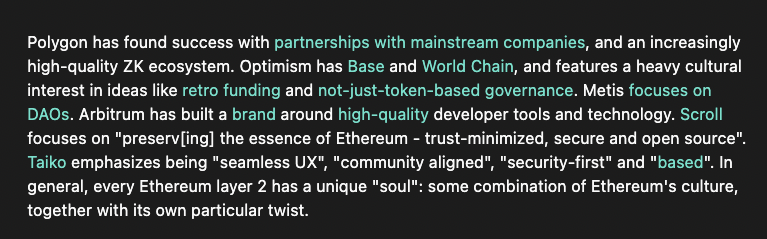
The image above translates as: "Polygon succeeded through partnerships with mainstream companies and an increasingly high-quality ZK ecosystem. Optimism has Base and World Chain, with a strong cultural interest in retroactive funding and token-based governance. Metis focuses on DAOs. Arbitrum has built a brand around high-quality developer tools and technology. Scroll emphasizes preserving Ethereum’s essence—minimal trust assumptions, security, and open source. Taiko prioritizes seamless user experience, community alignment, security-first principles, and human-centric design. Generally speaking, every Ethereum L2 has a unique 'soul': combining Ethereum’s culture with its own distinctive style."
Just as there remains ample room for technical innovation, I believe there's also significant space for cultural innovation among L2s. Few L2s today focus deeply on community building or optimizing the end-user experience. I expect to see more L2s emerge that are dedicated to incentivizing specific communities and crafting better user journeys.
What Does This All Mean?
End users will be the winners. We’ll continue to see L2s deliver lower fees, faster block times, and more optimized experiences. Additionally, applications tailored for specific VMs—previously impossible on standard EVM—will begin to emerge. Every imaginable community will build its own blockchain.
Join TechFlow official community to stay tuned
Telegram:https://t.me/TechFlowDaily
X (Twitter):https://x.com/TechFlowPost
X (Twitter) EN:https://x.com/BlockFlow_News
 @0xCygaar