Electric Capital: The future is multi-chain; don't overlook the impact of crypto social and NFTs
TechFlow Selected TechFlow Selected
Electric Capital: The future is multi-chain; don't overlook the impact of crypto social and NFTs
The importance of NFTs as digital items seems inevitable in an increasingly digital world.
 Navigating Web3 tides with focused insights
Author: STANFORD BLOCKCHAIN CLUB
Guests: Avichal Garg and Maria Shen
Translation: TechFlow
*Note: This article is from Stanford Blockchain Review. TechFlow is an official partner of Stanford Blockchain Review, exclusively authorized to translate and republish.
Introduction
In this article, I interviewed Avichal Garg and Maria Shen from Electric Capital about their insights into the future of cryptocurrency. This piece dives deep into three key topics we discussed: developer activity, crypto social, and NFTs. These discussions help us better understand the evolving trends in the crypto space over the coming years.
Developer Activity
Each year, Electric Capital releases its annual Developer Report, read by hundreds of thousands seeking the most important insights into cryptocurrency developer activity.
To compile this report, Electric analyzed over 480 million crypto-related code commits across more than 800,000 repositories. This exhaustive analysis provides invaluable insights into developer behavior in the crypto space. Additionally, Electric maintains an open-source crypto ecosystem taxonomy, which users can contribute to, and collaborates with major foundations like Optimism, NEAR, and Solana to include up-to-date chain and ecosystem data.
Why publish a developer report? The report began in 2018, following the 2017 ICO boom, as a way to cut through the noise in the crypto space. Given the extreme volatility of crypto, people often focus on misleading quantitative metrics—like price movements—to measure progress. But this approach is fundamentally flawed.
If we believe that crypto is a transformative technology enabling entirely new applications, then the key behavioral metric isn’t price—it’s developer engagement. We should pay attention to those who are making long-term commitments to crypto by investing their time building infrastructure and applications for users.
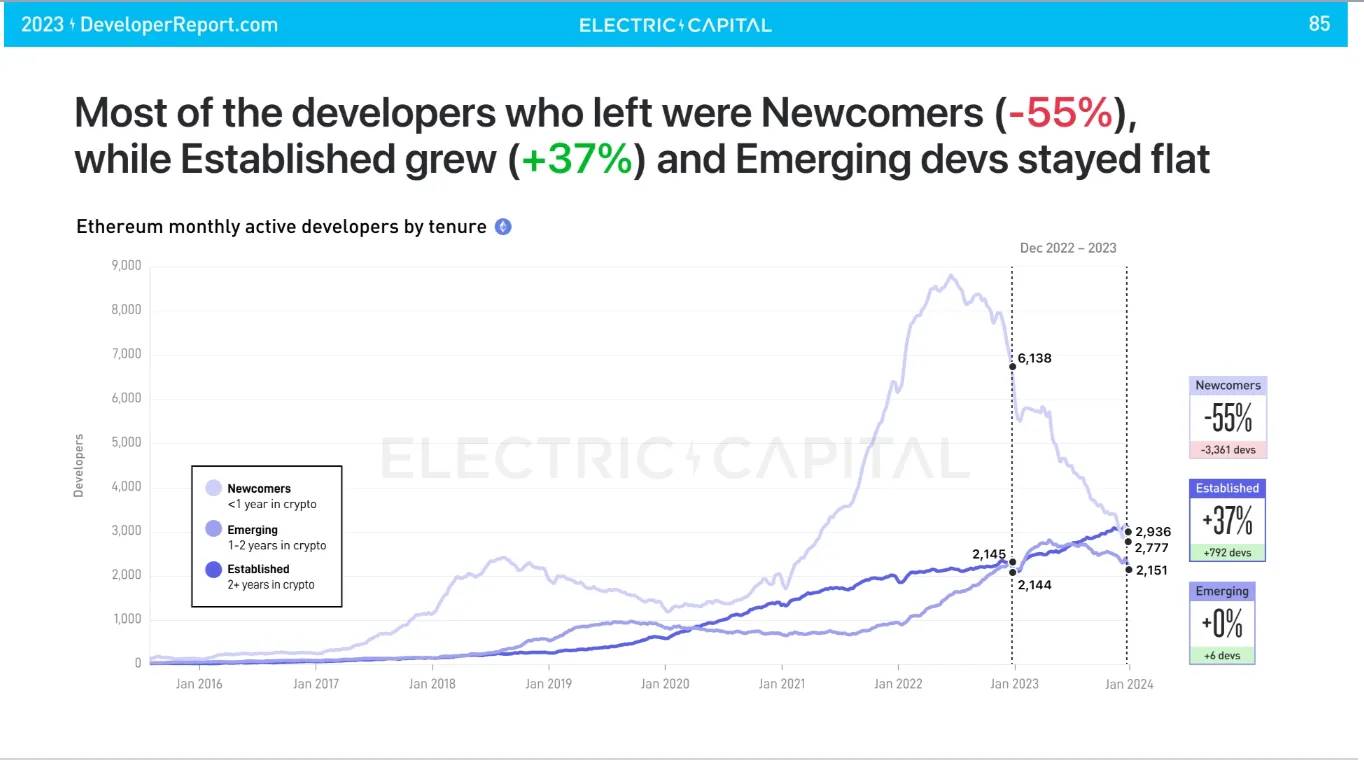
Separating signal from noise: Developer numbers grew in 2023 despite falling prices
Where do developers choose to build? How is the U.S. performing in crypto development activity? What infrastructure and applications are developers most interested in today? By answering these questions, the annual Developer Report delivers powerful signals—helping new developers decide where to build, guiding governments in crafting better crypto policies, and directing investors toward areas where real innovation is happening.
Here are three of my favorite insights derived from Electric’s developer data:
Insight One: The Future is Multi-Chain
The future is clearly multi-chain. Now, over 30% of developers support multiple chains—up from just 3% in 2015, marking a tenfold increase. Moreover, developers supporting three or more chains have grown to 17% of all developers in 2023, a record high.
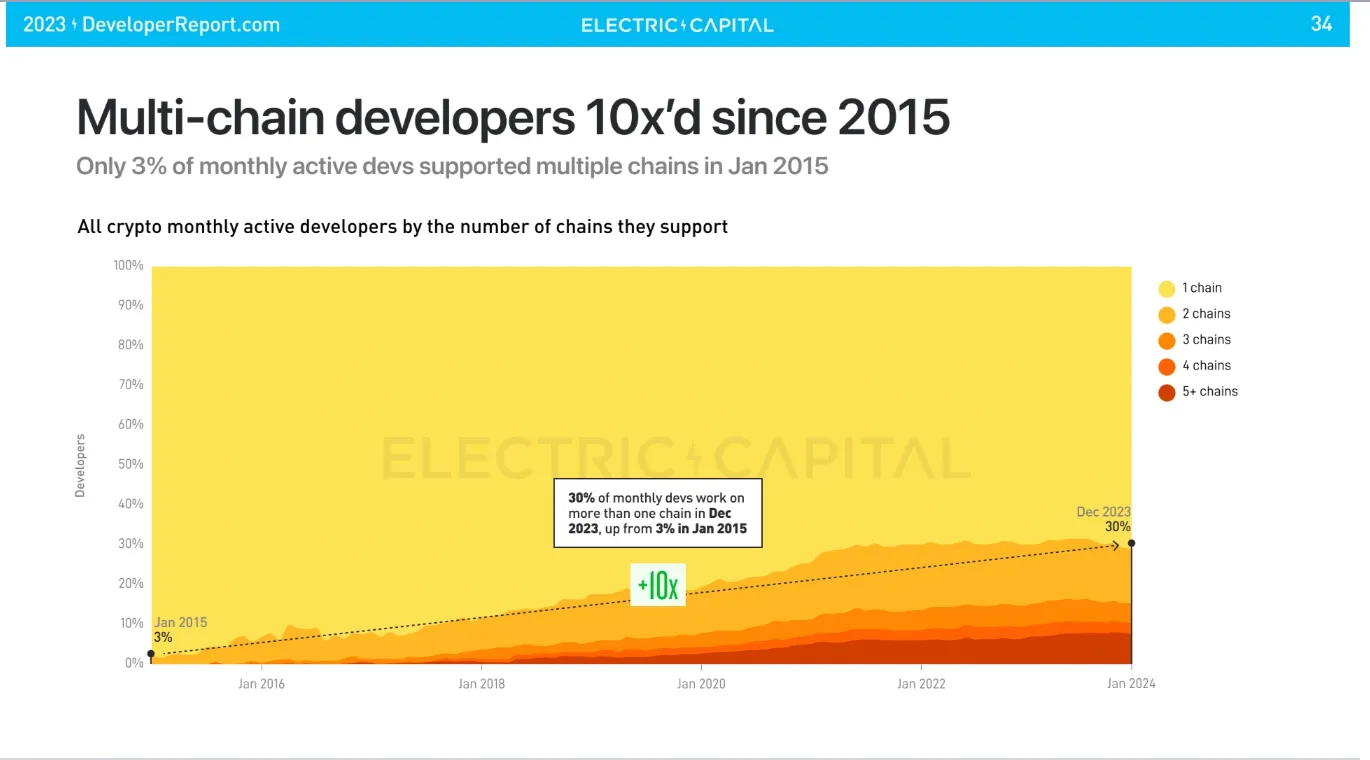
Growth of multi-chain developers
Beyond the headline numbers, the Electric Developer Report offers deeper insights into developer behavior. The 2023 network graph reveals overlapping developer communities across crypto ecosystems. It may not be surprising that Ethereum shares many developers with Layer 2 solutions like Optimism and Polygon, and EVM-compatible chains like BNB and Avalanche. However, it's intriguing to see the overlap between Polkadot and Cosmos developers, or how many Solana developers are also working on Bitcoin projects.
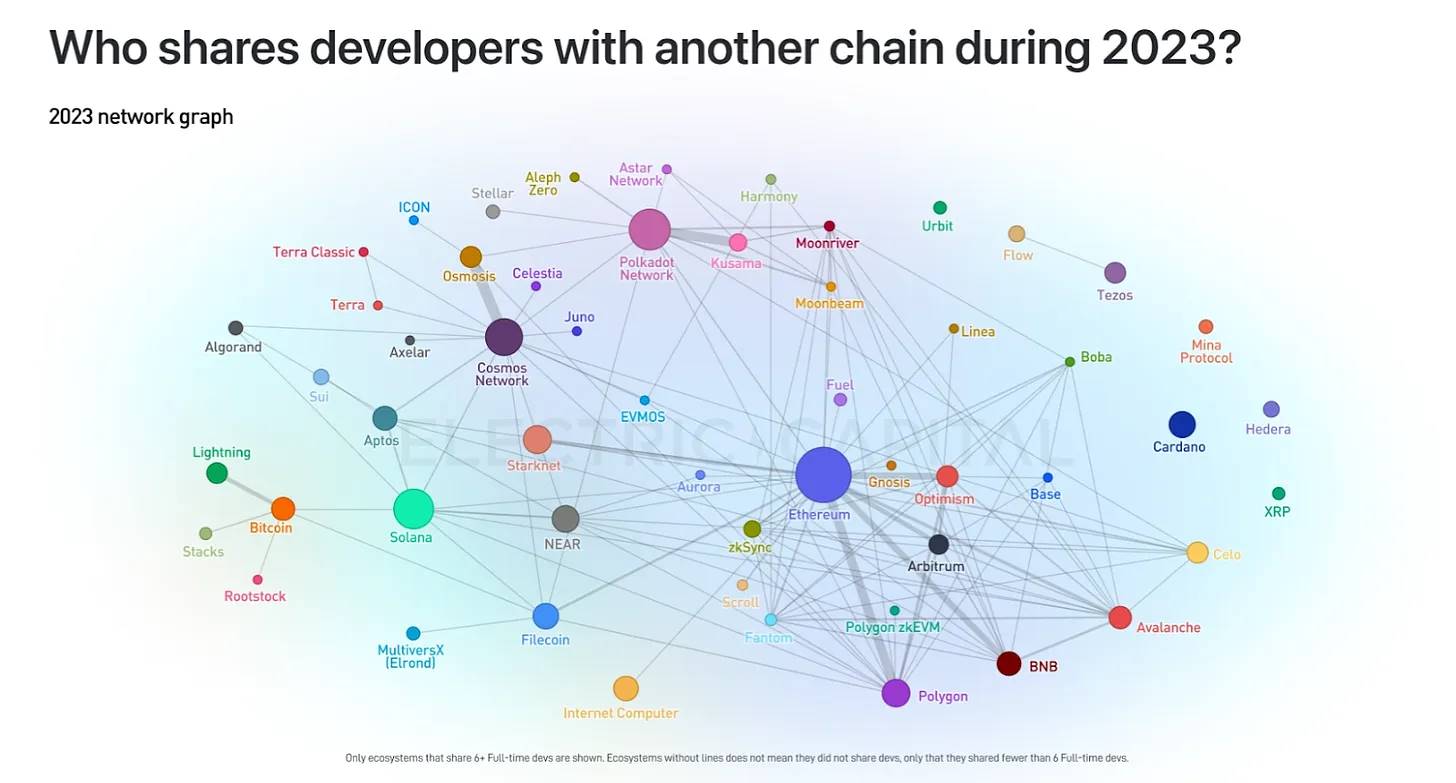
2023 Network Graph: Overlapping Developer Ecosystems
These insights are powerful for various use cases. Teams can use this data to identify the next chain to expand their developer infrastructure. Ecosystem teams can understand the types of developers building on their chain, and investors can focus on specific subsets of crypto ecosystems.
Insight Two: The U.S. Share of Developers Is Declining
By analyzing GitHub self-reported location data and code contributions, we can gain clearer visibility into regional developer activity. In 2023, Europe and Central Asia accounted for the largest share (36%), followed by North America (28%). While France and Germany each held over 5% of crypto developers, India captured 12% of the global crypto developer share in 2023.
Electric doesn’t just analyze regional data for a single year—it tracks shifts over time. One of the most striking findings is that while the overall developer ecosystem is growing, the U.S. share is shrinking. Innovation in crypto is increasingly concentrated outside the United States.
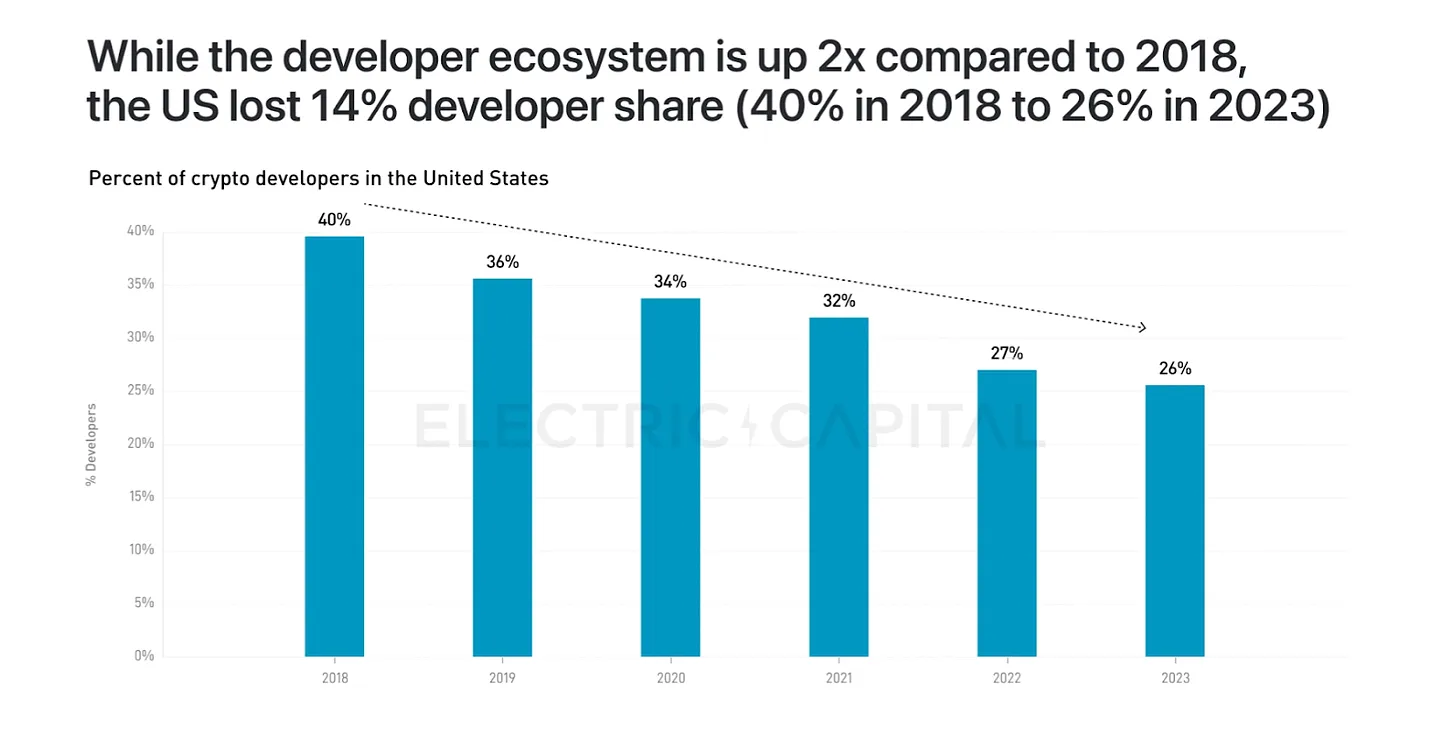
U.S. developer share over time
This data highlights a clear issue of innovation moving offshore—a point cited by U.S. House policymakers advocating for regulatory clarity to support American developers and crypto companies.
Insight Three: The Rise of Bitcoin Layer 2 and Base
Electric’s data shows significant developer growth in two emerging ecosystems: Bitcoin and Base.
Bitcoin is a prime example of how Electric identifies meaningful signals amid noise when measuring crypto progress. Despite extreme market volatility, Bitcoin development has remained strong: over a thousand new developers have joined the Bitcoin ecosystem every year since 2017. Furthermore, with the rise of Bitcoin Ordinals driving transaction volume and innovative proposals like Fraud Proofs and OP_CAT gaining traction, developer activity focused on Bitcoin scaling solutions has visibly increased.
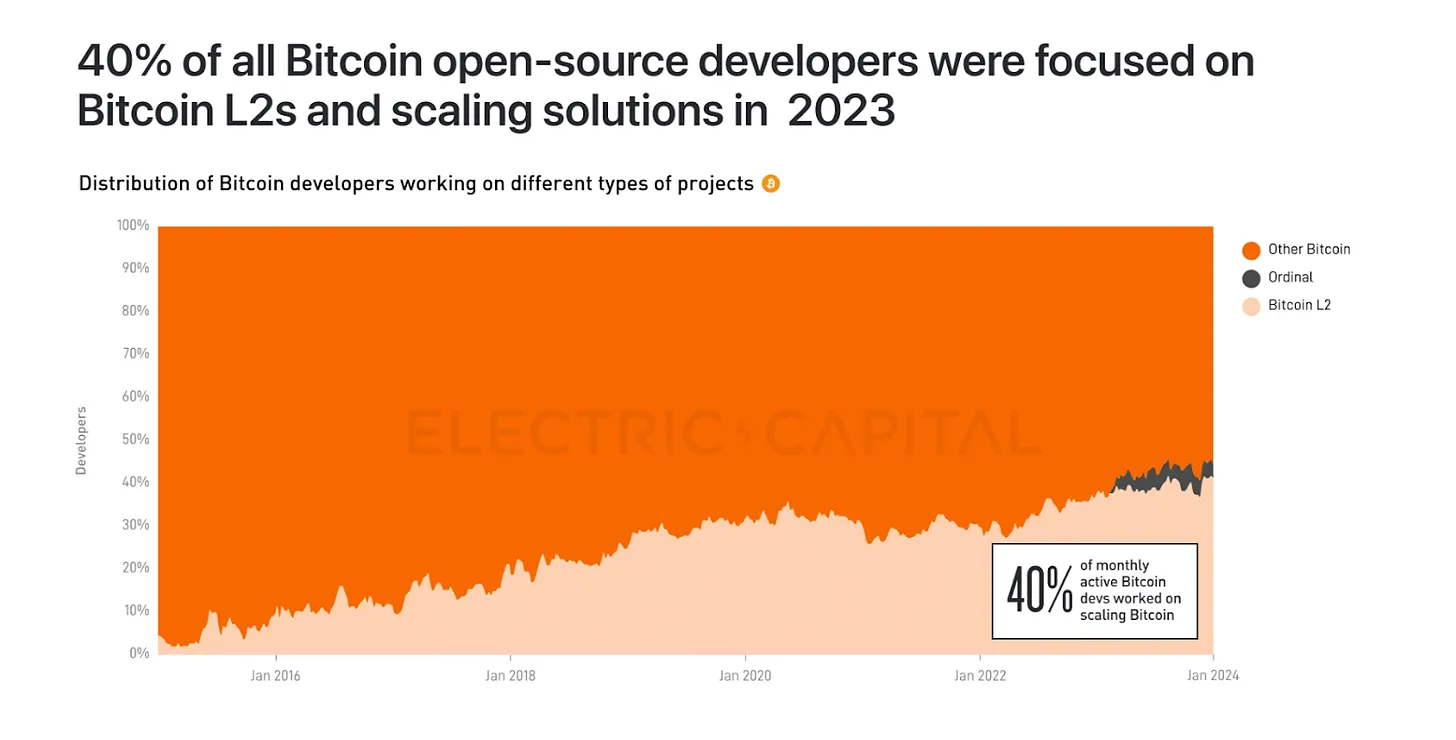
Growth in work on Bitcoin scaling solutions over time
Another ecosystem worth watching is Base. In just over a year since launch, Base has grown to host one thousand active monthly developers—an unprecedented milestone for a new crypto ecosystem.
Overall, the crypto developer ecosystem is experiencing fragmentation. The emergence of new chains like Bitcoin Layer 2 and Base means a wave of experimentation is underway. Fragmentation will likely persist until developers converge on a narrower set of chains that prove most effective.
Crypto Social
As crypto infrastructure improves, the range of possibilities for users expands dramatically. While a single NFT purchase on Ethereum L1 could cost hundreds of dollars in 2021, low gas fees and higher throughput on L2s like Base now enable new experiments—especially for social use cases.
With crypto now offering better user experiences for applications requiring frequent on-chain interactions, social apps are gaining widespread adoption in the crypto space. Friend.tech, a social app allowing creators to create private chat rooms for fans, and Farcaster, a decentralized social media protocol that allows clients to be built on top of it, are leading examples.
BasePaint
Yet, crypto remains in its early stages. Crypto social resembles social media in 2003—a period of massive experimentation. Novel apps like Basepaint, a shared pixel canvas application, exemplify this. On Basepaint, users mint brushes to contribute to a communal canvas; after 24 hours, they can mint an open version. Profits from the open version are distributed proportionally based on the number of pixels contributed by each artist.
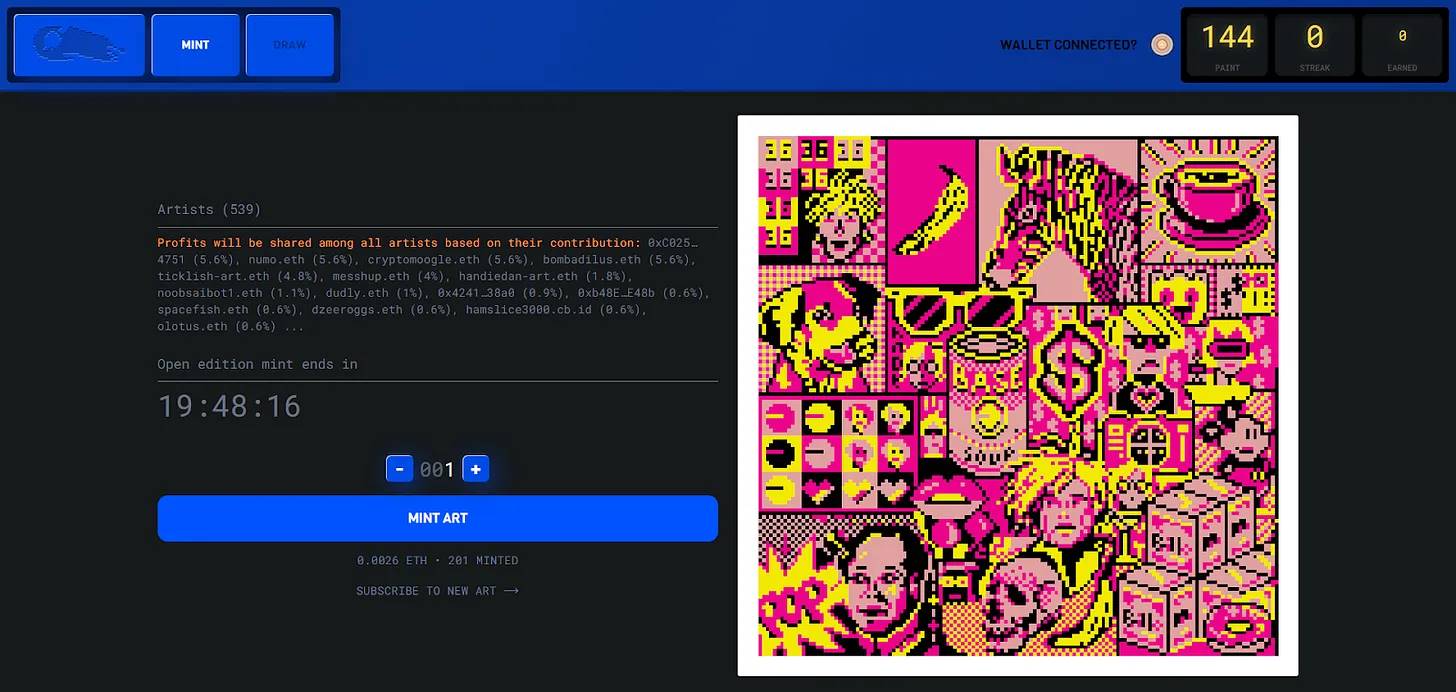
Source: Metaversal.banklesshq.com/p/basepaint
WorldPvP
Another example is WorldPvP, a social app and experiment on Base where 221 countries—each represented by an ERC-20 token—compete to achieve the highest market cap and control nuclear weapons. Players strategically trade and form alliances to increase their token’s value and avoid being nuked.
When a country is nuked, liquidity from its ERC-20 pool is used to buy back half of the attacking nation’s tokens, with the remainder distributed to randomly selected countries. The game lasts 30 days until one nation emerges victorious.
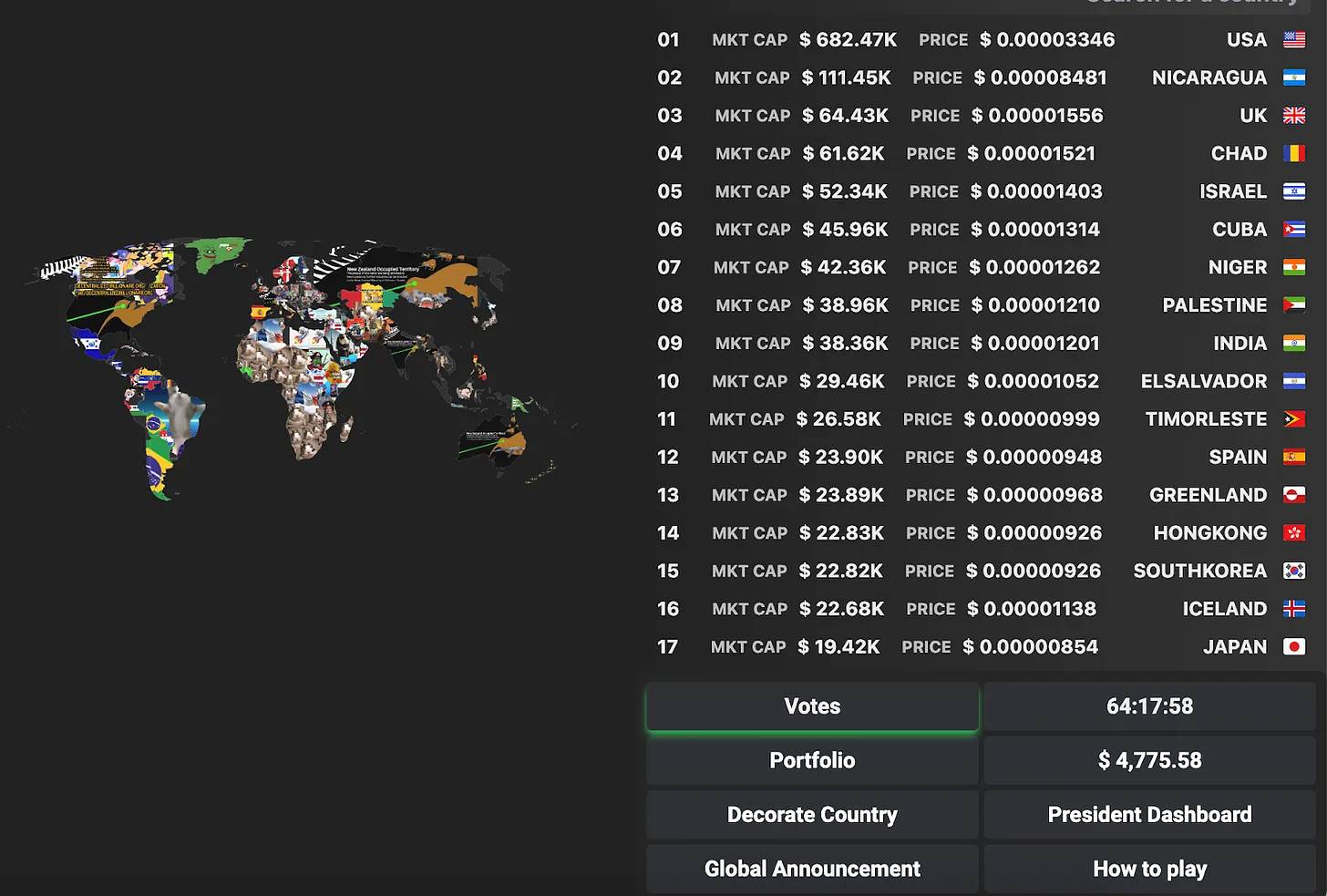
WorldPvP: Highest market cap ERC-20 wins the nuke
Observing experiments like Basepaint, it appears fewer iterations are needed before success. The rise of Friend.tech and Farcaster suggests apps are maturing quickly. On-chain experiments like WorldPvP indicate that the next generation of social apps may be far more gamified than their Web2 predecessors.
NFTs
Electric, as a major investor in MagicEden, holds several insights into the NFT ecosystem. Below are two key takeaways from our discussion.
NFTs Are Multi-Chain
NFTPulse, a tool developed by Electric to quantify and visualize the latest NFT data across ecosystems, shows that NFT trading volume is becoming increasingly multi-chain. While Ethereum dominated NFT trading in 2021 and 2022, the rise of Solana and Bitcoin Ordinals challenged Ethereum’s dominance by late 2023. At times, Bitcoin Ordinals even surpassed Ethereum in weekly NFT transaction volume.
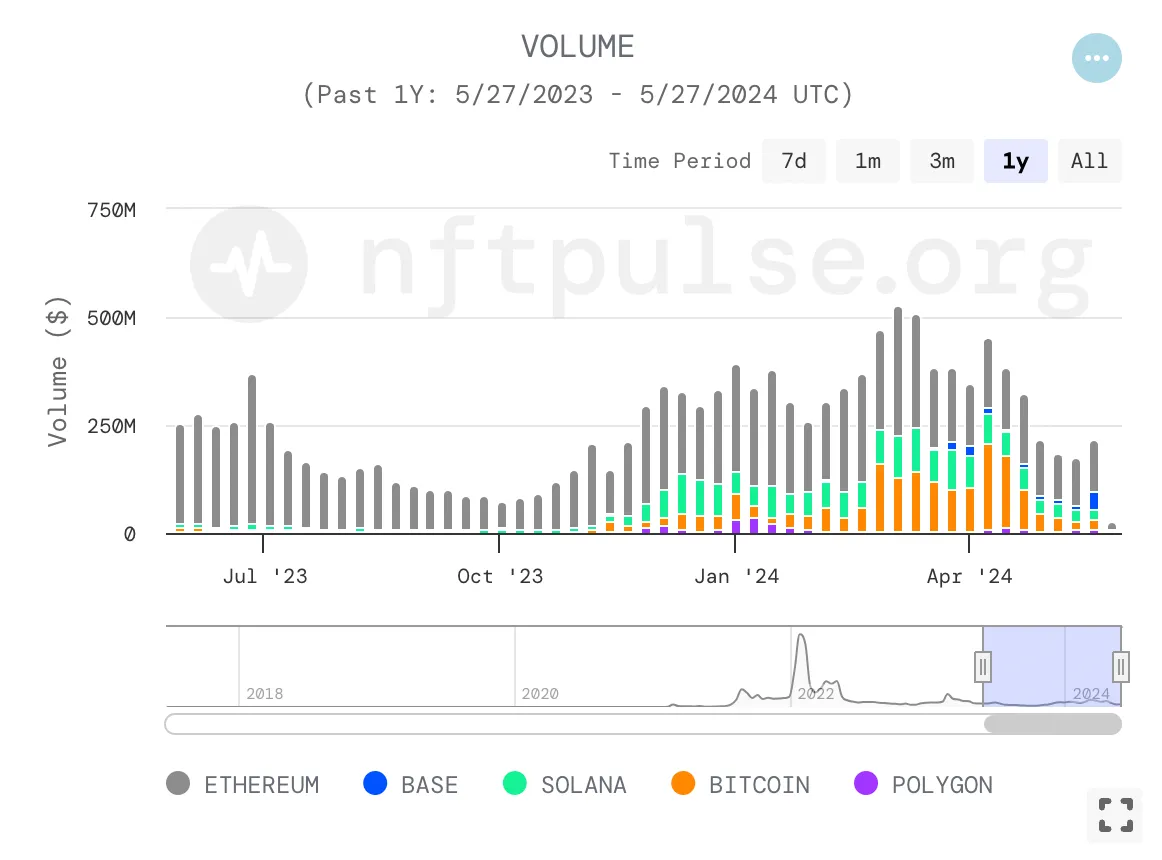
Until fall 2023, Ethereum frequently accounted for over 90% of weekly volume
Even though the user experience of buying NFTs varies across blockchains, NFTs represent digital culture. With the emergence of Ordinals, those passionate about supporting and participating in the Bitcoin ecosystem can now buy and sell Bitcoin NFTs. As Solana grows and develops its own unique culture, Solana NFTs are gaining popularity within the Solana community.
It’s Hard to Be Bearish on NFTs
Being bearish on NFTs is increasingly difficult. As we move toward a more digital world, the need for ownership of digital items becomes critical. We are already in the early stages of EU legislation requiring all fashion and consumer goods to have a “digital product passport” or NFT by 2026 for authenticity and
ownership verification. Moreover, despite the cyclical nature of markets, NFTs—due to their inherent nature as digital objects—will serve as foundational assets for digital music, real estate, collectibles, and luxury goods.
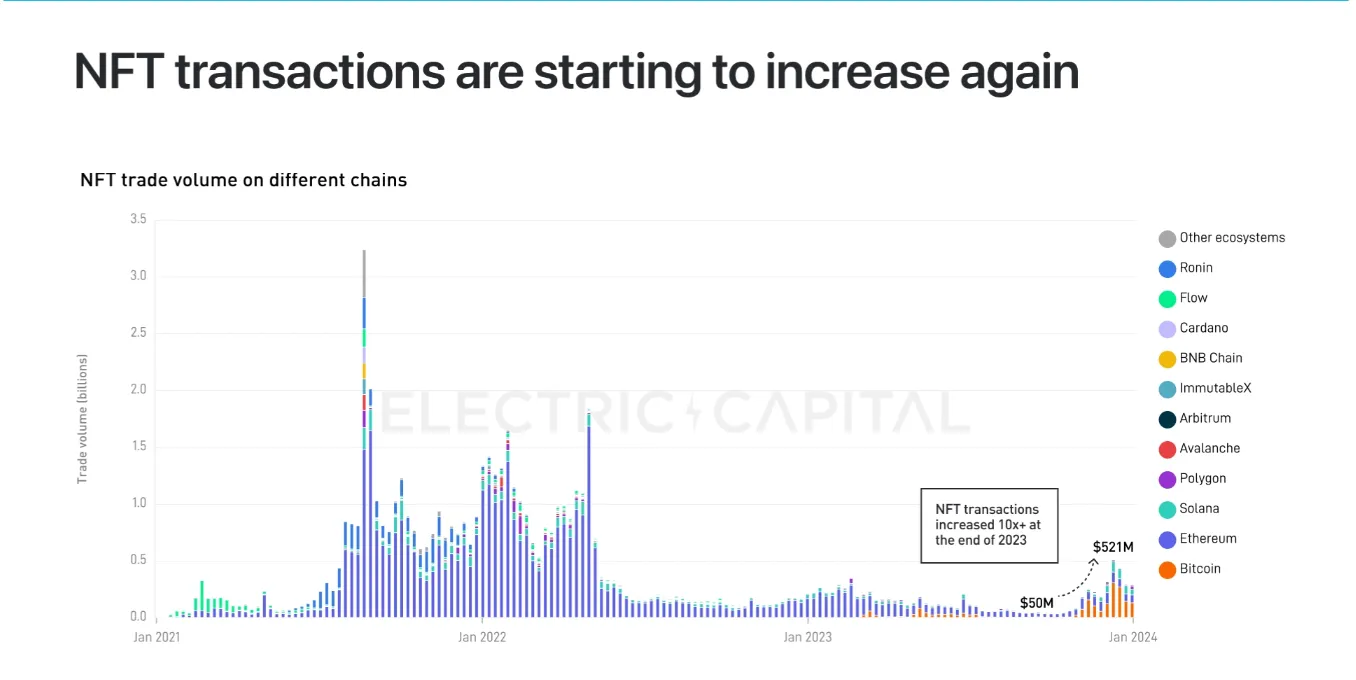
Despite declining NFT activity throughout the bear market, volumes are rising again
Emotional Connection
Unlike fungible tokens, NFTs can form deep emotional connections with their holders. A worn teddy bear bought for $20 might not be worth $20 to most people, but to its owner, that specific bear may hold far greater value. NFTs—including digital art and avatar collections—exhibit similar behaviors for their owners.
NFT owners often develop strong emotional bonds with their holdings. Avichal and Maria, both NFT enthusiasts, deeply understand this. To them, NFTs are more than tradable financial assets. Avichal co-owns several Fidenzas with artist Tyler Hobbs and proudly displays physical prints at home. Maria owns a Milady and even commissioned a custom portrait, highlighting the personal significance these digital assets carry.

Maria’s commissioned Milady portrait
Conclusion
Many of the payment systems we use today—such as ACH and credit card networks—were built in the 1960s and 1970s. Crypto fundamentally reimagines these systems, enabling people to solve new problems and opening up entirely new design spaces for applications.
With the emergence of low-gas, high-throughput blockchains like Base, we’re witnessing an exciting wave of experimentation in crypto social. Early successes like Friend.tech and Farcaster, along with innovative experiments such as Basepaint and WorldPvP, make this moment feel akin to social networking in 2003. The importance of NFTs as digital objects seems inevitable in an increasingly digital world. This is an exhilarating era for crypto, and Electric looks forward to seeing how it all unfolds.
Join TechFlow official community to stay tuned
Telegram:https://t.me/TechFlowDaily
X (Twitter):https://x.com/TechFlowPost
X (Twitter) EN:https://x.com/BlockFlow_News
 Stanford Blockchain Club