








Mind Network Chinese AMA Recap: Ecosystem Catalyst: The Second Half of Restaking
TechFlow Selected TechFlow Selected
Mind Network Chinese AMA Recap: Ecosystem Catalyst: The Second Half of Restaking
Mind Network is the first fully homomorphic encryption (FHE) restaking layer for AI and proof-of-stake (PoS) networks.
 Navigating Web3 tides with focused insights
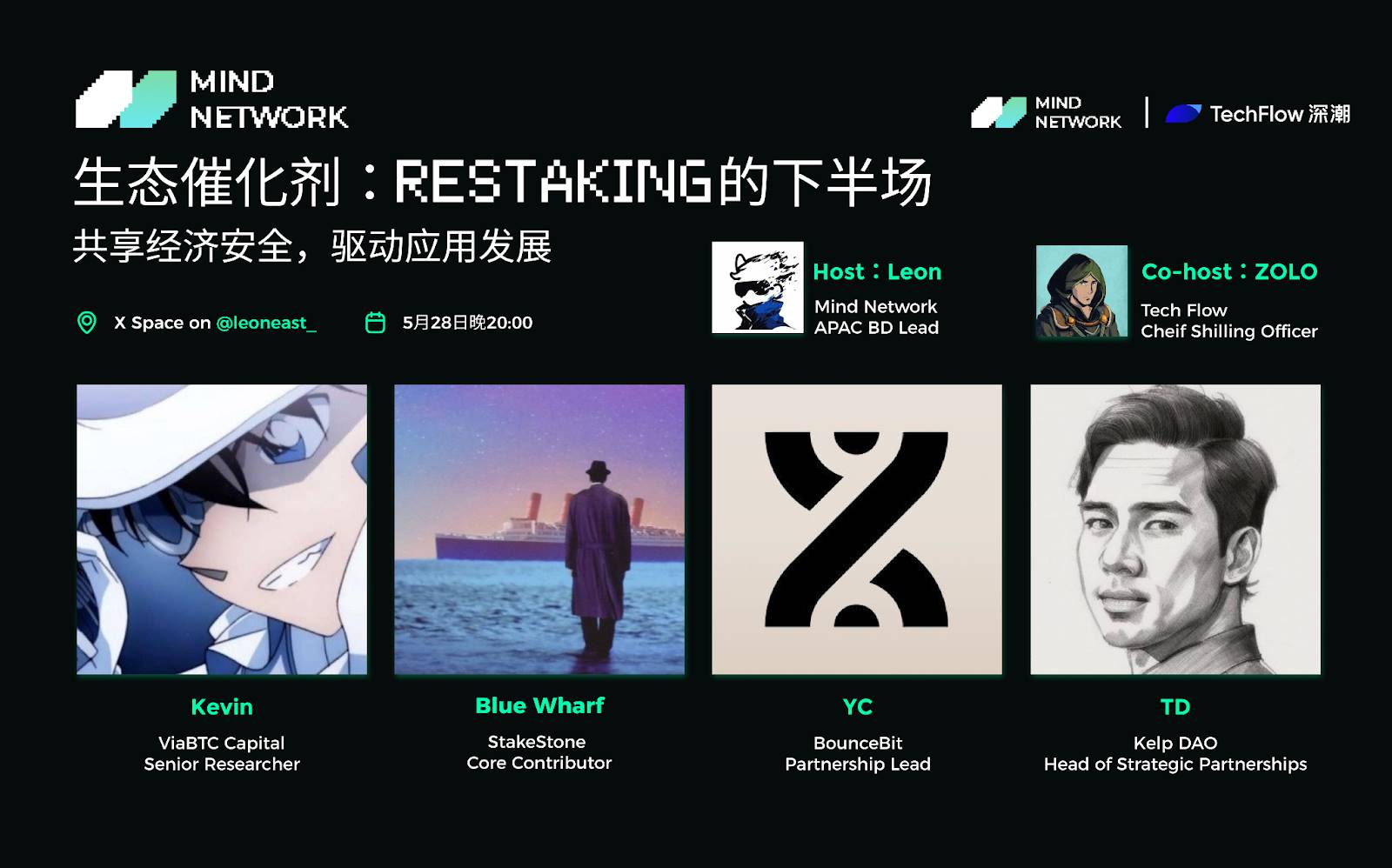
On the evening of May 28, Mind Network—the first FHE-based restaking project—co-hosted a Chinese-language themed AMA titled "Ecological Catalyst: The Second Half of Restaking" with TechFlow. Participants included representatives from ViaBTC, StakeStone, BounceBit, and Kelp DAO.
Guests:
TechFlow Chief Shilling Officer: Zolo
Mind Network APAC Business Development Lead: Leon
ViaBTC Senior Researcher: Kevin
StakeStone Core Contributor: Blue Wharf
BounceBit Partnerships Lead: YC
KelpDAO Strategic Partnerships Lead: TD
Mind Network is the first fully homomorphic encryption (FHE) restaking layer for AI and proof-of-stake (PoS) networks. It supports restaking tokens for ETH, BTC, and leading AI assets, operating as an FHE validation network that brings consensus, data, and cryptoeconomic security to decentralized AI, DePIN, EigenLayer and Babylon AVSs, and many critical PoS networks.
Mind Network’s solution enables verifiable, decentralized computation on encrypted data. Its testnet has already attracted over 650,000 active users and processed more than 3.2 million transactions. Mind Network is backed by Binance Labs, Hashkey, Big Brain Fund, Chainlink, and has received funding from the Ethereum Foundation for its FHE research on Ethereum.
This AMA focused on discussions around restaking. Below is a summary:
-
What changes will occur in the market after the approval of the Ethereum ETF?
Leon
ETF approval lowers the barrier to entry for Ethereum, allowing traditional investors to access the market through ETFs.
Professional institutional investors require new yield opportunities, and restaking can serve precisely this purpose.
Thanks to shared security via restaking, we’ll see more modular and composable application products emerge.
Kevin:
ETF approval strengthens market confidence and reinforces ETH’s position in the market.
It's highly beneficial for core Ethereum ecosystem sectors such as L2s, LSDs, and DeFi, attracting more capital and Web2 users into the space.
Vitalik’s vision is to promote Ethereum’s adoption in Web2 applications and its integration with Web3, thereby catalyzing the emergence of more outstanding projects.
Blue Wharf
The approval of the Ethereum ETF was expected, but its speed came as a pleasant surprise.
However, it will still take a long time before ETF funds flow into restaking-related areas.
On-chain data shows that Ethereum Layer 1 activity has declined significantly, with gas fees dropping as low as 3 Gwei. Most activity now comes from various Layer 2s. Thus, the ETF approval provides a boost effect across the entire ecosystem.
YC
For the Bitcoin ecosystem, the ETH ETF approval isn’t zero-sum—it benefits the entire industry by bringing crypto assets into broader public awareness.
ETF approval represents a battle for pricing power, shifting influence toward traditional institutions.
The correlation between BTC and ETF asset returns may also decrease, as current markets are largely driven by homogeneous speculation.
ETF approval serves as market education and could be seen as a kind of “vampire attack” on traditional financial markets.
TD
RWA is primarily built on Ethereum. Once the ETF is approved, RWA sectors will naturally attract more attention from traditional finance, with Ethereum’s technology forming their foundational layer.
As large funds and institutions join the ETH ecosystem, we may see more innovative applications, along with increased talent and capital inflows.
-
What advantages does restaking offer to users, businesses, platforms, and other participants?
Blue Wharf
Restaking offers a clear and direct solution for projects that have demand but lack sufficient resources to build their own protocols.
But for projects capable of building independently, it’s not a necessity.
The emergence of AVSs gives restaking its value and justification.
Ultimately, BTC, ETH, and even Solana will become essential infrastructure components within L1 ecosystems—indispensable like oracles.
Restaking has created a derivative outcome: a bond market.
AVSs are akin to corporate bonds; different AVSs represent tradable instruments built atop restaking.
StakeStone is prepared and continuously iterating to meet the diverse demands of future markets.
TD
Currently, about 30% of ETH is staked. L2 fees have dropped tenfold, and as staking rates rise, native staking yields decline—making restaking necessary to enhance returns.
On KelpDAO, multiple liquidity protocols are aggregated, enabling participants to earn higher and more diversified yields.
If more institutions and funds enter, they may seek balance between native staking and LSTs based on risk considerations—but overall, this expands the market.
Leon
For users, staking native assets and participating in restaking and AVSs generates additional layers of yield—like holding multiple jobs at once.
But each staking action introduces an additional security assumption, carrying inherent risks.
Mind Network uses Remote Staking technology, allowing assets to remain on their original chain while participating in restaking, thus preserving asset security.
Mind Network’s architecture consists of three layers: the staking layer provides users with staking access and yield.
Mind Chain acts as the consensus layer, providing consensus security via FHE and privacy-preserving fair voting.
Subnets serve as the application layer, connecting protocols and leveraging FHE to provide real-world use cases for restaked assets, improving capital efficiency.
YC
Restaking is fundamentally a revolution in asset efficiency—an amplified yield narrative.
Lending one ether can secure multiple projects simultaneously—akin to leveraging yield without liquidation risk.
Unlike traditional collateral reuse, restaking enables leveraged yield generation with lower risk and richer returns.
EigenLayer nearly monopolizes Ethereum restaking, whereas BTC restaking remains competitive—offering greater opportunity.
Restaking protocols function as yield aggregators—and yield aggregators are traffic gateways, making them fiercely contested.
Kevin
From an exchange perspective, restaking adds new business lines, increases revenue, and attracts user participation.
Integration with Web3 wallets lowers user barriers and improves the restaking experience.
From a VC standpoint, the restaking opportunity is massive—a compelling new destination for deployed capital.
From a mining pool perspective, BTC has lacked engaging use cases. With BTC restaking development, new derivative protocols and interactions emerge, offering miners and users novel income streams.
For miners, this means higher economic yields, diversified income models, and renewed ecosystem vitality driving broader prosperity.
-
Outlook for the Future of the Restaking Sector
Kevin
Emerging markets always involve competition and resource battles—such as the TVL wars.
Restaking will inevitably trigger a new wave of such conflicts, including liquidity wars.
If AVSs accumulate too many users and funds, they may negatively impact other AVSs or gain disproportionate pricing power, creating centralization risks that must be monitored.
Future AVSs may become more modular—distinct yet interconnected—enabling rapid assembly into diverse product forms.
As BTC restaking matures, it may unlock vast new possibilities.
Blue Wharf
The most pressing issue for restaking moving forward is solving exit liquidity—otherwise, dam-like congestion risks arise.
The more TVL absorbed, the harder exits become. High exit difficulty implies underlying instability in these instruments.
Therefore, exit difficulty can serve as a metric for protocol health.
Data farming may offer early advantages, but its value diminishes over time.
High TVL means high liabilities, which in turn increase sell pressure—an unhealthy market structure.
Current AVSs cannot support the massive scale of existing TVL—applications simply can't sustain today’s levels.
StakeStone will likely focus more on compatibility with emerging assets and market shifts—not just points-driven incentives, which ultimately erode trust.
BTC restaking may represent the next alpha opportunity, though it faces tougher challenges.
Because BTC struggles to find real-yield use cases comparable to AVSs, though this won’t stop BTC restaking from growing.
YC
The biggest current challenge for restaking is oversupply.
For example, with $1 billion in TVL and a 1% APR, AVSs would need a $10 million annual security budget—requiring far more applications to sustainably support long-term, recurring revenue.
If restaking evolves into a major asset class functioning as a yield aggregator, its foundation will be traffic—not yield.
The greatest challenge for protocols is growth. Renting liquidity involves not just security—but also traffic acquisition.
In some sense, restaking could evolve into a massive launchpad platform.
TD:
Symbiotic is a notable future competitor to EigenLayer—worth watching.
A key difference is support beyond ETH—to include ERC-20 assets.
Though EigenLayer leads, further innovation will emerge in this space.
Leon:
The future of restaking depends on more real-world applications and clear yield sources.
Mind Network delivers its products via Subnets, using restaking to provide secure consensus for AI and DePIN networks.
For example:
Imagine a CryptoAI project needing multiple nodes to vote on model output authenticity during training.
Voting can lead to herding and plagiarism, compromising model integrity and network security.
Mind Network uses FHE to encrypt votes, ensuring anonymity so validators must make independent, fair decisions to earn rewards.
For decentralized data and compute markets like Bittensor and Io.net, Mind Network enhances security via FHE-encrypted validation.
During subnet usage, nodes provide services secured by Mind Network’s consensus, and associated fees are ultimately redistributed to users as yield.
Join TechFlow official community to stay tuned
Telegram:https://t.me/TechFlowDaily
X (Twitter):https://x.com/TechFlowPost
X (Twitter) EN:https://x.com/BlockFlow_News
 @mindnetwork_xyz


