From Wallet to Ecosystem Platform: A Comprehensive Analysis of Bitget Launchpad's BWB Listing
TechFlow Selected TechFlow Selected
From Wallet to Ecosystem Platform: A Comprehensive Analysis of Bitget Launchpad's BWB Listing
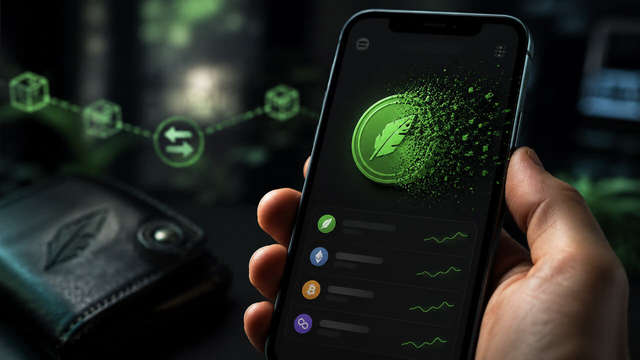
This article will introduce the Bitget Wallet product, ecosystem, and BWB token economics, as well as briefly discuss its market competitiveness and future development potential.
 Navigating Web3 tides with focused insights
Author: Kazmin
The Bitget Launchpad project, Bitget Wallet (BWB), initiated its snapshot on June 1, 2024 at 11:00, marking another major milestone following the March announcement of its ecosystem token BWB and points airdrop program. This BWB launch adopts an investment model, requiring users to deposit BGB or USDT during the holdings snapshot phase to qualify for purchase allocations. Since the initial BWB token announcement in March, I have closely followed Bitget Wallet. For those interested, this article will introduce Bitget Wallet’s product, ecosystem, and BWB tokenomics, while briefly discussing its market competitiveness and future potential.
An Industry Veteran Defining Modern Wallet Standards
Bitget Wallet is a one-stop Web3 wallet and stands as a seasoned veteran among the top five mainstream wallets—MetaMask, OKX Web3, Bitget Wallet, Rainbow, and Zerion. Public data shows it has over 20 million global users and surpassed MetaMask in swap transaction volume and value in April 2024.

Originally launched as BitKeep in 2018, Bitget Wallet was relatively unknown until it gained prominence during the DeFi Summer of 2020 by offering DEX coin market data and related features. It quickly rose to become a leading DeFi platform in the Chinese-speaking community, with nearly every Chinese DeFi participant using BitKeep for token queries and trades.
In 2022, Bitget Wallet secured a $15 million Series A funding round led by Dragonfly Capital, achieving a $100 million valuation. The following year, it received a $30 million investment from Bitget—one of the world’s top ten centralized exchanges and top five derivatives exchanges—raising its valuation to $300 million. Subsequent support from prominent institutions like Dragonfly Capital further accelerated Bitget Wallet’s growth and development.
Since then, Bitget Wallet has continuously innovated, adding practical features such as Swap, cross-chain bridges, NFTs, and DApps, gradually evolving into its current comprehensive structure. Today, Bitget Wallet integrates a multi-chain wallet with cross-chain trading, AI-powered market data, an NFT marketplace, DApp browser, inscription platform, Launchpad, and earn center. While this feature set may now seem common among popular wallets, it was actually pioneered and defined by Bitget Wallet itself.
Horizontal Comparison Among Mainstream Wallets
Let’s compare Bitget Wallet with two other leading wallets: MetaMask and OKX Web3.
First, MetaMask—its industry dominance is well known; in fact, it was my first crypto wallet. However, MetaMask has clear limitations: lack of robust multi-chain support, absence of integrated DeFi tools, and inability to aggregate and display total asset value across all chains within a single wallet. These shortcomings make interacting with various DeFi protocols and airdrop projects cumbersome. That said, criticizing MetaMask on these grounds may be unfair—it may simply adhere to a minimalist “personal key wallet” philosophy, much like Bitcoin’s elegant yet limited design. Nonetheless, user preferences are shifting, pointing toward what modern users expect from a wallet.
Contrasted with traditional wallets like MetaMask, Bitget Wallet’s pioneering nature becomes strikingly evident—a testament to the team’s agility in identifying and fulfilling user needs:
- First wallet built with a full-chain perspective—while most wallets align with individual blockchains, Bitget Wallet broke down chain silos early, enabling users to manage multi-chain assets from a single interface.
- First to integrate DEX market data—starting with on-chain Ethereum data and expanding to multiple chains, offering real-time intelligent price tracking and trending token lists.
- First to enable and promote seamless cross-chain swaps—allowing users to transfer assets freely between public chains without needing to understand concepts like gas fees or cross-chain bridges.
- First to launch an in-wallet Launchpad—enabling users to participate in new token launches directly within the wallet and capture emerging profit opportunities.
OKX Wallet, backed by OKX, operates as both a standalone browser extension and an embedded wallet within the OKX app—both web and mobile versions are designed primarily as extensions of the exchange. This differs significantly from Bitget Wallet, which, despite also being exchange-backed, maintains greater independence. There isn’t much more to add about OKX—it offers equally smooth UX and rich, user-friendly features that provided excellent experiences during my interactions with airdrops and DeFi protocols.
Since the start of this bull market, several wallets have entered the spotlight—Backpack, Venom, Uniswap Wallet, and the newly launched Binance Web3, among others. Yet across the entire wallet landscape, MetaMask—the former king—appears to be losing momentum, while Bitget Wallet and OKX Web3 are surging ahead, leaving competitors far behind. Given the high technical barriers in wallet development, it’s hard to imagine any new entrant disrupting this two-horse race. Still, we can hope someone will eventually lead the next evolution in wallet design.
From Wallet to Ecosystem Platform: A Six-Year Vision?
Integrating so many functions into a single product clearly signals Bitget Wallet’s ambition to redefine the wallet—not just as a “personal key vault,” but as a “Web3 ecosystem platform.” This mirrors the Chinese tech tradition of transforming successful products into expansive ecosystems—a path already taken by WeChat, Alipay, and TikTok in the Web2 era.
Indeed, Bitget has demonstrated a clear vision of extending Bitget Wallet into a decentralized future via its Bitget Onchain Layer, ultimately forming a complete Bitget Ecosystem. The official roadmap outlines this strategy in detail—I’ll summarize and highlight key aspects here.
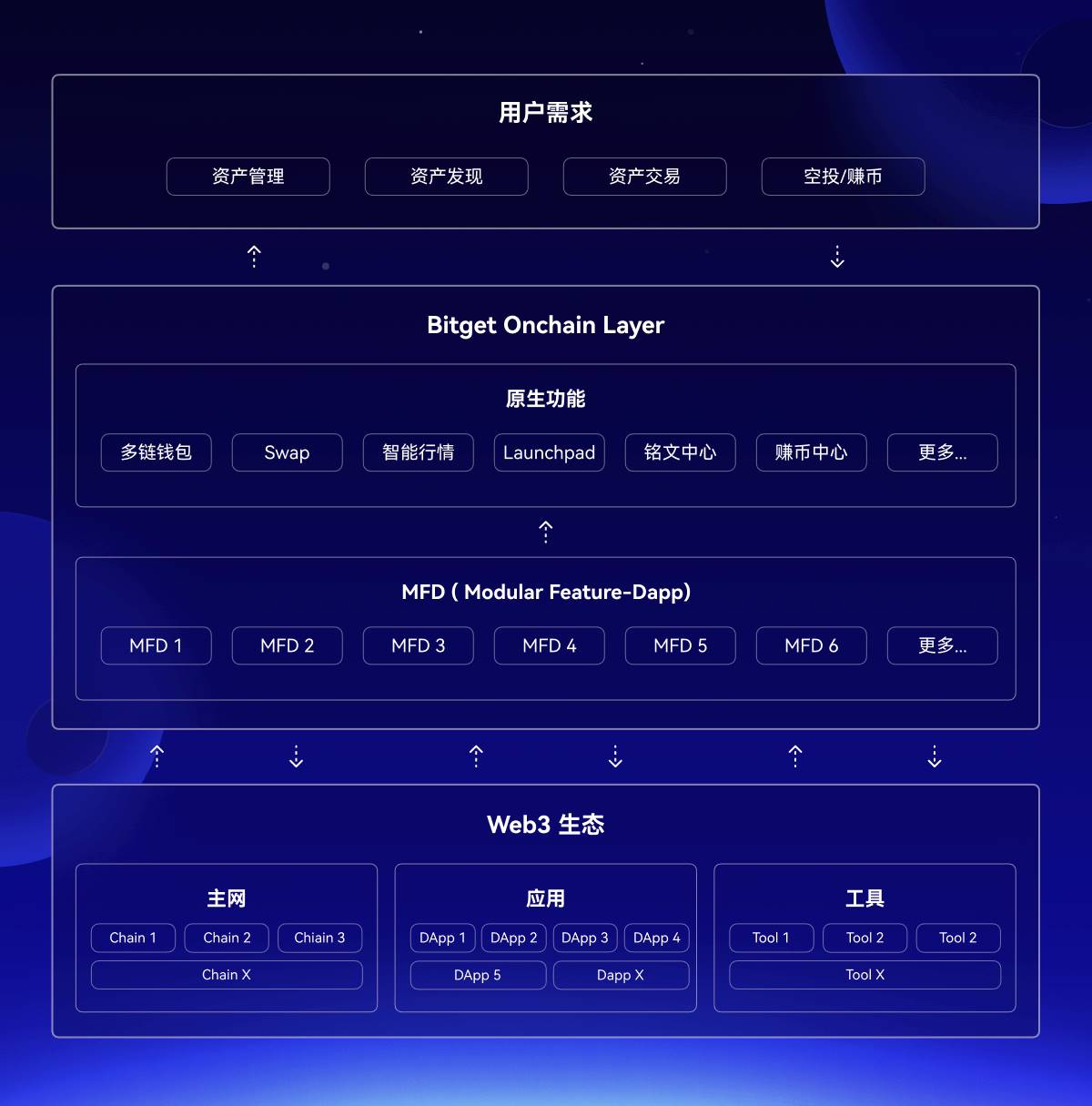
Currently, the Bitget Ecosystem is focused on redefining Web3 wallets and building the Bitget Onchain Layer.
Redefining the Web3 wallet means transitioning from a simple “entry point” to a full-fledged “platform.” Core user needs in Web3 fall into four categories: asset management, asset discovery, asset trading, and earning through airdrops—all addressed effectively by Bitget Wallet’s current feature set.
The construction of Bitget Onchain Layer consists of three pillars:
- Aggregated Trading Services: Through its native Bitget Swap, Bitget Wallet aggregates hundreds of DEXs across nearly 50 public chains, delivering optimal trade routes. It also offers gas-free and instant trading modes. This aggregation simplifies user operations while significantly reducing costs and risks, greatly enhancing convenience.
- Security and Liquidity: On security, Bitget Onchain Layer protects users from malicious DApp attacks. On liquidity, Bitget Swap not only pools on-chain spot liquidity but also taps into OTC, derivatives, and pre-market sources—greatly improving trading flexibility and accessibility.
- User Experience Enhancement: Committed to a “Mobile First” philosophy, Bitget Wallet provides standardized SDKs and UI KITs to help DApps deliver native-like mobile experiences. This mobile-centric approach will accelerate mainstream crypto adoption and improve usability on smartphones.
The next step is open ecosystem co-construction. To this end, Bitget Wallet has established a $10 million BWB Ecosystem Fund to donate to and invest in high-quality projects, especially those related to on-chain trading. This demonstrates deep industry engagement and support, providing developers with abundant resources and a thriving platform for innovation.
By collaborating with industry developers, Bitget Wallet will build MFDs (Modular Function DApps). These MFDs can operate as standalone DApps or be integrated as functional modules within Bitget Wallet. This flexible architecture meets diverse user needs while helping developers and DApp teams generate revenue.
Overview and Analysis of BWB Tokenomics
Officially, BWB is positioned as the native ecosystem token of Bitget Wallet and the system token of Bitget Onchain Layer, serving multiple roles: governance, staking, participation in Bitget Wallet Launchpad and airdrop events, eligibility for Bitget platform activities, access to future airdrops from Bitget Onchain Layer projects, and payment of multi-chain gas fees after the rollout of AA wallets.
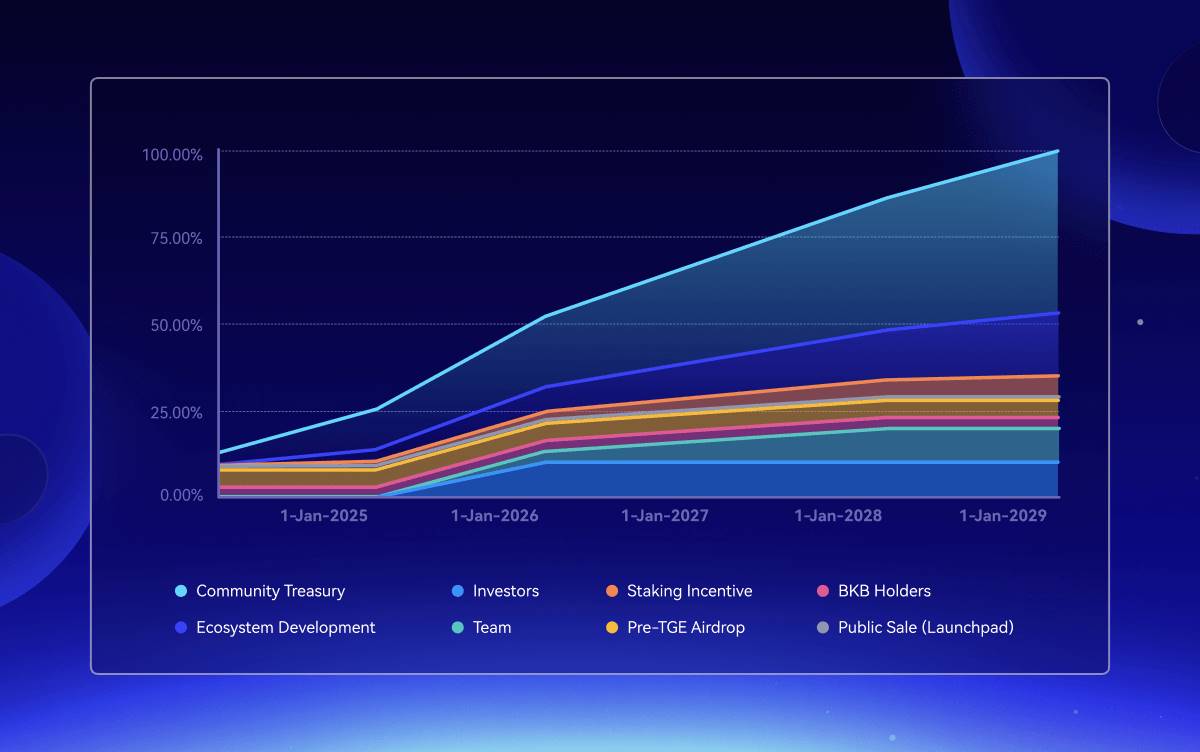
The total supply of BWB is 1 billion tokens, allocated as follows:
- Private Investors: 10%, linearly released over 12 months after a 12-month lock-up.
- Public Sale: 1.1%, with 0.1% distributed via Bitget Wallet’s Launchpad.
- Pre-TGE Airdrop: 5%, for users participating in airdrop campaigns.
- BKB Holders: 3%, convertible by holders of BitKeep’s legacy points (BKB).
- Team: 10%, linearly released over 36 months after a 12-month lock-up.
- Ecosystem Development: 18%, unlocked linearly post-TGE to support ecosystem growth.
- Staking Incentives: 6%, to reward users who stake BWB.
- Community Treasury: 46.9%, for user growth and community incentives, with 6.9% released at TGE and the rest gradually unlocked.
Tokens will be distributed over five years according to the release schedule shown below.
I evaluate the BWB tokenomics from the following perspectives:
1. Reasonableness of Allocation
The BWB allocation reflects Bitget Wallet’s comprehensive planning and long-term vision for ecosystem development:
- Private and Public Sales: Together accounting for 11.1%. The lock-up and gradual release for private investors help maintain market stability and prevent massive dumping. Although the public sale portion is small, the Launchpad distribution increases accessibility for retail users.
- Team and Ecosystem: Team allocation at 10% with a long vesting period incentivizes sustained commitment and talent retention. Ecosystem allocation at 18% is notably high, underscoring strong commitment to expansion and innovation, laying a solid financial foundation for future growth.
- Community and Staking Incentives: Community Treasury at 46.9% (with 6.9% at TGE) fuels user acquisition and engagement, ensuring vibrant community activity. Staking rewards (6%) encourage token holding, stabilize price, and deepen user involvement.
2. Diversity of Token Utility
BWB’s multiple use cases within the Bitget Wallet ecosystem enhance its utility and demand—governance, staking, multi-chain gas fee payments, platform participation, and airdrops. These functions enrich user experience and boost token circulation and intrinsic value.
3. Feasibility of Release Schedule
The five-year gradual release plan helps control supply, preventing excessive inflation and sell pressure. While this may seem conservative for yield farmers, it reflects a focus on long-term stability and confidence in ecosystem participants.
4. Potential Market Impact
The BWB token design reveals Bitget Wallet’s deep understanding of market dynamics:
- Liquidity and Security: Multi-chain deployment and strict lock-up terms ensure token liquidity and market safety.
- User Engagement and Community Growth: Multiple incentive mechanisms drive active participation and healthy community development.
- Innovation and Expansion: High ecosystem funding allocation supports ongoing innovation and scalability, demonstrating strong execution of long-term strategy.
5. Potential Returns
Compared to other wallets, BWB appears undervalued:
- Total BWB Supply: 1,000,000,000 BWB
- Circulating Supply: 123,361,000 BWB (~15% circulating rate)
- Points Conversion Rate: 4.1 BWB Points = 1 BWB
Current off-exchange BWB points price: $0.15, equivalent to ~$0.615 per BWB. This implies a market cap of ~$76 million and a fully diluted valuation (FDV) of ~$615 million. With the project previously valued at $300 million, the current FDV suggests significant upside potential. Given the team’s ambitious vision, returns for early participants could be substantial.
Long-Term Vision to Lead Web3 Forward
It’s clear that Bitget Wallet—and the broader Bitget Onchain Layer it enables—is more than just a tool or platform. It’s a comprehensive ecosystem delivering end-to-end services from asset management and trading to value creation. Looking back, Bitget Wallet has long been a crucial part of a consistent long-term strategy, executed with relentless innovation—a rare form of long-termism in today’s volatile Web3 landscape.
I deeply respect all teams and projects in Web3 that embrace long-term thinking. Beyond its exceptional product quality, Bitget Wallet demonstrates profound user insight, sharp demand detection, and rapid iterative innovation—qualities that serve as a powerful foundation for executing any strategic vision.
Finally, I hope BWB continues to expand its role within the ecosystem, enabling broader applications and utilities, and ultimately shaping a successful evolution path for the Bitget Onchain Layer and Bitget Ecosystem—just as it once defined the blueprint for modern wallet design.
Join TechFlow official community to stay tuned
Telegram:https://t.me/TechFlowDaily
X (Twitter):https://x.com/TechFlowPost
X (Twitter) EN:https://x.com/BlockFlow_News