Token Launch Imminent: A Comprehensive Analysis of AO's Technical Principles and Ecosystem Potential
TechFlow Selected TechFlow Selected
Token Launch Imminent: A Comprehensive Analysis of AO's Technical Principles and Ecosystem Potential
This article will primarily introduce the technical principles of AO and its related ecosystem.
 Navigating Web3 tides with focused insights
Authors: Charlotte, Kevin; Metrics Ventures
1 Starting with Storage: AO Revitalizes Arweave
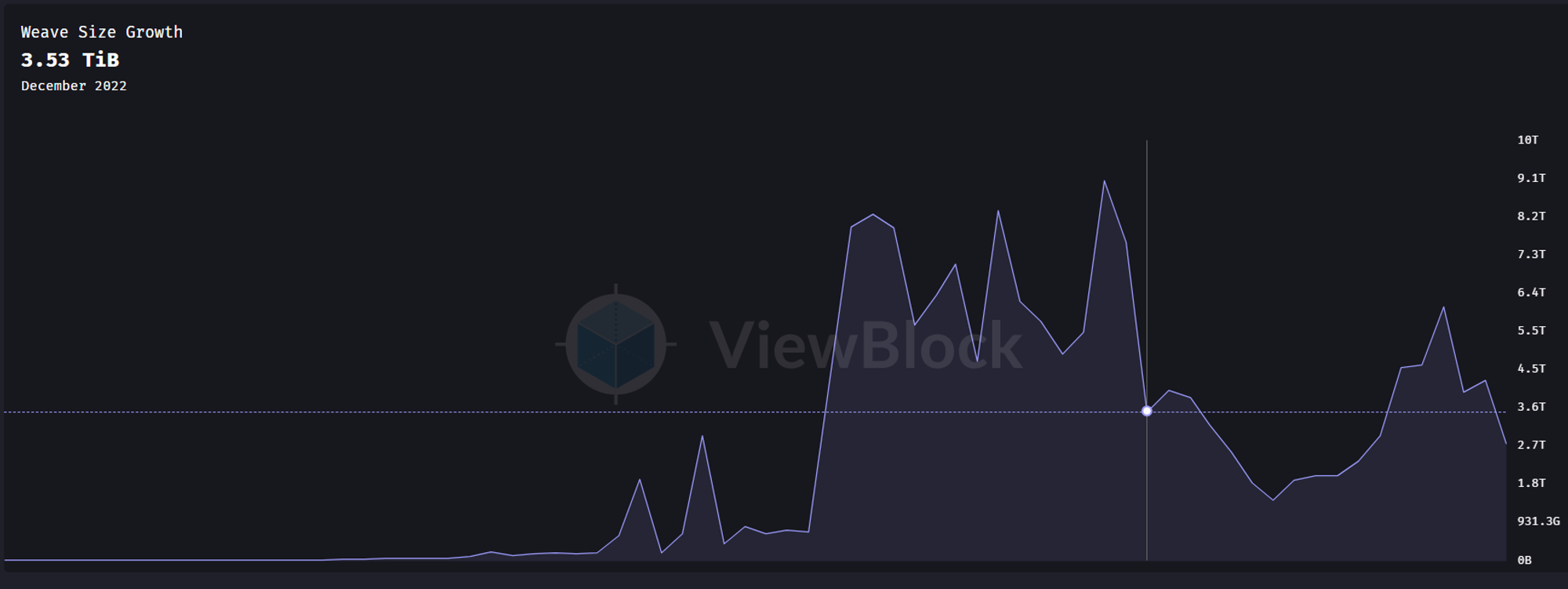
Arweave's mainnet launched on November 18, 2018. Over the past five-plus years, it has undergone 13 major upgrades, focusing on providing permanent decentralized storage services. However, analyzing network data reveals that these upgrades have not truly established a moat for Arweave. Observing its business metrics:
After entering 2023, Arweave’s storage growth noticeably slowed, with incremental storage data sharply declining. Monthly network storage volumes have largely fluctuated between 2–4 TiB, hitting a low of just 1.43 TiB in June. Total annual storage volume for 2023 reached only 32.96 TiB. In contrast, Filecoin’s network stored over 1.8 EiB (1 EiB = 1,048,576 TiB) in the same year. Clearly, in the realm of decentralized storage, Arweave cannot challenge Filecoin’s dominance and faces significant challenges in scaling its business.
Beyond struggles in direct competition, Arweave’s niche—decentralized storage—is relatively distant from average retail users who lack strong incentives to adopt it and cannot easily perceive fundamental changes. During the latest bull market, decentralized storage benefited somewhat from narratives around AI and DePIN, but this was largely "old wine in new bottles," failing to capture substantial market attention.
This困境 is also reflected in token price performance. Over a one-year period up until February 2024, AR traded within a narrow range of $6–$10, significantly underperforming BTC and showing no reaction to mainnet upgrades or broader bull market trends—until founder Sam announced the official launch of AO on February 14.
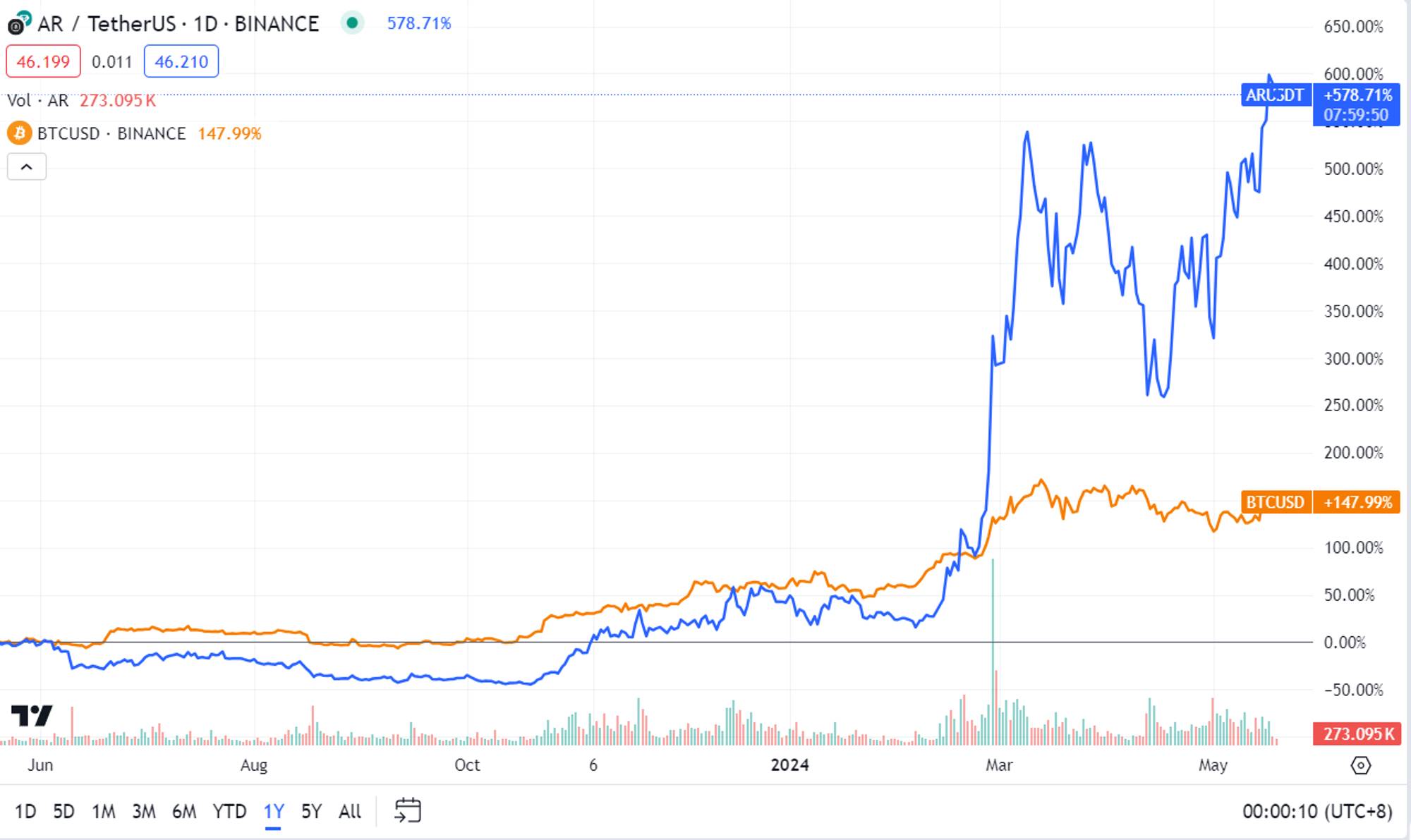
As a storage protocol, Arweave can be seen merely as a hard drive. A standalone hard drive cannot support expansive narratives or diverse use cases. For a long time, Arweave relied on other protocols utilizing its “hard drive,” with limited success. Its infrastructure remained too far removed from end-users and lacked market visibility. Thus, Arweave built a perfectly compatible CPU for its hard drive—AO—which propelled the AR token price from $8 to nearly $50. This article will primarily explore AO’s technical principles and ecosystem.
1.1 AO Technical Principles: How Does It Achieve Verifiable Infinite Computation?
AO is an Actor-Oriented computer running on top of Arweave, designed as an environment capable of hosting any number of parallel processes that coordinate via an open message-passing layer.
The core features of AO can be summarized in two points:
(1) An arbitrary number of processes run in parallel—enabling infinite scalability of computational power;
(2) Computation results are verifiable and reproducible, achieving minimal trust assumptions.
Before explaining how AO achieves these capabilities, let’s first understand its basic components. The AO system consists of two fundamental units—processes and messages—and three key functional roles: Scheduler Units (SU), Compute Units (CU), and Messenger Units (MU).
-
Process: The unit of computation in the network. A process’s state can be computed by a compute unit, and it can receive messages from users or other processes. Formally, $P_i$ represents the $i^{th}$ process, defined as $P_i = (Log_i, Init_i, Env_i)$, where $Log_i$ is the ordered sequence of all messages received by $P_i$, $Init_i$ is the initialization data of $P_i$, $Sched_i$ is the scheduler for $P_i$, and $Env_i$ is the execution environment of $P_i$. At any given step, the state of $P_i$ is $S(P_i) = F(Log_i, Env_i)$, where function $F$ is defined by $Env_i$ and computes the state based on the message log.
-
Message: Every interaction with a process in AO is represented as a message. Messages are essentially data items conforming to the ANS-104 standard. Message format uniformity is crucial—the entire AO environment settles and processes interactions through standardized messages on Arweave’s decentralized data layer.
-
Scheduler Unit (SU): Responsible for assigning atomic, incrementally numbered time slots (similar to Ethereum nonces) to messages sent to processes—essentially ordering process messages. After assignment, the scheduler ensures the data is uploaded to Arweave, making it permanently accessible to others.
-
Compute Unit (CU): Nodes responsible for computing the state of processes in AO. CUs form a decentralized compute market similar to Akash Network. They compete with each other to provide state computation services. Upon completion, a CU returns both the result and a signed state proof. Users distrustful of a single CU can request computations from multiple CUs. CUs must stake collateral; if they submit incorrect states, their stake is subject to slashing.
-
Messenger Unit (MU): Receives incoming messages from clients, routes them to the appropriate Scheduler Unit, and retrieves results from Compute Units.
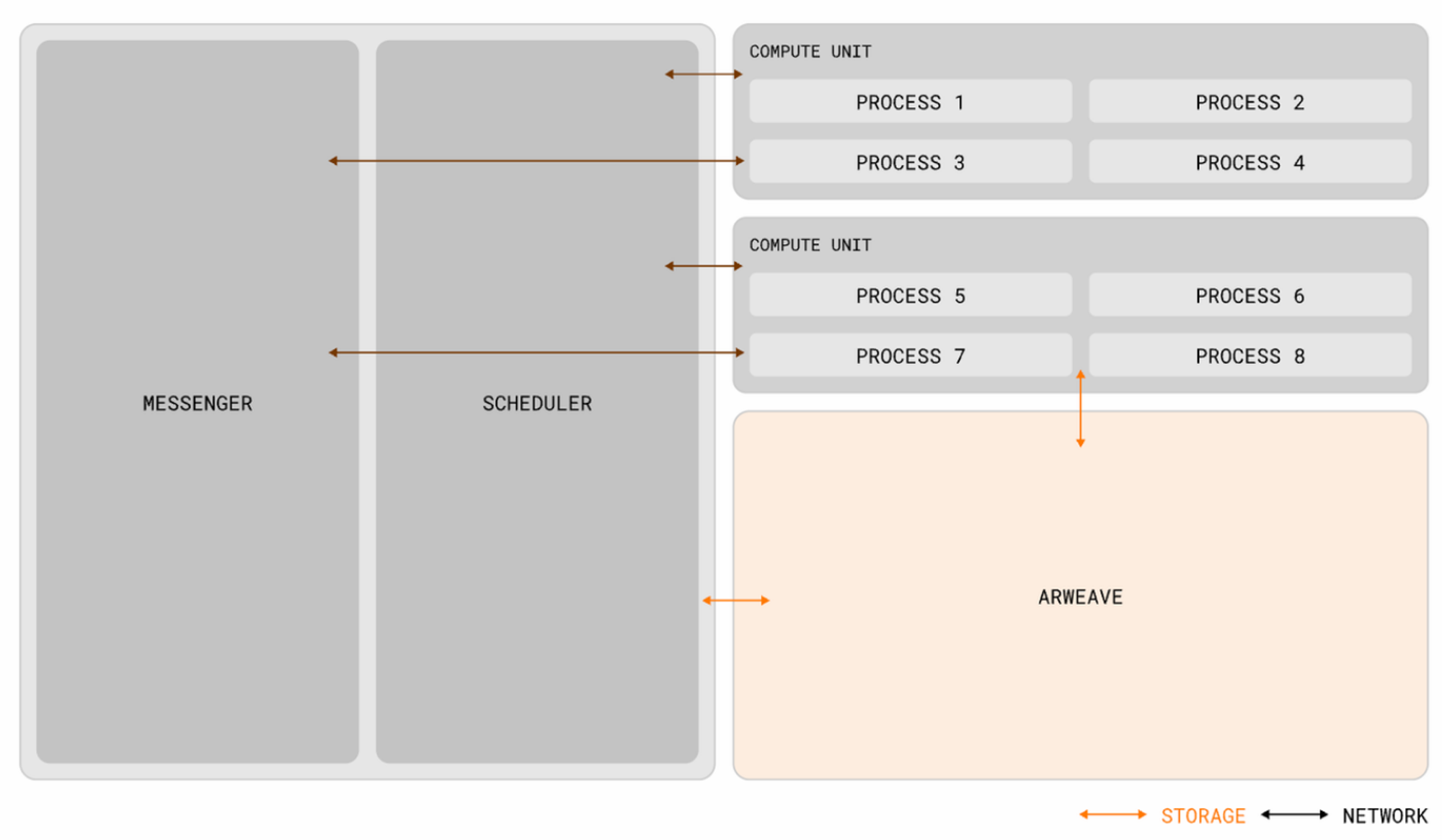
AO achieves verifiable infinite computation through several key technical innovations:
(1) Storage-based Consensus Paradigm (SCP): The AO computer reaches consensus via holographic storage of message logs in Arweave. Arweave acts as a continuous, immutable ledger storing all message logs, ensuring interaction logs remain permanently available so any participant can recompute the state.
(2) Consensus only on data order and storage, not on state: Traditional blockchains like Bitcoin and Ethereum require participants to agree on the current state of the ledger—a process that wastes computational resources and limits speed and scalability. AO avoids state consensus altogether. Instead, nodes only need to agree on the order and storage of interaction logs within Arweave. The state of AO is “holographically” implied in the message logs hosted on Arweave. While there is no explicit agreement on state, anyone can theoretically compute the state using data stored on Arweave. To obtain a state, users may request a compute unit to perform the calculation and return a cryptographic proof.
(3) Functional separation between AR and AO: As analyzed above, AR and AO serve distinct roles. AO does not solve verification—it handles message delivery, ordering, and state computation, focusing solely on computation. Arweave addresses security and verifiability by achieving consensus on data order and guaranteeing permanent, immutable decentralized storage. AO builds upon Arweave’s interaction logs but cannot alter Arweave’s consensus mechanism.
(4) Message-passing based parallel computing architecture: Two primary methods enable parallel computation—shared memory and message passing. AO adopts a message-passing architecture, contrasting with shared-memory approaches used by parallel blockchains like Solana and Sei. In shared-memory systems, when one user accesses and modifies certain data, others must wait until it is unlocked (“lock contention”), limiting scalability. AO avoids lock contention entirely—only requiring message exchange during interactions—enabling horizontal scaling and effectively achieving unbounded parallel scalability.
(5) Modular architecture of AO: Modularity is evident in the separation of CU, SU, and MU. Users can freely choose suitable schedulers, message relays, and compute units. Even system-level virtual machines are replaceable, enabling seamless integration of processes from various smart contract platforms into AO. CUs, SUs, and MUs can scale horizontally, ensuring computational capacity grows with demand.
Based on the above, the key workflow in AO involves: Interaction messages are verified by MU, passed to SU, sequenced, then uploaded to Arweave, where consensus on message order is achieved and data is stored immutably. When a user requests a state update, MU forwards the query to SU, which selects an appropriate CU. The CU computes the state using data from Arweave and returns the output via MU to the user.
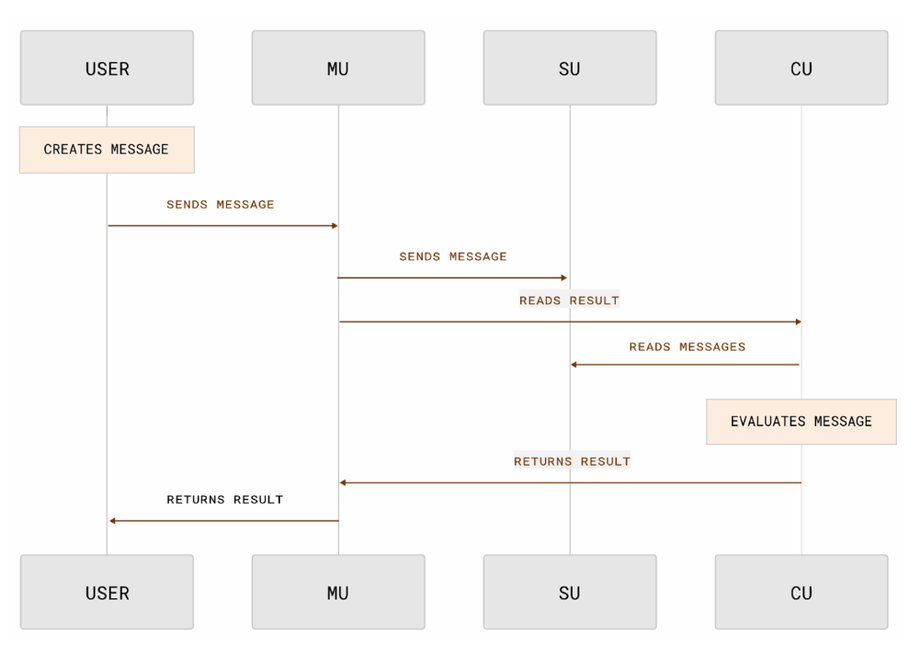
1.2 Does AO Possess a Competitive Moat?
To assess this, we compare AO against two categories of similar projects: high-performance parallel blockchains (e.g., parallel EVMs, Solana) and decentralized compute networks (e.g., Akash).
Comparison with High-Performance Parallel Blockchains:
The main difference lies in the underlying architecture for parallel computation. Using Ethereum as a baseline clarifies AO’s uniqueness. Traditional EVM chains like Ethereum process transactions sequentially—one transaction modifies state at a time—resulting in linear progression.
Parallel blockchains generally allow concurrent processing of non-conflicting transactions (conflicts arise when multiple transactions attempt to access and modify the same data simultaneously, risking inconsistency). For example, Solana’s Sealevel allows thousands of smart contracts to execute concurrently, with each transaction declaring read/write sets. The system identifies non-overlapping ones and executes them in parallel. Similarly, parallel EVMs like Monad follow three core steps: (1) Optimistic execution—assuming all transactions are conflict-free and executing them in parallel, potentially requiring rollbacks upon detecting inconsistencies; (2) Scheduling and dependency analysis—using static code analyzers to predict inter-transaction dependencies and optimize execution; (3) State merging—after parallel execution, individual state updates are merged to maintain global consistency across blocks.
Despite improved efficiency, such chains face clear scalability bottlenecks—they can only parallelize non-conflicting transactions. When accessing shared state, “lock contention” remains unavoidable. AO differs fundamentally: (1) It uses a message-passing rather than shared-memory model; (2) It requires consensus only on data order, not on global state. This enables stronger parallel scalability—SUs, MUs, and CUs can all scale horizontally, supporting effectively infinite computational expansion.
Comparison with Decentralized Compute Markets:
Networks like Akash offer decentralized container hosting markets but sacrifice trustless service creation—their outputs are neither verifiable nor reproducible, thus lacking smart contract functionality. In contrast, AO provides verifiable computation thanks to its holographic state storage. AO preserves traditional smart contract properties. All interaction logs are written immutably to Arweave, ensuring persistent availability. Any participant can recompute the state, reproduce the process, and verify correctness. Key mechanisms ensuring verifiability and trustlessness include: (1) Holographic storage of all interaction logs on Arweave, enabling full reproducibility; (2) Cryptographic signatures attached to computation results by CUs; (3) Staking requirements with slashing penalties for incorrect results.
In summary, the combined AR-AO architecture ensures both infinite computational scalability and verifiable, minimally-trusted computation, setting it apart from existing projects and establishing a meaningful competitive advantage.
1.3 The AO Ecosystem Is Rapidly Growing
The AO ecosystem is still in its earliest stages but rapidly evolving. According to AOlink data, AO has processed over 116 million messages. Daily active users peaked above 5,000 but recently settled around 1,500. The number of holders of AO’s test token ($AOCRED, distributed to ecosystem builders) has surpassed 4,100.
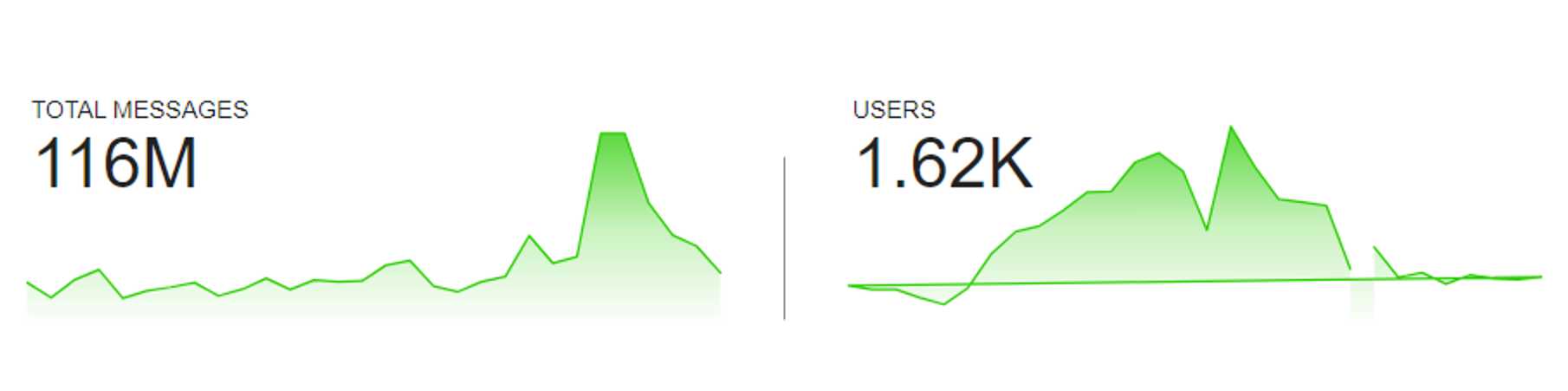
Within three months of launching the testnet, foundational infrastructure and financial systems began emerging on AO, including cross-chain bridges, oracles, wallets, AMMs, stablecoins, alongside early applications in gaming, social media, memecoins, and AI.
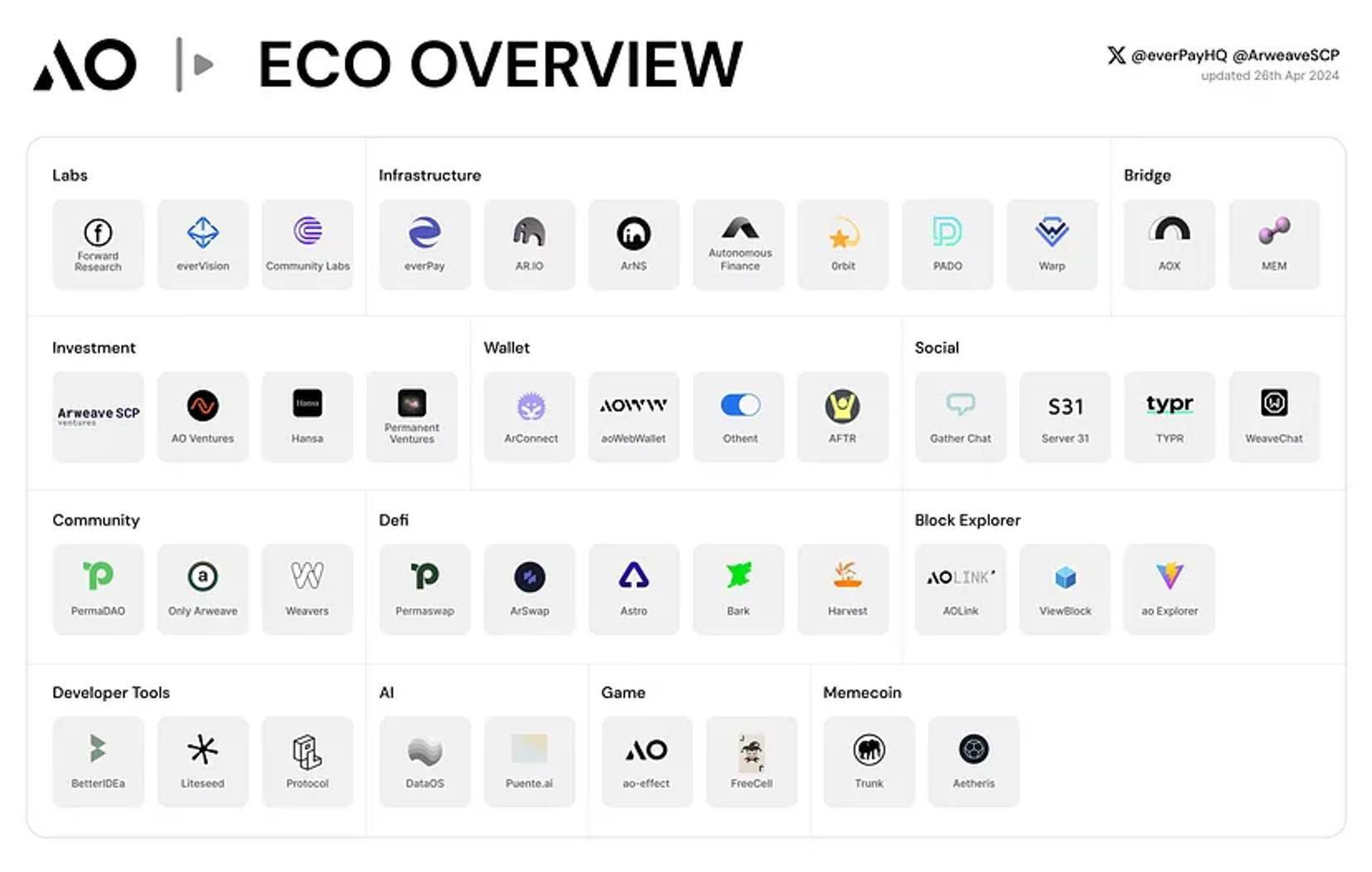 (AO ecosystem landscape as of April 26, 2024. Source: @everPayHQ @ArweaveSCP)
Key protocols include:
-
AOX: The first cross-chain bridge in the AO ecosystem, leveraging MPC technology to enable asset transfers between chains. Currently in beta, it supports only $AR bridging between Arweave and AO (represented as Wrapped AR). An incentive program rewards users with $TAOX test tokens for completing bridge tasks, potentially qualifying them for future airdrops.
-
0rbit: An oracle for AO that brings external data into processes via valid URLs. Users send messages requesting data, and 0rbit nodes fetch and deliver it to their processes.
-
Arconnect, aoWebWallet: Wallet infrastructure for the AO network.
-
Astro: A stablecoin protocol on AO. Its testnet launched in April, allowing users to claim test tokens tAR and mint the stablecoin USDA.
-
Permaswap, ArSwap, Bark: DEXs on AO. Permaswap recently launched, currently supporting swaps between Wrapped AR and AOCRED. ArSwap and Bark launched earlier and support more assets, including various ecosystem and meme tokens beyond AOCRED and Wrapped AR.
-
typr: A Twitter-like social app on AO, offering nearly identical features—posts, long-form stories, chatrooms—with added support for tipping using TRUNK, Wrapped AR, AOCRED, or typr test tokens.
-
Permaverse: A game and metaverse publishing platform on AO. Its first game, dumdum, lets players earn points by petting their green elephant avatar—potentially earning future airdrops—and includes a simple metaverse environment.
-
AO Games: A newly launched game and metaverse platform, teased on Twitter with features like Web2-like gameplay and integration of on-chain AI.
-
outcome_gg: A prediction market on AO covering topics like AO ecosystem developments, games, DeFi, memes, business, and tech. Future plans may involve AI agents competing in forecasting powered by LLMs.
-
TRUNK, Aetheris: Memecoins within the AO ecosystem.
-
AOVM: An AI tool for the AO ecosystem. For end users, it could act as a personal assistant or market analytics tool. For developers, it may assist in smart contract development. The product has not yet launched.
Overall, the AO ecosystem remains in its infancy—just beginning to lay the foundation. Most applications are still at the whitepaper stage, with some having only Twitter accounts or websites without actual products or technical documentation. AO’s full technical potential has yet to be realized or tested at the application layer. Nevertheless, ecosystem growth will feed back into Arweave’s storage business—if external adoption stalls, building its own CPU unlocks the value of its “hard drive.”
2 How Is AO Related to the AI Sector?
Following AO’s release, Arweave has been increasingly compared to projects in the AI and parallel EVM spaces. Having already discussed AO’s differences from parallel EVMs, this section analyzes AO’s positioning within the AI landscape.
AO is built on the Actor model, which has deep connections to AI research. In this model, every system component is an independent, autonomous agent that communicates via message passing—very similar to AI Agents. This makes hosting AI models and building AI applications on AO particularly compelling. So how exactly does AO empower AI?
In short: AO makes it feasible to put AI models on-chain, enabling verifiable computation and paving the way for integrating AI models with smart contracts and expanding AI use cases in crypto.
First, “on-chain models” refer to storing ML models directly in blockchain smart contracts and invoking them via contract calls. But this requires: (1) On-chain storage of AI models and data—meaning thousands of nodes must store complete models and datasets, resulting in prohibitively high costs, especially for large language models; (2) Limited computational resources, high latency, and low throughput inherent to blockchains restrict high-performance AI computations. Running inference on-chain would require all nodes to perform the same computation—an inefficient single-threaded approach clearly unsuitable for modern AI workloads.
Therefore, most current solutions perform model inference off-chain and post results on-chain. Some compromise approaches use opml/zkml to prove inference correctness and enhance verifiability.
Compared to traditional blockchains like Ethereum, AO offers key advantages: (1) Native integration with Arweave provides a low-cost storage layer capable of handling massive datasets; (2) Verifiable, infinitely scalable parallel computation. These allow AO to overcome many limitations of putting models on-chain—such as storing large models, even LLMs, becoming viable. Additionally, parallel computation reduces redundant node-wide calculations, improving efficiency. Furthermore, all data on Arweave can serve as input for AO computations, vastly increasing the amount of reliable on-chain data available for AI agents to make decisions.
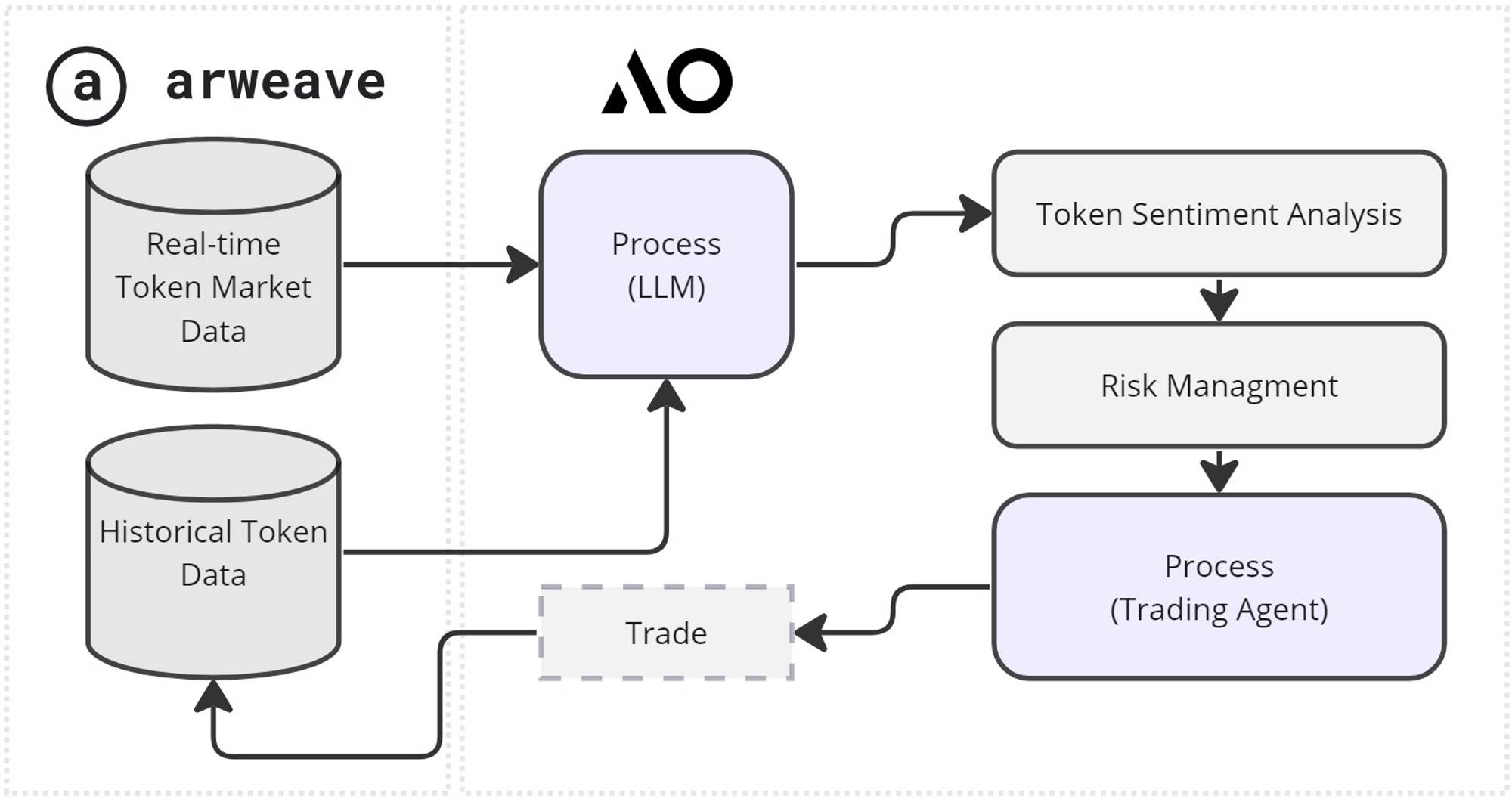
AO’s first major push in AI will focus on combining AI with finance—introducing AgentFi. AgentFi leverages AI reasoning to create and manage complex investment strategies akin to fund managers. Entrusting AI with financial control is sensitive—trustworthiness is paramount. Compared to other chains attempting AgentFi, AO leads in verifiable computation. The first project launched is Autonomous Finance, aiming to build financial agents such as: DCA portfolio managers, self-balancing index fund agents, customized-risk hedge fund agents, on-chain prediction agents, and high-frequency trading agents. Currently, the DCA investment agent is live—users can set parameters like asset type, slippage tolerance, liquidity pool, and schedule—but this remains automated execution without external triggers, not yet leveraging AI intelligence for strategy formulation. We must monitor future developments to determine whether these are serious innovations or mere hype.
3 Tokenomics and Holder Analysis
On May 30, 2024, AO announced the upcoming issuance of the $AO token, scheduled to go live on June 13 Beijing time. Until $AO completes its TGE, $AR remains a key speculative asset tied to the project.
$AR has a maximum supply of 66 million, with 55 million initially minted—all now in circulation. The remaining 11 million are reserved for mining rewards. So far, 10,744,796 tokens have been mined. Current block rewards are ~0.75 $AR per block, halving annually. With approximately 660 blocks mined daily, around 500 new $AR enter circulation each day—minimal inflationary pressure. Circulating supply stands at 65,744,796, with 99.61% already released—effectively fully diluted.
In terms of utility, $AR serves as payment for data storage and incentivizes miners for block production and data hosting. Arweave implements a Storage Endowment mechanism: only 16.67% of storage fees go to miners; the rest flows automatically into a long-term fund used to cover future storage costs. This fund disburses only when miner storage costs exceed the sum of new block rewards and transaction fees—ensuring miners remain profitable. Since Arweave’s inception, no tokens have ever been withdrawn from the Storage Endowment, making it functionally equivalent to a burn mechanism. When endowment inflows exceed new $AR issuance, $AR enters deflationary territory.
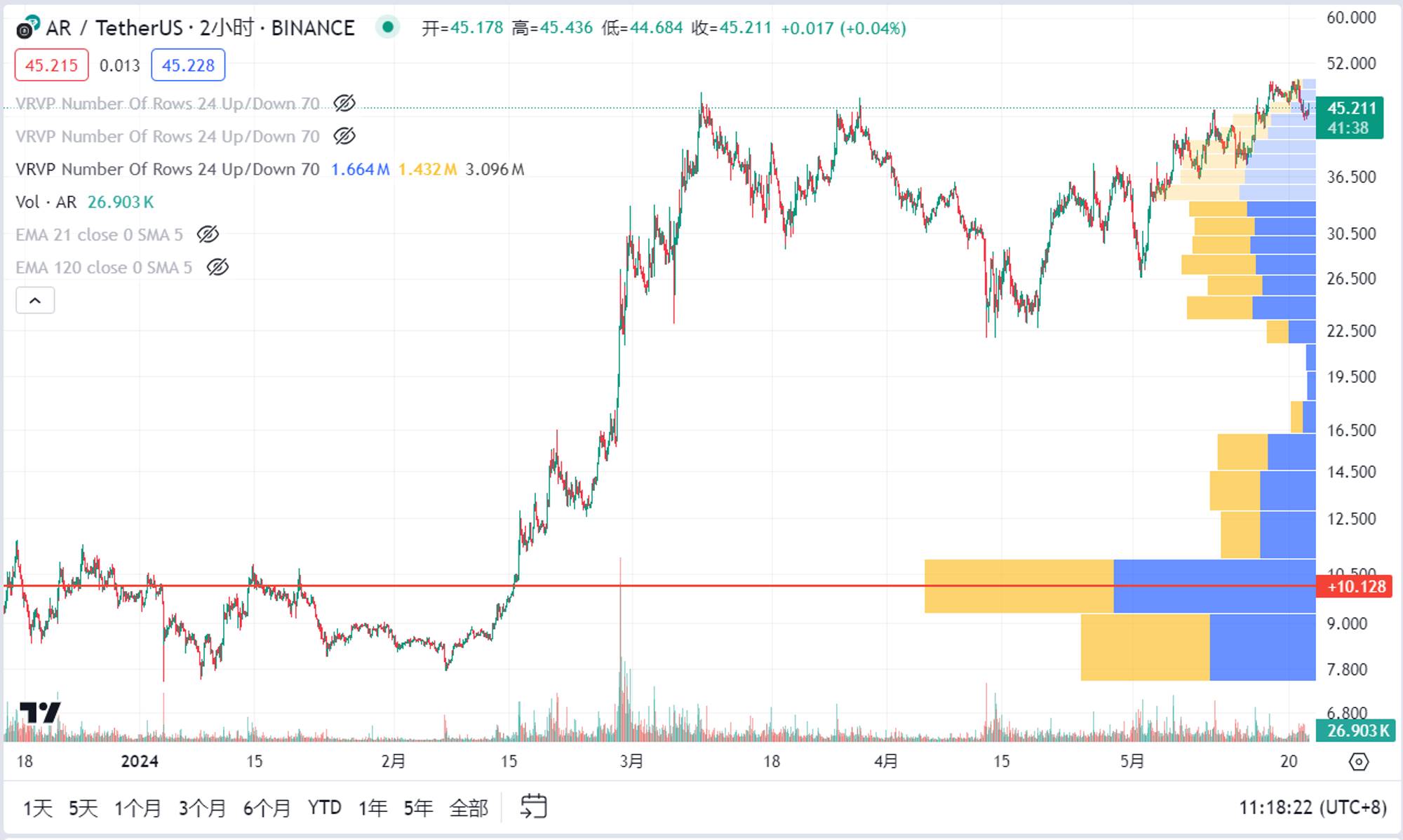
From a price perspective, $AR surged after AO’s announcement, quadrupling within a month. Recently, during broader market downturns, AR逆势 rose, approaching new highs. Key concentration zones remain around $10, with secondary clusters between $20–$40. AR has twice approached $47 and is now nearing that level again.
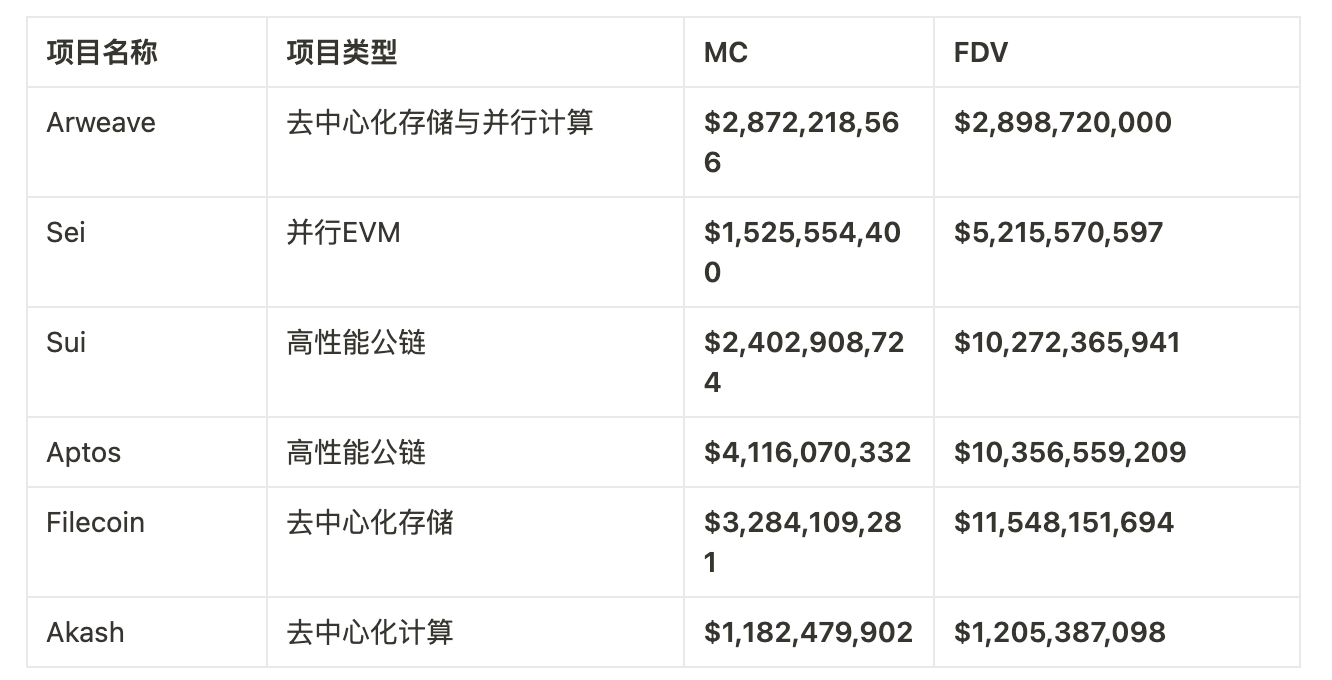
Valuation-wise, no direct peers match Arweave and AO exactly. Comparable projects include parallel EVMs, high-performance blockchains, decentralized storage, and compute networks. In terms of market cap, Arweave aligns closely with high-performance L1s and Filecoin, higher than Akash or Sei, though FDV comparisons show L1s and storage projects far exceeding Arweave. Given AO’s ecosystem is extremely early—mainnet not yet live—$AR does not appear significantly undervalued. However, near-full dilution reduces future token emission risks, potentially lowering resistance to upward price movement.
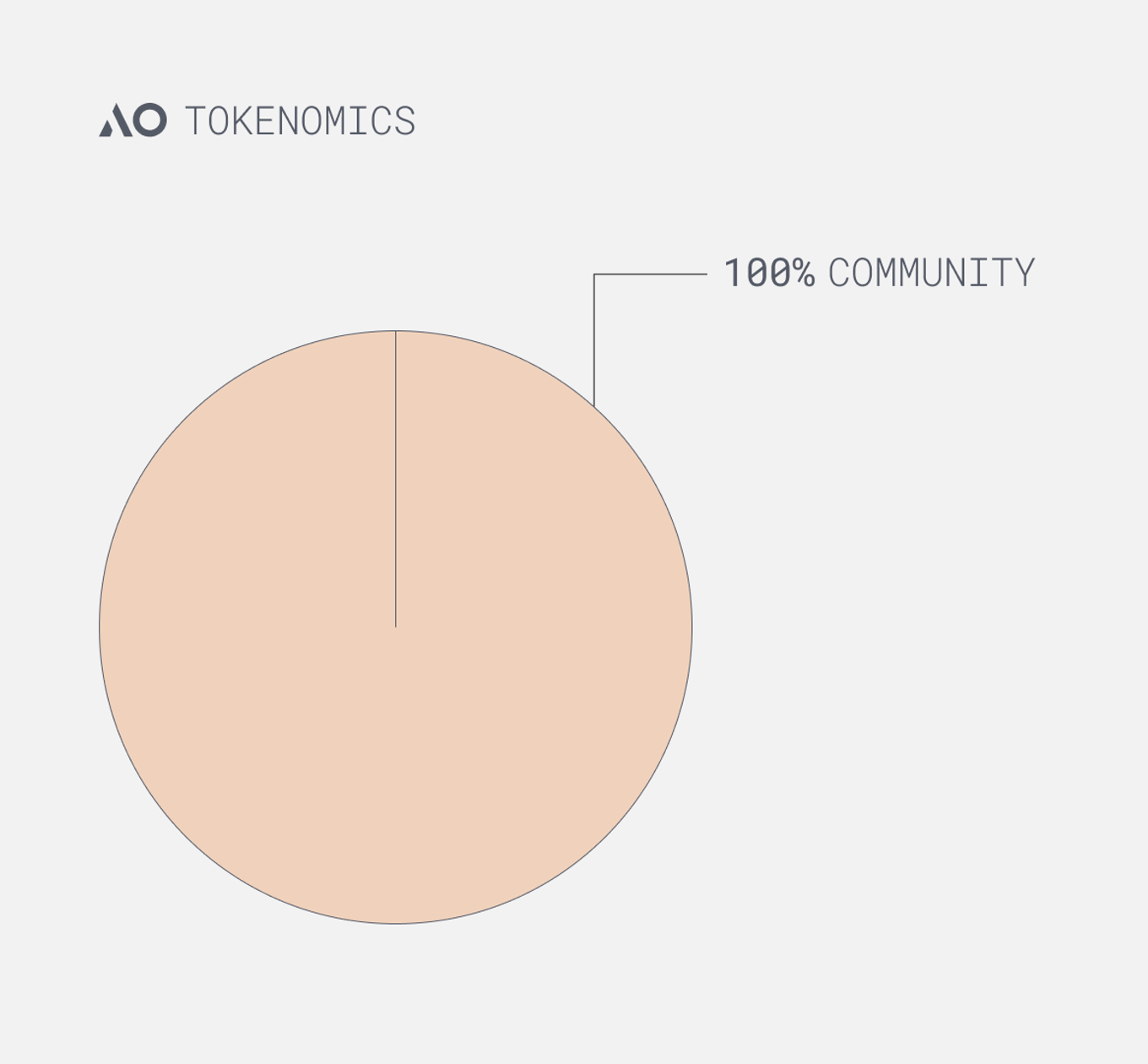
Closely related is the upcoming $AO token launch. Officially, $AO will undergo a 100% fair launch—no pre-mine, no private sale, no preferential access. Total supply: 21 million, halving every four years. Key ways to acquire $AO: (1) Bridging assets to AO; (2) Holding $AR; (3) Contributing to AO ecosystem development. The exact token model hasn’t been published yet. According to outprog, one of AO’s creators, $AO and $AR will have distinct roles: $AR focuses on Arweave’s storage and consensus, while $AO handles communication between computation and applications—separately maintaining storage and compute layers of the network.
After the $AO announcement, $AR briefly spiked over 18%. Partly because $AR is currently the only tradable asset linked to the event, and partly due to expectations that holding $AR grants eligibility for $AO airdrops. Rules involving bridging assets to AO (currently $AR is nearly the only eligible asset) and holding $AR help absorb selling pressure from this event. However, note that $AR currently reflects market valuation for both storage and computation. Once $AO launches, $AR will likely undergo repricing, potentially diluting part of its current market cap.
4 Summary
Markets often say “chase new, ignore old,” as older narratives struggle to regain attention. Yet some legacy projects are delivering fresh surprises through technological innovation. Compared to newly launched tokens, these mature projects typically have near-full circulating supply, minimal unlock-related sell pressure, and were thoroughly tested during bear markets—offering greater upside potential. Arweave exemplifies this trend. The combination of AO and AR delivers verifiable, infinitely scalable parallel computation, creating a technical moat and injecting renewed vitality and narrative momentum.
From an ecosystem standpoint, AO remains on testnet, with development in its earliest phase. Its true computational capabilities have yet to be proven in practice. We expect AO to spawn applications that leverage its unique strengths—permanent storage, verifiable computation, and massive parallelism—such as decentralized social apps (with guaranteed permanence and accessibility of social data), AI infrastructure, and AI-native applications. In terms of market awareness, while AR’s price has steadily climbed, discussion among retail users remains limited. The AO testnet has not become a “free money” event capturing broad attention. Due to its complex technical nature, most users struggle to distinguish AO from high-performance blockchains or decentralized compute protocols, or grasp how it fits into the AI narrative—thus failing to appreciate its growth potential. AO is still in the earliest stage of protocol development, leaving ample room for growth. However, if ecosystem progress lags—especially if mainnet performance, UX, or flagship AI projects fail to meet expectations—$AO’s valuation could suffer significantly.
Join TechFlow official community to stay tuned
Telegram:https://t.me/TechFlowDaily
X (Twitter):https://x.com/TechFlowPost
X (Twitter) EN:https://x.com/BlockFlow_News
 @MetricsVentures