Interview with the MCM Hackathon Winning Team: Exploring New Trends in the Solana Ecosystem
TechFlow Selected TechFlow Selected
Interview with the MCM Hackathon Winning Team: Exploring New Trends in the Solana Ecosystem
Among the winning projects in this hackathon, four are related to AI, and all of them strive to combine Web3 technology to address industry pain points and meet genuine user needs.
 Navigating Web3 tides with focused insights
Host: Yao, MCM Growth Lead at Solana Foundation
Guests: Sean, Founder of RateX; DY, Co-Founder of HajimeAI; Dr. Darcy, Co-Founder of Starpower; Edison, Co-Founder of CUDIS; Tony, Founder of jogojogo; Rene, Founder of CharacterX; Shannon, Co-Founder of IntentAGI; Kevin, Co-Founder of HackQuest.
Compiled by: aididiaojp.eth, Foresight News
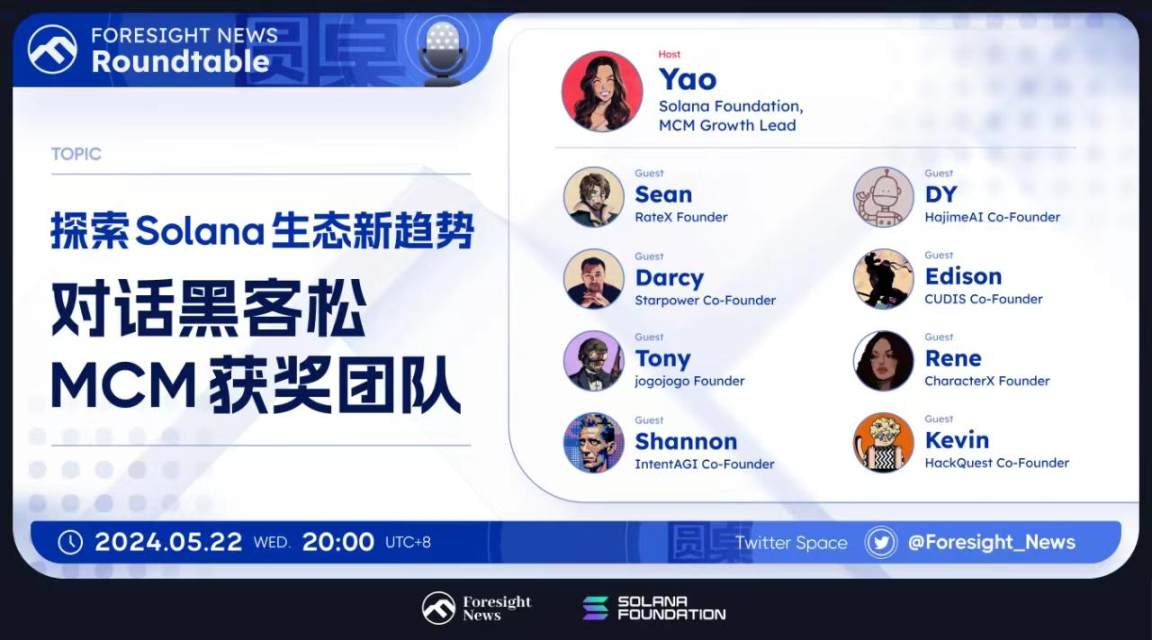
The Solana 2024 Renaissance Hackathon’s MCM track has recently concluded, with winners announced. The first prize went to RateX (a margin-based synthetic interest rate trading market); second prizes were awarded to CUDIS (a wearable device offering health data ownership and AI support) and JogoJogo (an on-chain social entertainment platform); third prizes went to CharacterX (core product is XFriends, an AI-powered social economy tool), Hajime AI (a decentralized AI Hub for households), Starpower (a decentralized energy internet), and IntentAGI (an autonomous agent operations layer).
On this occasion, we invited key members from the winning teams to share insights into exploring new trends within the Solana ecosystem.
Host Yao: Please introduce yourselves.
Sean: Hello everyone, I’m Sean, founder of RateX. Before founding RateX, I spent 10 years in traditional capital markets as head of fixed income investment and portfolio manager, managing portfolios exceeding $1 billion. I’ve been involved in crypto for three to four years now. Since last year’s fourth quarter, I’ve gone all-in on crypto and launched RateX.
Tony: Hi, I’m Tony, founder of JogoJogo. Prior to starting JogoJogo, I worked in game publishing and global payments. Our games generated $1.5 billion in revenue in Brazil alone, and our payment system handles around $2 billion annually. I was also an early investor in FTT and have a natural affinity for Solana. Personally, I enjoy the process of building something from zero to one—walking together on a path that feels vaguely right—and hope to make small but meaningful improvements to the world.
Edison: Hello, I’m Edison from CUDIS. Before launching CUDIS, I had several startup experiences. I entered the crypto space in 2016, initially investing in Bitcoin and Ethereum, then participating in early-stage investments and incubations. I also spent over two years working at a traditional VC firm. We focus on building real-world physical products or brands within the crypto space, aiming to deliver better solutions that solve practical problems people face in daily life.
Rene: Hi, I’m Rene, founder of CharacterX. Before entering tech, my dream was to become a literature professor, deeply interested in human loneliness and social dynamics in postmodern society. At Stanford, surrounded by strong entrepreneurial energy, I got inspired and eventually joined the tech industry. Previously at Tencent, I worked on social products targeting Southeast Asian markets. Through various twists and turns, I landed in crypto. I started during a major bear market, experimenting with many directions until ChatGPT emerged—this sparked my imagination about how AI+social could help humans stay connected in modern society. That’s when I began assembling a team to launch CharacterX.
Shannon: Hi, I’m Shannon, co-founder of IntentAGI. I’m an AI researcher with over six years of experience across mainland China and Silicon Valley. Currently, we’re developing a new decentralized multimodal actionable model.
Dr. Darcy: Hello, I’m Dr. Darcy, co-founder of Starpower. After completing my PhD in photovoltaics and renewable energy in 2016, I’ve been working in the renewable energy sector. Last year, my co-founder approached me with the idea of building a DePIN project focused on energy. Given blockchain’s distributed nature aligns well with next-gen energy systems, we founded Starpower to connect distributed energy devices into a decentralized energy internet.
DY: Hi, I’m DY, graduated from the University of Auckland. In 2017, I mined Bitcoin and Ethereum; in 2019, I worked on market cap management at Binance and OKX. At HajimeAI, I lead hardware development, economic model design, and mining rig hosting. HajimeAI is a peer-to-peer edge computing network that delivers plug-and-play AI models and personalized AI assistants for specific use cases. Using Docker containerization, we deploy these models directly onto edge devices with real-time update capabilities. Our main applications include home companionship, personalized AI services, and voice processing.
Kevin: Hi, I’m Kevin, founder of HackQuest. We run a developer education platform and organize hackathons. Since 2021, we’ve partnered with major internet companies and Web3 blockchains to host hackathons.
Host: Please introduce your projects—what they do, what problems they solve, and your team backgrounds.
Sean: RateX is building a margin-based synthetic interest rate trading market—functionally similar to Pendle V3. Beyond core functionality, we enable users to generate strategies with one click and create customized yield-bearing synthetic assets.
We are Solana’s first leveraged interest rate trading DeFi protocol, aiming to expand choices for users in the Solana ecosystem. During fundraising, investors often ask how we differ from Pendle. First, as a leveraged trading protocol, we offer significantly more capital efficiency—users can trade with roughly 10%-20% of the capital required on Pendle today. As a margin trading protocol, we support both long and short positions. Second, for low-yield assets (e.g., under 20% absolute return), we provide lower slippage. Third, since we’re a synthetic yield protocol, our yields derive from public market data—not limited to native Solana yield assets, but also including yield-generating assets from Bitcoin L2s, and even real-world assets like US Treasuries and CPI.
Our team has nearly 20 members, over half of whom are engineers. We have three co-founders: besides myself, our COO was previously a top-tier interest rate derivatives trader, giving us deep expertise in this domain. Our CTO has nearly 20 years of experience developing trading systems, having led development at prominent derivatives exchanges, and is also a security expert who served as chief security advisor at a leading derivatives exchange.
Tony: JogoJogo aims to become a prediction market protocol addressing three core issues. First, assetizing personal opinions and making them tradable—true respect comes from putting skin in the game. Second, solving trust between prize pools and players via on-chain construction ensuring automatic settlement. Third, introducing APYs with genuine positive expected value (EV) to push LST and DeFi into their next phase. These are the three key areas we aim to address.
Our team combines extensive experience in game publishing and DeFi development, with proven global execution and organizational capabilities. We tailor localized products per country and plan to scale our team further.
Edison: CUDIS consists of three components. First is our Smart Ring. While existing smart rings emphasize tech and fitness, ours focuses more on fashion—design and materials. It tracks heart rate, blood oxygen, steps, calories burned, and sleep quality, providing multidimensional health data.
Second is our app. Besides displaying data, it features an AI coach offering daily advice based on user metrics. We train the AI using coaching methodologies from top experts in the U.S. and Asia. The app supports social activities—users can manage family health or initiate community challenges. We emphasize wellness across eight dimensions: career, physical, mental, etc.
Third is our website. Currently, we only accept SOL for purchases. We just sold 1,500 rings and will conduct a second sale next week. Soon, we’ll accept various Solana-native assets as payment.
We aim to solve two core problems. First, helping users encrypt and store their data on-chain so they retain control and can export it to other apps. Second, many creators struggle to earn in this space because Web2 apps are mostly free. With Web3, we want builders to collaborate with communities and user data to build better products—and earn sustainable income while delivering value.
Most of our team graduated from UCLA and UCB—I’m from UCLA, my co-founder from UCB—and we’ve all been active in crypto. Team members have strong crypto and consumer industry backgrounds, coming from companies like Amazon, Microsoft, and Nike. We aim to deliver increasingly innovative products that improve quality of life.
Rene: In its early days, CharacterX positioned itself as an AI social platform where users can create AI characters and interact with others’. From day one, we embedded multimodal interactions—including private photo sharing—with AI generating personalized responses based on images received. Thanks to excellent product design and lack of competition, we seized the moment and rapidly attracted users—now reaching 4 million registered accounts. We continuously observe user behavior and collect feedback.
We realized decentralization is crucial in the AI-social era. Two major needs emerged: First, users want portability—if they switch platforms or try a new game, they want to bring their “AI partner” along. Rebuilding from scratch every time is tedious. Worse, if a platform shuts down, their AI companion dies too.
Users want persistent memory storage and cross-platform mobility for their AI partners. Also, creating high-quality AIs remains challenging—even with intuitive tools, skilled creators remain rare. Yet users contribute valuable interaction data and desire participation in the AI economy. That’s why we aim to empower them through a more democratic economic system.
Based on these two core user demands, our product evolved—which is why we joined the Solana hackathon. We’re building a full decentralized AI social identity system, assigning each AI its own identity with independent identity and memory management.
We’re also integrating economic mechanisms via underlying tech—all driven by observed user needs. We’ve brought on seasoned Solana developers and AI experts to assist in long-term AI modeling. Our core team includes former colleagues from Tencent.
Dr. Darcy: Starpower uses IoT, blockchain, and AI to connect household and commercial energy devices—air conditioners, water heaters, EVs—into a dispatchable network. This improves energy efficiency and responds to application demands like virtual power plant load balancing, enhancing overall grid efficiency and data management.
Climate change is arguably humanity’s biggest challenge, and our energy mix is shifting toward renewables. But renewables are inherently unstable. For example, when clouds pass over solar panels, output may drop by 10%. At such times, we activate our networked devices to reduce demand by 10%—say, raising AC temperature by 1°C or lowering water heater settings.
One exciting trend is EV adoption. With ~10 million EVs sold annually, we expect 1 billion in circulation within a decade. Most EV owners install chargers—and often add batteries—increasing available distributed energy resources. This is a growing blue ocean market requiring rapid capture. Leveraging Web3 token flywheel effects, Starpower accelerates user growth. We aim to be the Web3 Uber of energy—connecting homes’ generation, storage, and consumption devices into intelligent grid调度.
Our team comes primarily from traditional energy sectors. My co-founder is assistant to the chairman of HashKey Group. We have about 20 team members, combining IoT talent from Wanxiang, Web3 specialists, and energy hardware supply chain experts.
DY: HajimeAI is fundamentally a peer-to-peer edge computing infrastructure. Users access AI services via HajimeBot while contributing idle computing power to the network.
Our system has three parts: HajimeAI, HajimeBot, and HajimeGarden. HajimeBot preloads AI models with basic configurations. Our first-gen units have 8GB VRAM—essential for edge inference. HajimeGarden functions like a crowdfunding platform providing AI compute power.
HajimeAI builds an N-to-N decentralized P2P network. Transformer-based deep learning architectures demand massive computation through stacked neural networks and multi-dimensional data ingestion. Centralized cloud computing cannot achieve low latency or ensure privacy—users don’t want sensitive data like photos, voices, or health records uploaded to the cloud.
Additionally, OpenAI-style Transformers suffer unavoidable high latency and cannot maintain long-term memory due to token limits. So we built HajimeAI—a decentralized scheduler—that allocates power resources, verifies computational validity, and offers standardized services via custom models.
Our team includes investment research talent from Yale and Goldman Sachs. Data modeling is led by a Harvard PhD. Most R&D members have over 20 years’ experience from Baidu Ads, Huawei, and JD Smart Home divisions.
Shannon: Today’s common AI tasks—writing poetry, drawing art, chatting—are forms of content generation. But AI still can’t actually *do* work for us—the very thing we most want. We envision AI assistants operating our computers autonomously, understanding our desktop state and predicting next actions.
Current GPT-4 multimodal components achieve only ~10.59% accuracy. Our team boosted this to 50%, currently the best-performing AI assistant among researchers. Our model has reached a GPT-2-like stage—usable but still imperfect. Hence, we introduced "AI Coach to Earn," inviting users to join feedback-driven training, incentivized with tokens. Second, we solved model benchmarking, laying foundations for composable ecosystems. By month-end, we’ll launch our first browser plugin: users issue commands via chat, our product interprets intent, and operates the browser to complete tasks.
Host: Why did you join the Solana hackathon? How does your product integrate with Solana’s technology and ecosystem? What are your future product, operation, and funding plans?
Sean: We’ll launch a testnet next month and begin community testing early next month, gathering feedback on trading features. In H2, we’ll release synthetic yield stablecoins and bonds based on RateX’s core functionality. We closed our Pre-Seed round last month and will begin Series Seed after product launch.
Tony: In June, we’ll launch a Euro Cup-themed product on the Snoic testnet. Users can create betting pools, invite friends to share predictions, and earn special rewards from JogoJogo and Snoic. After testing, we welcome community feedback. In July, we’ll start internal testing of a DePIN device for opinion trading and open test slots—stay tuned!
Edison: Next week, we’ll hold our second ring sale. This September, we’ll meet users offline in Singapore. Our global user base spans continents—we host monthly events worldwide: New York in March, Dubai in April, Austin in May, Malaysia in June, Brussels in July, etc.—to deepen user experience with our smart ring while iterating new features. In Q4, we’ll develop or co-build new products. We’ve largely completed seed funding. Historically focused on North America, in Q3 we’ll expand outreach to APAC communities.
Rene: We’re currently running SDID minting for human users. In July, we’ll launch AI-focused SDID minting, accompanied by numerous events over the coming months. We closed our Seed round earlier this year and expect to begin next fundraising in June.
DY: Starting June, we’ll begin validator node pre-sales—these validate compute nodes. Clients will test voice data collection on an edge testnet running customized models. In August, we’ll launch a HajimeGarden prototype testnet enabling scheduling and verification. We’ve partnered with last year’s hackathon champion to integrate them into HajimeGarden, supplying compute power. Node sales reached ~$1M last month. This month, we plan fundraising tours in Europe and the U.S.
Shannon: This month, we’ll release our first product version, launching "Train AI to Earn"—users interact with our model and submit training data. Going forward, we’ll focus development on our action layer and invite more AI professionals into our economic system. Based in North America, we have upcoming fundraising plans.
Dr. Darcy: In April, we pre-sold our first smart plug—over 20,000 units ordered, already making it a significant DePIN project. We’re launching another campaign offering 300 engineering units as giveaways—follow Starpower’s official Twitter to participate and get hands-on with prototypes. Our team is fully committed, preparing global rollouts. We’re obtaining certifications in Korea, EU, and U.S.—once cleared,第一批 pre-order customers will receive devices.
Host: Did you receive support during the hackathon? Many winning teams came from HackQuest and Solana MCM’s founders bootcamp—what did you gain from it?
Adam: Let me share what we do around hackathons. The Solana ecosystem isn't yet widely known among Chinese-speaking developers, so we warmly welcome anyone with questions about Solana or development to reach out—we’ll do our best to help. Before hackathons, if you have ideas or want to learn more, feel free to engage with us, attend HackQuest events or local meetups to connect with ecosystem partners. During hackathons, technical or multidimensional support is available through HackQuest and others. The Solana ecosystem is unique—it’s endured many hardships, grown resiliently, and that resilience has shaped a culture of mutual support, traffic sharing, and collective growth. We’re thrilled to see so many outstanding Chinese-language projects emerge.
I believe the key is how to collaborate with other ecosystem projects.
Kevin: This year, our bootcamp with Solana MCM featured founders from leading Solana projects like Helius, Helium, and BackPack. Each session offered valuable insights. I’m proud to see so many award-winning teams emerge from this bootcamp and community. As a developer education platform, we can help teams hire developers. Looking ahead, we hope to co-host more online and offline events with Solana Foundation and other projects.
Host: As veterans, any advice for future participants?
Sean: My biggest advice: innovate genuinely. Build something truly cool that meaningfully contributes to the Solana ecosystem—that’s paramount. And believe in Solana; it’s fundamentally different from other chains.
Edison: Participating in the Solana hackathon was unforgettable. Before and after, we engaged deeply with the Foundation and many Solana projects. We hope to strengthen communication with the ecosystem and Foundation going forward.
If you want to build a product people love—one they’ll recommend and pay for—you must invest heavily in user proximity: show them the product, talk to them. In Solana, many successful projects rose from humble beginnings by doing exactly this—tackling seemingly tedious tasks: hosting events, meeting people, forging partnerships, refining products. These efforts lay the foundation for explosive growth later. The Solana ecosystem—including the Foundation—is warm and supportive. People gladly offer advice and answer questions. So my advice: ask more, communicate more.
Tony: Stay mission-driven. Believe Web3 solves real problems—peer-to-peer transparency, trustless value exchange. Second, stay passionate—this journey brings many challenges. Communicate proactively and continuously refine your business model.
Rene: From a startup perspective, keep an open mind—especially important for experienced Web2 founders. In conversations, I often find skepticism or unfamiliarity with Web3 mechanics.
During the hackathon, Solana helped us transform and upgrade—our SDID decentralized solution emerged from extensive discussions with Solana ecosystem members. Support ranged from technical architecture to minor procedural details. The Solana ecosystem is highly open; here you gain more than prizes—you undergo profound project evolution.
DY: We built HajimeAI because we believe edge computing + large models is a mainstream future direction. When choosing a project, pick one likely dominant in 3–5 or 5–10 years. Secondly, as we explore general-purpose agents, blockchain can provide verifiable compute power for edge devices while ensuring fair reward distribution and computational integrity.
Dr. Darcy: First, deeply understand the problem. Your project must solve a real, market-validated need. For instance, energy storage is a booming blue ocean—China's new energy sector is thriving. Hardware manufacturers struggle to scale quickly. Think how tokens can drive flywheel effects to accelerate hardware deployment. Technology must serve applications—find optimal integration points. Second, build a strong, complementary team—this is key to success. Third, actively engage the community, leverage shared resources, and collaborate with other projects. Finally, maintain innovation—dream boldly, constantly iterate and optimize.
Shannon: First, solve a real problem. For us, AI should work *for* us—as a true assistant. Continuously iterate and listen: observe how users interact, learn how they want to use it. Second, clarify why you need tokens—why Web3 incentives? For us, token incentives are essential during AI training. Alternatives like OpenAI pay cash—but tokens offer scalable, community-driven alignment.
Finally, actively participate in and collaborate within the Solana ecosystem. AI projects benefit from high throughput, low fees, and broad applicability. In Solana, every project could become a potential partner.
Adam: This cycle, Solana has unlocked immense upward potential. Memecoin mania proved the network’s growing stability and scalability.
Kevin: Solana is my top-pick public chain—strong user activity, VC backing, and a vibrant, loyal developer base. A killer app may emerge soon.
Join TechFlow official community to stay tuned
Telegram:https://t.me/TechFlowDaily
X (Twitter):https://x.com/TechFlowPost
X (Twitter) EN:https://x.com/BlockFlow_News
 Foresight News