








Finding the Next Crypto Killer App: The Fusion of Content Publishers and Exchanges
TechFlow Selected TechFlow Selected
Finding the Next Crypto Killer App: The Fusion of Content Publishers and Exchanges
As information becomes democratized and accessible, so too will money.
 Navigating Web3 tides with focused insights
Author: Arnav's Musings
Translation: TechFlow
The Killer Use Case for Crypto
Imagine you're scrolling through Instagram and see your favorite influencer wearing a hoodie from an emerging brand. You like the design, click on the image to check the price. One more tap, and you're reading the product description page. A few seconds later, you decide to buy the hoodie and confirm the transaction via FaceID...
You’ve just completed a social-first purchase in under a minute—without ever leaving Instagram.
Welcome to the era of the "Publisher-Exchange," where consumers can directly exchange value through content platforms. This emerging trend eliminates all friction in the purchasing process, creating a more immersive user experience that tightly couples money and attention. This is the future of e-commerce.
What exactly is a "Publisher-Exchange"?
Publisher = Platforms that thrive by capturing user attention
Examples include Instagram, X (formerly Twitter), Spotify, YouTube, Netflix—platforms competing ruthlessly for “regret-free user time.”
Exchange = Platforms that control the flow of money
Examples include PayPal, eBay, Venmo, Robinhood, Coinbase—platforms vying for control over monetary systems.
Thus, the fusion of publishers and exchanges creates a Publisher-Exchange—a platform operating at the intersection of attention and money. Let’s look at some key examples of major publishers transitioning into the Publisher-Exchange model:
-
Spotify Merch Bar: Allows artists to sell merchandise and tickets directly through their Spotify profiles, merging music streaming with e-commerce.
-
Instagram Live Shopping: Influencers can host live streams on Instagram to sell products in real-time to fans. This builds on the ability to add shopping tags to posts, enabling direct purchases.
-
TikTok Shop: Digital storefronts let creators sell products directly alongside videos, often offering discounts, subscriptions, and exclusive items. In fact, TikTok lost over $500 million in U.S. e-commerce last year, subsidizing products (often entirely free) to familiarize users with the platform.
-
YouTube Shopping: Through YouTube’s partnership with Shopify, businesses can sell products via livestreams, videos, or digital storefronts on YouTube.
-
Snapchat AR Filters: Or “catalog-powered shopping lenses,” allowing users to virtually try on glasses, beauty products, clothing, etc., then purchase within the app.
Essentially, every publisher is becoming a Publisher-Exchange by enabling direct value exchange on the front end. The data doesn’t lie:
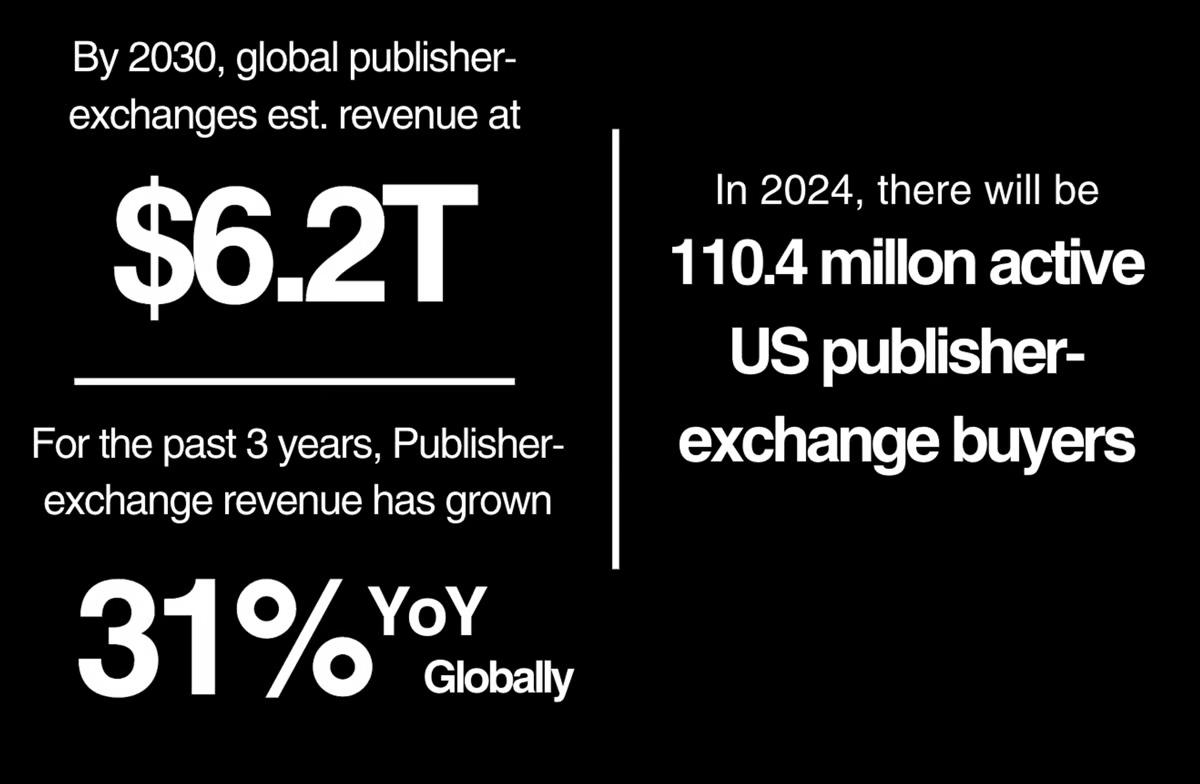
Source: source 1, source 2, source 3
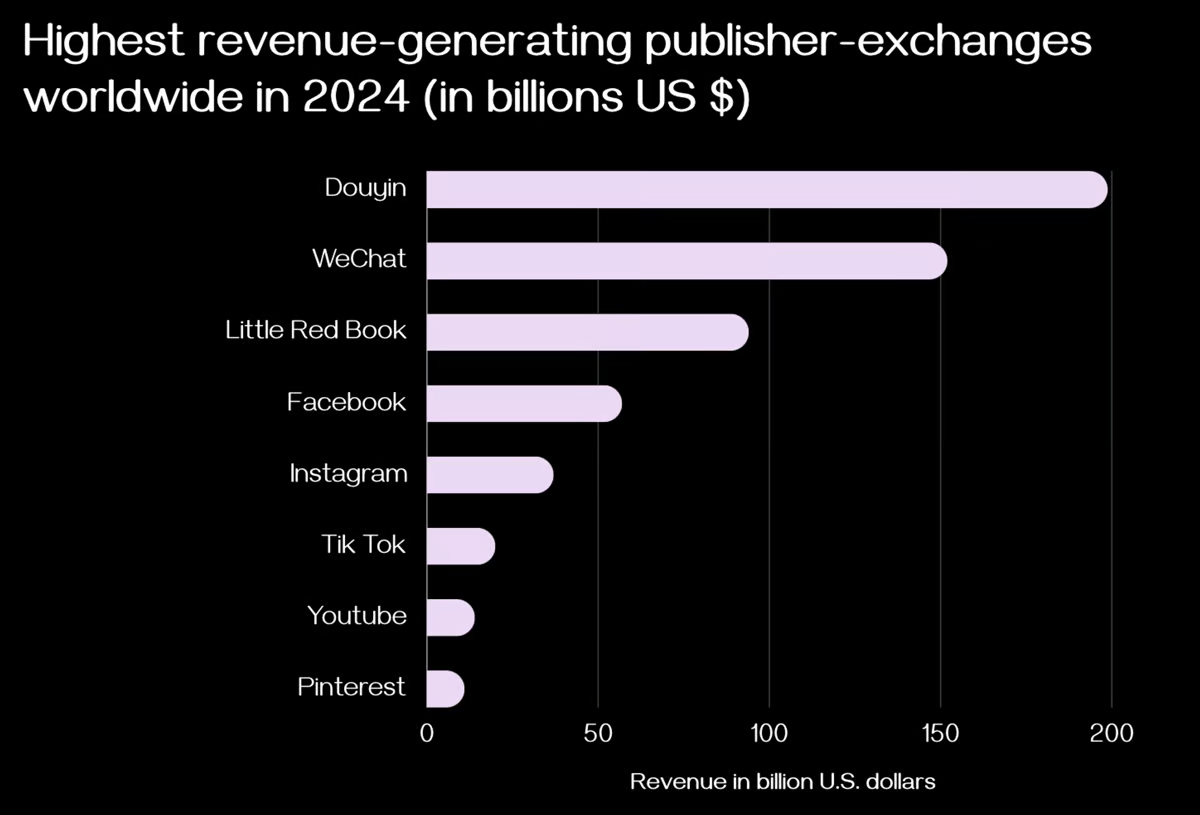
Source: Statista “Digital Shopping Behavior”
According to Statista’s “Digital Shopping Behavior” report, leading Publisher-Exchanges Douyin (China’s TikTok) and WeChat generated over $350 billion in annual revenue combined!
Moreover, every exchange is also becoming a Publisher-Exchange:
-
Amazon Live: Combines e-commerce with live streaming, allowing influencers to showcase products while viewers purchase in real time.
-
Alibaba: Entered media through Alibaba Pictures, Youku Tudou (video streaming), and Ali Music, blending e-commerce with content streaming.
-
Every fintech company: All are moving into content creation and curation, offering financial education and business insights (e.g., Robinhood, Square, Stripe, Bloomberg, Coinbase).
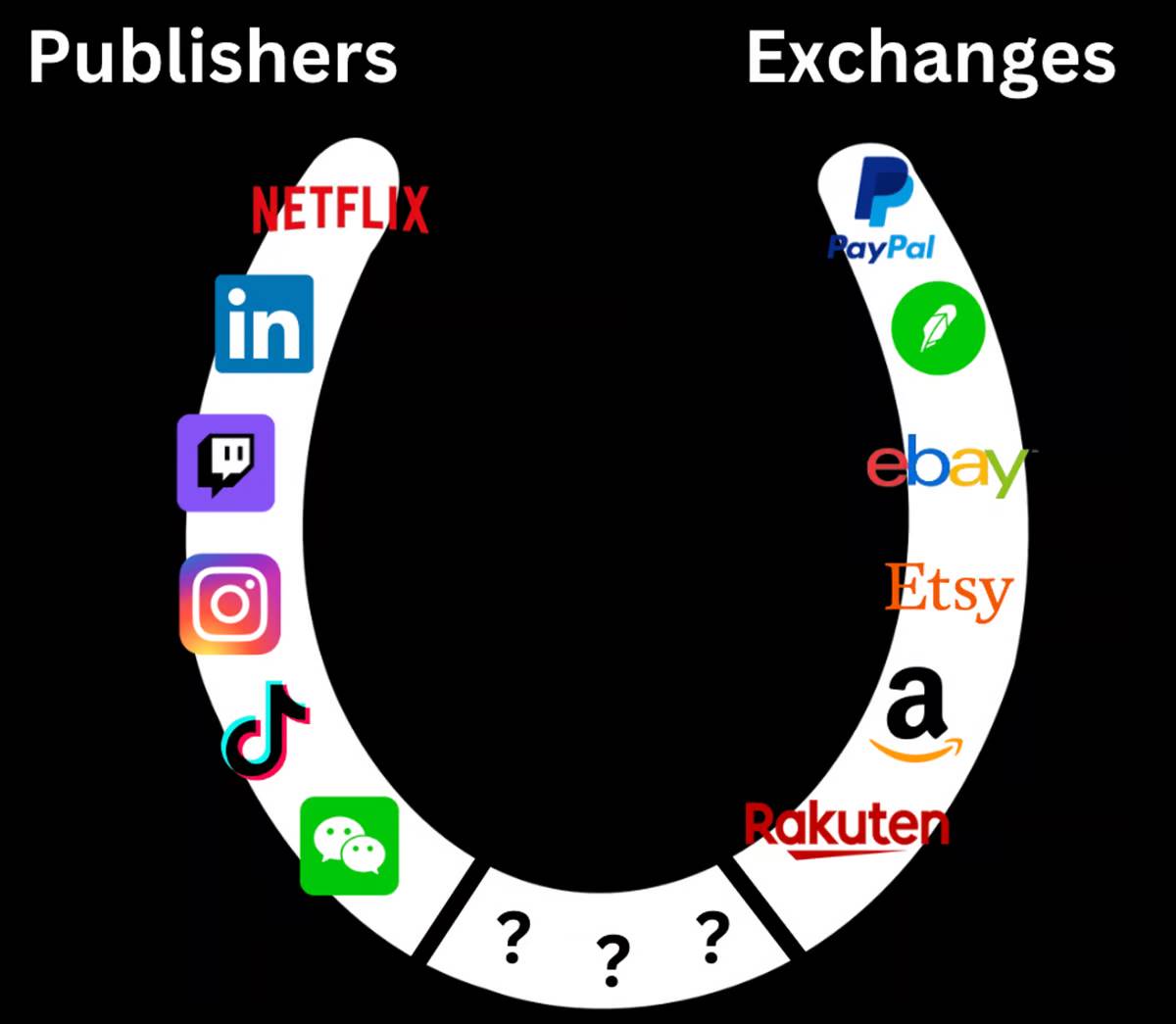
Summary: Every publisher and every exchange is moving toward a hybrid Publisher-Exchange model because it maximizes user engagement, retention, spending, and growth.
So, what does this have to do with crypto?
-
Web3 publishers and exchanges converge into unified Publisher-Exchanges, accelerating new application creation and adoption.
-
Web2 Publisher-Exchanges will adopt crypto payments to “onboard the next billion users.”
Web3 Publisher-Exchanges
In Web3, we already have many publishers—including blockchain explorers, data providers, analytics tools—and many exchanges, including wallets, decentralized exchanges (DEXs), NFT marketplaces. Unlike Web2’s technical debt, we now have the opportunity to unify publishers and exchanges inseparably, creating experiences previously impossible in Web2.
In Web2, popular consumer apps like Instagram, TikTok, and Netflix are meticulously designed (every detail fine-tuned) to deliver frequent dopamine hits, effectively locking in user attention. As we’ve seen with WeChat and Douyin, when you layer financial products onto sticky consumer apps, they perform exceptionally well.
We live in a world of exponentially increasing content and information consumption. Imagine if money could be exchanged as quickly or seamlessly as information—that’s crypto’s breakthrough point.
Crypto-native consumer applications can enable any publisher or exchange (crypto-native or not) to offer new forms of user engagement through native transactions, speculation, credit issuance, etc. If executed well, these new apps can foster deeper user commitment than single publishers alone. The ability to seamlessly integrate financial products into their frontend gives newer Publisher-Exchanges a critical edge against established players.
Here are some examples of crypto consumer applications:
Frames
Frames extend Facebook’s OpenGraph standard, transforming static embeds into interactive experiences. It’s a new crypto primitive giving developers a standard to run app Y inside app X without coordination between them. Here are some Frame implementations:

Someone even built a playable version of Doom inside a Frame:
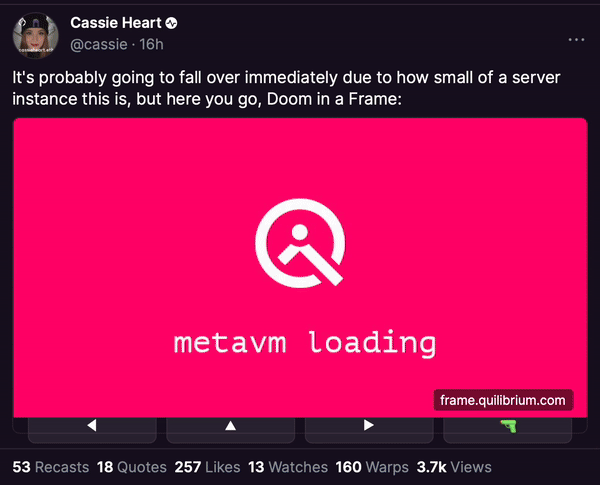
If you can build a full video game inside a Frame, anything is possible.
Now imagine Frames embedded within wallets, blockchain explorers, and other Web3 publishers. When combined with smart publishing infrastructure, Frames provide a powerful way for all publishers to become next-gen ad networks. For example, a blockchain explorer sells ad space to a derivatives platform, which can conduct real-time trades via credit issuance within the ad Frame. This is a prime example of a Web3 publisher becoming a Publisher-Exchange through native value issuance. Emerging infrastructure providers like Relayer equip publishers with tools for on-chain discovery, management, and rewards.
Additionally, Frames open up an entirely new marketing frontier for advertisers, proving far more effective than traditional methods of acquiring ad inventory on FB or X.
Frame stack development is in full swing, with teams building everything from attribution tools to smart publisher infrastructure to non-custodial social accounts. For a deeper dive into Frames, check out the awesome-frames repository.
Couldn’t we do this in Web2?
Technical debt from legacy infrastructure, plus the difficulty of multi-team coordination required to implement Frame-like primitives, makes it nearly impossible. That’s why many—including Facebook—have tried and failed.
Therefore, interactive advertising via Frames—even without requiring a wallet—will likely become a defining trend in the coming years.
The Era of Curated Wallets
Wallet interfaces can determine how we interact with Web3. Just as Yahoo curated news or Google curated websites, wallets have the opportunity to do both. While wallets started purely as transaction platforms, I expect them to aggressively enter the publisher space. Specifically, wallets can:
-
Allow dApps like Uniswap, dYdX, Aave to be accessed within the wallet. Additionally, wallets can curate leading protocols across each sector (money markets, perps, etc.).
-
Leverage users’ Web3 profiles to create a “For You Page” (FYP) featuring recommended new protocols.
-
Create a “Deals” page where users discover brands and earn rewards, while wallets generate ad revenue. Think of it as composable credit card rewards we know and love.
This is a prime example of “meeting users where they are,” rather than forcing them to navigate elsewhere for the same outcome. And we’re only scratching the surface—wallets could evolve into aggregators of prediction market data, news sources, or curators of crypto events from X and Farcaster.
Applications
Since we’re still early in the crypto consumer lifecycle, we’re seeing the emergence of “v1 Web3 Publisher-Exchanges.” These early versions take many forms but aim for the same goal: establishing a new coupling between information and money beyond Web2’s limitations.
Social
-
Farcaster: A community-built protocol for a new kind of social network.
-
Unlonely: A livestreaming platform where users mint tokens and play prediction games during streams.
-
JokeRace: A gamified protocol that enables monetization through participation.
Prediction Markets
-
Polymarket: A decentralized prediction market where users can speculate on anything.
-
Swaye: A prediction market and battle royale game built for Farcaster, letting users create markets, bet with friends, and earn rewards.
-
Parcl: A real estate prediction market enabling liquid exposure to this asset class.
Gaming
-
Parallel: A sci-fi trading card game using NFTs so users own parts of the world they help build.
-
Karate Combat: A full-contact striking league combining motion capture and real karate fights, where users earn tokens when their fighters win.
-
Anichess: A chess game introducing new mechanics powered by NFTs and tokens.
Of course, we've already seen early validation of this theme via Telegram bots like Banana Gun, Maestro, and BonkBot, which collectively processed nearly $15 billion in trading volume.
TikTok is to media as crypto is to money
Just as TikTok became the dominant media format by shortening content consumption units, crypto will become the dominant form of value by shrinking the unit of monetary exchange.
Younger generations are shifting from TV and Netflix to short-form video content. I believe crypto is a natural extension of the “TikTok thesis”—we’ve already reduced the unit of media consumption; why not do the same for money?
The above applications are the first real attempts at doing so. As infrastructure matures and applications advance, I have no doubt Web3 Publisher-Exchanges will lead the charge in attracting the next generation of internet users.
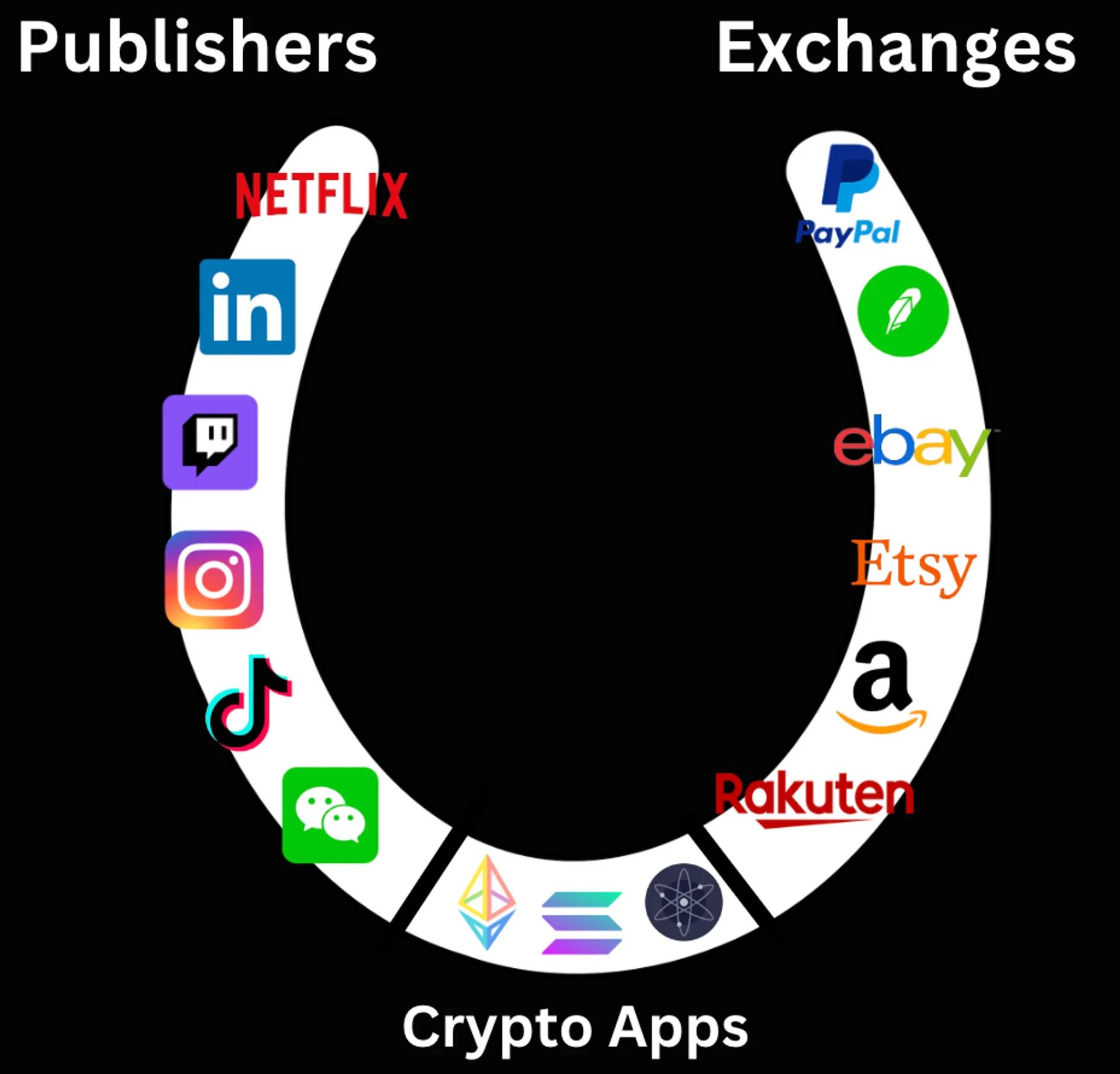
So what do Web3 Publisher-Exchanges offer that Web2 doesn't?
Two distinct features may give Web3 a clear advantage over Web2:
1.Protocol-Issued Credit
Crypto reduces friction in money movement, enabling money to flow as fast and freely as data. As mentioned, crypto allows publishers to seamlessly add financial rails to their apps. Many use cases exist, but the most important is Protocol-Issued Credit (PIC).
Previously, marketers measured campaign performance via cost-per-click (CPC) or cost-per-thousand impressions (CPM). Future marketing will include interactive ads powered by PIC. For example, a new perp DEX could issue $10 USDC via an ad frame for in-app trading, or a game might offer $15 OP for completing a tutorial, usable later. This would structurally change marketing spend by directly compensating users’ time—and early Frame data suggests it actually boosts engagement—a true win-win.
But don’t I need to be a crypto-native user to participate?
Not necessarily. Today, many crypto apps simplify onboarding complexity. No initial crypto needed, so no entry barrier.
Here are examples of crypto apps requiring no crypto wallet:
-
Pudgy Penguins: The founder shared a great demo showing how users can onboard by buying a Pudgy Penguin at Target, opening a digital mystery box, and logging in via email to save progress.
-
Blackbird: Users earn status, points, and perks from Blackbird-affiliated restaurants—no crypto or gas fees required.
-
Lolli: A browser extension letting users earn Bitcoin during purchases via affiliate marketing—no wallet or onboarding needed.
By leveraging decentralized identity platforms like Privy, developers can seamlessly integrate login functionality without requiring users to hold a crypto wallet.
2. Phasing Out Cookies
Despite companies like Facebook, Snapchat, and Google preaching values centered around capturing your attention. You might think these platforms are free, but as the old saying goes, “If it’s free, you’re the product.” And that couldn’t be truer.
Yes, I’m referring to cookies—their use revolutionized modern digital advertising and user experience by delivering personalized content and targeted ads across sites based on individual browsing behavior. But… a paradigm shift is coming.
Traditional use of third-party cookies in web browsers is finally declining. Major browsers like Safari and Firefox already block third-party cookies by default, and Google Chrome plans to phase them out by early 2025.
The phasing out of third-party cookies—driven largely by privacy concerns and regulatory changes—has several implications:
-
Enhanced Privacy: Removing third-party cookies strengthens user privacy and reduces cross-site tracking. Users gain greater control over personal data (already a core tenet of Web3).
-
Advertising Impact: Advertisers must find new ways to deliver personalized ads without relying on broad tracking.
-
Changes in Web Analytics: Without third-party cookies, businesses must adapt analytics methods, relying on first-party data or aggregated reports.
-
Development of New Technologies: Efforts like Google’s Privacy Sandbox aim to create a more private web while supporting personalization—but effectiveness won’t match third-party cookies.
This presents a once-in-a-generation opportunity for Web3.
Enter On-Chain Data and Digital Identity
Content curation and targeted advertising is a trillion-dollar industry, primarily built on algorithms optimized using cookie-based data. The end of cookies opens the door for Web3 to “flip” Web2—offering stronger alternatives to cookie-based targeting.
At the heart of Web3 is the belief in incentivizing data based on merit. Numerous platforms now allow users to earn tokens by contributing off-chain data: whether through Worldcoin’s eye scans, connecting Web2 social profiles via Oamo, or sharing ZKP-protected demographic data on other platforms. Additionally, platforms like JokeRace let you share your projects, memes, tweets, songs, etc., with others voting to form a value graph. While the Web3 identity stack is fragmented today, I expect standardization will boost adoption and utility of these primitives.
The key is that on-chain data paired with incentivized off-chain data means Web3 can build richer user profiles, leading to better curation and higher ad conversion rates.
Because of this, I fully expect Web2 companies to begin sourcing data via Web3-native platforms to gain a competitive edge.
In summary: The combination of protocol-issued credit and the Web3 “flip” on data may provide a viable path toward long-term, widespread crypto adoption.
So far, we’ve covered the transformation toward Publisher-Exchanges and how Web3 serves as the ultimate testing ground for the next generation. Next, we’ll explore why Web2 Publisher-Exchanges are more likely than you think to adopt crypto payment rails.
Onboarding the Next Billion Users
There have been many reasons why institutions haven’t adopted crypto payments yet: high fees, slow settlement, lack of privacy and compliance, poor UX and DX, brand risk, etc.
Fortunately, most major infrastructure issues have now been solved. Naively, one could spin up an app chain and modify everything—gas fees, block times, FaceID support, and almost anything else imaginable.
We’ve reached a stage where infrastructure is good enough. Now, the benefits of adopting crypto payments may outweigh perceived risks.
In particular, Web2 Publisher-Exchanges face a unique opportunity to become among the earliest institutional adopters of crypto.
Of course, I don’t expect Publisher-Exchanges to adopt crypto payments simply because crypto is cool—crypto needs to offer a 10x improvement over existing infrastructure to justify switching costs and brand risk. Therefore, Publisher-Exchanges won’t all adopt crypto at once; early adopters will fall into three categories:
-
Demographics
-
Integrated reward systems
-
Trusted neutrality
Demographics
The global number of crypto users is growing rapidly. By the end of 2023, the global crypto user base surged to approximately 580 million, a 34% year-on-year increase. This growth trend is expected to continue, with estimates suggesting 850 million to 950 million users by end of 2024. Moreover, research shows 72% of crypto owners are under 34. Essentially, global crypto adoption is rising fast, with strong preference among younger generations.
Similarly, existing Publisher-Exchanges are primarily driven by users aged 10–34. With younger generations entering the market, two trends are clear:
1) They prefer short-form video content and instant gratification
2) Most of their purchases will happen through Publisher-Exchanges
Given the striking demographic overlap between crypto and Publisher-Exchanges, and increasingly similar user bases, it’s highly likely Publisher-Exchange users will eventually expect—or even demand—crypto payments.
On the other hand, people living in countries with unstable governments and currencies have clearly expressed their desire to move funds into stablecoins like USDC. Many in developing nations
1) are either devastated by inflation,
2) distrust banks,
3) or cannot even open bank accounts.
Fortunately, crypto’s two-way nature offers the clearest solution, which is why Visa is exploring merchant payments in USDC. Another notable example is Stripe reintroducing crypto payments. This decision wasn’t driven by improved infrastructure, but by rising demand in emerging markets.
Publisher-Exchanges sit at the forefront of commerce, just as crypto sits at the frontier of finance. Thus, shared user bases will grow in tandem until they become one.
Integrated Reward Systems
Traditional payment rails make sending value easy—but receiving value difficult. The nature of on-chain value transfer and ease of account creation make operations via crypto rails ~10x easier. This unlocks several breakthroughs:
1) You can seamlessly receive value
2) Due to fast, low-cost settlement, smaller units of value can be exchanged.
Here are some incredible use cases:
-
Interest Payments: Gambling platforms or custodial services can incentivize users to hold funds on-platform by offering real-time interest payouts.
-
Asset Issuance: Communities of special interest can create and distribute virtual assets without needing bank accounts or KYC. Reddit Awards or Discord Nitro are early signs of product-market fit.
-
Protocol-Issued Credit (PIC): As discussed earlier, PIC could fundamentally transform user acquisition as we know it. Crypto payment rails could allow Web2 companies to offer PIC too.
Trusted Neutrality and Privacy
The beauty of smart contracts lies in their embodiment of trusted neutrality. Any Publisher-Exchange facing censorship or high chargeback rates from traditional payment processors (and there are many) may opt to move payments on-chain. This includes industries like CBD, gambling, pharmaceuticals, adult entertainment, etc.
Just review Stripe’s list of prohibited and restricted businesses, and you’ll quickly realize there’s massive demand for alternative payment channels.
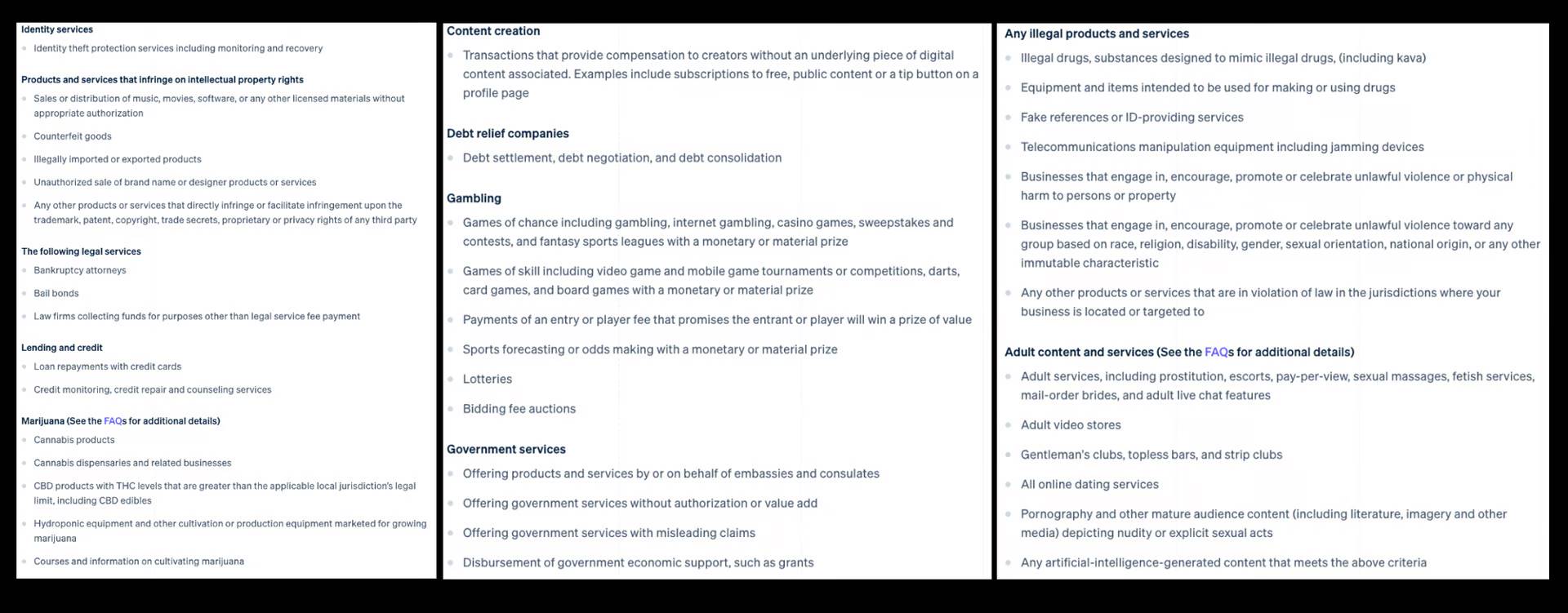
Generally, users in these segments also have higher privacy demands. We now have numerous tech and infrastructure providers—Fhenix, Aztec, Penumbra—building tools for private payments. A recent example is the Shiba Inu team adopting an FHE-powered privacy layer to expand its entertainment ecosystem.
Looking Ahead
Publisher-Exchanges represent the future of e-commerce. Especially Web3 Publisher-Exchanges, which offer an incredible opportunity to unify publishers and exchanges inseparably, creating tighter coupling between money and attention than Web2 allows.
Web2 Publisher-Exchanges are among the most likely institutions to adopt crypto payments, due to striking demographic alignment and the new capabilities and autonomy offered by on-chain payments. Looking ahead, I expect a resurgence of verticalized crypto payment startups, high-performance privacy tech, chain/balance abstraction, seamless non-custodial experiences, and more.
As information becomes democratized and accessible, so too will money become democratized and accessible.
Join TechFlow official community to stay tuned
Telegram:https://t.me/TechFlowDaily
X (Twitter):https://x.com/TechFlowPost
X (Twitter) EN:https://x.com/BlockFlow_News










