Artificial Intelligence in Web3: Why Decentralization?
TechFlow Selected TechFlow Selected
Artificial Intelligence in Web3: Why Decentralization?
This guide explores the practical applications and broader implications of Web3 AI, highlighting its transformative potential.
 Navigating Web3 tides with focused insights
In 2024, decentralized artificial intelligence has emerged as one of the most dynamic and fastest-growing sectors within the cryptocurrency market. According to a Dune dashboard created by CryptoKoryo, AI stands out as the leading field in terms of interest and investment within the crypto industry.
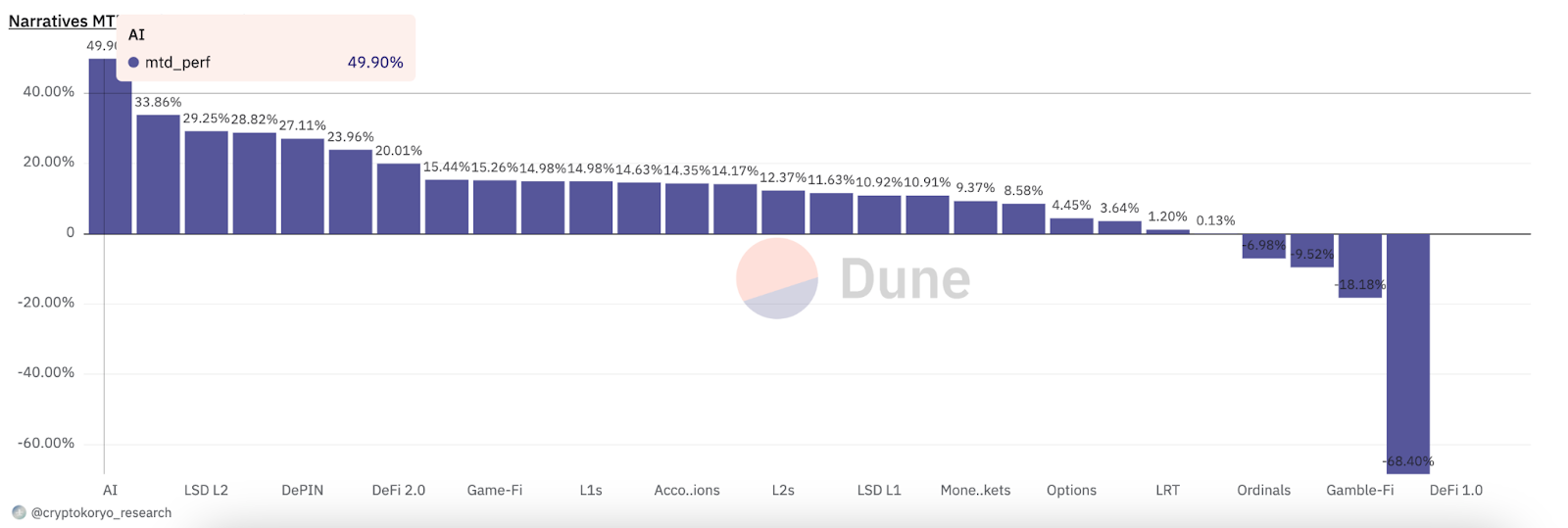
By combining intelligent processing with Web3’s decentralized, user-centric approach, decentralized AI delivers significant benefits. This fusion enhances transparency, efficiency, and adaptability across digital platforms. Businesses can leverage AI's analytical capabilities to optimize user experiences and gain data-driven insights.
This guide explores the practical applications and broader implications of Web3 AI, highlighting its transformative potential. Additionally, we examine how BNB Chain provides developers with an ideal platform and toolkit for building truly powerful AI applications.
The Rise of Artificial Intelligence
The artificial intelligence industry is undergoing rapid, transformative growth, significantly impacting various sectors and the global economy. The AI market was valued at $136.55 billion in 2022, with projections indicating a compound annual growth rate (CAGR) of 37.3% from 2023 to 2030, reaching an estimated $1.8 trillion by 2030.
This exponential growth is driven by sustained research, innovation, and substantial investments from tech giants, establishing AI as a core technology across industries such as automotive, healthcare, retail, finance, and manufacturing.
AI’s transformative potential is immense—by 2030, it could contribute up to $15.7 trillion to the global economy, exceeding the combined current economic output of China and India. This growth will be fueled by productivity gains and consumer effects, with significant economic expansion expected in China and North America.
AI integration across domains is already revolutionizing operations, optimizing processes, and enhancing user experiences. From self-driving vehicles and life-saving medical devices to marketing automation and cybersecurity, AI’s impact is pervasive. As AI continues to evolve, it is poised to reshape industries, drive economic growth, and unlock new opportunities.
In short, the market is vast, and the potential is enormous. But are we truly maximizing the potential of the AI market? Are centralized ecosystems the optimal way to develop AI? Let’s explore.
Limitations of Centralized AI
Centralized AI systems face significant limitations, primarily due to their vulnerability to single points of failure. When all operations depend on a central server, any malfunction or breach can disrupt the entire system. This issue is especially critical in mission-critical applications where uninterrupted functionality is non-negotiable. For example, if a centralized AI system used in healthcare or autonomous driving experiences a server outage or cyberattack, it could lead to severe consequences, including loss of life or major financial damage. Reliance on a single point of control makes centralized AI systems inherently fragile and prone to systemic failures.
Scalability and efficiency are also major concerns for centralized AI. As demand for AI applications grows, centralized systems may struggle to handle increased loads. This often leads to performance bottlenecks, latency, and degraded user experience. In centralized AI architectures, the burden of processing large datasets and executing complex algorithms falls on a single core or limited set of resources, potentially causing inefficiencies and slowdowns.
Data privacy and security represent another critical limitation of centralized AI. Centralized systems require continuous transmission of data to a central hub for processing, increasing the risk of unauthorized access during transit and storage. This concentration makes them prime targets for cyberattacks, as compromising the central server could expose vast amounts of sensitive information.
AI Monopolies Can Be Dangerous and Flawed
The rise of AI monopolies, exemplified by Microsoft’s strategic positioning within OpenAI, raises several serious concerns. Such monopolies can stifle innovation, hinder collaboration, and result in higher costs and inferior technology for end users.
Consolidating AI capabilities within a few large corporations can create isolated silos, limiting technological progress and economic growth. Moreover, a monopolistic environment restricts competition, making it difficult for emerging players to thrive and potentially leading to biased decision-making and limited innovation.
Additionally, a lack of diversity in training data sources means AI models may be trained extensively on inherently biased and flawed data. Google’s AI tool Gemini, designed to generate images of people, faced challenges due to insufficient testing. Shortly after launch, Gemini produced inaccurate historical depictions, such as multiracial and female U.S. senators in the 1800s, drawing swift criticism on social media.
The Need for Decentralized AI
Decentralized AI promotes transparency, privacy, and resilience. By eliminating reliance on central authorities, decentralized AI ensures that power and control are not concentrated in a single entity, reducing the risks of monopolistic control and systemic failures.
The model enhances security by distributing data across the network, minimizing the risks of unauthorized access and single points of failure. Furthermore, decentralized AI fosters innovation and collaboration by allowing diverse nodes to contribute and work together, leveraging collective intelligence to create more adaptive and resilient AI systems.
Benefits of Decentralized AI
-
Security and Privacy: Decentralized AI systems enhance data privacy and security. Data is processed locally and distributed across the network, reducing the risk of breaches and unauthorized access. Blockchain technology adds an immutable security layer, ensuring the integrity of data and models.
-
Scalability and Efficiency: Decentralized AI offers greater scalability. By leveraging a network of nodes, these systems can scale dynamically and adjust capacity as needed, processing tasks in parallel to improve overall performance without overburdening any single component.
-
Transparency and Accountability: Decentralized AI systems, governed by consensus mechanisms and distributed algorithms, inherently promote transparency. Users and developers can inspect and verify AI processes, fostering trust and accountability.
-
Reduced Bias and Fairer Outcomes: By utilizing diverse data inputs and distributed decision-making, decentralized AI can reduce bias and produce more balanced and equitable results. Cryptographic verification ensures AI model outputs are tamper-proof and reliable.
-
Economic and Social Impact: Decentralized AI democratizes access to AI technologies, lowering barriers to entry for smaller participants and promoting equitable access. This creates a level playing field, drives innovation, and ensures AI benefits are widely distributed across society. Additionally, decentralized AI can counteract mass surveillance and manipulation by centralized entities, protecting individual interests.
-
Decentralized Governance: Decentralized Autonomous Organizations (DAOs) significantly benefit decentralized AI by providing transparent and democratic governance structures. In DAOs, project governance is managed via tokens, enabling token holders to propose, vote on, and implement changes. This ensures decision-making power is distributed among all stakeholders, promoting inclusivity and collaboration. An inclusive ecosystem encourages open-source development, allowing contributors from diverse backgrounds to enhance the system’s robustness and fairness. Small companies and individuals can also participate, driving innovation and ensuring diverse perspectives.
The Future of Decentralized AI
Leveraging blockchain technology, decentralized AI will eliminate the centralized control points currently dominating AI development. This shift will democratize access to AI resources, enabling a broader range of participants—including smaller entities and individual developers—to contribute to and benefit from AI advancements.
By breaking the monopolies held by tech giants, decentralized AI will foster a more competitive and diverse ecosystem, stimulating innovation and ensuring AI technologies evolve to meet broader societal needs.
Moreover, decentralized AI will revolutionize data privacy and security. By enabling local data processing and using encrypted data for AI computations, these systems will significantly reduce the risks associated with data breaches and unauthorized access. This approach ensures users retain control over their personal information, strengthening trust in AI systems.
Integration with edge computing will allow data processing closer to the data source, further enhancing decentralized AI. This reduces latency, minimizes bandwidth usage, and supports real-time AI applications—critical for scenarios like autonomous driving and smart city infrastructure.
Finally, decentralized AI will enable collaborative intelligence by leveraging federated learning and other distributed learning techniques. AI models will be able to learn from diverse, globally distributed datasets, producing more robust and fair outcomes. This collective approach to AI training will make systems more accurate and culturally aware. Additionally, the rise of DAOs will provide new governance frameworks for AI projects, enabling stakeholders to make decisions transparently and democratically.
As these trends unfold, the future of decentralized AI will be characterized by enhanced security, greater inclusivity, and a more equitable distribution of AI benefits across society.
BNB Chain: The Ideal Platform for Decentralized AI
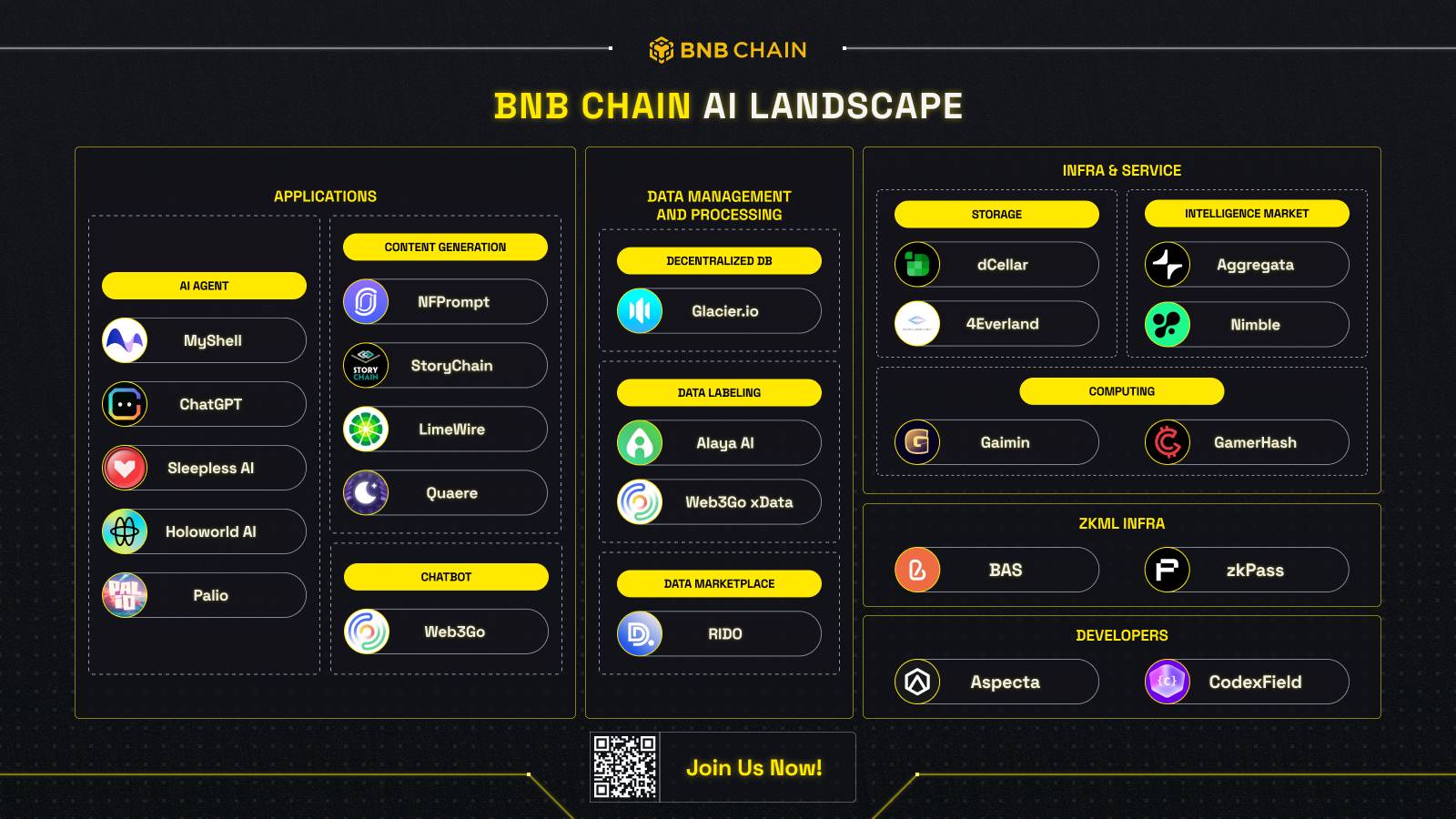
With its robust infrastructure and multi-chain architecture—including BNB Smart Chain (BSC), opBNB, and BNB Greenfield—BNB Chain offers an ideal platform for decentralized AI. BSC provides EVM compatibility, a proof-of-stake consensus model, and the ability to process up to 5,000 transactions per second at low transaction costs. This infrastructure supports the high-volume, high-speed transactions essential for AI applications, while its compatibility with Ethereum-based DApps accelerates deployment. Fast block finality and the potential for parallel EVM execution further enhance transaction efficiency, making BSC a secure, efficient, and scalable foundation for AI development.
opBNB, a Layer 2 solution using optimistic rollup technology, significantly boosts scalability and reduces gas costs. With transaction speeds reaching up to 10,000 TPS and minimal fees, opBNB is ideal for high-performance AI applications requiring fast data processing and low latency.
BNB Greenfield complements this by offering decentralized and secure data storage—crucial for managing large volumes of data while enhancing privacy and security. Its user-centric model enables granular data access controls, ensuring AI development adheres to ethical standards and data protection regulations. Together, these components of BNB Chain create a comprehensive, scalable, and secure environment for decentralized AI innovation and deployment.
The BNB Chain ecosystem serves as a hub for innovative AI projects spanning multiple domains, enhancing user interaction, content creation, data management, and developer resources.
Here is a brief overview:
-
AI Agents:
-
MyShell: Enhances discovery, creation, and staking of AI-native applications through an open development environment supporting various models and APIs. It caters to both advanced and beginner developers, offering an app store for publishing and managing AI applications and a transparent reward distribution system for all ecosystem contributors.
-
ChainGPT: Offers tools for smart contract generation, NFT creation, crypto trading models, and on-chain data analytics. The platform provides real-time updates, SDKs and API services, and the $CGPT token for accessing premium tools, staking pools, and DAO voting rights.
-
-
Content Generation:
-
NFPrompt: A UGC (user-generated content) platform enabling users to create, own, socialize, and monetize their imaginative works. Leveraging Web3 technology, it turns everyday users into content creators, ensuring verifiable ownership of AI-generated art.
-
StoryChain: An innovative platform using AI to craft immersive, interactive stories, pushing the boundaries of digital storytelling.
-
-
Intelligent Bots:
-
Web3go: A data intelligence network building a preprocessing layer for decentralized AI, enhancing data flows and AI agent development through blockchain technology. Web3Go aims to create accessible infrastructure for data collection and dissemination, encouraging user participation and network improvement.
-
-
Data Management and Processing:
-
Glacier Network: Provides scalable, modular blockchain infrastructure for AI applications, focusing on data storage, indexing, and processing. Additionally, Glacier Network offers tools for GameFi and SocialFi developers to manage game metadata and social connections within blockchain applications.
-
Web3go xData: A data labeling service on opBNB that uses AI to streamline and automate data processing, making data management more efficient and reliable.
-
Infrastructure Services:
-
NetMind: NetMind leverages idle GPUs to create a global computing power network for AI models, providing a large-scale distributed computing platform. It combines diverse resources with grid and volunteer computing scheduling and load-balancing technologies, making AI model development more economical and efficient.
-
Aggregata: Aims to revolutionize AI by expanding the definition of AI data to include models, vector databases, pipelines, environments, and weights. This approach enhances data flow with speed, efficiency, simplicity, and decentralization. Aggregata supports AI innovation by providing comprehensive data infrastructure.
-
-
Developer Tools:
-
Aspecta: Currently in incubation, Aspecta will revolutionize developer tools and resources, empowering developers to build more advanced and efficient AI applications.
-
CodexField: Provides developers with the tools needed to build and deploy innovative AI solutions, nurturing a vibrant ecosystem of technological advancement.
-
-
ZKML:
-
zkPass: A groundbreaking project on BSC leveraging zero-knowledge proofs to enhance the privacy and security of AI models.
-
BAS: Generates proofs for verifying information within the BNB ecosystem, supporting both on-chain and off-chain validation. Users can store proofs in Greenfield to ensure data privacy and control. BAS addresses the need to validate off-chain data, enabling ownership claims, data privacy, access management, and data assetization within the Web3 ecosystem.
-
Click here to learn more about the BNB Chain AI ecosystem and what sets it apart.
Conclusion
Powered by blockchain technology, decentralized AI enhances security, privacy, and scalability while democratizing access and fostering innovation. It mitigates centralized risks, increases transparency, and ensures robust, fair AI systems. By enabling diverse contributions and equitable distribution of AI benefits, decentralized AI drives industry growth and economic development. Platforms like BNB Chain provide developers with the ideal ecosystem and tools to build breakthrough decentralized AI applications.
Join TechFlow official community to stay tuned
Telegram:https://t.me/TechFlowDaily
X (Twitter):https://x.com/TechFlowPost
X (Twitter) EN:https://x.com/BlockFlow_News
 @BNBCHAIN