








Conversation with Farcaster: How Can a Decentralized Social Media Scale from 100,000 to 1 Billion Users
TechFlow Selected TechFlow Selected
Conversation with Farcaster: How Can a Decentralized Social Media Scale from 100,000 to 1 Billion Users
Farcaster co-founders Dan Romero and Varun Srinivasan shared their views on a range of topics.
 Navigating Web3 tides with focused insights
By Sage D. Young, Unchained (formerly of CoinDesk)
Translated by Yangz, Techub News
On Wednesday, Dan Romero, co-founder of decentralized social network Farcaster, announced that the project has raised $150 million in a Series A round at a $1 billion valuation. The round was led by Paradigm, with participation from a16z Crypto, Haun Ventures, Union Square Ventures, Variant Fund, Standard Crypto, and others. Since becoming a permissionless social network in October 2023, Farcaster has reached 350,000 paid registrants, and network activity has increased 50-fold. This year, Farcaster will focus on growing daily active users and adding developer primitives like channels and direct messaging to the protocol. “In the coming years,” said Dan Romero, “we’ll double down on Farcaster’s vision, truly building it into an internet-scale protocol.”
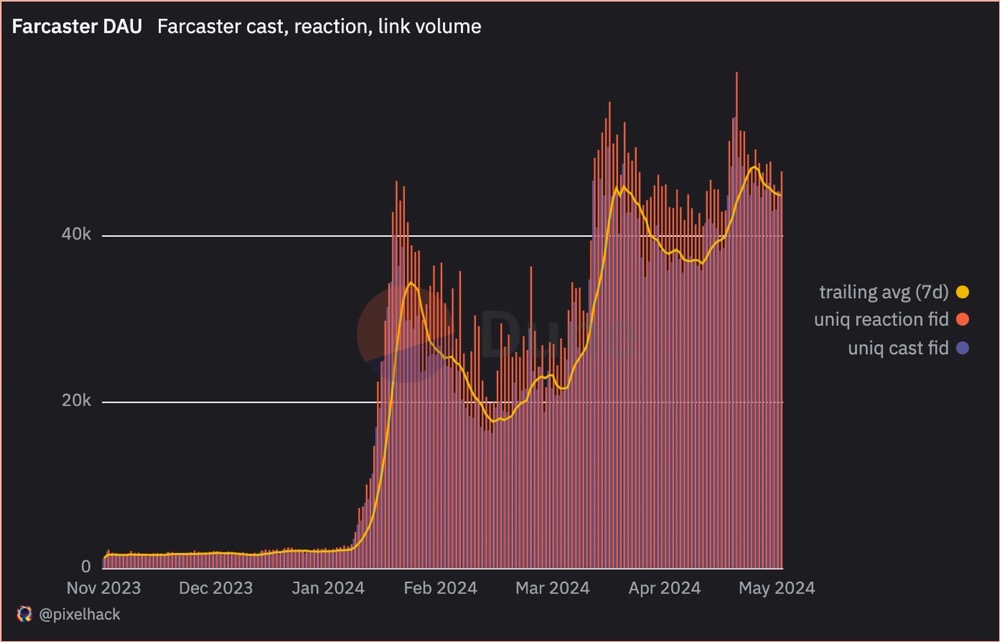
According to data compiled by Pixelhack on Dune Analytics, Farcaster’s daily active users reached nearly 45,000 on May 20—up 30% from the spike seen on February 11 following the launch of Frames, a feature that turns posts into interactive apps. However, this figure remains far behind mainstream social media giants like Facebook, TikTok, and X (formerly Twitter).
As one of the leading decentralized social protocols, how does Farcaster plan to achieve its ambitions? To find out, Unchained interviewed its two co-founders, Dan Romero and Varun Srinivasan. The founders shared their views on a range of topics, including their upcoming decentralization plans, their current perspective on the crypto social landscape, and lessons learned during their time at Coinbase. Below are the key takeaways from the interview.
Q: Farcaster’s decentralized channels are launching soon. Can you share more details?
Dan Romero: We believe it's essential to allow channel creators the flexibility to implement economic models—whether through subscriptions or requiring ownership of specific assets—for access. This flexibility incentivizes higher-quality content. Being a community moderator should no longer be thankless work; producing quality content should be rewarded.
That’s where channels come in. They’re similar to subreddits, but the creator owns the channel and can manage it flexibly, introducing economic value in any way they see fit.
Q: What’s the difference between current channels and the upcoming decentralized ones?
Dan Romero: Current channels are centrally managed and stored in Warpcast’s database. While the channel content and casts (similar to tweets or Reddit posts) live on the protocol and are permissionless, the metadata and curation capabilities aren’t part of the protocol—they only exist within Warpcast.
Varun Srinivasan: If you create and set up a (decentralized) channel, all data—including the channel icon and feed—is fully decentralized and can run across multiple different clients. Any app built by anyone can display the same version of the channel. Moreover, creators actually own their channels. So if a creator wants to transfer ownership to a friend, they can. Or, after building up a following, they might choose to sell it—that freedom exists.
Q: How much effort have you put into Farcaster’s decentralized governance?
Varun Srinivasan: Our model for decentralized governance is highly effective—the so-called "rough consensus and running code," used by IETF to build standards like TCP/IP. Its strength lies in its lack of rigid structure. The logic is simple: if you can build something useful and convince most people it’s valuable, then you can deploy it.
There are those who operate Farcaster Hubs (nodes storing data on the network), developers building applications that interact with Hubs to fetch and generate data, and end users using these apps. These three groups balance each other. … You must release something that the majority across all three groups agree is good. Otherwise, they vote with their feet: Hub operators can stick to older versions, apps can connect to different Hubs, and users can switch apps. This system ultimately prevents harmful changes from being forced through against the network’s broader interests.
Dan Romero: Right now, we're focused on keeping governance simple, increasing total daily active users, and shipping genuinely useful features. We could spend a lot of time designing complex, indirect governance structures, but that wouldn't help us reach our goals.
Q: What were the key insights gained when transitioning from working at centralized exchange Coinbase to building a decentralized social network?
Dan Romero: Despite concerns about Twitter’s trajectory under Musk, its network effects proved stickier than I initially thought. When we entered the market in 2021, we noticed people in crypto talking enthusiastically about decentralization and demand for alternative apps. We naively assumed, “Great, people will want to try something new.” But it turned out users preferred sticking with what they already had.
We’ve since deeply internalized the need to build truly useful products for people. Over the past few years, this mindset shift has been profound. Ultimately, we won’t win because of our architecture—we’ll win by building products people love.
Varun Srinivasan: Early on, we realized we’d need to spend just as much time attracting users as we do developers. We quickly learned that building social apps is extremely hard. Just developing Warpcast (Farcaster’s client) took about 20 people a full year. It’s unrealistic to expect other teams to show up on day one and dedicate 100% of their resources to building on Farcaster without existing users.
The most effective way to increase Farcaster’s value to developers is by building a client, telling a compelling story, and drawing users in. Not by asking someone to build an SDK, toolchain, or add a function—but by asking: can you multiply the number of people using this product tenfold? That’s been the biggest shift in our thinking since the early days.
Q: What lessons did you learn at Coinbase that can guide Farcaster’s development?
Dan Romero: From my experience at Coinbase, I’m convinced ordinary people don’t care about everything you’re building. They just want a good app—and that journey starts with onboarding. In fact, it starts even earlier: how do you position the product and explain it to them?
We can improve here. Currently, Farcaster and Warpcast confuse people. We’re not competing against fintech apps—we’re competing against the best social apps in the world.
Once users enter the app, is it engaging enough that they want to come back? Many crypto users enjoy comparing crypto apps, but realistically, if your app isn’t fun, they’ll go back to TikTok or YouTube.
Varun Srinivasan: Another lesson I learned from Brian Armstrong is to stay focused on building what people actually want, regardless of shifting fundamentals. He said things are never as good as they seem, nor as bad. One reason Coinbase has consistently succeeded is that it keeps shipping and building, whether the market is at a peak or trough. Having lived through multiple crypto cycles, we’ve seen this strategy in action. We know long-term focus is what truly wins.
Q: The crypto social ecosystem includes players like Farcaster, Lens, Nostr, and Friend.Tech. How do you view the current landscape?
Dan Romero: Compared to centralized platforms like Facebook with billions of users, the total number of crypto users doesn’t matter much. We’re talking about tens of thousands of users across all decentralized social platforms—possibly the same group of 100,000 people who use crypto daily.
Our real interest is how to grow from 100,000 crypto app users to 1 billion. I don’t think focusing on competitors helps. The real questions are: what do people want? What do they find interesting? If you can make your product fun and engaging enough that people return every day, developers will follow. Nothing else matters.
Varun Srinivasan: These competitors are taking slightly different paths, but our goal is very clear: operate within the crypto space, empower users to build their own communities, and enable developers to create applications for these users.
Join TechFlow official community to stay tuned
Telegram:https://t.me/TechFlowDaily
X (Twitter):https://x.com/TechFlowPost
X (Twitter) EN:https://x.com/BlockFlow_News
 @Unchained_pod






