








Understanding Morph: A New Layer2 Driven by Optimistic and zkEVM Technologies
TechFlow Selected TechFlow Selected
Understanding Morph: A New Layer2 Driven by Optimistic and zkEVM Technologies
Morph's technical logic and ecosystem positioning stand out in the current crowded L2 landscape, primarily addressing issues such as fragmented liquidity and user security found in existing L2 projects.
 Navigating Web3 tides with focused insights
1. Project Overview
Morph is an innovative project dedicated to applying blockchain technology to everyday life. Its mission is to make blockchain technology decentralized, fair, and accessible to everyone. Morph's architecture integrates the strengths of Optimistic Rollup and zkRollup, leveraging a decentralized sequencer network and modular design to reduce development and operational costs while enhancing market competitiveness.
Morph’s technical logic and ecosystem positioning stand out in today’s crowded L2 landscape by addressing key issues such as liquidity fragmentation and user security found in existing L2 projects. Moreover, Morph’s consumer-focused L2 positioning attracts a large number of Web2 users into the Web3 world by offering rich application scenarios and low-barrier user experiences.
Azim Khan, Co-Founder and Chief Operating Officer of Morph, emphasized that Morph aims to solve a critical problem in the current blockchain space—most existing products are designed for industry insiders rather than ordinary users. For the blockchain industry to mature, products must be simplified to become user-friendly. Therefore, while focusing on technological innovation, Morph also prioritizes lowering the entry barrier for users to attract broader adoption.
2. Core Mechanisms
2.1 Decentralized Sequencer Network
2.1.1 Background and Motivation
In traditional Layer 2 (L2) solutions, sequencers are typically centralized. While this centralization enables fast transaction confirmation, it introduces several problems:
-
Single point of failure: If the centralized node fails, the entire network may experience prolonged downtime.
-
Unfair transaction ordering: Centralized sequencers may reorder transactions based on personal profit maximization, extracting more Miner Extractable Value (MEV), or even censoring or rejecting certain users’ transactions.
Morph addresses these issues through its decentralized sequencer network, ensuring network security, stability, and fairness. The design principles include high efficiency, low cost, scalability, and ease of maintenance.
2.1.2 Key Features
-
Multi-node participation: Morph’s decentralized sequencer network allows multiple nodes to participate in transaction packaging and ordering, instead of relying on a single controlling node. This multi-node mechanism enhances network resilience, ensuring that other nodes can continue processing transactions even if one fails.
-
Elimination of single points of failure: By distributing sequencing tasks across multiple nodes, the risk of a single point of failure is significantly reduced, ensuring continuous network operation.
-
Fair transaction ordering: The decentralized sequencing mechanism ensures transactions are ordered fairly, preventing manipulation based on individual interests and improving transparency and fairness.
2.1.3 Operational Mechanism
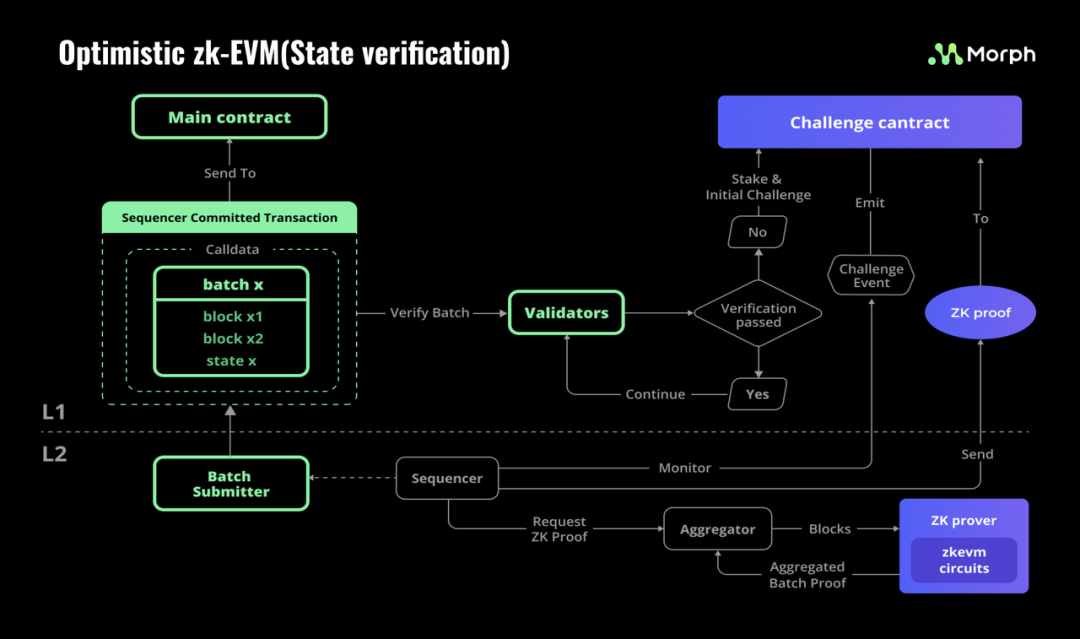
Within Morph’s decentralized sequencer network, multiple sequencer nodes work collaboratively to process transactions. The specific operational workflow is as follows:
-
Sequencer node selection: Nodes are selected via a competitive mechanism, ensuring every node has an opportunity to participate in transaction sequencing. This increases decentralization and incentivizes broader node participation.
-
Transaction packaging and ordering: Each sequencer node packages received transactions and orders them according to predefined fair rules, preventing any single node from manipulating transaction sequence.
-
Rotational submission: Sequencer nodes take turns submitting packaged batches to the Ethereum mainnet. This rotational mechanism avoids overloading any single node and ensures consistent batch submissions.
2.1.4 Incentive Mechanism
To incentivize more nodes to participate in sequencing, Morph implements a comprehensive incentive system:
-
Profit distribution: After collecting transaction fees from users, sequencers redistribute profits according to a predefined mechanism to on-chain projects and DApp developers. This not only encourages more nodes to join but also motivates developers to build and operate DApps on the Morph platform.
-
Fair competition: Through equitable profit sharing and competitive mechanisms, each sequencer node and project receives rewards proportional to their contributions, fostering community engagement.
2.1.5 Security and Efficiency
The decentralized sequencer network enhances both the security and efficiency of the Morph network:
-
Security: Eliminating centralized control removes risks associated with single points of failure and unfair transaction ordering, strengthening overall network security.
-
Efficient processing: Collaborative multi-node operations improve transaction throughput and ensure rapid confirmation and execution.
2.1.6 Ecosystem Impact
Morph’s decentralized sequencer network brings significant positive impacts to its ecosystem:
-
Promotes DApp development: Fair sequencing and incentive mechanisms attract more developers to build DApps on Morph, driving ecosystem growth.
-
Enhances user trust: Increased transparency and fairness in transaction handling strengthen user confidence in the Morph network.
Morph’s decentralized sequencer network solves the problems of single points of failure and unfair transaction ordering inherent in traditional centralized sequencers by enabling multi-node participation, fair ordering, incentive alignment, and efficient processing. It improves network security and performance while laying a solid foundation for ecosystem prosperity and encouraging innovation and active user participation.
2.2 Responsive Validity Proof (RVP)
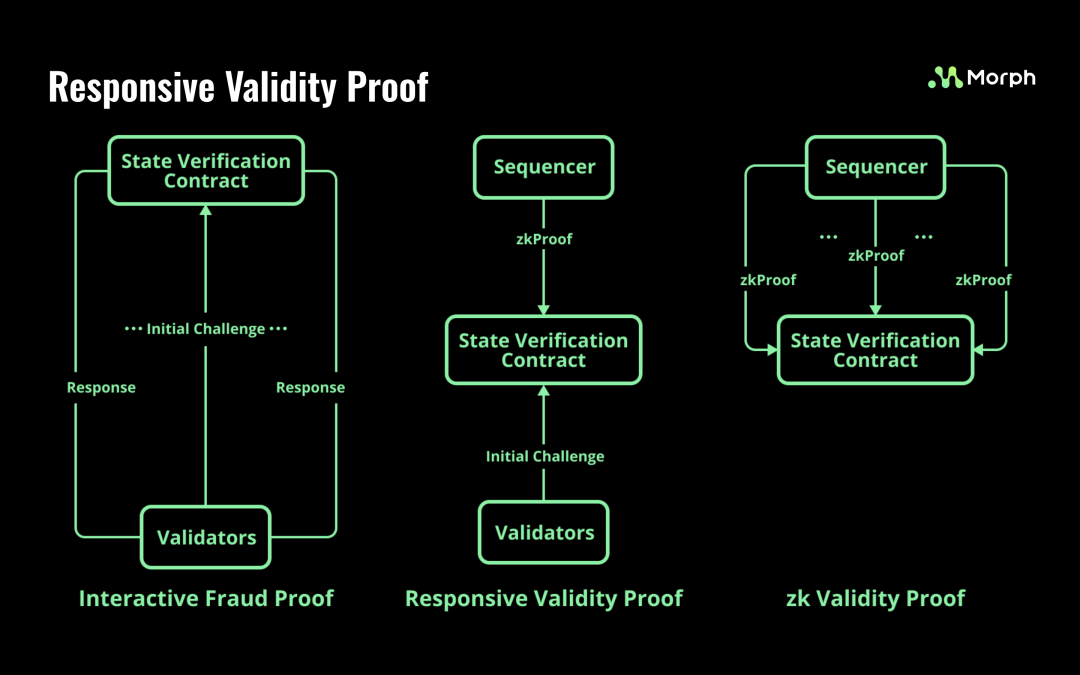
Morph’s RVP combines the advantages of Optimistic Rollup and zkRollup, using zkProofs to verify state correctness while retaining the high-efficiency transaction processing capability of Optimistic Rollup. This design achieves an optimal balance between security and efficiency.
2.2.1 Key Features:
-
Hybrid verification mechanism: RVP uses a hybrid approach combining Optimistic Rollup and zkRollup. By default, transactions are processed efficiently; zkProofs are used only when challenges arise to verify correctness.
-
Shortened challenge period: Leveraging zkProof verification, RVP reduces the traditional 7-day challenge window of Optimistic Rollup to just 1–2 days, accelerating transaction finality.
-
Efficient state validation: During transactions, sequencers generate zkProofs to validate state integrity. This enhances security while reducing computational overhead.
2.2.2 Operational Mechanism
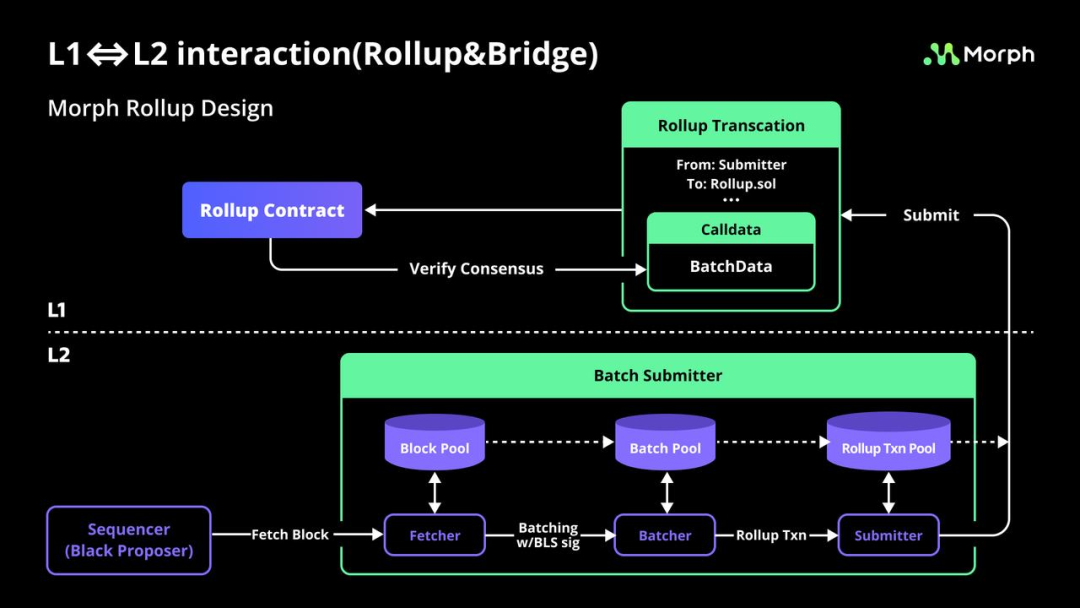
In Morph’s RVP system, the transaction validation process works as follows:
-
Transaction processing: After users submit transactions, the sequencer quickly processes them in Optimistic Rollup fashion and submits blocks to Layer 1.
-
State challenge: During the challenge period, any node can dispute the submitted state. Upon a challenge, the sequencer must generate a zkProof to prove state validity.
-
zkProof verification: The sequencer submits the generated zkProof to Layer 1 for verification. If valid, the transaction state is confirmed; otherwise, it is rolled back and the challenger is rewarded.
2.2.3 Security and Efficiency
RVP’s design ensures both high-speed transaction processing and robust security guarantees:
-
Efficient transaction processing: Under normal conditions, transactions are handled via Optimistic Rollup, maintaining high throughput and speed.
-
Strong security guarantee: zkProofs provide cryptographic assurance against malicious transactions and state fraud during disputes.
-
Reduced computational overhead: By generating zkProofs only when challenged, RVP minimizes computation costs compared to full zk-rollup systems.
2.2.4 Ecosystem Impact
The introduction of RVP has significant positive effects on Morph’s ecosystem:
-
Boosts user trust: Strong security combined with fast transaction processing strengthens user confidence in the Morph platform.
-
Encourages DApp development: A secure and efficient validation mechanism attracts more developers to build decentralized applications (DApps) on Morph, fueling ecosystem expansion.
-
Lowers development barriers: The hybrid verification model simplifies trade-offs between security and efficiency, making it easier for developers to build and deploy applications on Morph.
Morph’s Responsive Validity Proof (RVP) strikes an optimal balance between efficient transaction processing and strong security by integrating the best aspects of Optimistic Rollup and zkRollup. RVP accelerates transaction finality, ensures safety, and reduces computational load. With RVP, Morph delivers a fast, secure transaction experience for users and creates an ideal environment for developers, promoting vibrant ecosystem growth.
2.3 Modular Architecture
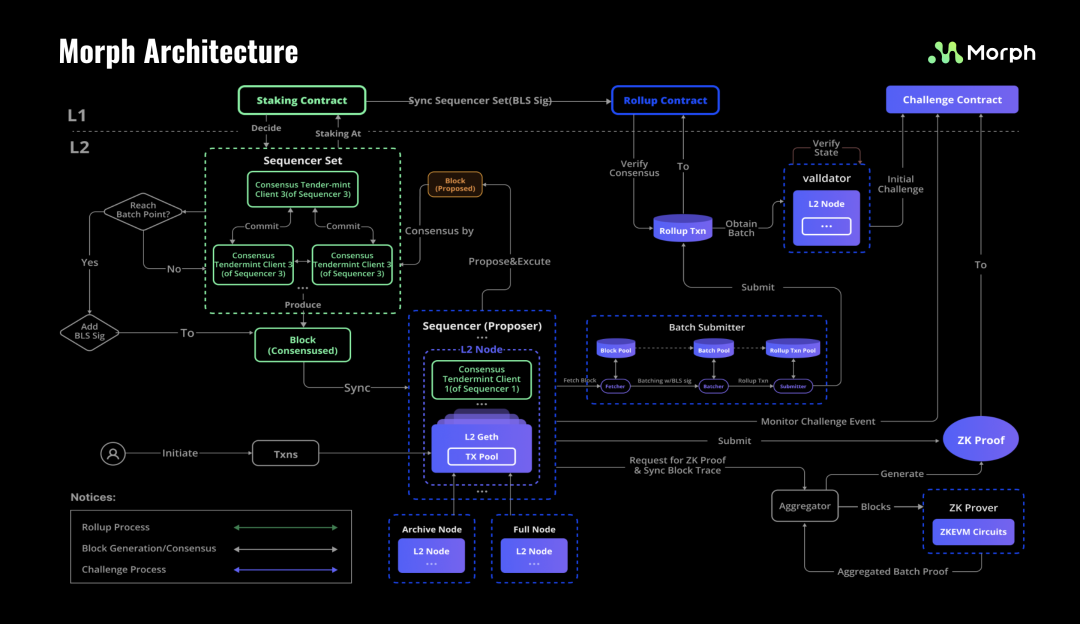
Morph’s modular architecture consists of three core components: Consensus & Execution Module, Settlement Module, and Data Availability Module. This design enhances system flexibility and scalability while reducing development and operational complexity.
2.3.1 Key Features
-
Separated consensus and execution: Similar to Ethereum 2.0, separating consensus from execution prevents invalid transactions from being included, improving system efficiency.
-
Modular collaboration: Independent modules operate autonomously yet cooperate seamlessly, enabling efficient operation and flexible scaling.
-
High compatibility: The modular design ensures strong interoperability with Ethereum and other blockchain systems, facilitating easy migration and integration for developers and projects.
Morph’s modular architecture includes the following three primary modules:
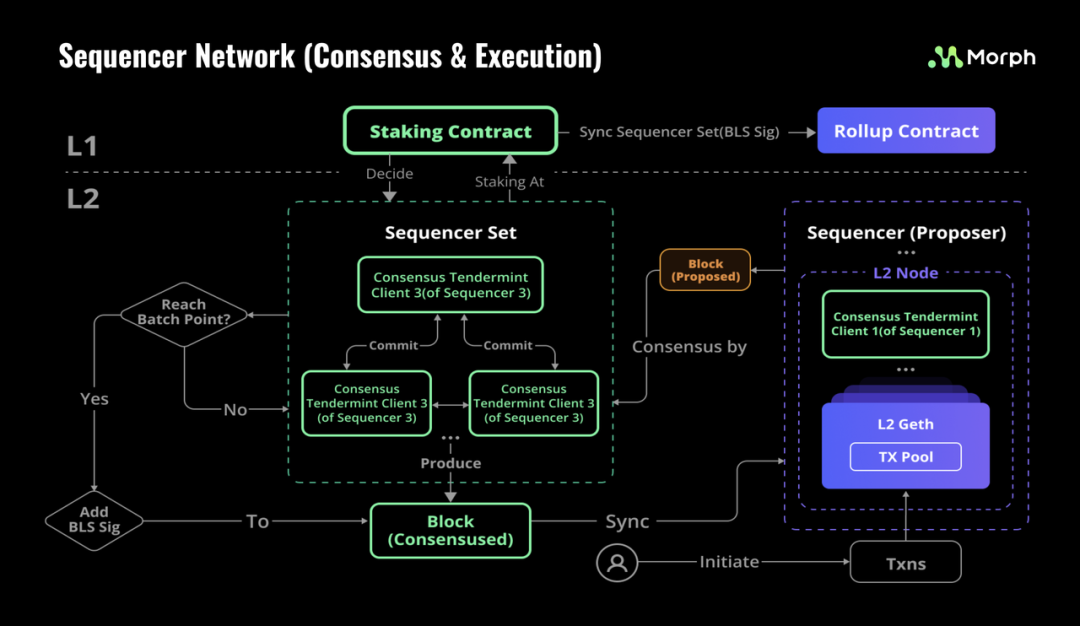
2.3.2 Consensus & Execution Module (Sequencer Network)
-
Responsibility: Handles transaction ordering and execution, ensuring sequential processing.
-
Decentralized sequencer: Employs a decentralized sequencer network where multiple nodes participate in transaction packaging and ordering, enhancing security and fairness.
-
Separation design: Separating consensus and execution avoids including invalid transactions in blocks, minimizing gas losses for users.
2.3.3 Settlement Module (Optimistic zkEVM)
-
Responsibility: Manages transaction settlement and state validation.
-
Optimistic zkRollup: Combines the benefits of Optimistic Rollup and zkRollup to deliver efficient and secure state validation.
-
RVP verification: When challenged, zkProofs are used to verify transaction correctness, ensuring security.
2.3.4 Data Availability Module (Rollup)
-
Responsibility: Ensures transaction data availability and storage.
-
Data compression: Uses zkProofs to compress block content, effectively managing L1 data availability costs.
-
Multi-node submission: Multiple sequencer nodes take turns submitting batches, avoiding single points of failure and ensuring liveness of data publication.
2.3.5 Advantages
Morph’s modular architecture offers significant advantages in flexibility, scalability, and compatibility:
-
Flexibility: Independent modules allow developers to select and customize components based on specific use cases.
-
Scalability: Modular design facilitates seamless upgrades and expansion, allowing quick adaptation to new technologies and standards.
-
Low-cost operations: Reduces development and maintenance complexity, simplifying system management.
-
High compatibility: Seamless integration with Ethereum and other blockchains eases migration and onboarding for developers and projects.
2.3.6 Ecosystem Impact
The modular architecture plays a crucial role in shaping Morph’s ecosystem development:
-
Promotes DApp development: High flexibility and low operational costs attract more developers to build DApps on Morph, accelerating ecosystem growth.
-
Enhances user experience: Efficient transaction processing and secure state validation improve user satisfaction and trust in the Morph platform.
-
Simplifies development workflow: Modular design streamlines the development process, enabling faster deployment of applications on Morph.
Morph’s modular architecture separates consensus & execution, settlement, and data availability into distinct modules, delivering a flexible, scalable, and maintainable blockchain infrastructure. This modular approach provides an efficient, secure, and cost-effective solution that enhances system performance, simplifies development, and fosters vibrant ecosystem growth.
3. Ecosystem
Morph’s ecosystem strategy aims to drive widespread blockchain adoption by providing robust technical infrastructure and diverse incentive programs that attract developers and users alike.
3.1 Ecosystem Development Strategy
Morph’s ecosystem development strategy encompasses the following key areas:
1. Partnership with BitGet
Morph partners with BitGet, a leading global cryptocurrency exchange, leveraging its vast user base and exchange resources to rapidly bootstrap initial liquidity and user activity, creating a strong foundation for developer growth.
-
BitGet user base: With tens of millions of users, BitGet enables Morph to quickly onboard early liquidity and drive user engagement.
-
BitGet Wallet: Provides users with convenient tools for trading and asset management, further boosting participation and transaction volume.
2. Ecosystem Events and Programs
Morph continuously launches ecosystem initiatives to attract developers and projects to build and operate DApps on its platform.
SparkLoom Builder Program: A four-month initiative featuring online hackathons and incubator tracks, offering a $20,000 prize pool and inviting winners into an incubator program with up to $100,000 in funding and access to 30% of Morph’s total airdrop allocation.
HackSummit Hackathon: A collaborative hackathon with Berachain, Solana, The Graph, and others, featuring workshops and lectures on various Web3 use cases, with prizes to accelerate real-world Web3 adoption.
Offline Meetups and MiniHackerHouse: In-person events co-hosted with OpenBuild, Chainlink, and others, supporting aspiring blockchain developers in building within the Ethereum ecosystem.
3. Funding and Technical Support
Morph offers comprehensive financial and technical support to help developers and projects innovate and grow on its platform.
Funding support: Through the SparkLoom Incubator and other incentive programs, Morph provides grants of up to $100,000 and 30% of initial token airdrops to help projects scale from concept to launch.
Technical mentorship: Offers guidance from experts at renowned organizations like Dragonfly, Pantera, and LayerZero to help teams overcome technical hurdles and accelerate product delivery.
3.2 Incentive Mechanisms
Morph’s incentive mechanisms are designed to fairly and transparently reward developers and users for contributing to ecosystem growth.
1. Decentralized Sequencer Incentives
Morph’s decentralized sequencer network not only improves security and fairness but also redistributes sequencer profits to on-chain projects and DApp developers, incentivizing innovation and development on the platform.
Profit distribution: After collecting transaction fees, sequencers redistribute profits according to a predefined mechanism, ensuring contributors are rewarded proportionally.
2. Developer Incentives
Through diverse incentive programs, Morph attracts numerous developers to build and operate DApps on its platform.
SparkLoom Builder Program: Offers generous prize pools and incubator funding to attract top talent into the ecosystem.
Technical support and mentorship: Provides expert guidance to help developers resolve technical challenges and increase productivity.
3. User Incentives
Morph employs diverse user incentive programs to boost participation and activity, promoting healthy ecosystem growth.
Usage rewards: Users earn transparent and fair rewards for interacting with protocols, holding positions, borrowing, and other activities.
Community participation: Through the sequencer profit-sharing mechanism, users can share in network revenues, strengthening community cohesion and engagement.
3.3 Ecosystem Impact
Morph’s ecosystem strategy and incentive design have profound implications for platform development:
Drives DApp proliferation: Robust infrastructure and diverse incentives attract numerous developers and projects to build on Morph, fueling ecosystem vitality.
Improves user experience: A fast, secure, and fair transaction environment increases user satisfaction and trust in the Morph platform.
Strengthens community cohesion: Transparent and equitable incentives enhance community unity, attracting more users and developers to contribute to platform growth.
Morph’s ecosystem development—through partnerships with BitGet, diverse community programs, funding and technical support, and transparent incentives—has successfully attracted a growing base of developers and users. These efforts not only advance blockchain adoption but also lay a strong foundation for future innovation and sustainable growth.
4. Tutorial
4.1 Step-by-Step Guide
1: Preparation
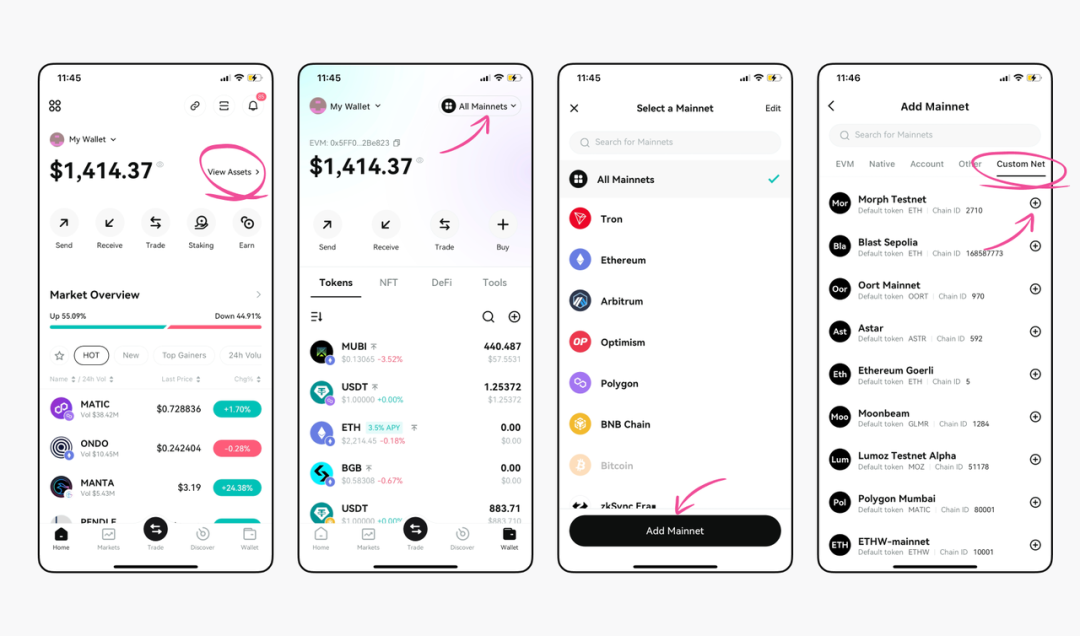
1. Install MetaMask:
Ensure you have the MetaMask browser extension installed.
2. Obtain Sepolia ETH:
Visit the Sepolia Faucet to claim testnet ETH.
Register and log in to your Alchemy account.
On the Sepolia Faucet page, enter your wallet address, complete verification, and claim Sepolia ETH.
3. Add Morph Testnet Network:
Visit Chainlist.
Connect your MetaMask wallet and search for “Morph Testnet”.
Add the Morph Testnet to your MetaMask.
4.2
Step 2: Bridge ETH to Morph Testnet
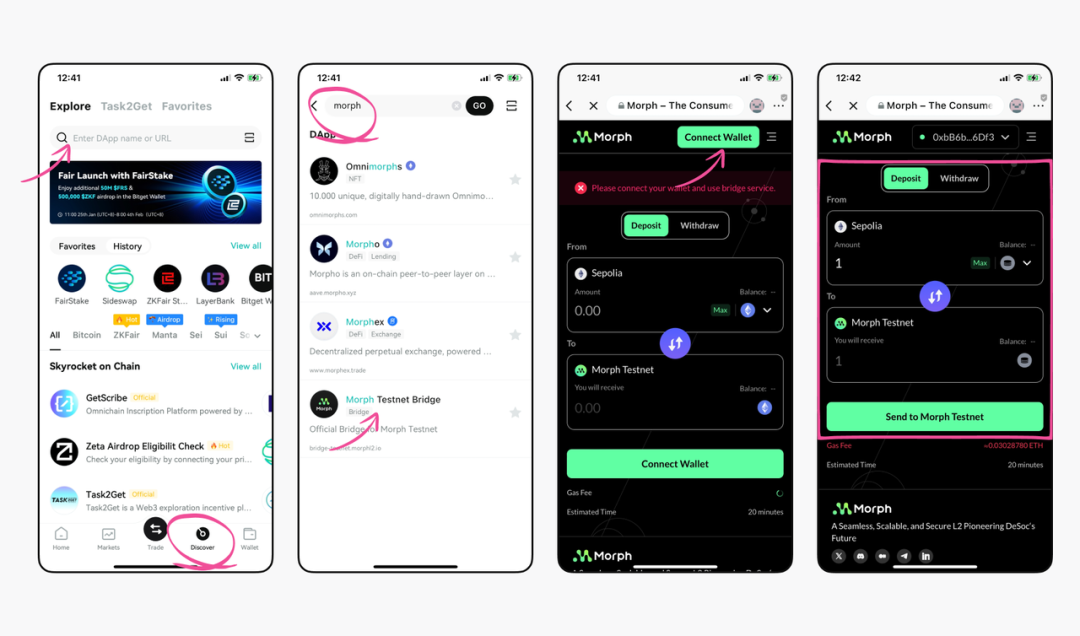
1. Access the Bridge Page:
Go to the Morph Testnet Bridge.
Connect your MetaMask or Bitget Wallet.
2. Bridge ETH:
On the bridge interface, select the amount of ETH to transfer (recommended to split 0.5 ETH into smaller transactions).
Confirm the transaction and pay gas fees. Wait approximately 20 minutes for completion.
3. Bridge back to Sepolia:
After completing actions on Morph, you may choose to bridge ETH back to Sepolia.
This process may take longer (20 minutes to 7 days). Once completed, remember to claim your ETH on the Sepolia network.
4.3
Step 3: Participate in Galaxy Campaign
1. Join the campaign:
Visit the Galaxy event page.
Complete tasks such as following social accounts, joining Discord and Telegram, reading documentation, bridging ETH, liking, and retweeting.
2. Claim NFT:
After completing all tasks, use your Bitget Wallet to claim the NFT, which may be used for future airdrop snapshots.
5. Team and Funding
The Morph team comprises experienced professionals from the blockchain and finance industries, with expertise spanning marketing, business development, project management, and strategic planning. The team is committed to advancing blockchain adoption in finance, gaming, social media, and entertainment through innovative Layer 2 solutions.
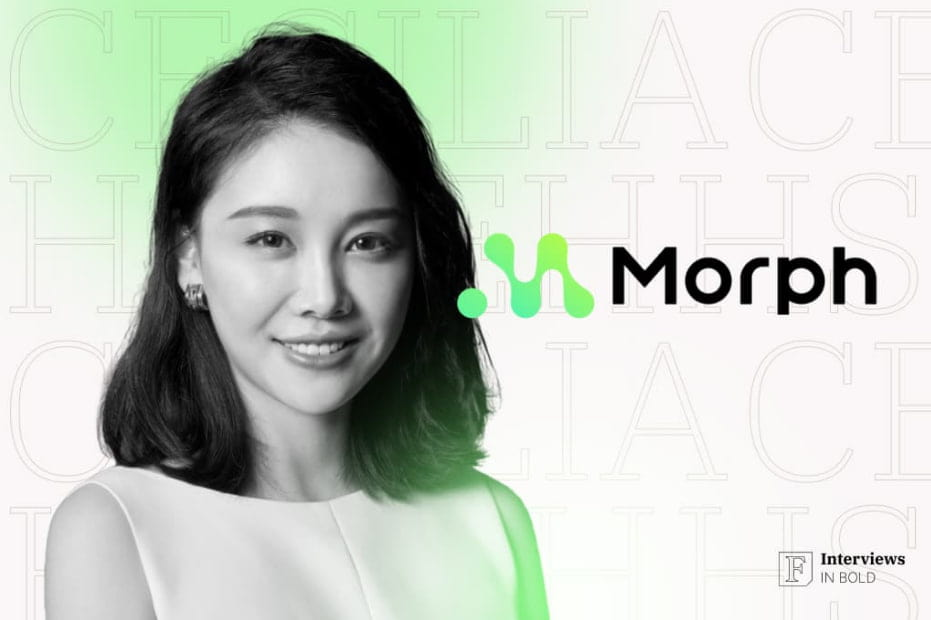
Co-Founder and CEO Cecilia Hsueh previously served as CEO of Phemex and holds a Bachelor’s degree in Marketing from East China Normal University, bringing extensive leadership experience in finance and blockchain.
Co-Founder and COO Azeem Khan formerly led impact initiatives at Gitcoin, was a partner at Foresight Ventures, and a mentor at ConsenSys Accelerator, with deep experience in blockchain ecosystem development, project management, and strategy.
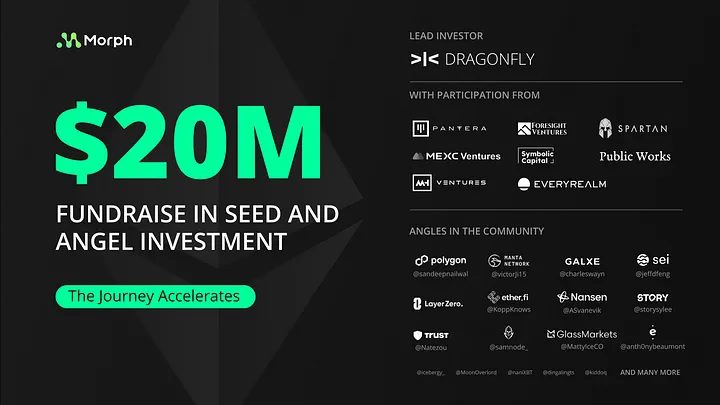
On March 20, 2024, Morph successfully raised $20 million in its seed round. The round was co-led by Dragonfly, Pantera Capital, Foresight Ventures, MH Ventures, and The Spartan Group.
These funds will be used to further develop and promote its innovative Layer 2 solution. Through collaboration with leading investment firms and individuals, Morph aims to accelerate platform growth and expand blockchain applications in finance, gaming, social media, and entertainment.
Additionally, on December 11, 2023, Morphism announced a multi-million-dollar investment from crypto exchange Bitget, with terms undisclosed. This investment will further advance its technology, particularly in cost-efficiency, security, and scalability of blockchain transactions.
6. Project Evaluation
6.1 Sector Analysis
Morph operates in the Layer 2 blockchain scalability sector. Specifically, it is an EVM-compatible Layer 2 network combining Optimistic Rollup and zkRollup technologies to deliver a highly scalable, secure, and efficient blockchain infrastructure. This makes Morph particularly suitable for decentralized applications (DApps) requiring high throughput and low latency, such as those in finance, gaming, social media, and entertainment.
Similar projects include other Layer 2 scalability solutions focused on enhancing blockchain performance and scalability. Notable examples include:
1. Polygon (MATIC):
Polygon is a Layer 2 scaling platform offering multiple solutions including Plasma Chains, zkRollups, and Optimistic Rollups.
Key features: Integration of multiple scaling technologies, Ethereum compatibility, and a broad developer ecosystem.
2. Arbitrum:
Arbitrum is an Optimistic Rollup-based Layer 2 solution designed for fast, low-cost Ethereum transactions.
Key features: High transaction throughput, strong security, and excellent compatibility.
3. Optimism:
Optimism is an Optimistic Rollup-powered Layer 2 solution focused on scaling Ethereum.
Key features: Efficient transaction processing, robust developer tooling, and extensive ecosystem partnerships.
6.2 Project Strengths
1. Technological Innovation
Decentralized sequencer network: Enhances network security and fairness, eliminating single points of failure and unfair transaction ordering.
Responsive Validity Proof (RVP): Combines the strengths of Optimistic Rollup and zkRollup for efficient and secure transaction validation, shortening challenge periods and reducing computational overhead.
Modular architecture: Offers a flexible, scalable, and easily maintainable blockchain infrastructure, enabling developers and projects to customize and extend functionality as needed.
2. Strong Investment Backing
Backed by leading investors including Dragonfly, Pantera Capital, and Foresight Ventures, raising $20 million in seed funding, plus additional multi-million-dollar investment from Bitget. These funds will accelerate tech development and market expansion.
3. Broad Application Scenarios
Supports diverse use cases in finance, gaming, social media, and entertainment, meeting high-throughput and low-latency demands through efficient and secure transaction processing.
4. Ecosystem Development
Attracts developers and projects through initiatives like the SparkLoom Builder Program and hackathons, driving vibrant DApp creation and ecosystem growth.
Offers diverse incentive programs to strengthen community engagement and loyalty.
6.3 Project Limitations
1. Intense Competition
The Layer 2 scalability space is highly competitive, with established players like Polygon, Arbitrum, Optimism, zkSync, and StarkNet already capturing significant market share. Morph must continuously innovate technically and in marketing to stand out.
2. Early-Stage Project
Morph is currently in the testnet phase, with technology and market outreach still maturing. Real-world performance and viability require validation through mainnet launch and large-scale adoption.
Despite substantial funding, effectively utilizing capital for rapid development and scaling remains a challenge.
Join TechFlow official community to stay tuned Telegram:https://t.me/TechFlowDaily X (Twitter):https://x.com/TechFlowPost X (Twitter) EN:https://x.com/BlockFlow_News






