Explaining Metis's Technical Advantages, Opening a New Chapter in Decentralization
TechFlow Selected TechFlow Selected
Explaining Metis's Technical Advantages, Opening a New Chapter in Decentralization
Metis launches zkMIPS and decentralized Sequencer, driving the thriving development of the L2 ecosystem.
 Navigating Web3 tides with focused insights
Author: Wilson Lee, Core Contributor of Biteye
Editor: Crush, Core Contributor of Biteye
01 Background
On April 10, a16z Crypto launched Jolt, a zero-knowledge solution designed to accelerate and simplify blockchain scaling operations.
Jolt integrates SNARKs (Succinct Non-Interactive Zero-Knowledge Arguments of Knowledge), enabling developers to rapidly build SNARK-based Layer 2 solutions. The team also claims that Jolt is up to twice as fast as current zkVMs.
Zero-knowledge (ZK) technology remains one of the central long-term narratives in the crypto industry. ZK-Rollups, in particular, have been highlighted by Vitalik Buterin as Ethereum’s primary long-term scaling solution. a16z's journey from unveiling Jolt in August last year to its official release this year underscores the fact that ZK-Rollup remains a high-potential, long-term赛道 (sector).
The ZK-Rollup space already hosts numerous players, leading to increasingly fine-grained technical categorizations. Among these, EVM compatibility stands out as the most representative classification criterion.
Due to historical design choices, the EVM contains many components that are inherently unfriendly to ZK proofs. However, a vast number of existing projects were originally built on the EVM, and ZK-Rollups are still widely seen as the future of scalability—forcing most ZK-Rollup projects to make a trade-off between EVM compatibility and ZK efficiency.
ZKM, incubated by Metis DAO, takes a more foundational approach by introducing a universal zkMIPS architecture.
zkMIPS translates program execution into ZKP-friendly formats using the low-level MIPS instruction set. Beyond EVM compatibility, it supports other VMs such as MoveVM and RustVM, opening ZK-Rollups to a broader developer ecosystem.
This article provides an in-depth analysis of Metis’s advancements in ZK technology and decentralized sequencers.
02 ZKM and Hybrid Rollups: Bridging OP and ZK
Metis has achieved notable market performance thanks to its innovative Hybrid Rollups mechanism, which combines fraud proofs and validity proofs to leverage the strengths of both.
The zkMIPS technology developed by ZKM further strengthens Metis’s Hybrid Rollups with robust cross-VM compatibility, enabling seamless integration between ZK proofs and EVM execution.
2.1 Mechanism and Advantages of Hybrid Rollups
In Hybrid Rollups, key roles include:
-
Sequencer: Receives and processes user transactions, determines optimal transaction ordering, and batches them for publication to the consensus and data availability layer.
-
Proposers: Evaluate transaction batches and state roots submitted by the Sequencer and record them onto the State Commitment Chain (SCC).
-
Verifiers: Validate state roots on the Rollup chain to ensure correctness and prevent fraudulent activity.
In standard L2 solutions, the Sequencer collects and processes transactions before publishing transaction data to Ethereum mainnet (L1). This process relies on L1 for final data validation and confirmation, ensuring security and consistency.
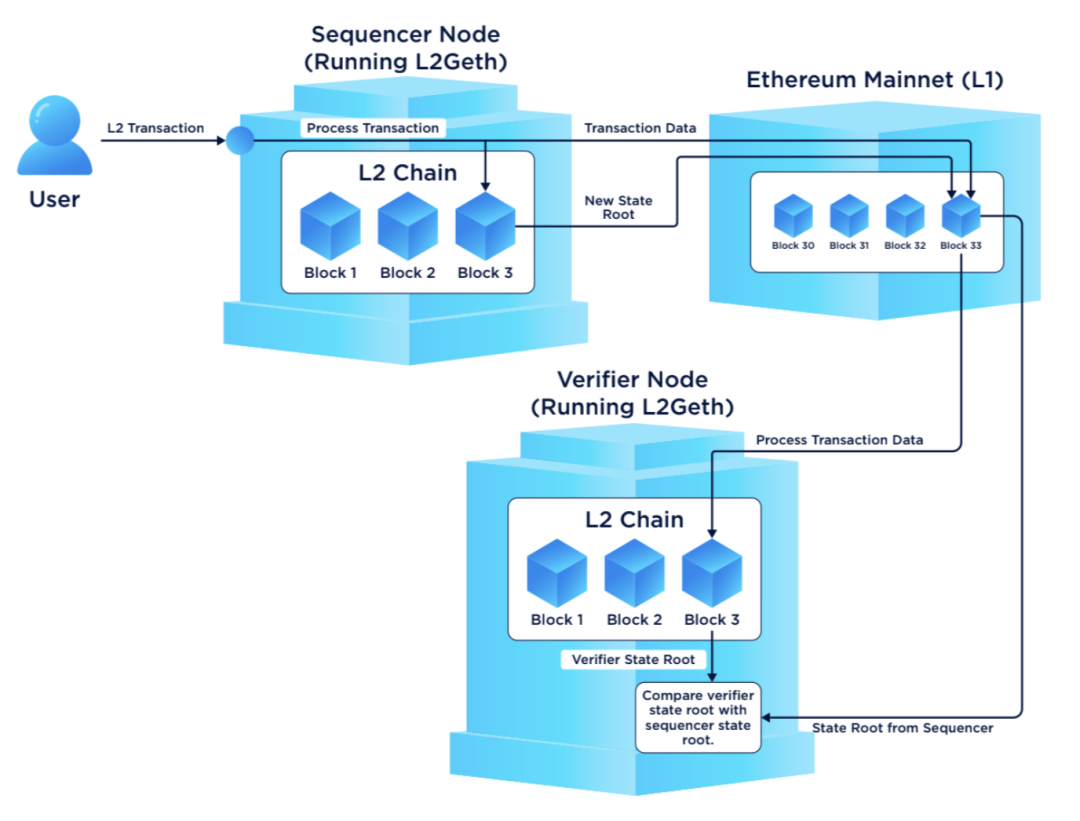
(Source: https://mirror.xyz/msfew.eth/WQJaOcFkpTOZLns8MBQaCS4OepRoaZ7uoctnLAnalVw)
Hybrid Rollups employ a hybrid approach when processing and optimizing L2 transactions, following these steps:
1. Transaction Initiation and Processing:
-
Users initiate transactions on L2.
-
The Sequencer receives and processes these transactions, determining their order on the Canonical Transaction Chain (CTC).
2. State Submission and Verification:
-
Proposers evaluate the transactions and submit state roots to the SCC.
-
Verifiers audit the state roots in the SCC to ensure accuracy.
3. Generation and Verification of Zero-Knowledge Proofs:
-
Provers read data from L1 and generate ZK proofs—a core feature of Hybrid Rollups that enables transaction validity verification without revealing transaction details.
-
If a ZK proof is not submitted on time, Verifiers trigger a fraud proof process, potentially penalizing the Sequencer.
4. Final Confirmation of Data and State:
-
Once the ZK proof is verified, transactions are finalized via smart contracts.
-
Smart contract bridges ensure secure transfer of funds and states between L1 and L2.
The Hybrid Rollups design offers several significant advantages:
-
Efficiency and Cost-Effectiveness: By leveraging ZK proofs, Hybrid Rollups can process more transactions while consuming less gas.
-
Enhanced Security: Combining traditional fraud proofs with ZK proofs ensures transaction safety and correctness even in the presence of malicious actors.
-
Scalability: Recursive proofs enable Hybrid Rollups to handle large-scale transactions without sacrificing performance, supporting broader blockchain applications.
-
Compatibility and Flexibility: Supports multiple smart contract platforms and programming languages, allowing developers to easily migrate existing applications to Hybrid Rollups.
2.2 How zkMIPS Achieves Strong ZK Compatibility
The core idea behind ZK is transforming program execution into mathematically verifiable proofs, enabling anyone to easily verify correctness without re-executing the program. The challenge lies in converting arbitrary program logic into stable mathematical representations.
Developers typically use high-level languages, each interfacing differently with hardware.
As a result, existing ZK implementations are often incompatible. Scroll directly circuits every EVM opcode, achieving opcode-level equivalence—but at immense engineering cost;
Polygon zkEVM creates a custom VM optimized for performance, translating EVM bytecode directly into its own VM bytecode—an efficient path to opcode-level equivalence, though extensive customization risks long-term divergence from EVM;
zkSync builds its own VM (SyncVM) with a register-based algebraic intermediate representation (AIR), then constructs a dedicated compiler pipeline that converts Yul (an intermediate language akin to low-level Solidity) into LLVM-IR and finally into SyncVM instructions—achieving Solidity-level compatibility but losing direct access to Ethereum tooling and requiring re-auditing due to language translation;
StarkNet abandons EVM compatibility entirely, opting instead for its own low-level language (Cairo) and custom VM (Cairo VM) to maximize ZK efficiency.
In contrast, ZKM chooses a more inclusive path: zkMIPS.
MIPS, short for "Microprocessor without Interlocked Pipeline Stages," is a minimalist instruction set architecture introduced in 1985.
MIPS simplifies complex processor instructions to their most basic forms, improving speed and reducing execution complexity.
In the zkMIPS system, this instruction set is used to translate general-purpose programs into ZK-provable formats.
The zkMIPS implementation process is as follows:
-
Program-to-MIPS Translation: High-level programs written in languages like Solidity or Rust are first compiled into MIPS instructions—converting high-level abstractions into hardware-executable operations.
-
ZK Proof Generation: These MIPS instructions are then used to generate corresponding zero-knowledge proofs. Thanks to the simplicity of the MIPS architecture, this step is computationally efficient, enabling faster proof generation without compromising security.
Advantages of zkMIPS
-
Compatibility: zkMIPS supports not only EVM-compatible Solidity but also other mainstream languages such as Rust and Move, enabling broader adoption across diverse blockchain development ecosystems.
-
Cost-Efficiency: The efficiency of the MIPS instruction set significantly reduces computational costs during ZK proof generation, enhancing system sustainability.
-
Recursive Proofs: zkMIPS supports recursive proof composition, allowing multiple proofs to be aggregated into a single manageable unit—critical for scalability.
In practice, MIPS has already proven valuable in systems like Optimism. Optimism’s Cannon fault-proof system converts executed programs into MIPS format, enabling simpler and more efficient error detection and re-execution during dispute challenges.
Metis has followed this trend by integrating Cannon into its ecosystem, further validating the practicality and efficiency of zkMIPS technology.
03 Decentralized Sequencer: Decentralization and Sustainability
Beyond combining the benefits of OP and ZK through Hybrid Rollups, Metis is actively advancing decentralized sequencers, setting a benchmark for decentralization in the Rollup landscape.
In traditional Rollup models, a single centralized sequencer, while efficient in processing transactions, concentrates excessive power and introduces several risks:
-
Operational Risk: If the sequencer fails or is compromised, transaction processing across the entire system may halt.
-
Censorship Risk: The sequencer can selectively process or reject transactions, potentially restricting user access to specific DeFi protocols or services.
-
Manipulation Risk: In transaction ordering, the sequencer may prioritize its own transactions or extract MEV (Maximum Extractable Value) through inflated fees.
To address these issues, Metis has designed a decentralized sequencer pool composed of multiple sequencer nodes that collectively aggregate, order, and execute transactions. This design enhances fairness and transparency:
-
Consensus Mechanism: Over two-thirds of sequencer nodes must reach consensus on each new block’s state before batch submission to Ethereum mainnet (L1).
-
Multi-Party Computation (MPC) Signatures: Before submitting batches to L1, MPC signatures verify batch authenticity, ensuring data integrity.
Advantages of Decentralized Sequencers:
-
Enhanced Security: Collective decision-making across multiple nodes reduces single points of failure, increasing network resilience and security.
-
Reduced Censorship and Manipulation: With multiple sequencers, no single node can unilaterally censor or manipulate transactions, protecting user transaction freedom.
-
Stability and Redundancy: The system supports smooth sequencer rotation, minimizing the impact of failures or disruptions and improving overall network stability.
In Metis’s decentralized sequencer model, each node consists of several key components:
-
L2 Geth (including OP-Node): Handles transaction ordering and block assembly.
-
Adapter Module: Acts as an intermediary for interaction with external modules, primarily PoS nodes.
-
Batch Submitter (Proposer): Constructs transaction batches and submits them to L1 upon approval from multiple sequencers.
-
PoS Node: Coordinates between Ethereum, consensus, and Metis layers, securing asset locks and rewarding validators.
-
Consensus Layer: A set of Tendermint PoS nodes running parallel to Ethereum mainnet, ensuring operational efficiency without interfering with L1 progress.
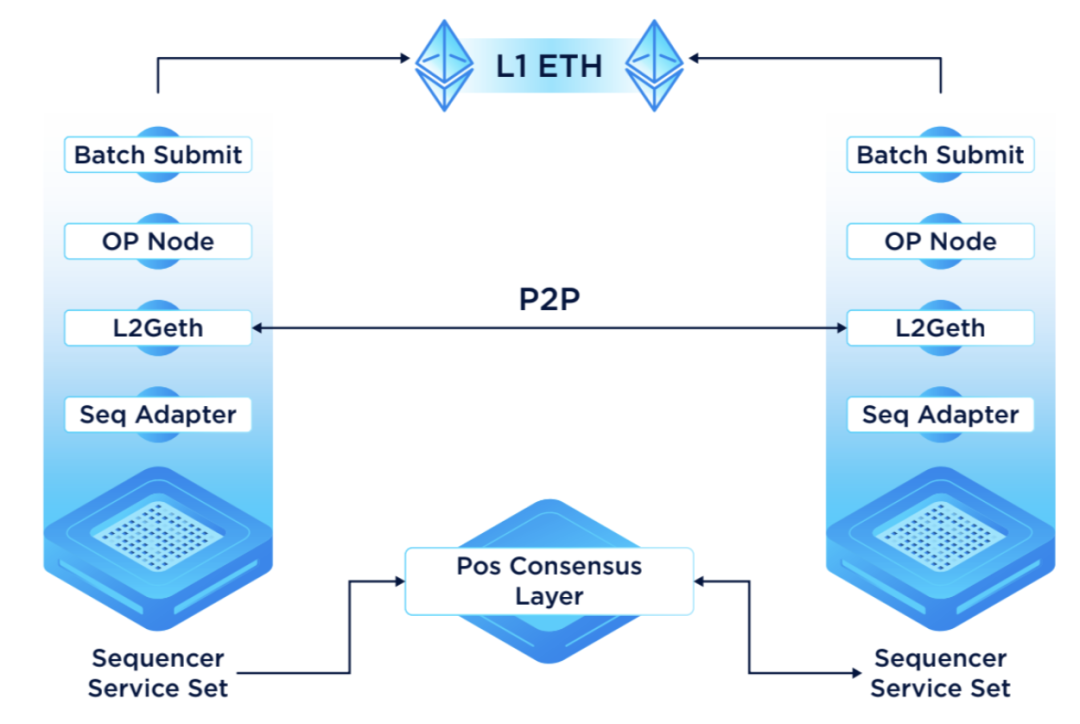
(Source: https://ethresear.ch/t/pos-sequencer-pool-decentralizing-an-optimistic-rollup/16760)
Through this architecture, Metis’s decentralized sequencer pool enhances fairness and transparency in transaction processing, while distributing authority to improve network security and stability—key pillars for building a trustworthy and sustainable blockchain ecosystem.
04 Conclusion and Outlook
Metis’s technological and philosophical strengths lay a solid foundation for future growth. Its zkMIPS-powered Hybrid Rollups offer a promising path to resolving compatibility challenges in ZK-Rollups, paving the way for a more diverse developer ecosystem.
Its commitment to decentralized sequencers reflects a genuine vision for decentralization. As Metis’s ecosystem matures, we have strong reasons to believe it will emerge as a persistent dark horse in the L2 race, continuously delivering value to users and developers alike.
Join TechFlow official community to stay tuned
Telegram:https://t.me/TechFlowDaily
X (Twitter):https://x.com/TechFlowPost
X (Twitter) EN:https://x.com/BlockFlow_News
 @BiteyeCN