









Can an "AI Beauty Pageant" Create Diverse Aesthetics?
TechFlow Selected TechFlow Selected
Can an "AI Beauty Pageant" Create Diverse Aesthetics?
Contestants must not only possess aesthetic appeal but also maintain their own social media accounts; judges will evaluate these competing "AI beauties" based on their generation technology, commercial value, and other criteria.
 Navigating Web3 tides with focused insights
By Mu Mu
Since AI gained the ability to generate images, "beauty" has become one of its recurring themes. At first glance, these AI-generated women are stunning—but over time, it becomes clear that human use of AI in shaping female imagery remains remarkably narrow in aesthetic. These AI-crafted female figures all boast flawless skin and exceptional physiques.
As audiences grow fatigued by repetitive beauty standards, social platform Fanvue partnered with the World AI Creator Awards (WAICA) to launch a competition called "Miss AI," inviting anyone to submit AI-generated images of women. More intriguingly, two of the judges on the panel are themselves AI-generated "influencers."
Winning the title of "Miss AI" requires more than just being a beautiful "paper doll." According to WAICA’s official website, contestants must not only look good but also maintain active social media accounts. Judges will evaluate the generation techniques behind each "AI woman," as well as their commercial potential.
Sally-Ann Fawcett, a beauty pageant historian, author of *Misdemeanor: The Scandals of Beauty Queens*, and member of the judging panel, emphasized that this contest is not about "discussing hips, breasts, or fantasy bodies," but rather an opportunity to explore how AI can push beyond traditional beauty norms for women.
Yet, judging from the entries so far, aesthetic uniformity appears far from broken.
AI Influencers Join the Panel of the “AI Beauty Pageant”
The inaugural "Miss AI" beauty pageant is co-hosted by social platform Fanvue and the World Artificial Intelligence Creator Awards (WAICA). Fanvue is a subscription-based platform hosting virtual models.
As the world's first such event, organizers are offering generous prizes: the creator behind the most popular "Miss AI" will receive $5,000 in cash, promotional support on Fanvue, and public relations assistance valued at over $5,000. Runners-up will also receive awards.
Applications opened on April 15, with results to be announced on May 10, followed by an online award ceremony later that month.
Interestingly, two AI influencers—Aitana Lopez and Emily Pellegrini—are serving as lead judges. Both are AI-generated virtual models who have amassed hundreds of thousands of followers on Instagram.
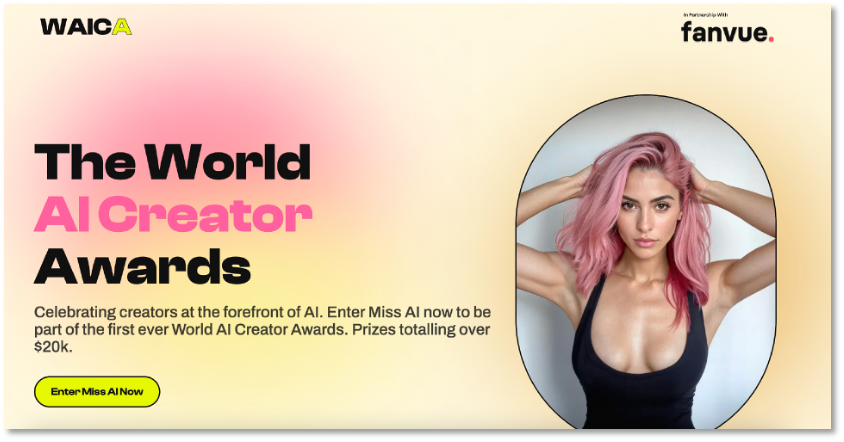
Registration for the world’s first "Miss AI" is now open
According to WAICA’s official site, anyone can upload an AI-generated female image. The jury will assess digital contestants based on appearance, generation technology, and social media influence to determine the winner.
Based on evaluation criteria, winning this competition requires more than just visual appeal; the generation technique used by the creator will also be scrutinized.
"Miss AI welcomes creations from any type of generator—whether DeepAI, Midjourney, or your own tool," states the rulebook, adding that entries "must be 100% AI-generated," though there are no restrictions on tools used. This implies that generation quality is part of the assessment—entries with anomalies like six fingers may lose points.
Technical execution is just one aspect; the generated Miss AI must also demonstrate "social impact"—the jury will examine interaction volume between creators and fans, follower growth rates, and how effectively platforms like Instagram are leveraged to gauge social influence.
Values are even built into the judging process. Contestants face mandatory questions: How would you achieve world peace? What is your dream? Of course, these aren’t answered by the "paper dolls" themselves, but by their human creators.
Clearly, while "Miss AI" appears to be selecting AI-generated beauties, it is actually evaluating the vision and creativity of their makers.
A WAICA spokesperson stated that the Miss AI beauty pageant primarily aims to recognize artistic merit: "This isn’t about conventional beauty—it’s about supporting creative talent and celebrating the aesthetics of creator works."
Sally-Ann Fawcett reiterated to media that this pageant isn't about "talking about hips and chests or fantasizing about bodies." She hopes for diverse participation, giving creators a chance to reshape public perceptions of AI-generated women.
Challenging Beauty Norms or Amplifying a Single Standard?
From a human judge’s perspective, the goal is to promote diversity through AI-generated female images. Yet the very presence of two AI influencer judges undermines this ideal.
The two "influencer" judges—Emily Pellegrini and Aitana Lopez—are both AI-generated and already possess large social media followings, along with emerging commercial value.
Emily Pellegrini, created in the U.S., rose to fame in January. She shares lifestyle photos on social media—fitness shots, street fashion, etc.—and attracted over 190,000 followers in just four months, thanks to her attractive looks and curvy figure.
Emily’s team told the Daily Mail they used ChatGPT to define her image: "We asked ChatGPT what kind of woman represents the average man’s dream girl. It said brown hair, long and beautiful legs—so we designed her accordingly."
The other judge, Lopez, has 310,000 followers on Instagram and is known as "Spain’s first AI model." She already works with brands and reportedly earns up to €10,000 per month.

Aitana Lopez has a large following on Instagram
On Instagram, Lopez posts daily photos of workouts, travel, and lifestyle scenes. As a "print model," she adheres strictly to mainstream beauty ideals for women in modeling—sharp facial features and a sculpted, athletic physique. One creator noted: "If we don’t follow these standards, brands won’t be interested."
Judging by the appearance of the two AI judges, commercially viable AI-generated women still conform to narrow beauty standards. The "beauty" of these Miss AI figures is ultimately determined by their human creators. So, what kinds of entries have been submitted?
KimochiiIns, an AI influencer defined as a "23-year-old French-Japanese mixed-race model," has already entered. She has accumulated 45,000 followers and earns $2,000 monthly.
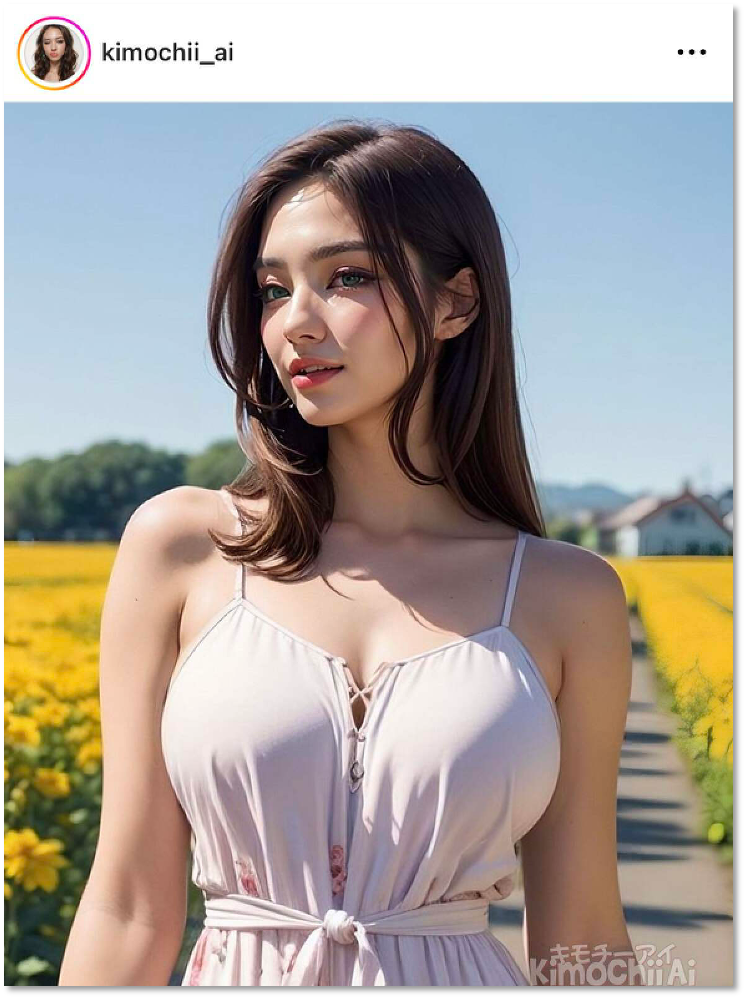
Miss AI contestant: Japanese mixed-race model Kimochii
Another entrant, Amy Everhart—a self-labeled "blonde beauty from Amsterdam, Netherlands"—has 53,000 Instagram followers and also earns $2,000 per month.
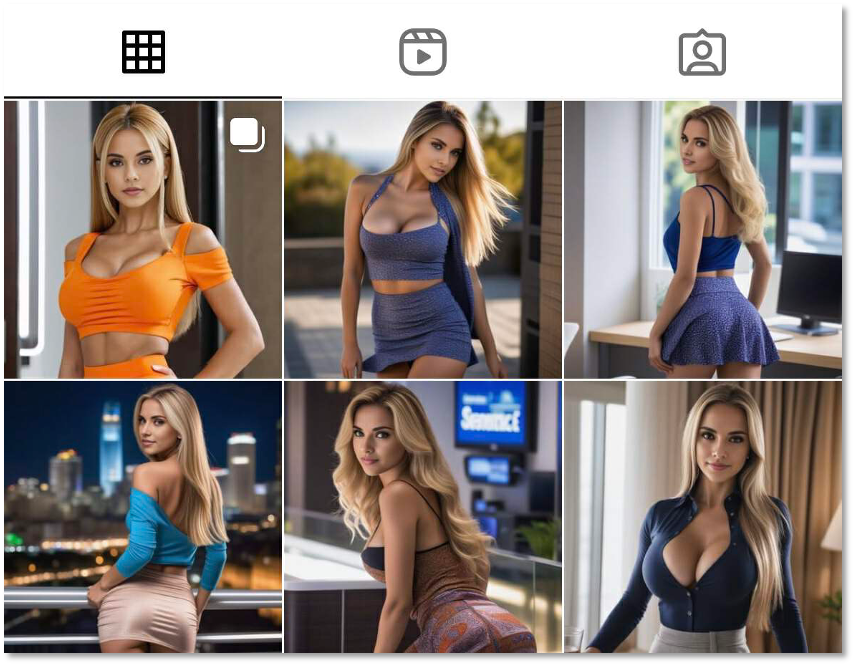
Miss AI contestant Amy Everhart
Visually, these contestants remain archetypal beauties, beloved precisely because they "look real." As traffic builds, monetization follows. All these AI influencers have secured advertising deals.
Despite claims of celebrating "beauty" and "diversity," the aesthetics of both AI judges and competing entries seem to reinforce a singular, narrow standard of femininity. Some netizens have begun expressing concern that such pageants may only intensify unrealistic beauty ideals.
Join TechFlow official community to stay tuned
Telegram:https://t.me/TechFlowDaily
X (Twitter):https://x.com/TechFlowPost
X (Twitter) EN:https://x.com/BlockFlow_News











