









With frequent capital backing and projects rolling out airdrops one after another, the LRT staking赛道 has become the "new gold rush destination."
TechFlow Selected TechFlow Selected
With frequent capital backing and projects rolling out airdrops one after another, the LRT staking赛道 has become the "new gold rush destination."
What opportunities remain in the restaking and LRT sector?
 Navigating Web3 tides with focused insights
Author: Xiyu, ChainCatcher
Editor: Marco, ChainCatcher
Within one month, Binance Launchpool has successively launched two projects from the restaking sector—Etherfi and Renzo. The latest project, Renzo (REZ), will conclude its new token mining program on April 30 before officially listing for trading. This round attracted over $15 billion in staked assets and more than 400,000 users, marking unprecedented participation enthusiasm.
Since the beginning of 2024, the restaking sector has consistently drawn strong interest from capital, with multiple projects securing millions in funding one after another. Later this month, the sector received two significant funding rounds: On April 16, restaking protocol Puffer raised $18 million in a Series A round at a $200 million valuation; then on April 23, liquid restaking protocol YieldNest secured $5.2 million in fresh funding.
Backed by frequent investments, new project listings on Binance Launchpool, and continuous airdrops, the restaking sector has become a new gold rush destination.
Restaking refers to re-pledging ETH already staked on Ethereum's PoS chain by using it as collateral in other blockchain networks to provide validation services, thereby earning additional rewards beyond those offered by Ethereum’s native PoS staking.
In simple terms, Ethereum stakers can reuse their staked ETH in other PoS networks to earn dual staking yields—from both the Ethereum mainnet and secondary networks.
Since Ethereum transitioned to PoS, over 32.5 million ETH have been staked on the mainnet—representing more than 26% of total ETH supply and valued at over $100 billion.
Common liquid staking protocols (LST protocols) such as Lido and Rocket Pool have released liquidity for staked ETH via LST tokens, but these LSTs cannot be used as staking assets on other networks.
Restaking protocols aim to allow ETH staked on Ethereum to also secure other blockchain networks, unlocking new revenue opportunities for ETH stakers while increasing capital efficiency of staked ETH.
Thus, restaking protocols create a marketplace for staking assets: networks or DApp developers needing staking and validation services are demand-side participants, while ETH stakers serve as the supply side. Through this market, users can re-stake their ETH or LST assets originally locked on Ethereum to other chains and earn additional returns.
As of April 29, the total value locked (TVL) in ETH and LST assets on EigenLayer—the pioneer platform in the restaking space—has surpassed $16 billion.
Hundreds of billions of dollars in liquidity built around EigenLayer have given rise to numerous liquid restaking token (LRT) protocols such as Etherfi and Renzo. These products simplify the complex restaking process on EigenLayer, enabling users to participate simply by depositing ETH or LST assets without having to manage node operations or make technical choices.
Currently, restaking products in the market fall into two main categories based on design logic: native restaking protocols like EigenLayer, and LRT protocols built atop them such as Etherfi and Renzo.
EigenLayer: Pioneer of the Restaking Protocol
EigenLayer introduced the concept of restaking, allowing users to re-stake their LST assets and earn rewards beyond Ethereum’s PoS staking yield.
On April 10, EigenLayer announced the launch of its mainnet.
According to Rootdata, EigenLayer has completed three funding rounds totaling $164.5 million, including a $100 million investment from a16z announced in February.
The EigenLayer ecosystem consists primarily of three roles: asset providers (stakers of ETH or LSTs), Actively Validated Services (AVS), and application-specific chains or DApps that require staking services.
AVS, short for Actively Validated Services, is the core innovation of EigenLayer—a middleware solution connecting Ethereum stakers or LST holders with projects requiring decentralized node infrastructure. AVS provides security and decentralization guarantees for blockchains or DApps through shared validation services, earning revenue from node rewards and transaction fees paid by service-consuming applications.
By offering node operator services, EigenLayer enables appchains, cross-chain bridges, oracles, rollups, and others to rent validation power instead of building and maintaining their own validator sets from scratch—saving time and resources so they can focus on core development.
Beyond AVS, EigenLayer also developed EigenDA, a data availability (DA) service handling data publication, transaction execution, and similar functions akin to Celestia in modular blockchain architectures.
Several application chains and Layer 2 solutions have already adopted EigenLayer’s AVS and EigenDA services. For example, Mantle, Cyber, Celo, and Treasure’s Layer 2 use EigenDA; AltLayer, Brevis, and Xterio utilize AVS validators.
Users can participate in restaking on EigenLayer in two primary ways: directly staking ETH, or depositing supported LST tokens. Currently accepted LSTs include stETH, swETH, mETH, wbETH, rETH, etc.
On April 16, EigenLayer removed deposit limits for all LST tokens, resulting in a $3 billion increase in TVL within a week. As of now, users staking ETH or LSTs on EigenLayer earn points.
As of April 29, the total value of ETH and LSTs staked on EigenLayer approached $16.2 billion—accounting for over 15% of total Ethereum staking. This includes 3.26 million native ETH and various LSTs such as stETH, rETH, and cbETH. Approximately 4.5 billion EigenLayer points have been distributed to restakers, with each point trading at around $0.14 on secondary markets like Whales Market.
LRT Protocols Simplifying EigenLayer Staking
Due to the complexity of EigenLayer’s product mechanics—including the need for users to manually select AVS projects and configure node settings—user experience barriers exist. This led to the emergence of one-stop LRT platforms built on top of EigenLayer.
With LRT protocols, users simply deposit ETH or LST assets, and the protocol handles the restaking process on EigenLayer automatically—similar to yield aggregators or vaults in DeFi. Users gain exposure to restaking benefits without managing intricate processes.
After depositing ETH or LSTs into an LRT platform, users receive a liquid restaking token (LRT)—a tradable receipt that can also be used in DeFi for lending, liquidity provision (LP), or other yield-generating strategies.
While similar in form to LSTs, LRTs represent true “multi-layer yield,” combining multiple income streams: Ethereum PoS staking rewards + AVS node incentives + LST platform token rewards + EigenLayer points or tokens + LRT platform-specific tokens or points.
Notable LRT projects currently include Renzo, Ether.fi, Kelp DAO, EigenPie, YieldNest, Swell, Pendle Finance, among others.
1. Renzo
Renzo is a liquid restaking protocol built on EigenLayer that simplifies the complex restaking mechanism by abstracting away operational details such as AVS selection and node management. Thus, users can participate in EigenLayer restaking without needing to understand or interact with underlying validator operations.
Users deposit ETH or LST assets into Renzo and receive ezETH—a restaking receipt token entitling holders to both Ethereum PoS staking rewards and AVS-related yields.
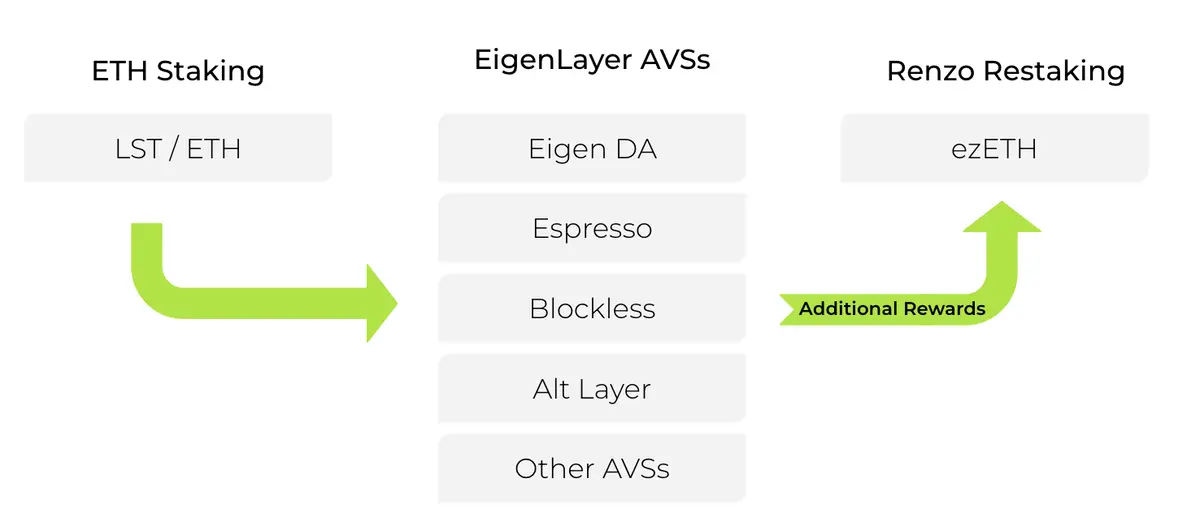
In January, Renzo raised $3.2 million in a seed round at a $25 million valuation. In February, it announced backing from Binance Labs. On April 23, Binance listed Renzo (REZ) as a Launchpool mining project and revealed REZ’s tokenomics: a total supply of 10 billion tokens, with 1.05 billion circulating at launch. Trading will begin on April 30.
During this period, Renzo launched an early incentive program called ezPoints. Users earn ezPoints by locking ETH or LST assets to mint ezETH, while also accumulating EigenLayer points.
As of April 29, Renzo’s TVL exceeded $3.51 billion, with over 930 million EigenLayer points and 1.53 billion ezPoints distributed.
Compared to other LRT protocols, Renzo stands out by supporting gas-based restaking across multiple Layer 2 networks early on—including Arbitrum, Base, Blast, BNB Chain, Mode, and Linea.
2. Ether.fi
Originally a liquid staking protocol (LST) on Ethereum, Ether.fi experienced explosive growth after integrating EigenLayer in November last year. Its TVL surged from tens of millions to $3.86 billion, making it the largest LRT protocol by TVL. Its native token ETHFI was listed on Binance Launchpool in March with a total supply of 1 billion tokens, currently priced at $4.44.
According to Rootdata, Ether.fi has raised $32.3 million across two funding rounds, most recently securing $27 million in a round led by Bullish and CoinFund on February 28.
Users who stake ETH or LST assets on Ether.fi receive eETH, a restaking receipt, and earn EigenLayer points. To date, over 1.1 billion EigenLayer points have been distributed via the platform.
Unlike pure LRT protocols, Ether.fi operates its own Ethereum PoS staking infrastructure and focuses heavily on decentralizing staking operations. On April 22, SSV.Network announced a collaboration with ether.fi to integrate Distributed Validator Technology (DVT), aiming to mitigate centralization risks in restaking node operations.
3. Puffer Finance
Like Ether.fi, Puffer Finance began as a liquid staking derivative (LSD) platform on Ethereum, reducing the validator entry threshold from 32 ETH to under 2 ETH. It received grants from the Ethereum Foundation and later integrated EigenLayer to offer additional AVS yield to stakers.
Rootdata shows Puffer Finance has raised $21.45 million across four funding rounds, including an $18 million raise at a $200 million valuation on April 16.
In January, Puffer launched a points rewards program where users could earn both Puffer and EigenLayer points by staking ETH, stETH, USDT, and USDC. However, the platform currently only supports deposits of stETH and wstETH.
As of April 29, Puffer Finance had $1.41 billion in TVL, issued approximately 2.44 billion points, and distributed 650 million EigenLayer points.
4. YieldNest
YieldNest is an EigenLayer-supported liquid restaking protocol currently in test phase, accessible only through Discord for early community members.
On April 23, YieldNest announced completion of a $5.2 million funding round.
5. Kelp DAO
Kelp DAO is a liquid restaking protocol built on EigenLayer by team members from multi-chain liquid staking platform Stader Labs. Users can stake ETH and LST assets such as stETH and sfrxETH to receive rsETH, a restaking receipt token.
Unlike other LRT protocols, Kelp DAO introduced KEP—a token representing EigenLayer (EL) points—at a 1:1 redemption rate (i.e., 1 KEP = 1 EL point). KEP can be traded on secondary markets and used in DeFi applications such as liquidity pools.
Currently, users earn EL points and Kelp Grand Miles by locking ETH or LST assets on Kelp DAO. On April 2, Kelp launched a “Billion Mile” campaign, offering an extra 5 million EL points to users who mint rsETH.
As of April 29, Kelp DAO’s TVL reached $863 million, accumulating 438 million EigenLayer points, 370 million Kelp Grand Miles, and distributing over 50 million KEP tokens.
6. EigenPie
EigenPie is an LRT protocol created by Magpie—a multi-chain yield protocol—as a subDAO under its community. It allows users to stake LST assets and receive LRT receipts.
Initially, EigenPie focused exclusively on LST restaking and issued separate LRT tokens per LST type to isolate risk between different LST assets.
However, on April 26, EigenPie announced support for direct ETH restaking. Users can now stake ETH or LST assets to earn both EigenPie and EigenLayer points. As of April 29, the platform’s TVL stood at $323 million.
7. Swell
Swell is also an Ethereum liquid staking protocol (LST), allowing users to stake ETH and receive swETH, a liquid staking token. In January, it launched rswETH—an LRT product based on EigenLayer.
Currently, Swell offers both products: swETH (LST) and rswETH (LRT). The former manages over $700 million in assets, while the latter has a TVL of $398 million.

In March, Swell announced its own Rollup network, Swell L2—a Layer 2 specifically designed for restaking, using rswETH as its native gas token. The network is expected to launch in late 2024.
Additionally, Swell launched a pre-deposit campaign for Swell L2 in April, promising SWELL token airdrops to participants upon mainnet launch. Deposits of ETH, LSTs, and LRTs are supported, with $379 million already deposited.
8. Pendle Finance
Pendle Finance (Pendle) originated as a DeFi yield protocol on Ethereum that splits yield-bearing assets into principal and yield components, tokenizing them to meet diverse investor needs.
Capitalizing on the growth of the LST and LRT sectors, Pendle has seen explosive expansion in managed assets, reaching $4.41 billion in TVL—ranking among the top 7 DeFi apps. Its PENDLE token rose over 50% in the past 30 days, currently trading at $5.50.
In Pendle, yield-generating assets are split into Principal Tokens (PT) and Yield Tokens (YT). Both PT and YT can be traded on Pendle’s AMM, allowing users to buy discounted assets, execute yield strategies, or provide liquidity to earn fees.
Pendle now supports LRT receipts such as ezETH, eETH, and pufETH. It separates their potential points-based future yield into YT-tokens and the principal into PT-tokens, enabling users to choose based on risk appetite and market outlook—either holding for yield or selling immediately for liquidity.
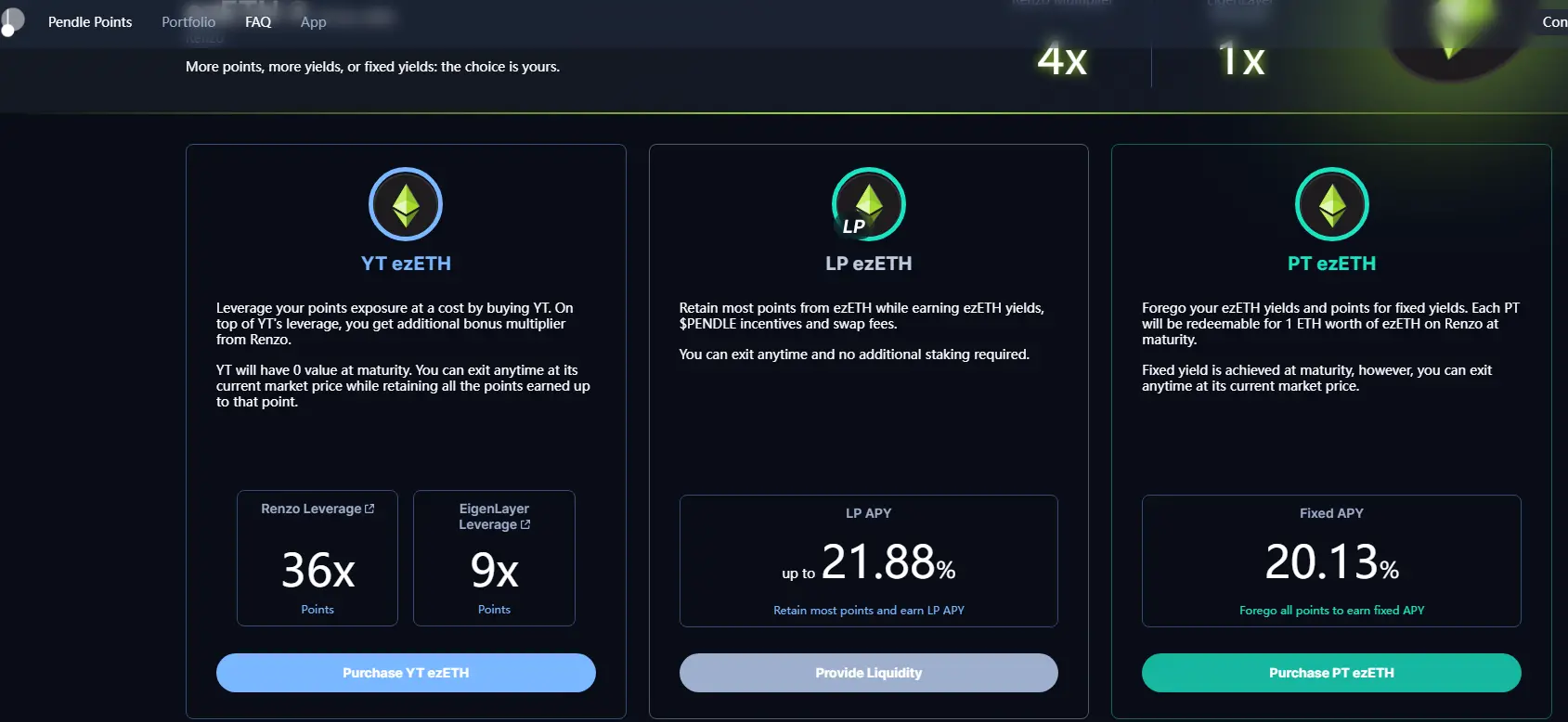
For instance, with Renzo’s ezETH, Pendle creates YT-ezETH (representing future points yield) and PT-ezETH (representing principal). Users can trade these tokens freely—for example, buying YT-ezETH if bullish on future rewards, or selling if bearish.
Moreover, Pendle distributes both EigenLayer points and Renzo points to holders of YT-ezETH.
EigenLayer Competitor: Karak Network
Karak Network is a restaking protocol developed by AndalusiaLabs (formerly a risk insurance provider for the LUNA protocol). Functionally similar to EigenLayer, it enables users to re-stake ETH already pledged on Ethereum to other blockchains, generating multiple yields from a single staking cost.
It closed a $48 million Series A round in December at a $1 billion valuation, backed by Pantera Capital, Framework Ventures, Digital Currency Group, Coinbase, and Nima Capital.
The key difference lies in terminology and scope: EigenLayer calls its service AVS (Actively Validated Services), whereas Karak uses DSS (Distributed Security Services).
Additionally, Karak supports a broader range of restakable assets, aiming to enable restaking for any digital asset. Beyond ETH and LSTs, it accepts LRTs like ezETH and pufETH, as well as stablecoins such as USDT, USDC, and DAI.
Karak has also developed its own Layer 2 network, K2, which has already launched on mainnet.
In February, Karak launched an early user incentive program called KarakXP, invite-only, allowing users to bridge ETH, USDC, and other assets to earn XP points. However, initial traction was minimal until April 8, when Private Access opened, triggering a surge in TVL. It now stands at $490 million.
Currently, users staking on Karak enjoy “multi-layer yield”: PoS staking rewards + restaking rewards + EigenLayer points + LRT protocol points + Karak XP. For example, staking Renzo’s ezETH on Karak yields: Ethereum PoS rewards + Karak restaking rewards + EigenLayer points + Renzo points + Karak XP. However, participation requires an invitation code, with each address limited to five invites.
Another critical metric for evaluating restaking protocols is their ability to attract DApps or blockchains to adopt AVS/DSS. More integrations mean higher potential rewards (e.g., airdrops), greater protocol revenue, higher token valuations, and increased TVL. While EigenLayer already has multiple AVS partners, Karak has not yet disclosed any collaborations, though it plans to announce them in the coming weeks.
Join TechFlow official community to stay tuned
Telegram:https://t.me/TechFlowDaily
X (Twitter):https://x.com/TechFlowPost
X (Twitter) EN:https://x.com/BlockFlow_News
 ChainCatcher 链捕手










