








Babylon Protocol vs. EigenLayer
TechFlow Selected TechFlow Selected
Babylon Protocol vs. EigenLayer
Since Bitcoin's mainnet cannot support full smart contracts, Babylon's architectural design and application scenarios differ significantly from EigenLayer.
 Navigating Web3 tides with focused insights
Author: Shawn, E2M Research
The Restaking sector, represented by EigenLayer, has attracted significant attention and become one of the hottest directions within the Ethereum ecosystem. E2M Research has conducted extensive discussions on EigenLayer. EigenLayer extends Ethereum’s security to other applications across the blockchain network while providing additional yield for participating ETH or liquid staking token (LST) holders.
Similarly, Babylon enables Bitcoin users to stake BTC to enhance the security of Proof-of-Stake (PoS) networks, improving network security while earning rewards—all while maintaining self-custody of their Bitcoin. Due to Bitcoin's mainnet inability to support full smart contracts, Babylon's architectural design and application scenarios differ significantly from those of EigenLayer. Anurag Arjun, former founder of Polygon and founder of Avail, commented on social media that Babylon is severely undervalued compared to projects like EigenLayer. He believes it will suddenly gain momentum at some point, marking a major unlock for the BTC ecosystem.

This article aims to conduct a comprehensive comparison between the two projects to gain deeper insights into their similarities and differences.
Introduction to Babylon
Babylon is a Bitcoin shared security protocol. Currently, it consists of two protocols:
-
Bitcoin Timestamping: This protocol sends concise and verifiable timestamps of any data (e.g., PoS blockchains) onto the Bitcoin network.
-
Bitcoin Staking: This protocol allows Bitcoin assets to be staked in a trustless (and self-custodial) manner, providing economic security for any decentralized system.
Bitcoin Timestamping Protocol
First, here is the architecture diagram of the Bitcoin timestamping protocol:

As shown above, Babylon's architecture comprises three components and features a two-tier checkpointing mechanism:
-
Bitcoin, serving as the timestamping service layer;
-
The Babylon chain (a Cosmos SDK-based chain), acting as an intermediary layer;
-
PoS blockchains as security consumers (e.g., other Cosmos zones).
An important design consideration is that Bitcoin's data capacity is extremely limited. In this context, the Babylon chain serves multiple functions:
-
It aggregates checkpoint streams from many PoS consumer chains, allowing a single aggregated checkpoint stream to be inserted into the Bitcoin network—thereby timestamping events across all consumer PoS chains simultaneously.
-
Checkpoints recorded on the Bitcoin network can be made compact using cryptographic techniques such as aggregate signatures.
-
It receives checkpoints from consumer PoS chains via the IBC protocol.
-
It verifies data availability of the checkpoints from PoS consumer chains to prevent attackers from timestamping unavailable data.
This structure enhances the security of PoS chains—for example, defending against long-range attacks.
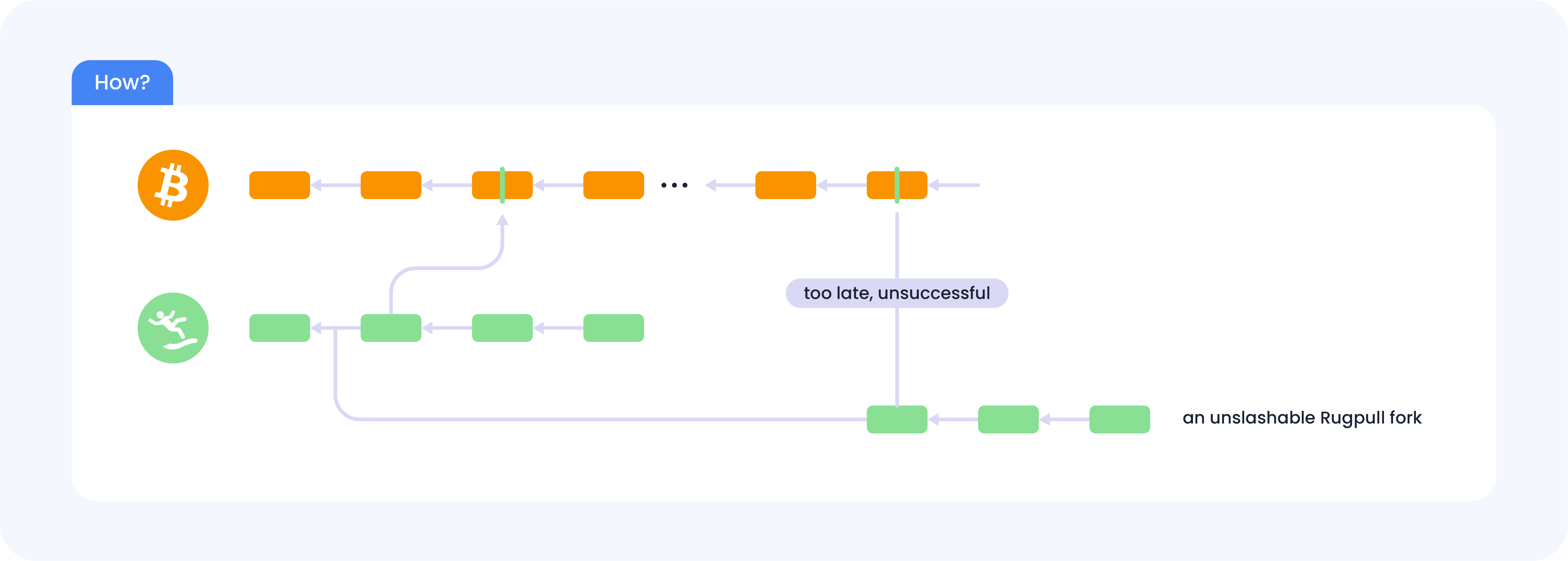
To protect PoS chains from long-range attacks, we can send block checkpoints from the PoS chain to Bitcoin and select the fork with the earlier Bitcoin timestamp as the legitimate one. Thus, only two scenarios are possible:
-
The attacking fork would have a later timestamp on the Bitcoin mainnet and thus never be selected by anyone, or
-
For the attack to succeed, the attacker must create a very long Bitcoin fork where the attacking PoS fork has an earlier timestamp—an economically infeasible task.
Therefore, long-range attacks can be effectively neutralized through Bitcoin timestamping.
Beyond mitigating long-range attacks, irreversible Bitcoin timestamps of PoS blocks provide additional security benefits:
-
Eliminates Weak Subjectivity: Bitcoin timestamps are objective, thereby eliminating PoS chains’ reliance on social consensus and weak subjectivity.
-
Shorter Unbonding Periods: By replacing social consensus, Bitcoin timestamps can reduce PoS chain staking unbonding times from weeks down to one day.
-
Bootstrapping New Chains: Newly launched PoS chains with low market valuations are more vulnerable to fork attacks. Bitcoin timestamping helps secure the growth of these nascent chains.
-
State Synchronization and Snapshot Verification: The objective truth provided by Bitcoin timestamps allows users to verify downloaded chain states or snapshots obtained from P2P networks.
-
Securing Critical Transactions: Bitcoin timestamps can provide additional confirmation for critical PoS transactions, albeit with longer confirmation delays.
-
Censorship Resistance: Bitcoin timestamps can also counter transaction censorship on PoS chains by publishing censored transactions onto Bitcoin.
Bitcoin Staking Protocol
Babylon’s Bitcoin staking protocol enables Bitcoin holders to stake their BTC without trusting any third party. This staking does not require bridging Bitcoin to a PoS chain but still provides fully slashable security guarantees for that PoS chain.
Here is an example of Bitcoin staking:
Alice owns one Bitcoin and wants to stake it on a PoS chain. First, she sends a staking transaction to the Bitcoin blockchain to enter a staking contract. This transaction locks her Bitcoin into a self-custodied vault on Bitcoin. The locked BTC can only be unlocked using Alice’s private key through one of two methods:
(1) Alice initiates an “unbonding transaction,” which unlocks the Bitcoin and returns it to her after three days.
(2) Alice initiates a “slashing transaction,” sending the Bitcoin to a burn address.
Once this staking transaction is confirmed on the Bitcoin blockchain, Alice can begin signing blocks to validate the PoS chain using her private key.
During her validation period, there are two possible paths.
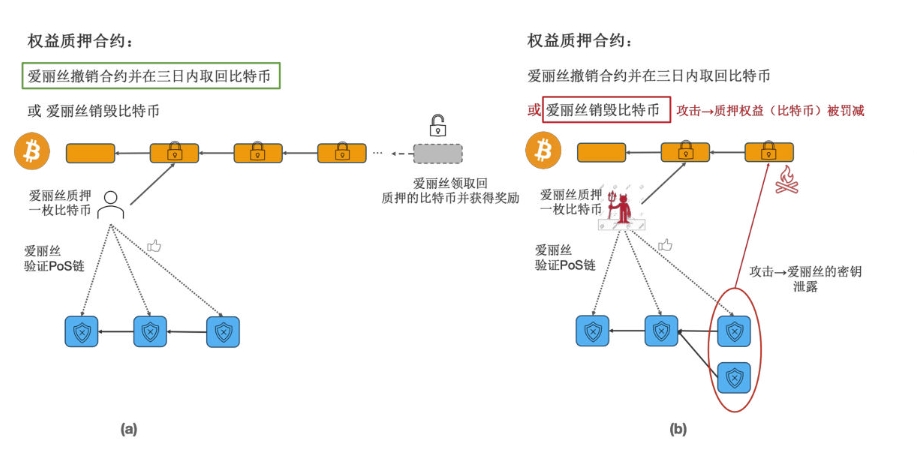
The first is the “happy path” (Figure (a) above), where Alice honestly follows the protocol. When she wishes to unstake, she initiates an unbonding request by sending an unbonding transaction to the Bitcoin blockchain (Figure (b) above). Once the unbonding transaction is confirmed, Alice’s validation duties on the PoS chain end. Three days later, she can withdraw and reclaim her Bitcoin. The PoS chain also rewards her for participation.
The second is the “unhappy path” (Figure (b) above), where Alice turns malicious and participates in a double-spend attack on the PoS chain. In this case, the staking protocol ensures Alice’s private key is revealed. Anyone can then use her identity to send a slashing transaction to the Bitcoin blockchain, burning her Bitcoin. The existence of this penalty path ensures attackers will be slashed, creating a deterrent that incentivizes everyone to follow the “happy path”—ensuring honest behavior.
For slashing penalties, Babylon leverages Extractable One-Time Signatures (EOTS). The core idea is that users sign messages once, similar to standard digital signatures. EOTS requires an additional tag parameter (e.g., block height during block validation). If a user attempts to sign the same message twice with the same tag (signing two blocks at the same height), their private key can be extracted from the two signatures.
Comparison
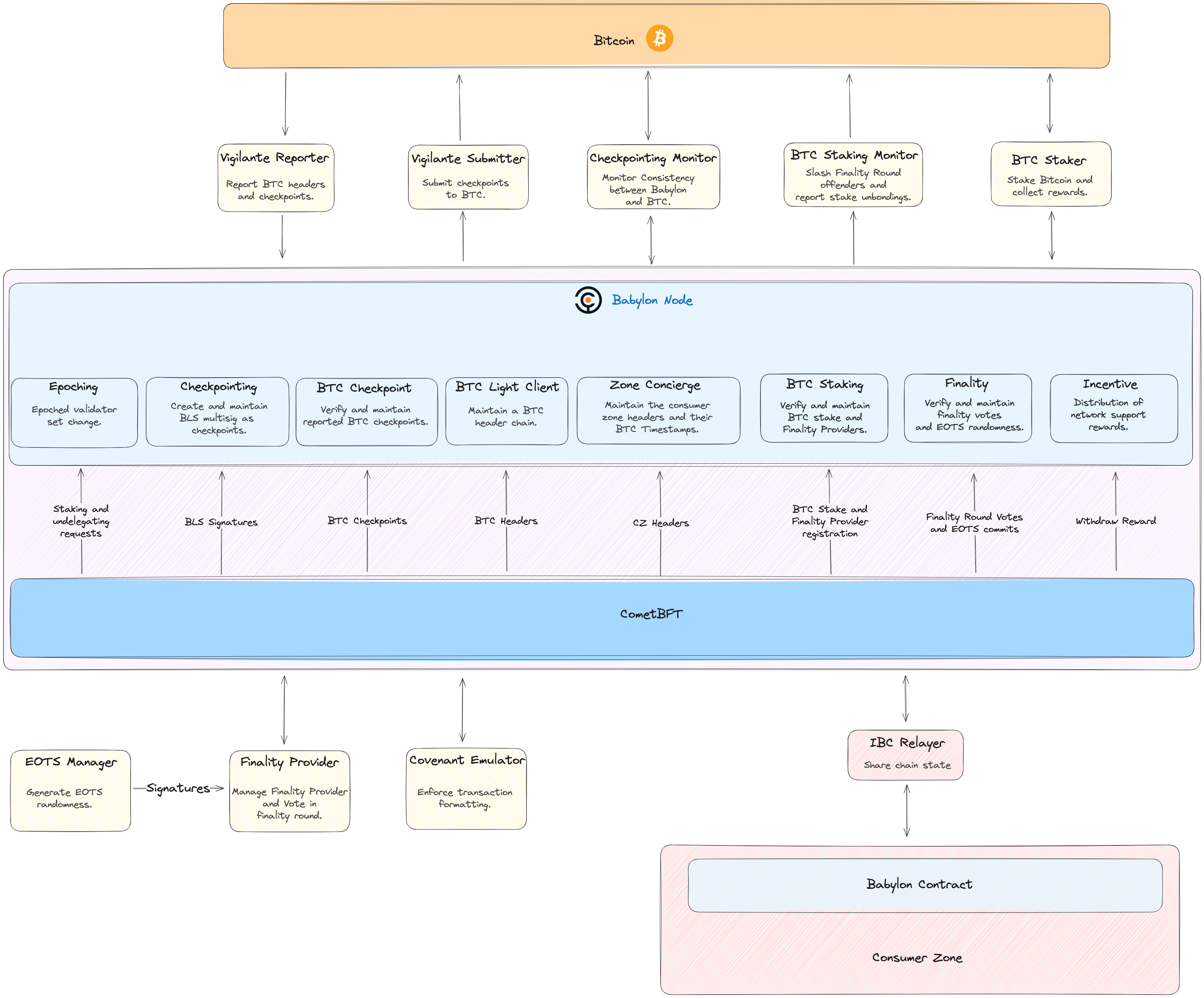
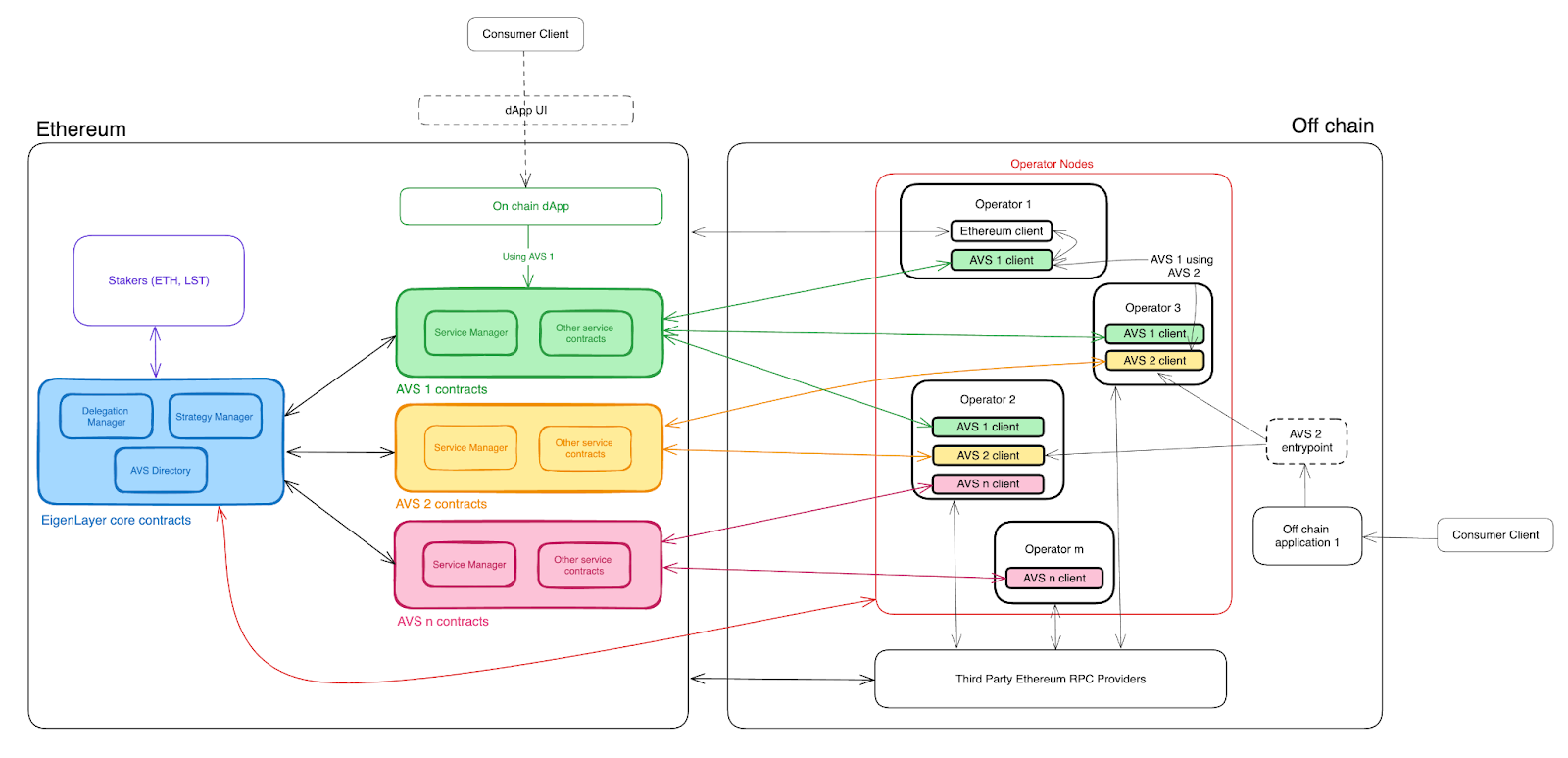
First, there is a fundamental structural difference between the Babylon protocol and EigenLayer:
Babylon:
EigenLayer:
Babylon consists of two components—the Bitcoin timestamping protocol and the staking protocol. Since Bitcoin is non-Turing complete, much of the processing must be handled by a separate chain. Hence, the Babylon protocol operates its own chain built on Cosmos SDK, complete with its own validator set, along with independent components such as the EOTS Manager and Finality Provider.
In contrast, EigenLayer is fundamentally composed of a set of smart contracts capable of accepting user deposits and managing AVS (Actively Validated Services) contracts. Its security and execution are underpinned by the Ethereum network.
Second, the slashing mechanisms differ between the two.
Since Ethereum supports smart contracts, EigenLayer implements complex slashing logic directly within its contracts, enabling customized slashing conditions for different AVSs. Additionally, if disputes arise that cannot be resolved by predefined slashing rules, an off-chain dispute resolution committee votes to resolve them.
Due to limitations of the Bitcoin mainnet, Babylon implements slashing via EOTS. This approach imposes more constraints and supports only relatively simple slashing logic—specifically detecting duplicate block signing at the same height.
Differences in slashing implementation lead to different target services.
EigenLayer’s ability to implement complex slashing logic allows it to provide security services to a broad range of AVSs. A key advantage for EigenLayer is its alignment with Ethereum. Ethereum hosts the largest ecosystem in crypto, meaning greater user adoption and demand. EigenLayer’s solution has the potential to address Ethereum’s limitations—such as the need for secure and decentralized bridges, data availability solutions, and decentralized sequencer layers for Layer 2s. Within the Ethereum ecosystem, using ETH as collateral is considered “politically correct.” As a result, most applications built around EigenLayer will primarily serve Ethereum-native use cases.
In contrast, Babylon primarily serves PoS chains, especially those within the Cosmos ecosystem. This is because the Bitcoin timestamping service relies on the IBC protocol to relay messages between the Babylon chain and Cosmos chains, imposing certain interoperability constraints. These PoS chains each maintain their own validator sets. However, the Cosmos ecosystem has already grown significantly and includes numerous high-quality PoS chains such as Celestia, Osmosis, Axelar, and dYdX—all of which can easily integrate with Babylon to inherit Bitcoin’s security. On the other hand, EigenLayer requires AVS developers to build and adapt their systems from scratch, putting it at a developmental disadvantage. Furthermore, building application-specific chains using Cosmos SDK is a well-tested and developer-friendly approach, giving Babylon an edge by bringing the entire Cosmos ecosystem under Bitcoin’s security umbrella.
This divergence also reflects the differing evolutionary paths of the Ethereum and Cosmos ecosystems. Ethereum first established a powerful security core—the Ethereum mainnet—on top of which numerous Layer 2s were built, though interconnectivity among these L2s remains unresolved. In contrast, Cosmos prioritized interoperability among different zones but lacked a strong central security hub—Cosmos Hub’s low market cap makes it unsuitable for this role. This creates a natural demand for an external security source, which Babylon aims to fulfill by importing Bitcoin’s security. Meanwhile, EigenLayer seeks to export Ethereum’s security into the Cosmos ecosystem. From an architectural standpoint, Babylon’s design may be better suited to the Cosmos ecosystem.
Conclusion
Both the Babylon protocol and EigenLayer aim to extend the security of Bitcoin and Ethereum networks to a broader range of applications. However, due to Bitcoin’s non-Turing complete nature, its ecosystem development lags far behind Ethereum’s. Additionally, Bitcoin’s asset issuance and Layer 2 solutions have taken a different trajectory than Ethereum’s. These factors contribute to fundamental differences between Babylon and EigenLayer in terms of technical architecture, slashing mechanisms, and target applications. Currently, both occupy distinct niches with unique advantages. As modular blockchain architectures evolve and cross-ecosystem integration deepens, the two may eventually compete—neither likely to dominate unchallenged.
Join TechFlow official community to stay tuned
Telegram:https://t.me/TechFlowDaily
X (Twitter):https://x.com/TechFlowPost
X (Twitter) EN:https://x.com/BlockFlow_News
 @E2mResearch







