What happens when too many altcoins and tokens are unlocked into the market?
TechFlow Selected TechFlow Selected
What happens when too many altcoins and tokens are unlocked into the market?
Cryptographic assets are reflexive.
 Navigating Web3 tides with focused insights
Author: ROUTE 2 FI
Translated by: TechFlow
The total market cap of altcoins is steadily growing as new tokens continuously enter the market.
I believe that when the BTC.D trend turns downward and the altcoin season arrives, only a few select altcoins will surge significantly. It won't be the case, as people are used to, that every single altcoin will experience massive gains.
Reflexivity: What happens when too many altcoins and tokens unlock and flood the market?

Let’s talk about altcoins, how they’ve recently launched, and their impact on the market.
In this cycle, there's a trend of launching tokens with high FDV, large-scale airdrops, low float, followed by massive unlocks from venture capital firms later on.
Cryptocurrencies are reflexive. What does that mean?
This article was inspired by Twitter threads, Telegram chats, conversations with crypto friends, and more—an idea I've wanted to write about for a long time. Special thanks to Cobie, Thor Hartvigsen, Thiccy, Andrew Kang, and Regan Bozman for their insights on this topic. Follow them on Twitter.
Reflexivity: A powerful idea about feedback loops
Originally proposed by George Soros, reflexivity is a theory stating that positive feedback loops between expectations and economic fundamentals can cause prices to deviate significantly and persistently from equilibrium levels. Bitcoin has always exhibited strong reflexivity. Bull cycles in Bitcoin can last a very long time, while bear cycles are notoriously known for their length and depth.
According to Cryptonary, it's important to remember that the concept of market reflexivity contradicts conventional wisdom when analyzing markets, their movements, and mechanisms. Theoretically, markets are always seeking equilibrium, all participants are rational actors making decisions based on facts. Bubbles, capitulation events, and boom-bust cycles are anomalies; prices eventually return to equilibrium. Price itself has no effect on the factors establishing equilibrium.
On the other hand, under market reflexivity, everyone makes judgments based on their interpretation of reality, and price affects market fundamentals. You can see where this goes: if pricing influences fundamentals, then changes in price must also affect fundamentals, which in turn influence investor expectations, thereby affecting price again, as investors act upon these revised expectations. Since collective behavior reinforces price movements, prices drift further and further away from reality—eventually becoming the new reality. If you will, a self-fulfilling prophecy.
Prices should tend toward equilibrium, but due to market reflexivity, they often stay above or below that equilibrium for extended periods. Only when market participants realize their perception of the market no longer reflects reality do prices begin reversing the current trend—this usually happens long after prices have already moved beyond reasonable levels.
And folks, that’s why we have the chart below:
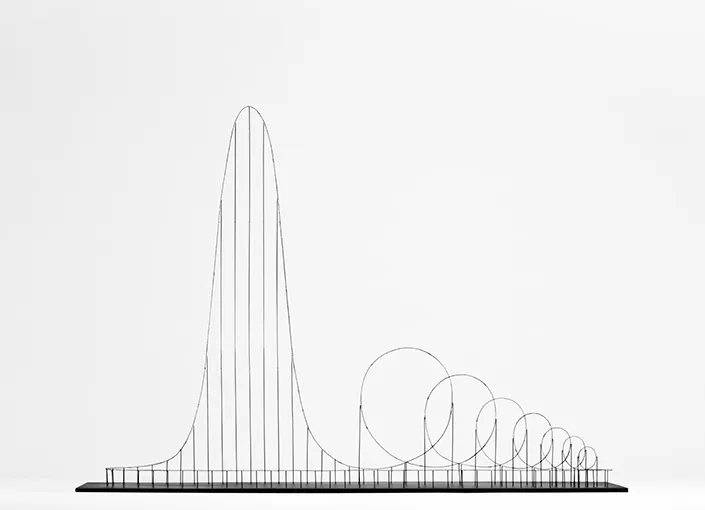
You see, reflexivity works both ways. There's no doubt that a ball thrown into the air will eventually fall back down.
If Bitcoin’s price rises sharply within a short period, then for some time after the initial move, the price may continue rising. The reverse is also true. The crypto market is still in its early stages, so significant price swings “easily” occur.
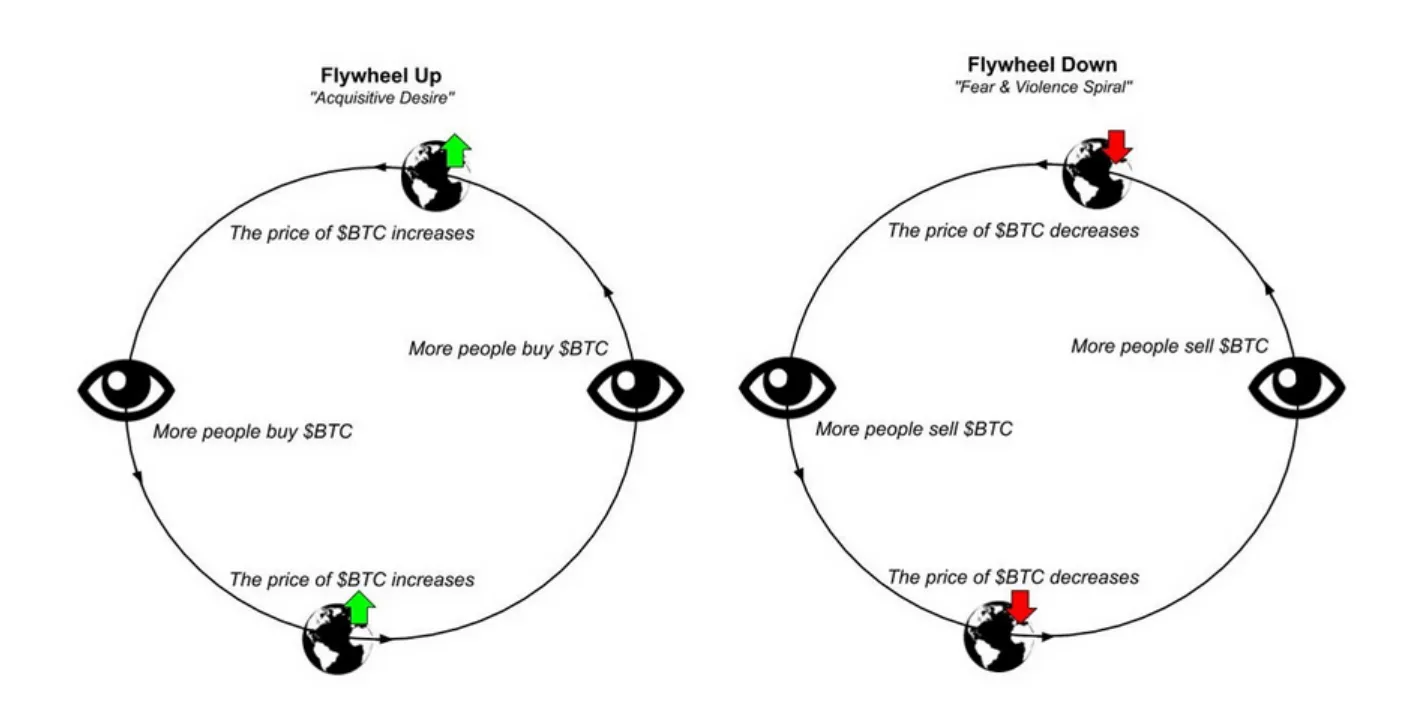
Look at the chart above. It perfectly illustrates reflexivity. I think you now have a solid grasp of the concept, so let’s move on.
Now, let’s examine altcoins and what will happen to the market as all these new tokens launch.
New tokens are great (until circulating supply increases)
I’ve written before about supply and demand issues in cryptocurrency, but let’s go over it again.
Market Cap: Circulating Supply × Price
Fully Diluted Valuation (FDV): All tokens (including unissued ones) × Price
Understanding the VC/angel investing game (especially from a retail investor perspective) is crucial.
Most crypto companies raise funds from investors through SAFTs (Simple Agreements for Future Tokens). In equity markets, SAFTs are comparable to SAFEs (Simple Agreements for Future Equity), allowing startup investors to convert their cash investments into equity at a future date, provided certain conditions are met.
To illustrate what a typical SAFT deal might look like, here’s a simple example:
Token Name: Yolo Coin
FDV: $100 million
Unlock Conditions: 10% at TGE, then 1-year cliff, followed by 3-year linear unlock
Circulating Supply at TGE: 12% (partly via airdrop)
Yolo Coin launches amid heavy hype, with its FDV now at $1 billion (10x seed investors’ valuation). Investors are happy—they can sell at breakeven and still hold 90% of their allocation, which will gradually unlock over the next 36 months (after the 1-year cliff).
But wait? Why such long VC lock-up periods? Briefly, it's to ensure long-term alignment and prevent immediate dumping at TGE.
Here’s why this is problematic:
Because investors are locked up for a long time, when they finally start unlocking, it creates sustained selling pressure on the market.
Look at the chart below.

Assume Yolo Coin’s price is $1 (investor price = $0.10). 12% of supply enters the market at launch, but we know more supply will flood in as tokens gradually unlock.
This leads to increased supply.
But here’s the problem: Where is the demand? Who will buy the tokens VCs are dumping on you?
You might argue price will rise due to factors X, Y, Z—such as increasing TVL in DeFi protocols, bullish events, etc.—which may work temporarily. But eventually, supply will outpace demand, leading to a downward spiral due to massive inflation.
Early buyers get trapped, causing pessimism in the community, leading to declining protocol TVL, developers (if any) leaving for better opportunities, team members quitting, etc.
As Thor Hartvigsen put it well: "Markets won’t be able to absorb all the extra liquidity + those receiving airdrops seem to want to cash out rather than hope for more airdrops in the future."
So far, the biggest change this cycle is fragmentation across the space. We were taught that altcoins would pump together. But now there are roughly 300 decent projects, yet liquidity is insufficient.
We often hear about altseason, but I think this time will be different. We’re used to hearing that every coin will pump given the right conditions. But is that really true?
Remember, today’s market features far more tokens with actual “utility” than in 2021. Now, 3–5 “quality” coins launch weekly. Total market cap grows, and everyone seems happy. But ask yourself: who will buy all these tokens? Unless institutions or retail investors pour in massive amounts, this will simply remain an endless PvP battle.
A recent example is the Wormhole airdrop. Launched at a $10 billion valuation. Now ask yourself: why would you own it? I don’t see any reason beyond pure speculation. Since launch, its price has dropped 40%, bringing its FDV down to $6 billion.
As Cobie said: "Market cap measures demand, while FDV measures supply."
This means market cap represents the total value of public demand, fluctuating with price. When price rises, FDV also increases, but FDV additionally grows as tokens unlock.
Take Pendle, for instance. Everyone loves Pendle now because its TVL surged dramatically due to points farming and the Eigenlayer narrative.
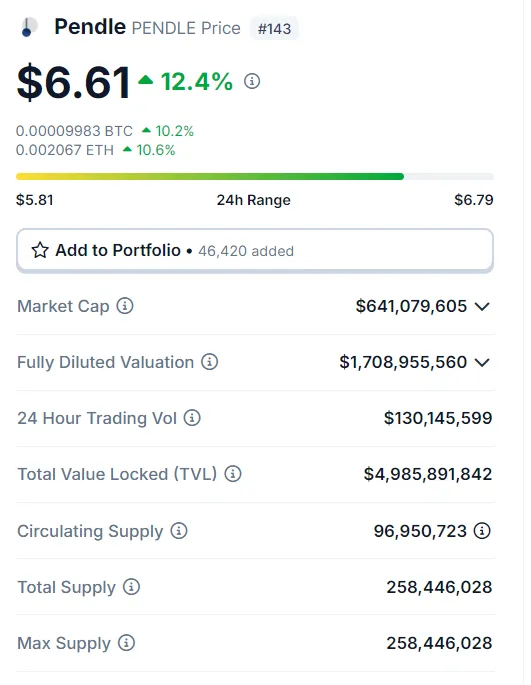
Note that only 950k of Pendle’s 2.58 million tokens are currently circulating (37%). As price rises, market cap increases. However, rising market cap doesn’t imply additional demand for locked tokens. To explain, think from an investor’s perspective. I know people got into Pendle for less than 10 cents. Now it’s trading above $6. Do you really think unlocking holders care whether it’s $6 or $7? No—they’ll sell. Again: supply increases, but demand stays flat. (I haven’t checked Pendle’s unlock schedule or exact FDV entry points—just making assumptions to illustrate supply/demand dynamics.)
Are high-FDV tokens scary? Not always. A good example is $TIA in November 2023. $TIA currently has a $12 billion FDV, but since locked tokens won’t hit the market until autumn 2024, it’s not so bad—other traders might be scared off by the high FDV.
For more on this, see Cobie’s article.
Alright, but back to demand. Where are the buyers?
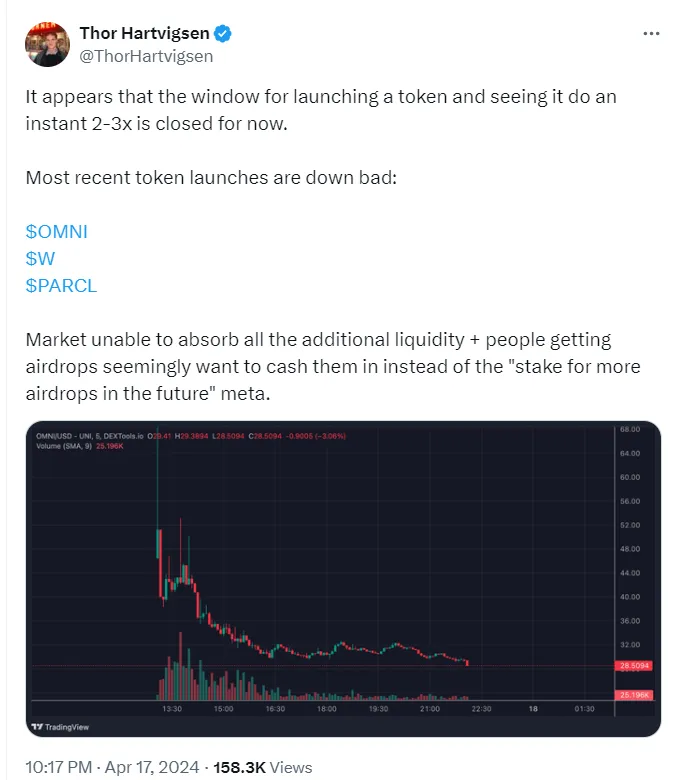
As I mentioned earlier, new “quality” projects with extremely high FDVs launch every week. This means massive supply entering the market—unless new buyers come in, these tokens will inevitably fall (at least in the long run).
Retail investors love meme coins and SOL shitcoins. They don’t buy sophisticated VC tokens. They learned their lesson from the 2021 rally. They’re smarter now. Permissionless token listings and greedy VC firms don’t help individual tokens thrive long-term. With 100 new tokens launching annually, existing tokens get diluted.
It’s April 2024, and inflows into altcoins appear more selective—but not enough to offset the massive unlocks.
Is there a solution?
We’ve learned that the low-float token model is flawed. Can we fix it?
Clearly, a key issue is the sheer number of projects launching. Not everyone can buy into all of them. But perhaps more linear unlock schedules (unlike Arbitrum), retroactive airdrops—think Ethena and EtherFi conducting second-round drops—could help. Maybe relaunching ICOs would create more loyal fans.
I believe when BTC.D turns downward, only a few altcoins will surge significantly—not every one as people expect. Today’s crypto participants outnumber the last cycle’s, but now they’re smarter.
According to Thiccy, over $250 million worth of altcoin supply unlocks daily from new tokens and all existing tokens. Due to upward reflexivity (positive feedback loops), most of these tokens weren’t sold during airdrops or investment rounds because the market kept rising (“Why sell today when you can make more tomorrow?” mentality). That’s why we saw massive sell-offs in April—the market just needed a trigger (war).
Alright, so token unlocks, new listings, and staking rewards from existing tokens have led to a daily increase of $250 million in altcoin supply so far in 2024. With numerous new coins launching, FDV growth has outpaced circulating supply, increasing by about 70% year-to-date. The gap between FDV and circulating supply represents future supply entering the market—this gap has widened by over $150 billion since the beginning of the year. As inflows into major coins slow, the weight of daily altcoin supply becomes increasingly apparent. The more I understand trading, the more I realize that strategically shorting crypto altcoins can actually be profitable—at least when doing pair trades.
Regardless, due to the continuous launch of new tokens and new supply entering the market, the total market cap of altcoins is steadily increasing.
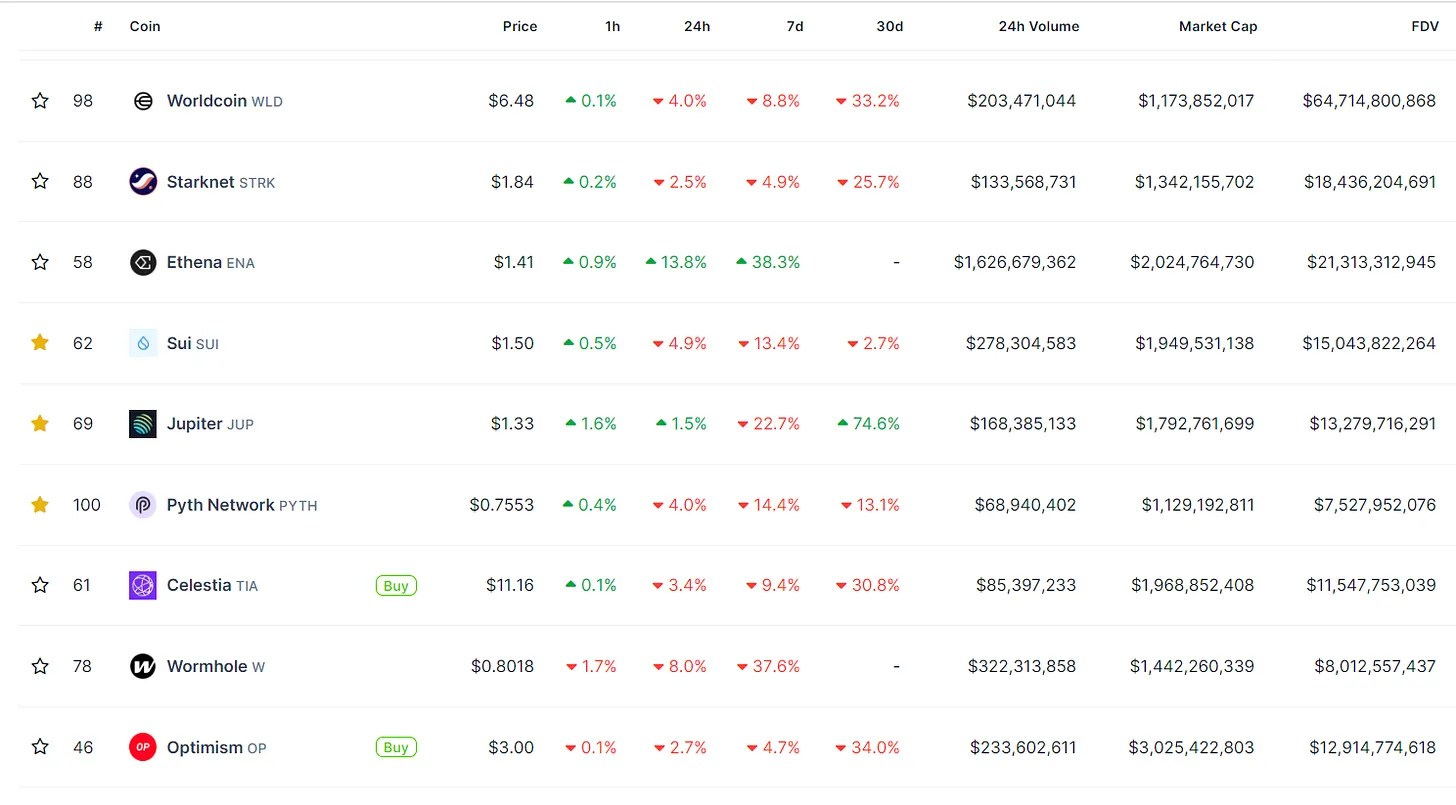
The above examples include several high market cap/FDV tokens. Take Worldcoin: $1 billion market cap, but FDV of $64 billion. What does that mean?
It means Worldcoin will continuously supply tokens to the market. In July 2024, they’ll start aggressively releasing—6 million $WLD tokens per day will enter the market. Currently, only 181 million $WLD tokens are circulating.
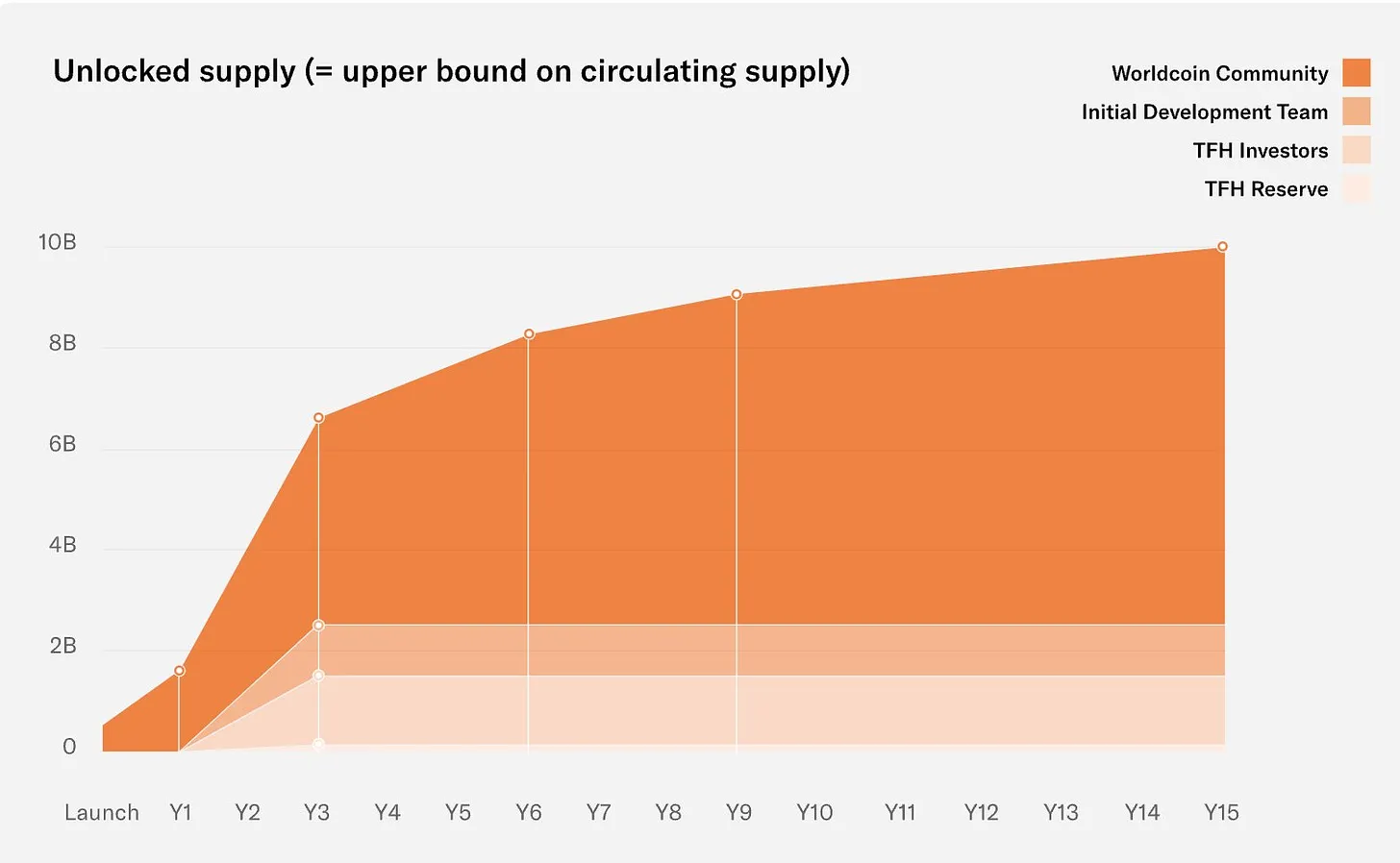
Using basic supply-demand curves, it’s easy to see how difficult it will be to maintain $WLD’s price once this supply hits the market.
Who will buy 6 million $WLD tokens every day?
What does this mean for the bull market?
As long as BTC/ETH keep rising, this might not matter much. We’ll see the full impact under bear market conditions.
However, I like Anteater’s approach: go long strong coins, short weak ones. It’s a hedging strategy, not triangular arbitrage like Ethena. Hedging during a bull market might sound odd, but on the path to peak, there will be several downturns. Reaching the top isn’t smooth sailing.
Also, several recent posts on crypto Twitter claim this cycle is already 70% complete. Who knows—so manage your risk accordingly.
I believe most new VC scam coins (high-FDV tokens) will eventually dump heavily. You can use this for hedging trades or as a hedge if desired.
Examples of weak coins could be $STRK, $APE, $BOME, $ADA, $CRV, and $XRP. Or, if altcoins broadly perform well, pair these weak altcoins against strong ones: currently strong ones include $ENA, $TON, $FTM, $PENDLE. However, this isn’t financial advice to buy/sell these coins, as market momentum shifts rapidly.
One benefit of memes is that they’re among the few honest coins. Look at $WIF, $PEPE, $DOGE, $POPCAT, etc. Circulating supply equals total supply. No one will dump your coin on insane unlock schedules. It’s purely a PvP game.
Finally, let’s hear from crypto trader Wazz:
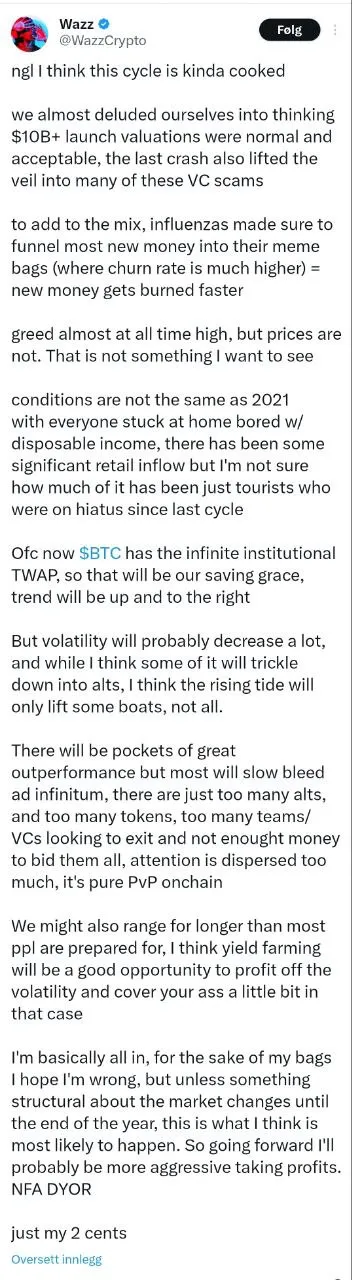
I find his argument rational and compelling. Too many altcoins, too many projects, too many unlocked tokens heading to market.
If Bitcoin’s price surges sharply in a short time, it’s almost certain that for some time after the initial move, the price will continue rising. The reverse is equally true. The crypto market’s low liquidity means prices can swing wildly with ease.
Join TechFlow official community to stay tuned
Telegram:https://t.me/TechFlowDaily
X (Twitter):https://x.com/TechFlowPost
X (Twitter) EN:https://x.com/BlockFlow_News
 @Route2FI