
In-depth Analysis of the Relationship Between ether.fi Season 1 Airdrop and Loyalty Points (Includes Link to Analytical Data)
TechFlow Selected TechFlow Selected
In-depth Analysis of the Relationship Between ether.fi Season 1 Airdrop and Loyalty Points (Includes Link to Analytical Data)
The Matthew effect was evident in EtherFi's first-season airdrop, and the airdrop distribution favored both "light participants" and "heavy loyal" users.
 Navigating Web3 tides with focused insights
Author: @Web3Mario
Data links:
-
TheGraph for EtherFi participant address analysis: https://api.thegraph.com/subgraphs/name/web3mario/etherfi_airdrop_analyze
-
Full account airdrop results: https://cf-ipfs.com/ipfs/QmP2tgnrAyUGwRs1o6B8YGzHmnecyZrVhY5QiFCESxUsBv
Introduction: In my previous article, I discussed how Web3 oligarchs exploit users through Loyalty Points. In this article, we will examine a real-world case to further support this argument.
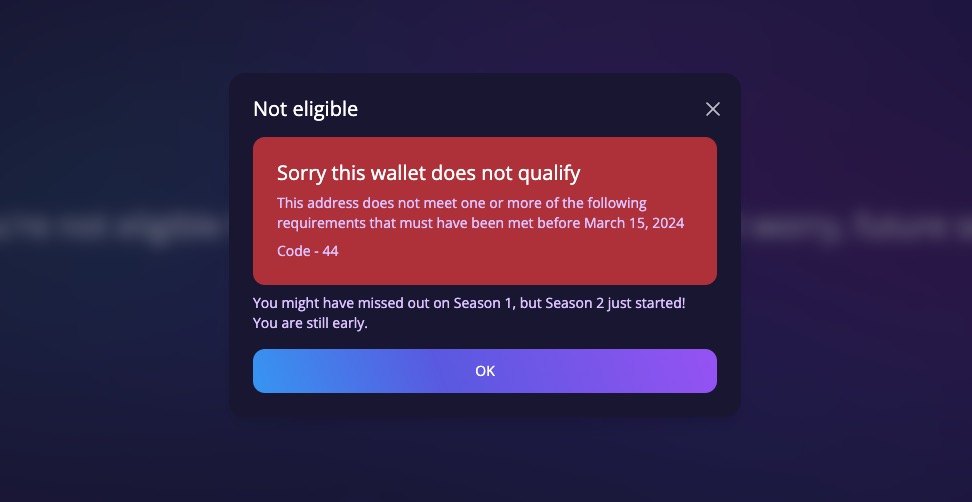
On March 18, 2024, Ether.Fi, a leading player in the Restaking sector, launched its TGE and distributed the first round of $ETHFI token airdrops, generating significant wealth effects. At the time of writing, $ETHFI is trading at $5.54, with a fully diluted market cap reaching $550 million. This valuation is substantial for an early-stage project whose core product has not yet launched, reflecting strong investor confidence in the project's vision.
However, many users expressed dissatisfaction with the airdrop outcome. For a long time, EtherFi’s promotion and incentive mechanisms were centered around the EtherFi Loyalty Point system, leading users naturally to associate their future airdrop rewards with accumulated Point amounts. After the airdrop results were revealed, however, many users found little correlation between the two—some loyal users with high Point balances received similar rewards to "light participants," while large whales leveraged their capital advantages to secure disproportionately large airdrop allocations.
Therefore, I spent some time conducting a detailed data-driven analysis of EtherFi’s airdrop design, identifying the biggest beneficiaries of this round, hoping to help readers optimize their strategies for future similar airdrop campaigns. Finally, I will speculate on potential designs for EtherFi’s Season 2 airdrop rules and estimate possible returns.
Reviewing EtherFi Season 1 Airdrop
First, let's review the official public rules of EtherFi’s Season 1 airdrop:
-
EAP: You participated in the Early Adopter Program
-
ether.fan: You are an ether.fan NFT holder
-
Solo Staker: You are an ether.fi Solo Staker
-
eETH / weETH: You hold eETH or weETH
-
DeFi rewards: You participated in eETH or weETH DeFi pools or vaults
-
Badges: You unlocked one or more ether.fi badges
-
Referrals: You referred one or more new users to participate in ether.fi
Notably, there was no direct mention of Loyalty Points in these criteria, nor was the exact calculation algorithm clearly defined. However, after analyzing the full dataset, we can still identify certain patterns.
Using TheGraph, we obtained all user addresses that interacted with EtherFi from July 10, 2023—the date it deployed its Liquidity Pool smart contract—to March 18, 2024 (TheGraph Query Link). We then used Python crawlers to collect airdrop allocation data for these addresses. The complete dataset has been uploaded to IPFS for public access. Key findings include:
-
Total participating addresses: 82,102; number receiving airdrops: 71,380;
-
Among recipients, the average user held 536,444 Loyalty Points and received 702 $ETHFI tokens;
-
On average, each $ETHFI required 755 Loyalty Points—indicating an effective conversion rate of 755 Loyalty Points per $ETHFI;
-
The Matthew effect (wealth concentration) is extremely pronounced. Among all airdrop recipients:
-
Top 20% by Loyalty Points held 94% of total Points and received 77.5% of total airdropped tokens;
-
Top 10% held 87.8% of total Points and received 72.2% of total airdrops;
-
Top 5% held 79.2% of total Points and received 65.6% of total airdrops.
The airdrop distribution mechanism clearly favored both “light participants” and “highly loyal” users—typically whales.
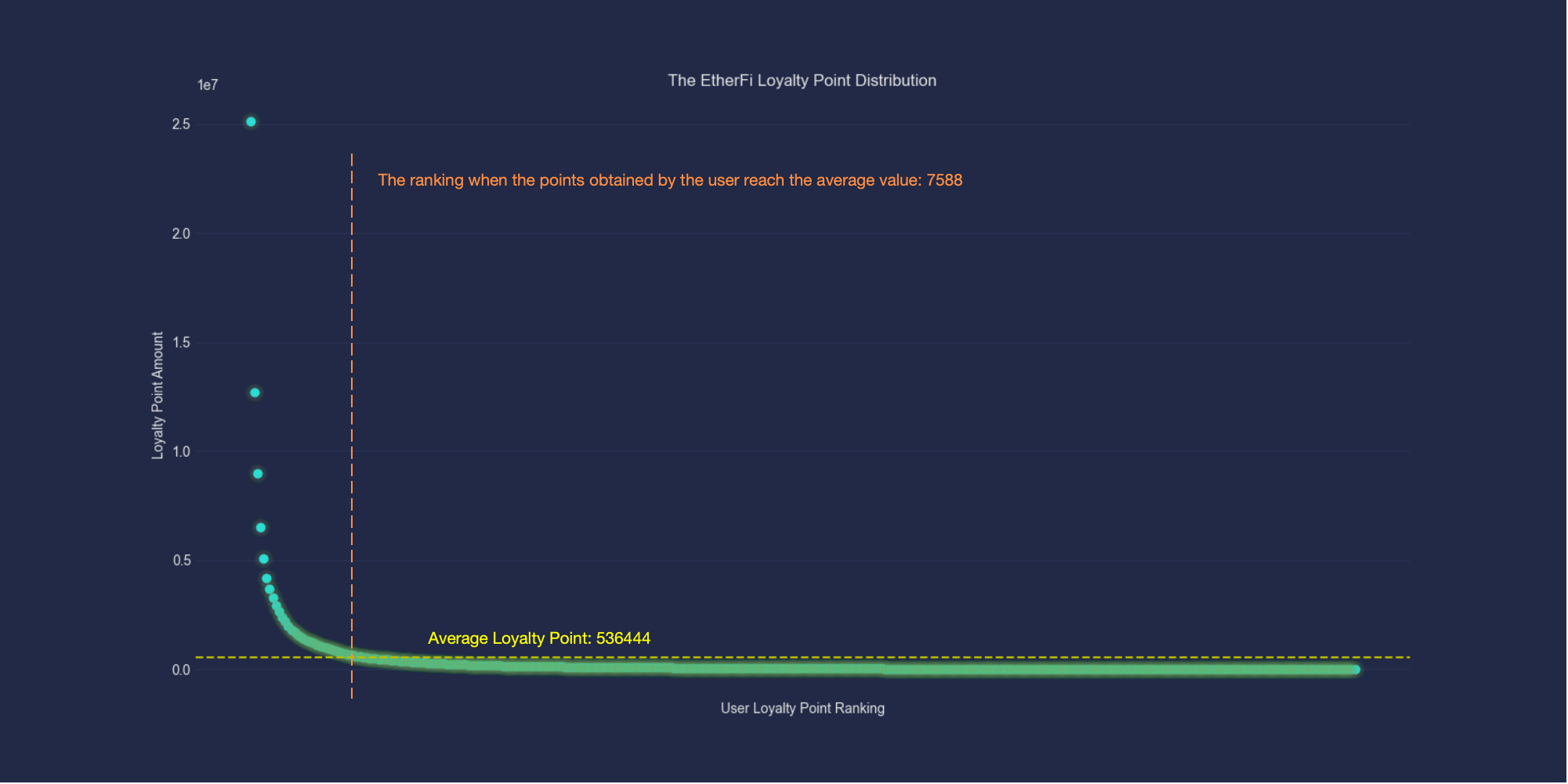
Let’s first look at the distribution of users’ Loyalty Points. As shown in Figure 1, the x-axis represents user ranking by Loyalty Points, and the y-axis shows the amount held. The average user earned 536,444 Loyalty Points, but only the top 7,588 users achieved this level. Compared to the total of 82,102 participants, this is a small fraction, indicating that whales dominate Point accumulation.
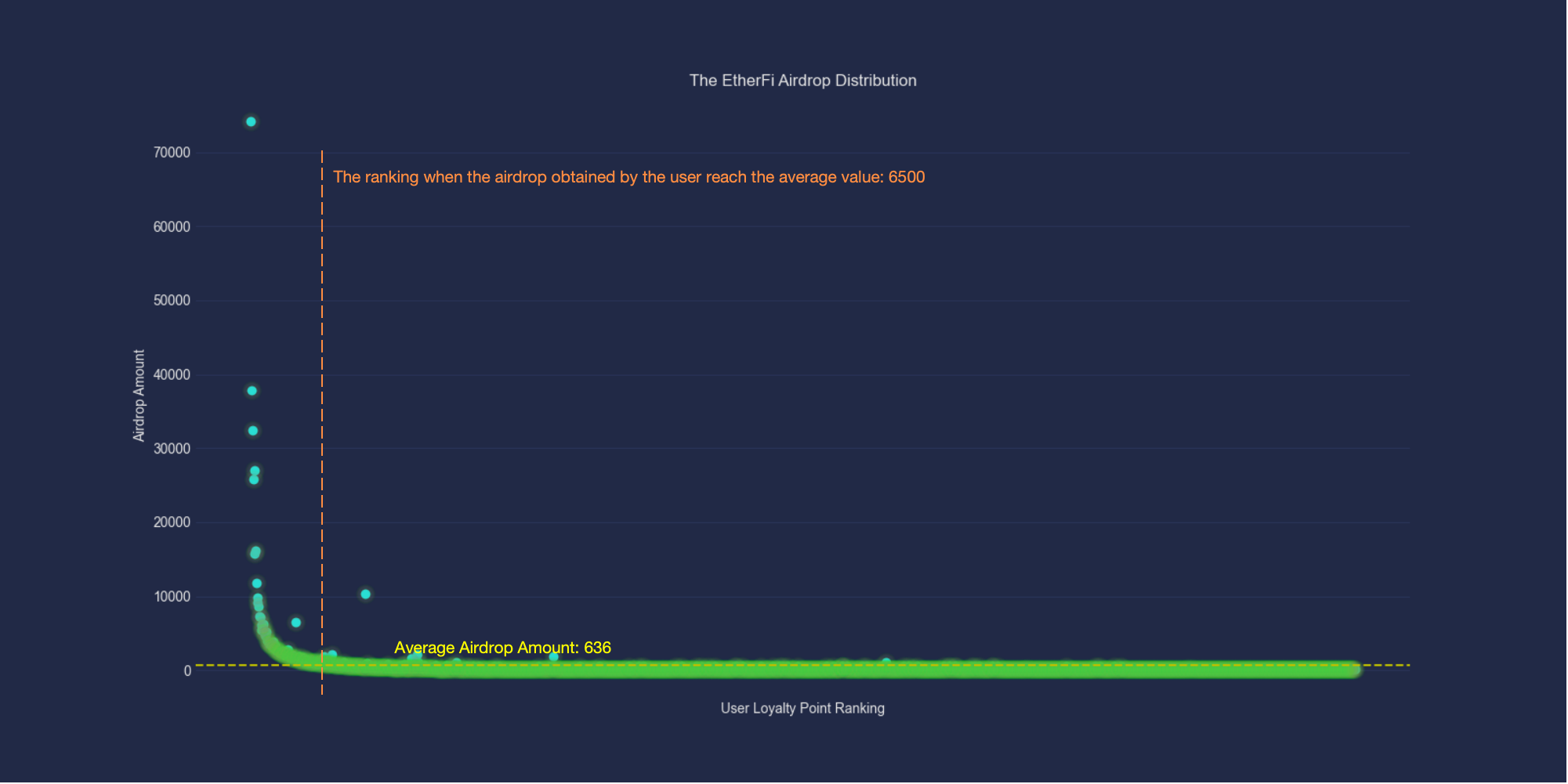
Next, consider the distribution of airdrop amounts. As shown in Figure 2, the x-axis remains the Loyalty Point ranking, while the y-axis now reflects $ETHFI airdrop quantity. The average recipient received 636 $ETHFI, which corresponds roughly to the top 6,500 users. Compared to the Loyalty Point distribution, airdrop allocations are even more concentrated among top-ranked users.
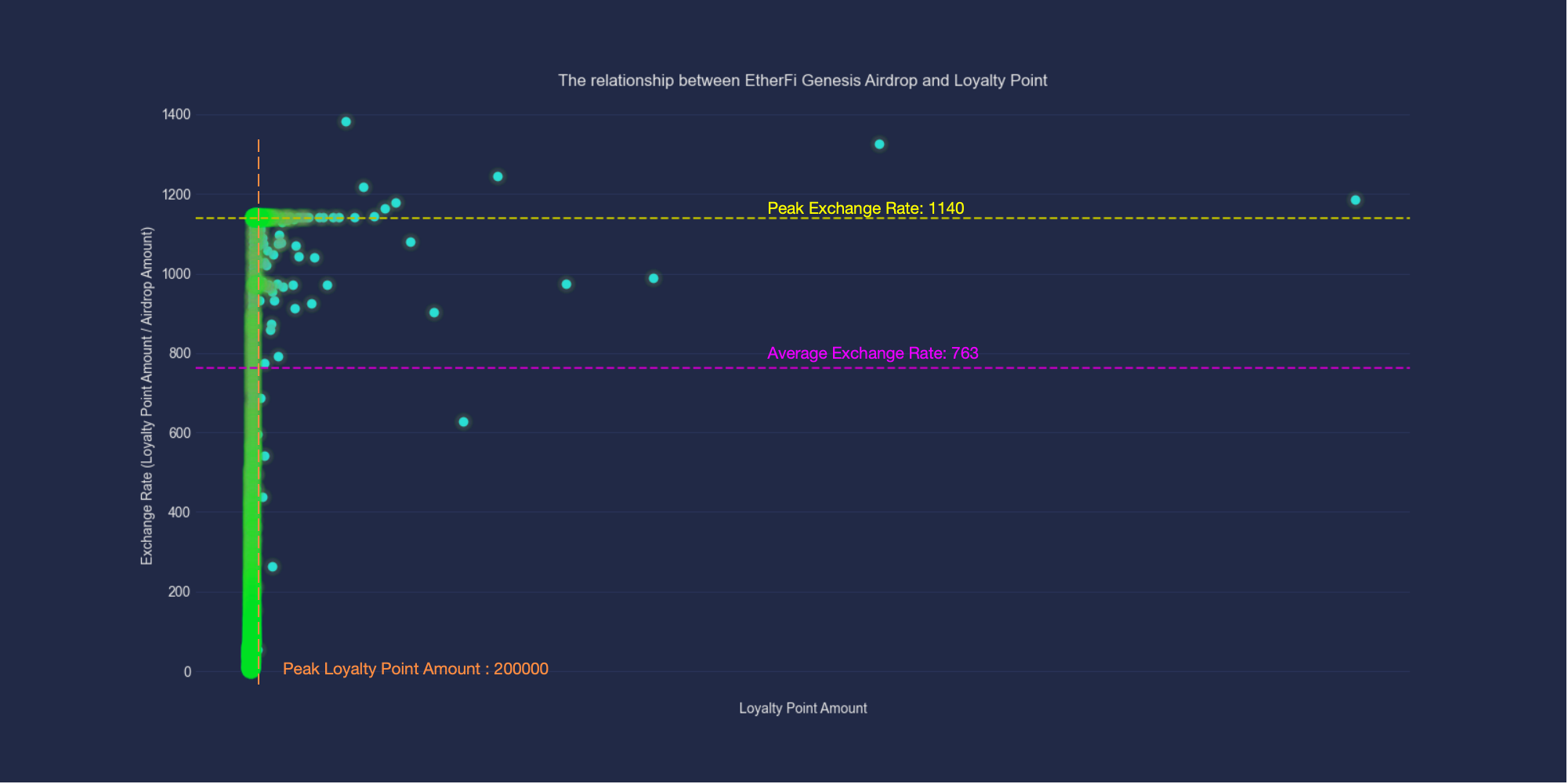
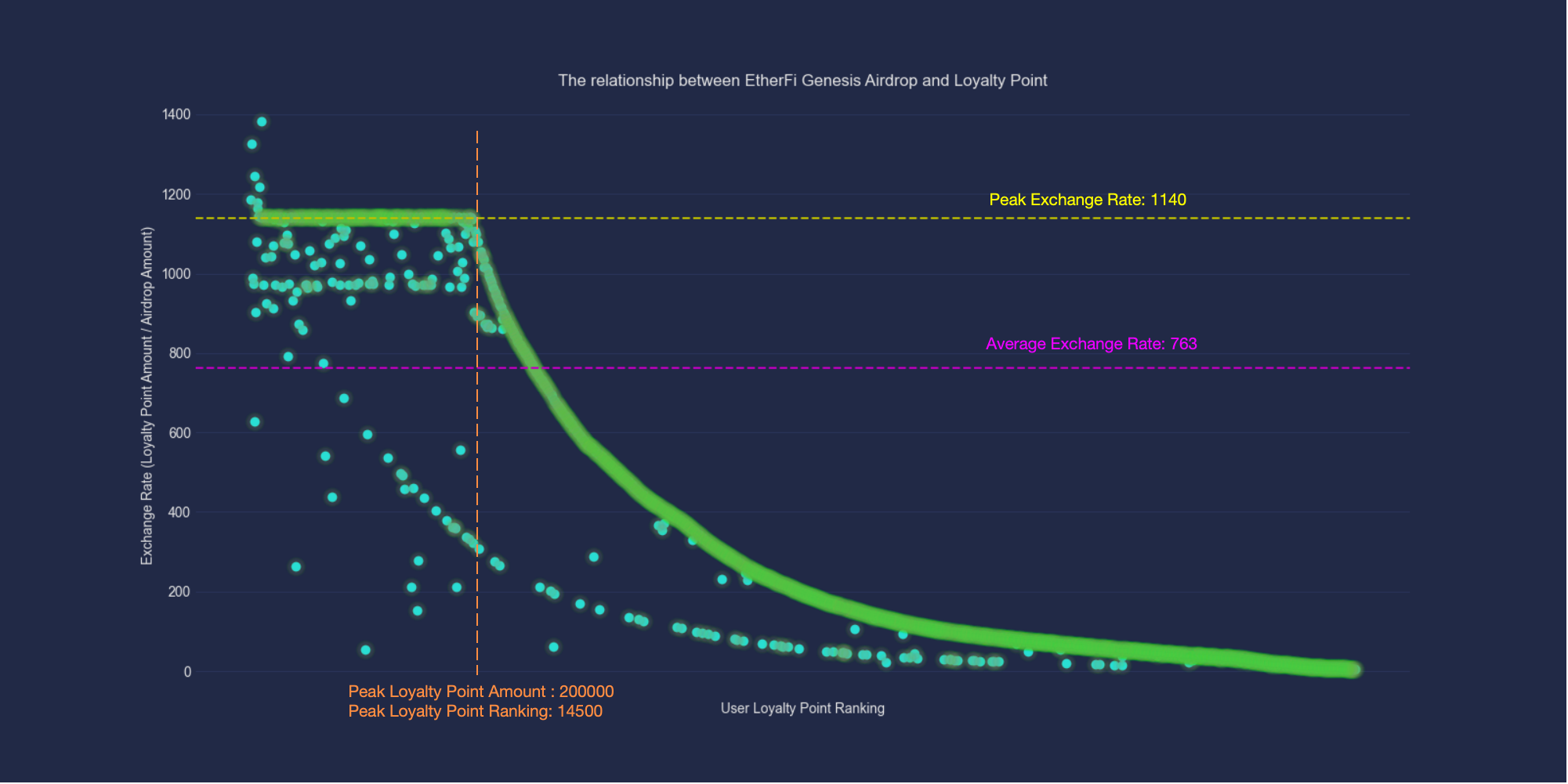
Finally, let’s examine the scatter plot of Loyalty Points versus airdrop conversion rates (Figure 3). The x-axis shows Loyalty Point holdings, and the y-axis shows the conversion rate—how many Points were needed to earn one $ETHFI. We observe an approximate piecewise function pattern. In the first segment, the conversion rate increases roughly proportionally with Loyalty Points: the more Points held, the higher the rate, meaning it becomes harder to obtain each additional $ETHFI. But once a user exceeds approximately 200,000 Loyalty Points, the curve enters a second phase. Here, the conversion rate peaks around 1,140 and stabilizes, meaning further accumulation does not increase difficulty—this benefits whales significantly.
To better illustrate this relationship, Figure 4 transforms the x-axis into Loyalty Point rank (from left to right, decreasing holdings), with the y-axis showing the $ETHFI conversion rate. The threshold becomes clearer: when a user’s rank drops below ~14,500 (i.e., they fall out of the top 14,500), the conversion rate begins to rise sharply, indicating increasing inefficiency for mid-tier and smaller users.
Outlook on EtherFi Season 2 Airdrop
Now, let’s turn to EtherFi’s upcoming Season 2 airdrop. The team has already published detailed information about Season 2: StakeRank:
-
StakeRank is an 8-tier level system
-
Users advance one level for every 100 hours of ETH staked on ether.fi
-
Each tier offers progressively higher Loyalty Point earning rates
-
Your stake balance must remain above 0.1 eETH to continue leveling up
-
Season 1 participants start at Rank II
-
Rank-based boosts range from 1x to 2x (subject to change)
-
Ether.Fan NFT holders are automatically upgraded to Rank III
-
One-time benefit per NFT holder
-
During the transition to Season 2, the protocol aims to recognize Season 1 participants without disproportionately allocating Season 2 airdrops to them. To achieve this, everyone’s Loyalty Point accrual rate will be increased tenfold. While this dilutes old points, they remain valid under certain conditions.
-
All eETH and weETH holdings and DeFi positions—including liquidity—will be treated equally under StakeRank.
-
If, by the end of Season 2, your total points consist of more than 70% from S1 accumulation, you become ineligible. However, the base Loyalty Point accrual rate in S2 will increase 10x. Staking in S2 means your new points should vastly exceed those collected in S1. In other words, S1 stakers are acknowledged—but S2 will reward active participation during S2.
The overall design revolves around a tiered Loyalty Point ranking system with different boosting effects per level. Most importantly, the guidelines for final airdrop redemption significantly dilute the impact of previously accumulated Points. This sharply reduces the advantage of users who have already amassed large Point balances, forcing loyal users to essentially restart from scratch. Crucially, EtherFi continues to use vague language regarding the precise relationship between Loyalty Points and final airdrop quantities, introducing considerable uncertainty. Given that Season 1’s design appeared to favor light participants and whales, this may offer strategic clues for Season 2 engagement. However, remember that Season 1 already distributed 6% of the total ETHFI supply—only 5% remains for Season 2 airdrops.
Join TechFlow official community to stay tuned
Telegram:https://t.me/TechFlowDaily
X (Twitter):https://x.com/TechFlowPost
X (Twitter) EN:https://x.com/BlockFlow_News
 @web3_mario