DeFi has flourished, but the next step for Web3 is non-financial applications
TechFlow Selected TechFlow Selected
DeFi has flourished, but the next step for Web3 is non-financial applications
The long and ever-growing tail of cryptocurrencies demonstrates the extent of demand for blockchain as a ledger for digital assets.
 Navigating Web3 tides with focused insights
Author: Mario Laul
Translation: Luffy, Foresight News
Decentralized public blockchain networks have existed for about 15 years, and their associated crypto assets are currently undergoing their fourth market cycle. Over these years—especially since the launch of Ethereum in 2015—significant time and resources have been devoted to researching and developing applications based on these blockchain networks. While remarkable progress has been made in financial use cases, other types of applications have struggled, primarily due to the complexity of delivering scalable and seamless user experiences under the constraints of decentralization, as well as fragmentation across ecosystems and standards. However, recent technological advances both within and beyond the blockchain industry have not only made broader applications feasible but also more necessary than ever before.
The early phase of blockchain applications was driven by a narrow definition of core functionality: enabling secure issuance and tracking of digital assets without reliance on centralized intermediaries such as traditional financial institutions or government agencies. Whether we're discussing native fungible tokens (e.g., BTC and ETH), on-chain representations of off-chain assets (such as national currencies and traditional securities), or non-fungible tokens (NFTs) representing artworks, in-game items, or any other form of digital goods or collectibles, blockchains track these assets and allow anyone with internet access to transact globally without depending on centralized financial channels. Given the scale and importance of the financial sector—particularly amid ongoing trends of digitization, globalization, and financialization—this single disruptive use case alone justifies the interest in blockchain technology.
Within this narrow framework, there are currently five blockchain applications with significant product-market fit beyond the underlying asset ledgers and the decentralized networks that maintain them: applications for token issuance, applications for storing private keys and transferring tokens (wallets), applications for trading tokens (including decentralized exchanges, or DEXs), applications for lending and borrowing tokens, and applications that give tokens predictable value relative to traditional fiat currencies (stablecoins). At the time of writing, CoinGecko, a crypto market data aggregator, lists over 13,000 individual crypto assets with a total market capitalization of approximately $2.5 trillion and daily trading volume exceeding $100 billion. Nearly half of this value is concentrated in Bitcoin, with the vast majority of the remainder distributed among the top 500 assets. The crypto tail is extremely long and growing, especially after including NFTs, reflecting the substantial demand for blockchains as digital asset ledgers.
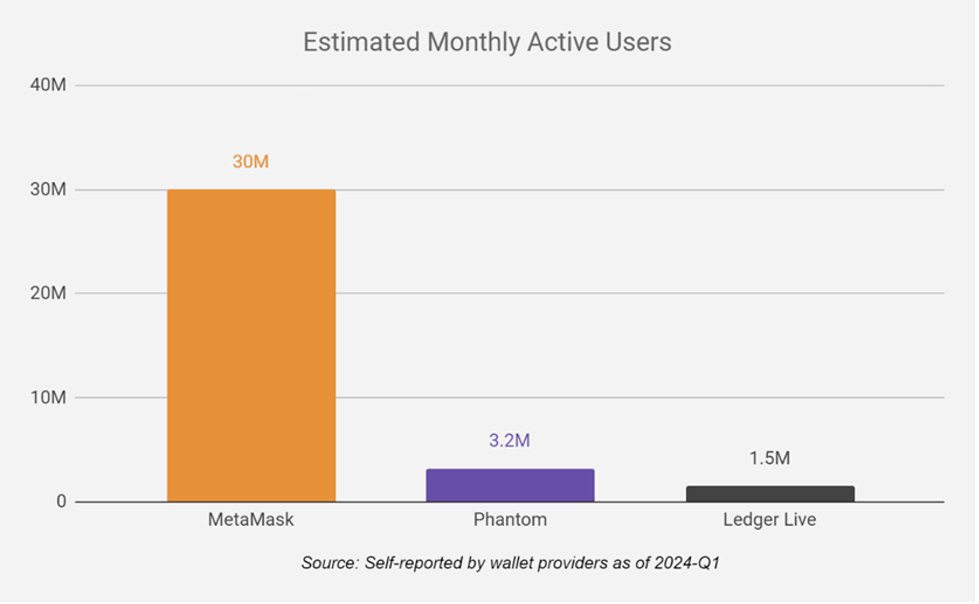
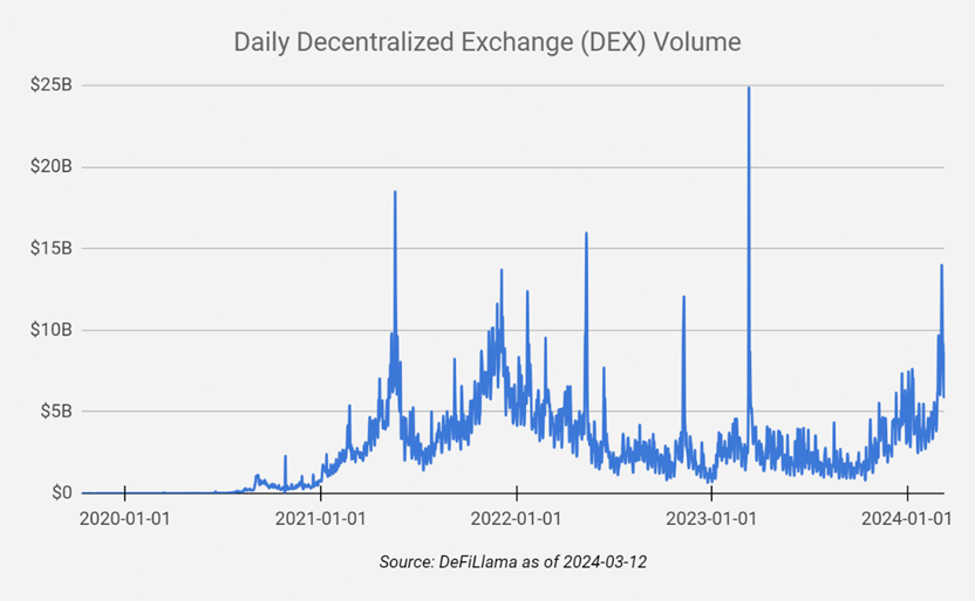
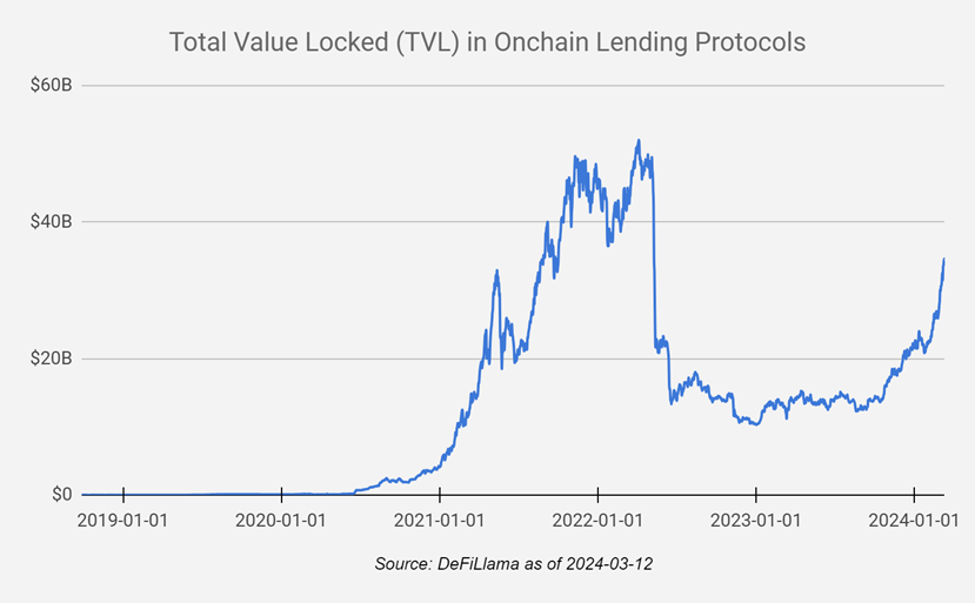
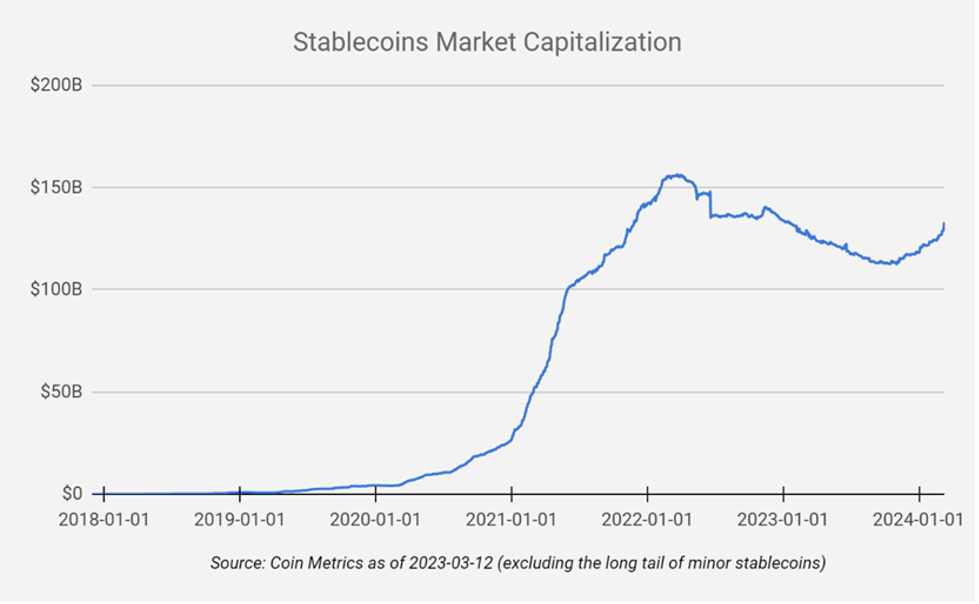
Recent estimates suggest around 420 million people worldwide hold cryptocurrency, though many may have never or rarely interacted with decentralized applications. Hardware wallet maker Ledger reports its Ledger Live software has about 1.5 million monthly active users, while software wallet providers MetaMask and Phantom claim approximately 30 million and 3.2 million monthly active users respectively. Combined with roughly $5–10 billion in daily DEX trading volume, $30–35 billion in capital locked in on-chain lending markets, and a stablecoin market cap of around $130 billion, these figures reflect the current adoption levels of the aforementioned five applications. They remain small compared to traditional finance and fintech, yet still significant. Admittedly, these numbers should be viewed against the backdrop of recent surges in crypto asset prices, but as blockchains become increasingly legitimized—with milestones like the approval of spot Bitcoin ETFs and tailored regulatory frameworks such as Europe’s MiCA—they may continue attracting new capital and users, particularly amid growing integration with traditional financial assets and institutions.
However, when it comes to applications that can be built on general-purpose programmable blockchains, token issuance, wallets, DEXs, lending, and stablecoins represent merely the tip of the iceberg. These five use cases alone are insufficient to justify blockchain as a universal alternative to centralized databases and web application platforms. With nearly 30 million developers globally, fewer than 25,000 monthly active developers build on public blockchains according to Electric Capital's latest Crypto Developer Report, of which only about 7,000 are full-time. These figures indicate that blockchain currently lags far behind traditional software platforms in developer attraction. Nevertheless, the number of developers with at least two years of crypto experience has increased for five consecutive years, the industry hosts multiple blockchain ecosystems each with over 1,000 contributors, and has attracted over $90 billion in venture capital over the past six to seven years. While the vast majority of this funding has indeed gone toward building foundational blockchain infrastructure and core decentralized finance (DeFi) services—the pillars of the emerging on-chain economy—there is also strong interest in blockchain use cases beyond finance, such as online identity, gaming, social networks, supply chains, IoT networks, and digital governance. How successful have these types of applications been on the most mature and widely used smart contract blockchains?
Three primary metrics measure user interest in specific blockchains and applications: daily active addresses, daily transaction volume, and daily fees paid. Before interpreting these metrics, note that all can be artificially inflated and thus typically represent the most generous estimate of organic adoption. According to Artemis, a chain data aggregator, six networks stood out over the past 12 months (each ranking in the top six on at least two of the three metrics): BNB Chain, Ethereum, NEAR, Polygon (PoS), Solana, and Tron. Four of these (BNB Chain, Ethereum, Polygon, Tron) use some version of the Ethereum Virtual Machine (EVM), benefiting from Solidity—the programming language specifically designed for EVM—and its extensive tooling and network effects. NEAR and Solana each have their own native execution environments primarily based on Rust, a more complex language than Solidity but offering multiple performance and security advantages, along with a thriving ecosystem beyond the blockchain industry.
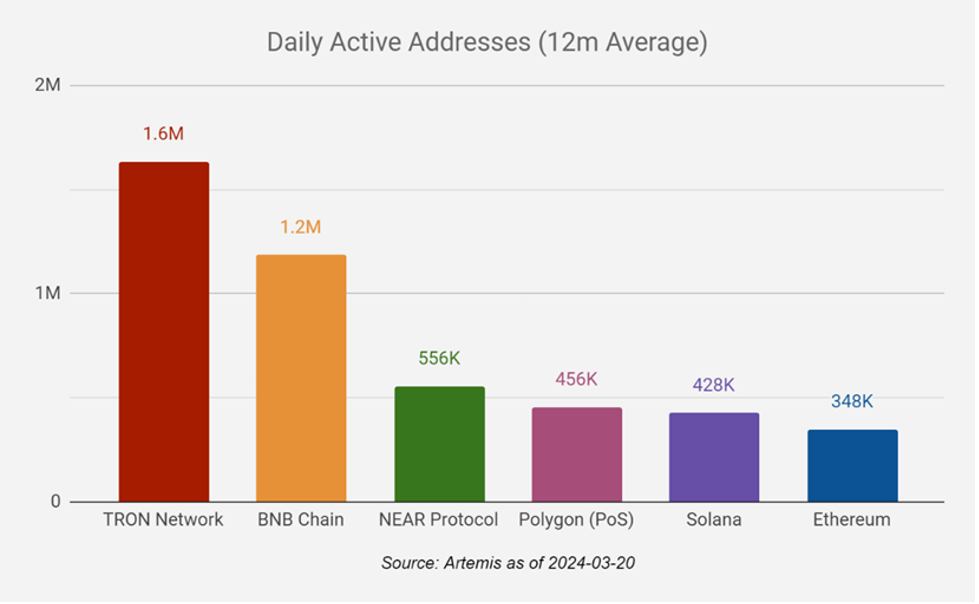
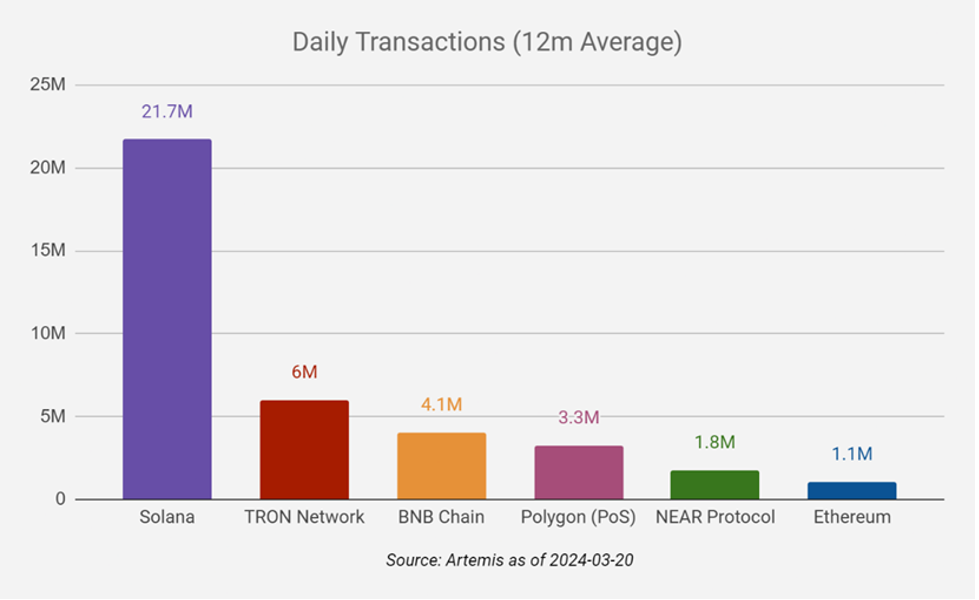
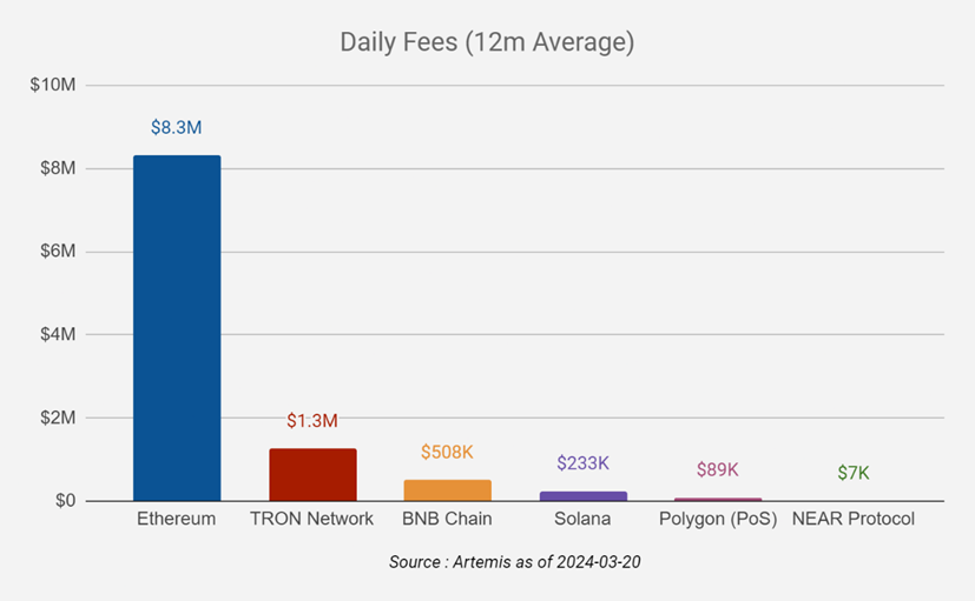
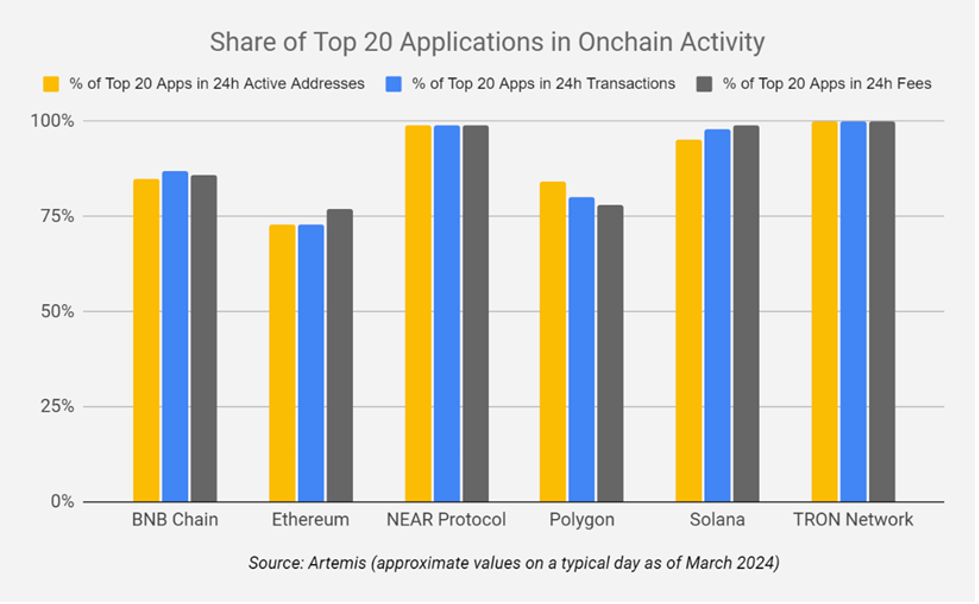
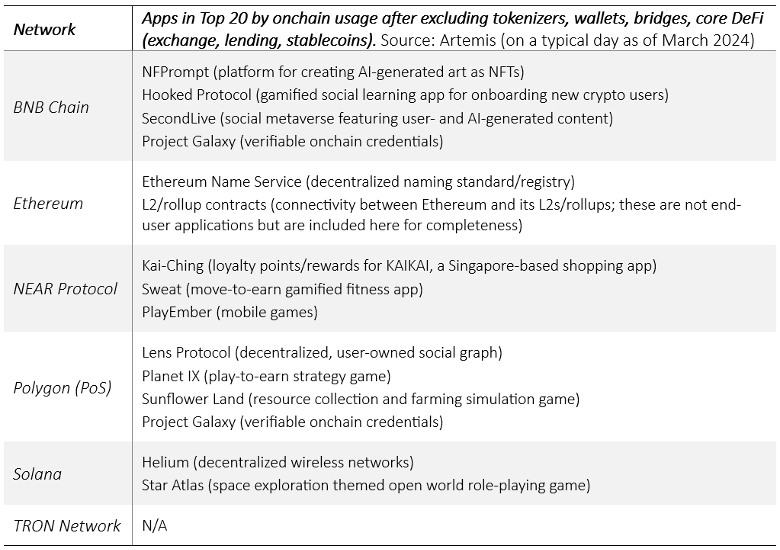
On-chain activity across these six networks is highly concentrated in the top 20 applications, with a sharp drop-off in daily active addresses for lower-ranked apps, varying by network. As of March 2024, on an average day, the top 20 apps accounted for 70–100% of activity across all three metrics, with Tron and NEAR showing the highest concentration and Ethereum and Polygon the lowest. Across all networks, the top 20 apps are predominantly those related to tokenization, wallets, and core DeFi primitives (exchanges, lending, stablecoins), with none or only a few (0–4 per network) falling outside these three categories. Beyond cross-chain bridges for transferring value across different blockchains and NFT marketplaces (both of which belong under asset transfer and trading), the remaining outliers are typically gaming or social apps. However, in most cases, these apps account for a small share of overall network activity (best-case scenario below 20% on Polygon, usually under 10%). The sole exception is NEAR, where usage is extremely concentrated: two apps (Kai-Ching and Sweat) account for roughly 75–80% of all on-chain activity, and fewer than 10 apps in total have daily active addresses exceeding 1,000.
The above reflects the legacy of blockchain's early development stage and further reinforces its core value proposition as a digital asset ledger. Criticism of blockchain for lacking applications is clearly unfounded, as its primary function is the programmable financialization and secure settlement of tokenized value. Asset issuance, wallets, DEXs (or more broadly, exchanges), lending protocols, and stablecoins exhibit such strong product-market fit precisely because they align closely with this purpose. Given that these five domains feature relatively simple business logic and powerful positive feedback loops, it's no surprise that first-generation leading smart contract blockchains are dominated by applications serving this narrow set of financial use cases. Moreover, since many proposed utilities for non-financial blockchain applications ultimately relate to tokenization and financialization, these five financial applications may dominate major general-purpose blockchains in the long run.
But what does this mean for blockchain’s grander vision as a general-purpose application platform? For years, the crypto industry has faced two major challenges: (1) scaling blockchains (in terms of throughput and cost), and (2) achieving user-friendly experiences without sacrificing the decentralization and security guarantees of the underlying infrastructure. In the context of scaling, a distinction is often made between more integrated architectures and more modular ones, with Solana typically representing the former and Ethereum—with its growing ecosystem of general-purpose and application-specific Layer 2 networks (rollups)—representing the latter. In practice, these approaches are not mutually exclusive and exhibit considerable overlap and convergence. More importantly, both are now proven methods for scaling blockchains, depending on whether an application requires shared state and maximum composability with others, or instead benefits from full sovereignty over its governance and economics while being indifferent to seamless interoperability.
Currently, end-user experiences for blockchain applications are also continuously improving. Specifically, thanks to technologies such as account abstraction, chain abstraction, proof aggregation, and light client verification, it is now possible to securely eliminate several major UX pain points that have plagued crypto for years: the need to store private seed phrases, the requirement for network-specific tokens to pay transaction fees, limited account recovery options, and excessive reliance on third-party data providers—especially when using multiple independent blockchains simultaneously. Combined with the growing availability of decentralized data storage, verifiable off-chain computation, and other backend services that enhance on-chain application capabilities, the current and upcoming cycles of application development will reveal whether blockchains remain primarily in their role as global financial infrastructure or evolve into a more general-purpose platform. Beyond DeFi, numerous use cases could benefit from greater resilience and user-centric control over data and transactions—such as online identity and reputation, publishing, gaming, physical infrastructure via wireless and IoT networks (DePIN), decentralized science (DeSci), and addressing authenticity issues in an AI-generated digital content world. Thus, the latter has always been theoretically compelling. Now, it is becoming practically viable.
Join TechFlow official community to stay tuned
Telegram:https://t.me/TechFlowDaily
X (Twitter):https://x.com/TechFlowPost
X (Twitter) EN:https://x.com/BlockFlow_News
 @placeholdervc