Detailed Explanation of AltLayer: A Rollup Service Protocol for the Modular + Restaking Narrative
TechFlow Selected TechFlow Selected
Detailed Explanation of AltLayer: A Rollup Service Protocol for the Modular + Restaking Narrative
AltLayer, as a decentralized and highly scalable L2 solution, may also achieve strong development driven by the modular design philosophy.
 Navigating Web3 tides with focused insights
Author: Chain Tea House
1. Project Overview
AltLayer is a decentralized, elastic Rollup-as-a-Service (RaaS) protocol designed to provide scalable Layer 2 solutions for blockchain applications.
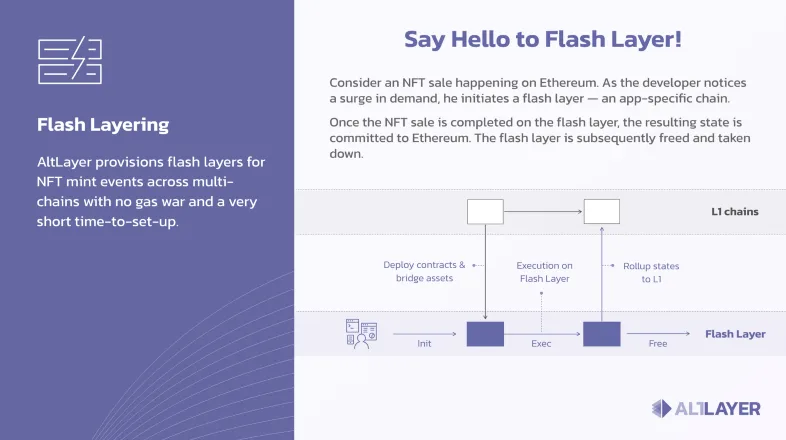
Built upon temporary scaling layers connected to Layer 1 and Layer 2 networks such as Ethereum and Solana, AltLayer supports multi-chain and multi-virtual machine functionality, elastic rollup technology, no-code deployment, and decentralized coordination. This setup helps alleviate on-chain congestion and high transaction fees, enabling developers to rapidly launch application-specific rollups.
As a restacked rollup protocol, AltLayer operates within the modular and restaking narrative, enhancing security, decentralization, and processing speed for rollups in the crypto market—similar to Op Stack, ZkStack, Arbitrum Orbit, and others.
AltLayer offers Rollup-as-a-Service (RaaS) tailored for Web3 projects. In short, it’s a tool that allows developers and non-programmers alike to create custom rollups with just a few clicks—in as little as two minutes. AltLayer provides two main products: a versatile rollup stack and a no-code dashboard.
From a technological narrative perspective, modularity is an emerging trend expected to significantly impact the future of blockchains. Since 2021, this trend has evolved through three parallel phases: addressing the operational costs of maintaining rollups/Layer 2s, simplifying and industrializing rollup creation (e.g., AltLayer and Dymension), and continuously launching new rollups after overcoming cost and technical hurdles. These phases progress at varying speeds across different project domains.
Among its offerings, AltLayer's Rollup-as-a-Service (RaaS) delivers rollup infrastructure to Web3 projects via three core services: restaked rollups, decentralized sequencing, verification of rollup state correctness, and faster finality—enhancing decentralization, security, and interoperability among rollups. Additionally, the no-code dashboard is a RaaS offering for developers or users without rollup development experience, allowing them to create execution layers and related components—such as sequencers and block gas limits—in under five minutes.
AltLayer has launched its native token, ALT. Transaction fees, storage fees, and other service costs within the AltLayer ecosystem will be paid in ALT. The token is also used for governance and participation in consensus mechanisms, contributing to network security. Currently, the ALT token is listed and available for trading on Bitget. Token holders can earn staking rewards and participate in protocol governance decisions, thereby strengthening overall network security and decentralized governance.
2. Core Mechanisms
AltLayer’s core mechanisms are built around its innovative Rollup-as-a-Service (RaaS) and restaked rollup technologies, giving it a competitive edge in the blockchain industry—particularly in speed, security, decentralization, and scalability.
(1) Restaked Rollup
Restaked Rollup is a core technology offered by AltLayer, combining restaking and rollup technologies to enhance blockchain security, decentralization, and performance.
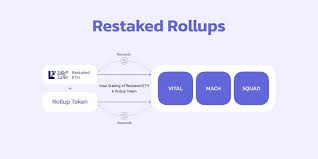
This mechanism functions through several key aspects:
Definition
A Restaked Rollup is a specialized rollup architecture whose core lies in leveraging restaking to improve the security and decentralization of rollups. Beyond handling standard transactions and smart contract operations, this rollup employs enhanced security and validation mechanisms to ensure higher data integrity and network trust.
Active Validation Services (AVS)
Restaked Rollup introduces Active Validation Services (AVS), which are pre-integrated and optimized to support efficient transaction processing and state validation.
These services include:
-
Decentralized Sequencing: Provides transaction ordering services for rollups, reducing reliance on single points of failure and improving system decentralization.
-
State Correctness Verification: Ensures all state changes within the rollup are accurate, enhancing overall system security.
-
Fast Finality: Enables rapid confirmation of transaction status through efficient validation mechanisms, reducing confirmation time and improving network responsiveness and user experience.
Restaking Mechanism
-
In Restaked Rollup, participants must stake their assets (such as ALT tokens) as collateral to contribute to the security and operation of the rollup. This staking not only provides additional network security but also allows stakers to earn rewards while helping secure the network.
Modular Components
The Restaked Rollup features multiple modular components, allowing the system to flexibly adapt to various application needs and scalability requirements:
-
Vital Mach Squad: A set of specially designed modules responsible for processing and validating transactions, ensuring high performance and security for the rollup.
-
Versatile Rollup Stack: Provides multi-layer architectural support for rollups—including settlement layer, transaction processing and validation layer, and data availability layer—enhancing scalability and flexibility.
Security and Decentralization
Restaked Rollup strengthens security and decentralization through multiple mechanisms:
-
Multiple Validators: Instead of relying on a single validator, multiple validators jointly process and validate transactions, reducing centralization risks.
-
Fraud Proof System: When potential fraudulent activity is detected, the system can generate fraud proofs to present evidence of errors or malicious behavior, further enhancing network security.
These characteristics enable AltLayer to deliver a secure and highly efficient Layer 2 solution, ideal for blockchain applications requiring high throughput and strong security guarantees.
(2) Rollup-as-a-Service (RaaS)
AltLayer’s Rollup-as-a-Service (RaaS) is an innovative offering designed to simplify and accelerate the deployment and management of rollup technology. Its core objective is to enable developers—regardless of technical background—to quickly and efficiently launch and operate customized Layer 2 solutions.
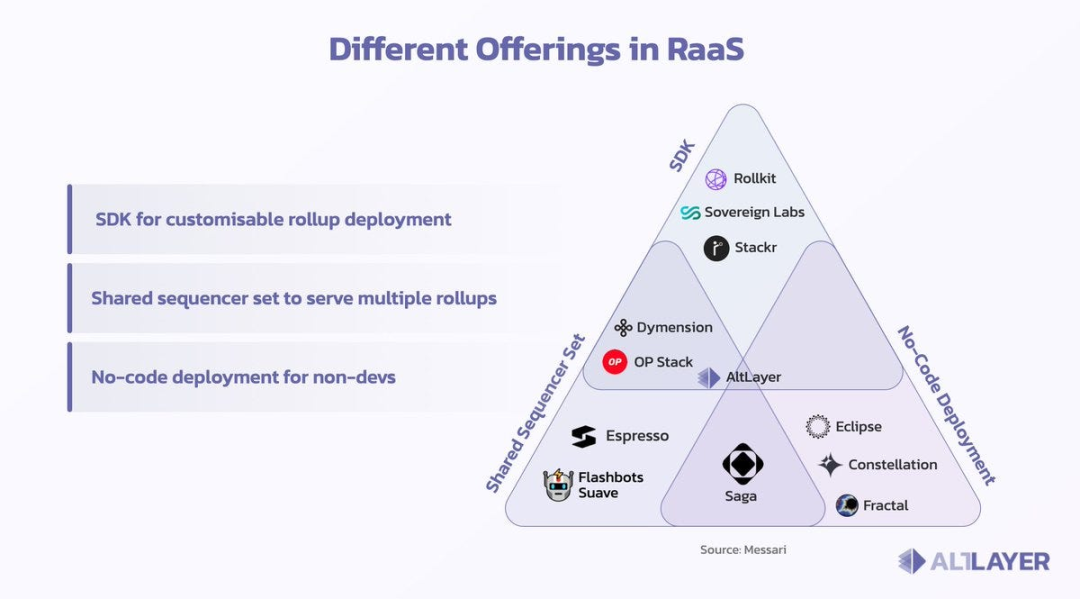
Below is a detailed overview of key aspects of AltLayer’s RaaS:
No-Code Interface
AltLayer’s RaaS offers a user-friendly interface that enables users with no programming knowledge to deploy rollups within minutes. This is achieved through a simplified graphical user interface (GUI) featuring preset options and templates—users simply configure and launch rollups via a few clicks.
Modular Architecture
AltLayer’s RaaS is built on a modular architecture, allowing users to customize selections of runtime layers, data availability layers, and settlement layers. For example, users may choose EVM or WASM-based runtime layers, pair internal or external data availability layers (e.g., Celestia), and use Ethereum or other blockchain networks as settlement layers.
Dynamic Scalability
AltLayer’s rollups are designed for high elasticity, dynamically scaling based on application demand. During peak demand—such as large-scale airdrops or token launches—the rollup can rapidly expand processing capacity; during low demand, it scales down accordingly, optimizing resource usage and cost efficiency.
Security and Decentralization
By leveraging restaking technology and decentralized sequencing, AltLayer’s RaaS enhances the security and decentralization of rollup solutions. This includes using multiple independent validators to distribute risk and utilizing Eigenlayer’s restaking capabilities to increase validator trust and security.
Fast Finality
RaaS improves transaction finality through enhanced validation and sequencing processes. This is especially critical for applications requiring fast response times, such as online gaming and real-time trading platforms.
Multi-Chain and Multi-Environment Support
AltLayer’s RaaS supports multi-chain deployment, enabling users to deploy and manage rollups across different blockchain environments—including Ethereum, Arbitrum, and other EVM-compatible networks. This gives developers maximum flexibility to select the most suitable underlying technology based on project needs.
Fraud Proofs and Enhanced Security
RaaS also includes a fraud proof system that allows any network node to report potentially fraudulent transactions. This mechanism enhances overall operational security and increases trust among participants.
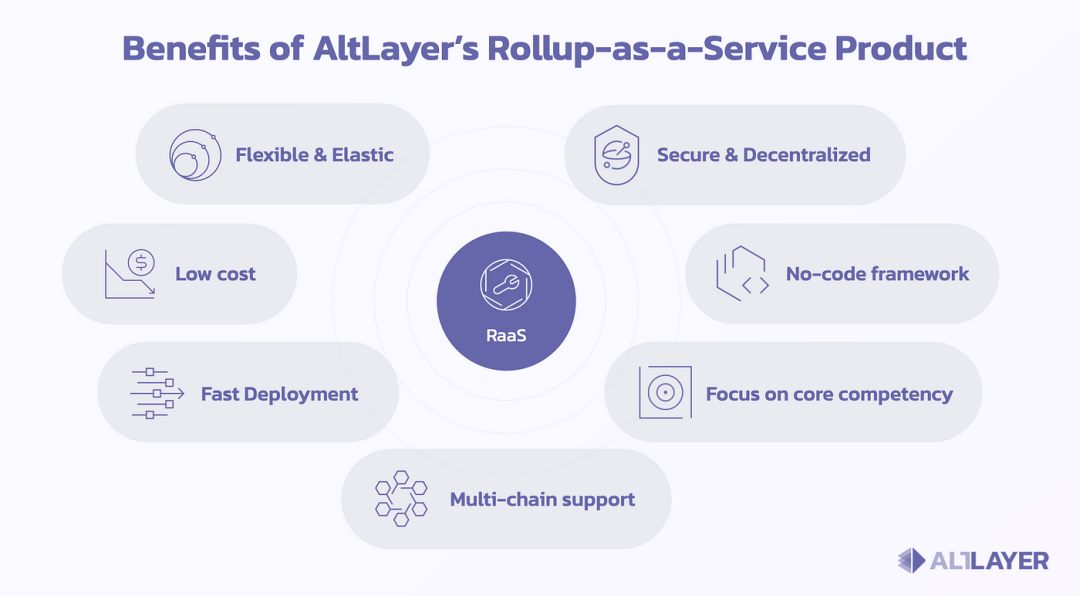
In summary, AltLayer’s Rollup-as-a-Service (RaaS) aims to provide an efficient, secure, and easy-to-use platform that lowers the technical barriers to deploying complex Layer 2 solutions, while delivering the necessary flexibility and scalability to meet diverse application requirements.
3. ALT Token
The ALT token is the native utility token of the AltLayer ecosystem.
It serves multiple purposes and functions aimed at supporting and incentivizing network operations and growth:
-
Economic Bonding: ALT token holders can stake their tokens to participate in consensus and earn rewards for securing the network. This mechanism not only safeguards network security but also slashes stakes when malicious activity is detected, further strengthening network resilience.
-
Governance: ALT holders have voting rights and can influence the protocol’s development direction and operational strategies. This governance model promotes decentralized decision-making, enabling community members to directly shape the evolution of the AltLayer ecosystem.
-
Fees: All transaction fees, storage fees, and service charges within the AltLayer ecosystem are payable in ALT tokens. This includes everything from simple transfers to complex contract executions, ensuring the token’s circulation and utility.
-
Incentive Mechanism: Operators and validators receive ALT tokens as rewards for providing network services. This incentivizes active participation, ensuring network security, service quality, and efficiency.
Through these functions, the ALT token not only supports AltLayer’s technical infrastructure but also fosters community engagement and the overall health of the ecosystem. By holding ALT, users benefit from network growth and can influence the ecosystem’s future through governance and other participatory activities.
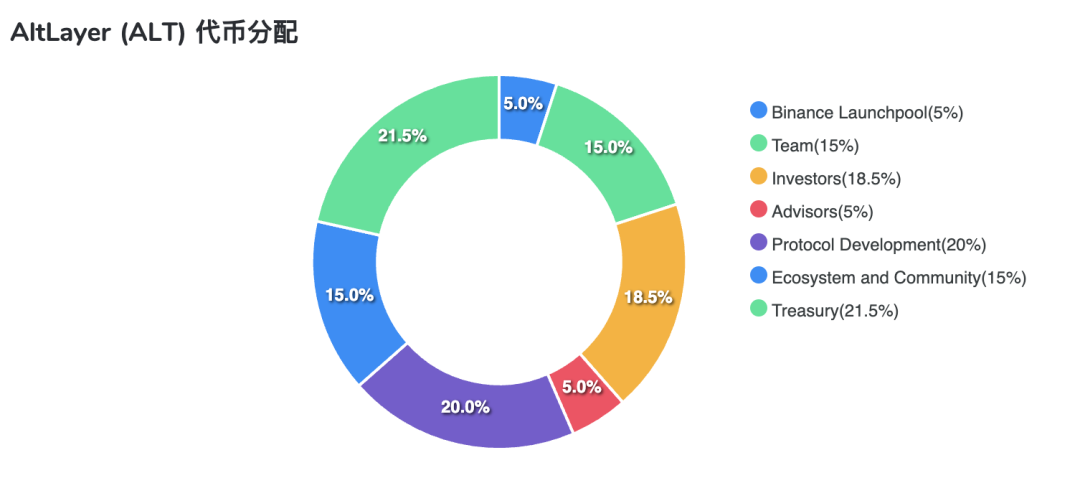
ALT has a total supply of 10,000,000,000 ALT; Binance Launchpool allocation is 500,000,000 ALT (5% of total supply); team allocation is 1,500,000,000 ALT (15%); investor allocation is 1,850,000,000 ALT (18.5%); advisor allocation is 500,000,000 ALT (5%); protocol development allocation is 2,000,000,000 ALT (20%); ecosystem and community allocation is 1,500,000,000 ALT (15%); treasury allocation is 2,150,000,000 ALT (21.5%).
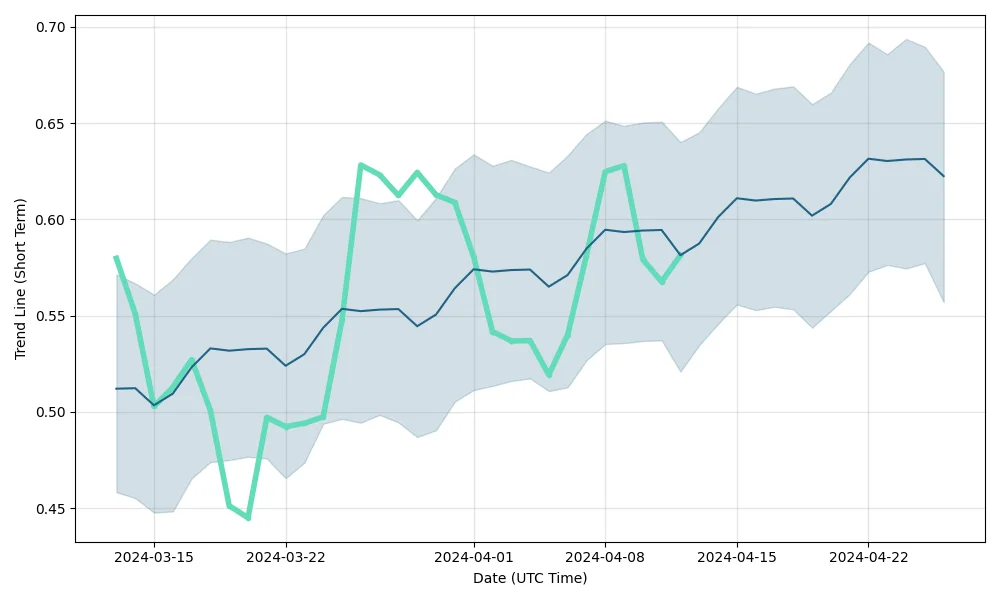
As of now, the latest price of ALT is $0.5712, reflecting a 0.53% increase over the past 24 hours—a positive sign of upward momentum. The market capitalization of ALT stands at $628,333,289, ranking it #131 among all cryptocurrencies.
4. Team / Funding
AltLayer was founded by Yaoqi Jia, former co-founder of Zilliqa (the first sharded blockchain network) and former general manager of Parity Asia (a blockchain infrastructure service provider), along with a team of over 20 members.
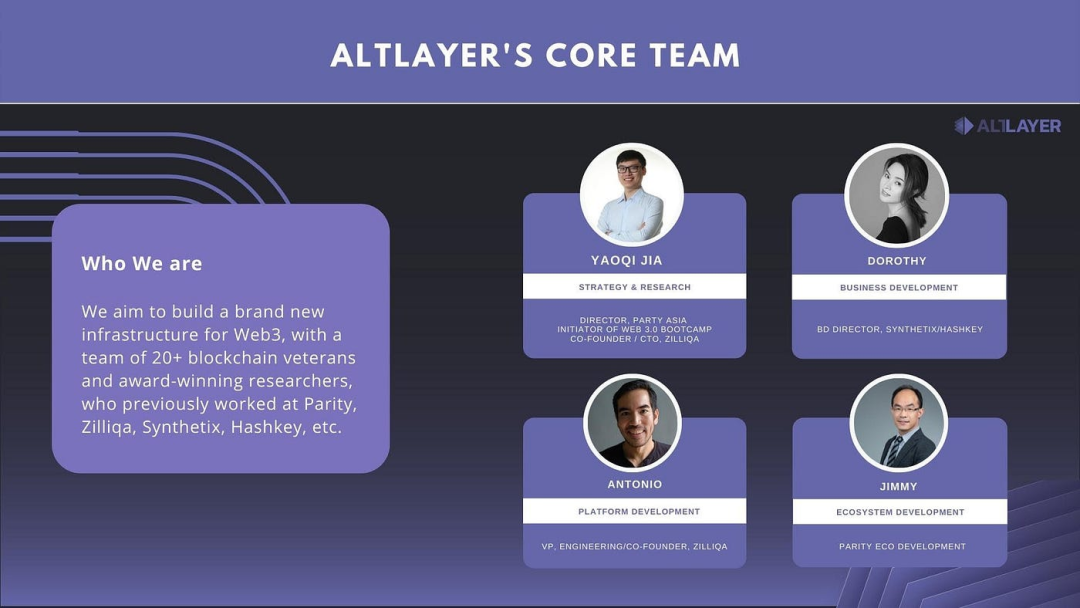
AltLayer has also secured over $7.2 million in seed funding from top global funds and investors, including Polychain Capital, Breyer Capital, Jump, and Gavin Wood. For instance, in July 2022, AltLayer raised $7.2 million in a seed round led by Polychain Capital and Jump Crypto, with notable participants including Gavin Wood (founder of Polkadot) and Balaji Srinivasan (former CTO of Coinbase). In August 2023, it received investment from Binance Labs.
The AltLayer team boasts strong credentials, with members hailing from leading blockchain projects, backed by a robust technical team and solid financial support.
5. Future Outlook
Ethereum’s liquidity and user base offer immense ecological opportunities, but high gas fees and on-chain congestion continue to hinder user experience and scalability. AltLayer emerges precisely to address these challenges.
With the rise of the modular narrative—especially as Celestia continues attracting strategic investments from diverse projects—modular blockchains are gaining increasing attention.
As a decentralized and highly scalable Layer 2 solution driven by modularity, AltLayer is well-positioned for strong future growth—stay tuned.
Beyond this, AltLayer has already attracted significant market capitalization and shows active exchange performance, indicating solid liquidity and investor interest—positive signals for future capital growth and expansion.
Of course, as an emerging project in the cryptocurrency space, AltLayer faces both opportunities and challenges ahead:
Opportunities
-
Industry Growth: As blockchain technology spreads and the crypto market matures, demand for high-performance, low-cost Layer 2 solutions continues to grow—offering AltLayer vast market potential.
-
Technological Innovation: AltLayer’s Restaked Rollup technology and RaaS platform hold promise in simplifying complex blockchain operations and improving transaction efficiency, helping attract developers and enterprise clients.
-
Modular Architecture: AltLayer’s modular design supports diverse blockchain technologies and execution environments, enabling it to adapt to varied market demands and technological advancements.
-
Partnerships and Ecosystem: By building strategic partnerships and cultivating a healthy ecosystem, AltLayer can drive broader adoption of its technology and token.
-
Governance and Community Engagement: With the rise of DeFi and decentralized governance models, AltLayer can leverage its decentralized nature to attract a wider participant base.
Challenges
-
Intense Competition: The blockchain space is highly competitive, with many projects developing Layer 2 solutions. AltLayer must differentiate itself to stand out.
-
Technical Complexity: While AltLayer’s innovations offer advantages, they may face performance and security challenges in real-world implementation.
-
Market Volatility: The inherent volatility of crypto markets may affect token value and project funding, posing challenges to long-term stability.
-
Regulatory Risks: Divergent global regulatory attitudes toward cryptocurrencies could impact AltLayer’s operations and expansion.
-
User Adoption: Attracting non-technical users and ensuring a user-friendly interface and experience will be crucial for widespread adoption.
-
Security: Maintaining network security while achieving scalability and efficiency remains one of AltLayer’s key technical challenges.
In conclusion, AltLayer’s future is filled with opportunities, yet it must navigate numerous challenges. Its success will depend on how effectively it leverages these opportunities and responds to obstacles. Strategic decision-making, technical execution, and adaptability to market dynamics will be critical determinants of its trajectory.
Join TechFlow official community to stay tuned
Telegram:https://t.me/TechFlowDaily
X (Twitter):https://x.com/TechFlowPost
X (Twitter) EN:https://x.com/BlockFlow_News


![In-depth Analysis of Trade[XYZ]: How Were 92 Markets and 98% HIP-3 Trading Volume Established?](https://upload.techflowpost.com/upload/images/20260716/20260716061117965147.jpeg?x-oss-process=image/resize,p_50/quality,q_80)