Analyzing the Decentralized RaaS Platform AltLayer: An Integration and Service Network Supporting dApp Developers
TechFlow Selected TechFlow Selected
Analyzing the Decentralized RaaS Platform AltLayer: An Integration and Service Network Supporting dApp Developers
AltLayer stands out in the market with its highly adaptable RaaS solution.
 Navigating Web3 tides with focused insights
Author: Greythorn
Project Name: AltLayer
Project Type: Rollup, Restaking
Token Symbol: $ALT
Crypto Rank: 161
Market Cap: 572 million
FDV (Fully Diluted Valuation): 5.19 billion
Circulating Supply: 1.1 billion (11%)
Max Supply: 10 billion
Opening Remarks
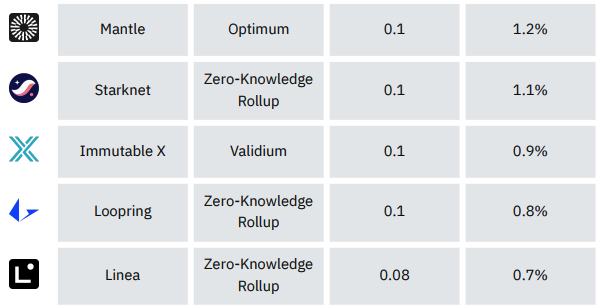
In the domain of Ethereum scaling solutions, rollups have emerged as pivotal innovations, offering promising pathways to alleviate the network's scalability challenges. By aggregating transactions off-chain and efficiently committing them to the Ethereum blockchain, rollups not only increase the volume of transactions the network can handle but also maintain the security and integrity of the base layer. This process has played a significant role in enhancing Ethereum’s capacity to support a broader range of dApps. Currently, eight of the top ten leading Ethereum scaling solutions are rollups.
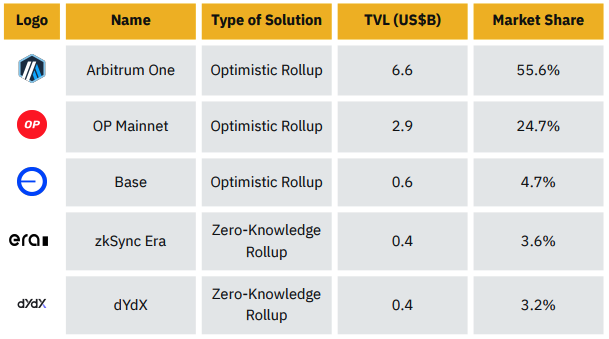
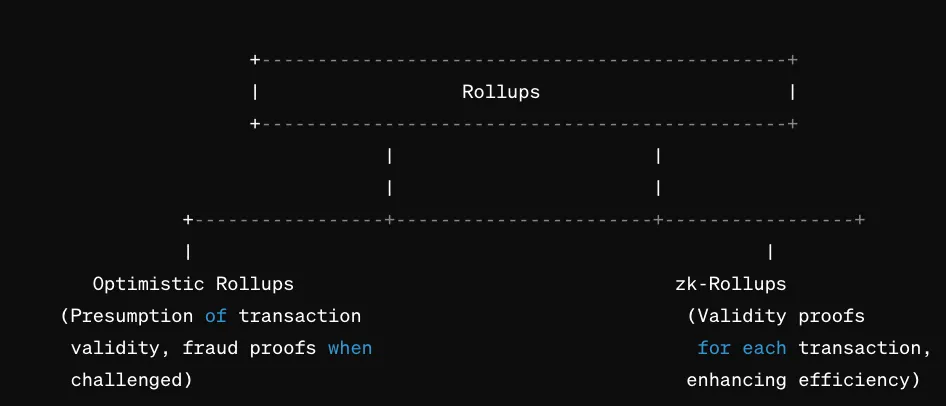
Within rollup technology, two main categories stand out: Optimistic Rollups and Zero-Knowledge (zk) Rollups. Each offers distinct methods of transaction validation, catering to different needs within the developer community and the dApp ecosystem.
Rollup-as-a-Service (RaaS) providers represent a significant milestone in this space, simplifying the deployment of customized rollup solutions. This advancement enables projects to leverage the benefits of rollups—customization, scalability, and efficiency—without requiring deep expertise in blockchain infrastructure.
As we examine the current state and future outlook of Ethereum scaling, the role of rollups and RaaS providers is undoubtedly central to fostering innovation and accessibility within the blockchain landscape. This article will closely examine these developments, providing insights into how rollups work, why they matter, and what they might mean for Ethereum’s future. In particular, we will focus on AltLayer and its role in this evolving landscape, highlighting its innovative solutions and contributions toward making Ethereum more scalable and accessible for everyone.
The Rise of Rollup-as-a-Service (RaaS)
Rollup-as-a-Service (RaaS) is becoming a key solution for developers seeking to harness the scalability and efficiency of blockchain technology without dealing with the traditional complexities associated with deploying on Ethereum Layer 1 or even Layer 2 networks.
Let’s start from the beginning. Today, developers looking to deploy dApps have several options, each with its own trade-offs:
● Deploying on Layer 1 blockchains: Offers strong security and a rich ecosystem but faces high costs and scalability issues due to limited transaction space.
● Deploying on Layer 2: Provides lower fees and better scalability, but may encounter rising costs and uncertain market adoption as popularity increases.
● Appchain deployment: Creating an application-specific blockchain offers customization and flexibility but introduces security and liquidity risks.
● Self-hosted rollup deployment: Launching a dApp on a custom rollup brings scalability, security, and customization without competing for block space, potentially generating ongoing revenue through transaction fees. However, launching one’s own rollup may not suit every type of dApp. Some may benefit more from joining the larger liquidity pools offered by existing Layer 1 or Layer 2 platforms.
- The Role of RaaS
RaaS platforms empower developers to launch their own rollups by providing:
● Technical Support: Simplifies the deployment process with tools and services tailored to project needs, including data storage, transaction monitoring, and no-code deployment options.
● Scalability and Cost Efficiency: Enables scalable, efficient blockchain solutions without requiring deep technical knowledge, fostering innovation across ecosystems.
● Value Capture: Offers a mechanism for projects to generate revenue via transaction fees, which can be shared with the RaaS provider.
AltLayer joins this growing group of RaaS providers while significantly expanding the possibilities by introducing Restaked Rollups. Theoretically, this marks a major step forward in addressing decentralization, security, and interoperability challenges associated with app-specific rollups. Here's how they achieve it:
● Decentralized sequencing: Provides a democratic and secure framework aligned with decentralized Web3 principles.
● Ensuring state correctness: Leverages Ethereum’s trust network to address security concerns.
● Achieving faster finality: Addresses Ethereum’s slow transaction finality, crucial for latency-sensitive applications.
In summary, by equipping developers with tools to deploy customized, efficient, and secure rollups, these RaaS services are paving the way for a more scalable and user-friendly blockchain ecosystem that meets the diverse needs of the developer community and their dApps.
AltLayer Project Overview
AltLayer is a decentralized Rollup-as-a-Service (RaaS) platform. It enables developers to create scalable Layer 2 solutions using its flexible, modular design. AltLayer operates seamlessly across different chains and virtual machines, has established partnerships with key players such as EigenLayer and Celestia, and is building a growing ecosystem of integrations and services aimed at empowering dApp developers.
- Foundational Support and Strategic Partnerships
Led by Dr. Yaoqi Jia, former head of Parity Asia and co-founder and CTO of Zilliqa, the team includes seasoned blockchain experts and top researchers with experience at Parity, Zilliqa, and Synthetix.
AltLayer successfully raised $14.4 million in a strategic funding round, led by Polychain Capital and Hack VC. This round received significant backing from notable figures including Balaji Srinivasan, former CTO of Coinbase; Sean Neville, co-founder of Circle and architect of USDC; Gavin Wood, co-founder of Ethereum and CEO of Parity Technologies; and Ryan Selkis, founder of Messari.
Additionally, AltLayer’s collaborations with major projects like EigenLayer and Celestia, along with its expanding ecosystem, form a network of integrations and services designed to empower dApp developers.
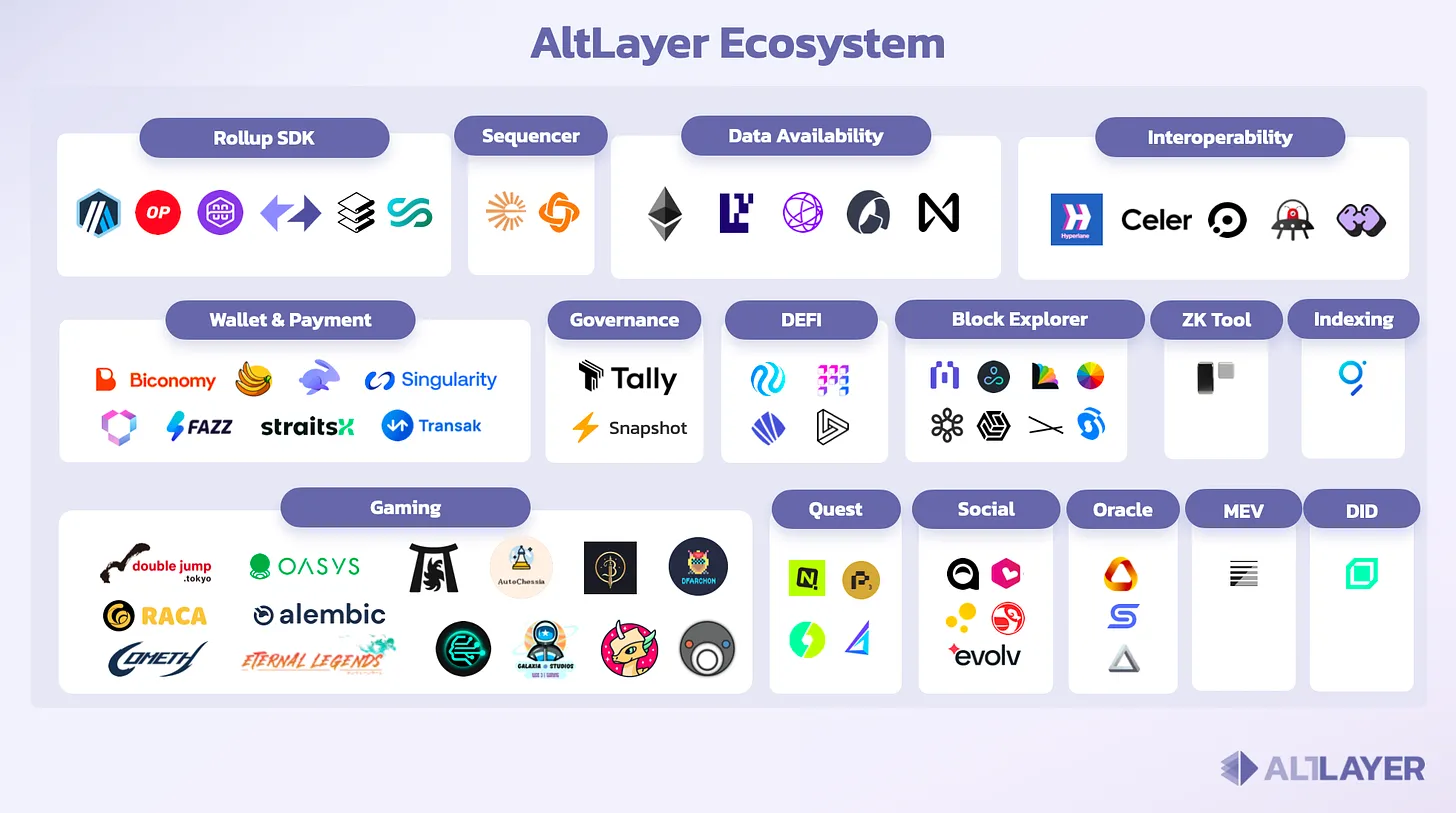
Source: AltLayer
- Core Features and Design
AltLayer’s Rollup-as-a-Service platform consists of three main components:
Restaked Rollups
1) Restaked Rollups
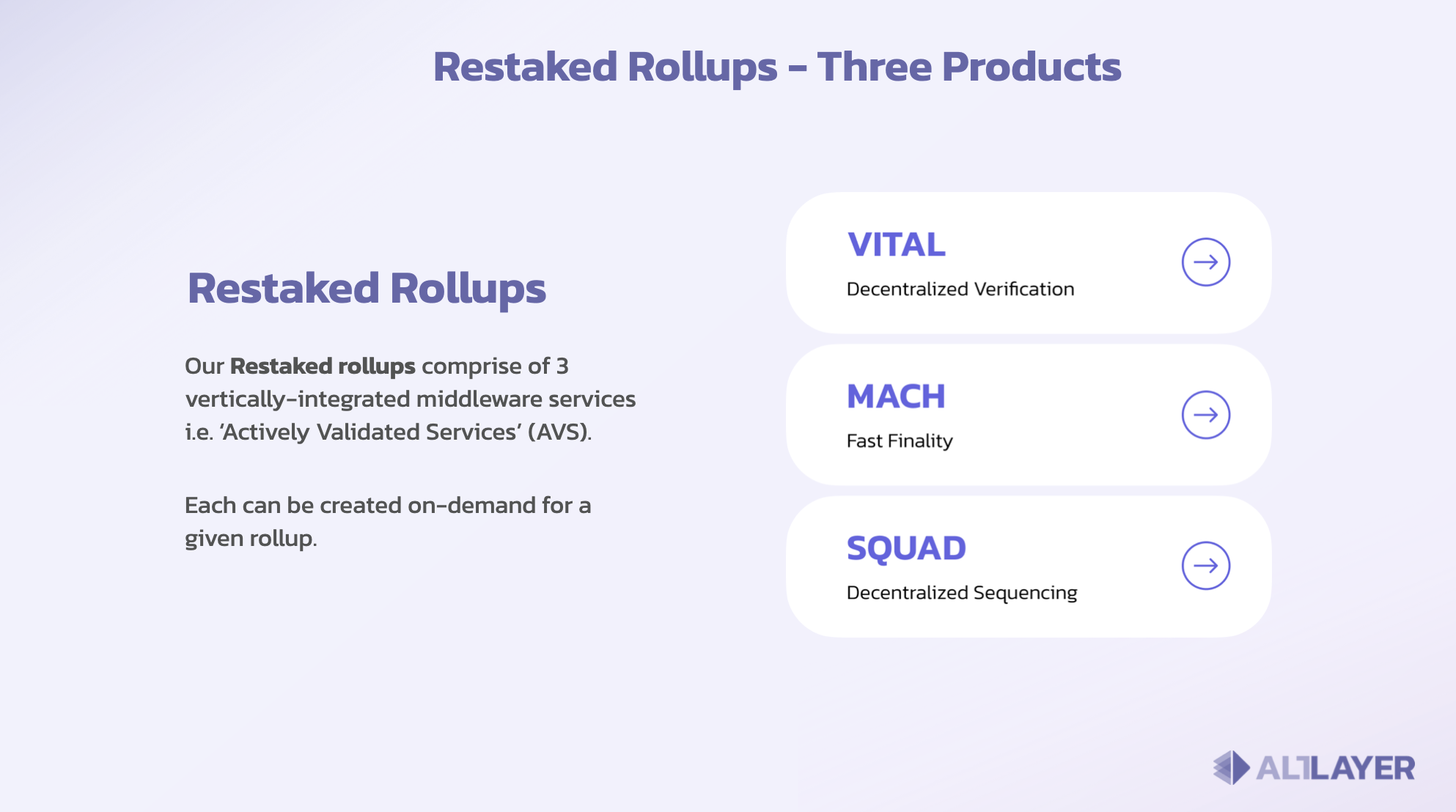
At the heart of AltLayer’s innovation lies its Restaked Rollups, comprising three key services known as Active Validation Services (AVS):
Source: AltLayer
● Vital: This service involves operators verifying blocks and states submitted by rollup sequencers. If any discrepancies are found, they can challenge them with fraud proofs, ensuring accuracy and trustworthiness.
● Mach: This protocol accelerates the finality process of rollups. It allows operators to use Ethereum-based assets as collateral for claims about rollup states, enabling faster settlements.
● Squad: This service introduces decentralized sequencing, backed by economic incentives. By decentralizing this process, it addresses and mitigates issues arising from single sequencer control, such as temporary system downtime and unfair transaction ordering (MEV).
By leveraging restaking to tap into Ethereum’s trusted network, these services tackle decentralization and security challenges inherent in app-specific rollups. Dividing functionality into three modular components, Restaked Rollups offer a versatile architecture that enhances rollup capabilities.
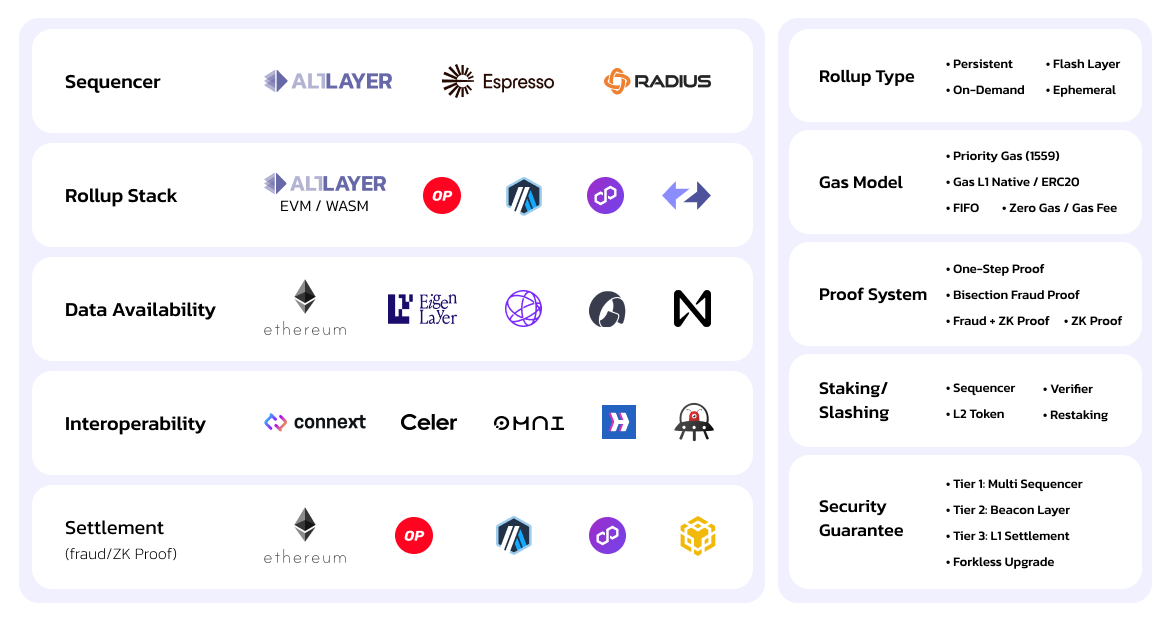
2) Multi-chain Rollup Stack
AltLayer makes blockchain development flexible and user-friendly, supporting various rollup stacks, data layers, and connectivity options. Its intuitive dashboard allows anyone to set up and launch their blockchain project with minimal technical knowledge, democratizing access to blockchain technology. The platform’s modular design lets users customize according to their needs, ensuring adaptability as requirements evolve. AltLayer also emphasizes security and supports multiple virtual machines, making it a versatile choice for developing blockchain applications.
Source: AltLayer
3) Easy Deployment via No-Code Interface
AltLayer simplifies the complex world of blockchains through a simple no-code dashboard. This easy-to-use tool enables anyone—whether a coder or non-coder—to configure their blockchain setup within minutes. From choosing the number of sequencers and setting gas limits to adding middleware like bridges and RPC providers, the dashboard makes customization straightforward and flexible. Now, with just a few clicks, users can rapidly launch a customized execution layer, extending blockchain development to a broader audience.
- Flash Layer and Persistent Rollups
AltLayer introduces two types of rollups to address blockchain scalability: Flash Layers and Persistent Rollups.
Flash Layers are temporary, customizable rollups created to handle sudden demand spikes for dApps, such as during token sales or gaming events. Developers can quickly spin up these rollups when heavy activity is expected, use them to manage load without slowing down the main network, and then shut them down afterward.
Persistent Rollups are designed for dApps needing long-term, continuous support. They are standard optimistic rollups customized for specific applications and capable of supporting both EVM and WASM environments. These rollups are ideal for applications in areas like GameFi, SocialFi, and DeFi, offering stable and scalable solutions for projects with sustained demand.
In essence, Flash Layers provide a flexible short-term solution for handling sudden peaks in blockchain activity, while Persistent Rollups offer a solid foundation for applications with ongoing needs.
Tokenomics
The ALT token serves as the primary currency of the platform, with a current circulating supply of 1.1 billion tokens—11% of its total supply of 10 billion. It fulfills multiple roles: acting as financial collateral that can be slashed in cases of abuse; enabling holders to vote on protocol decisions; rewarding contributors within the platform ecosystem; and serving as payment for services within the network.
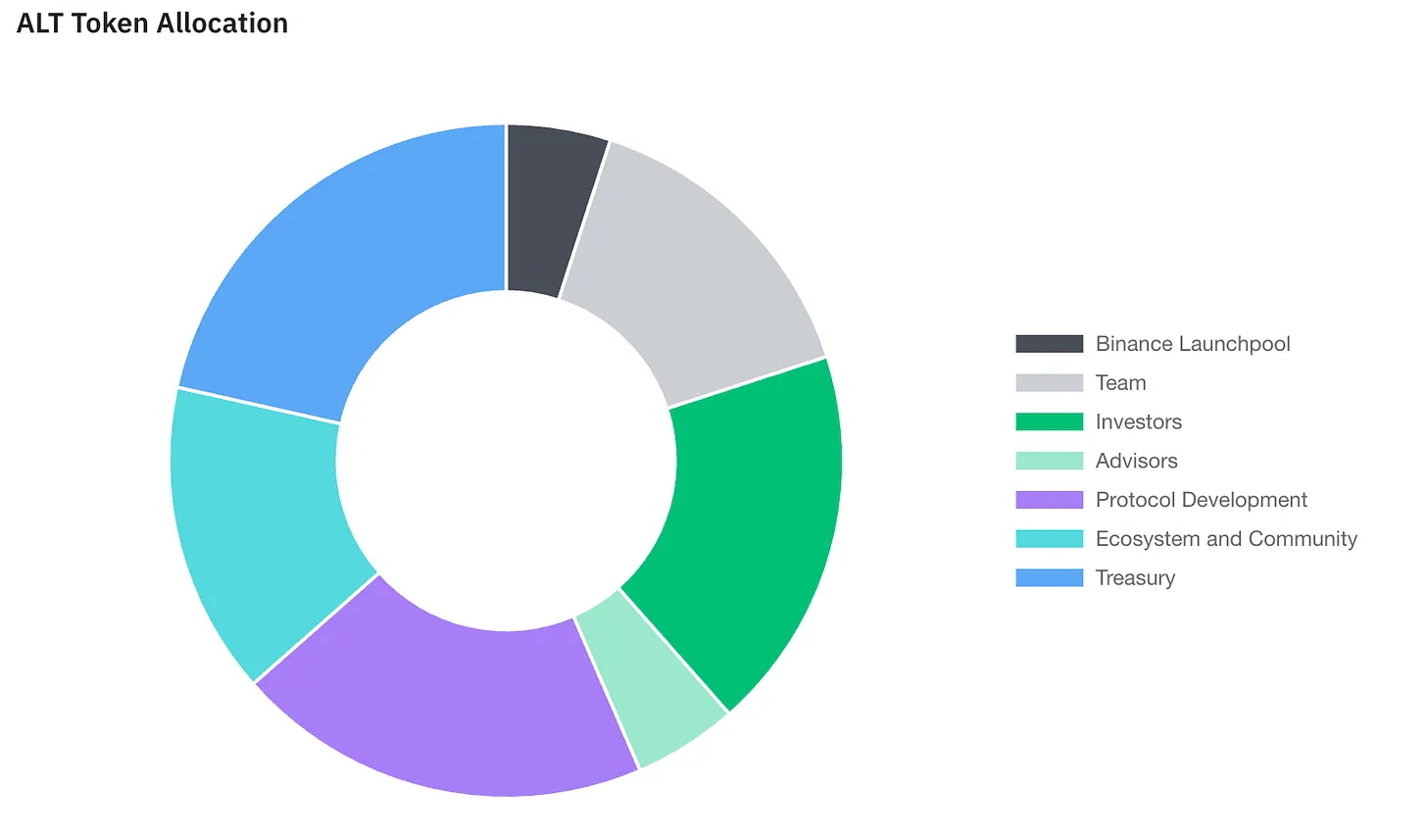
Treasury 21.50% | Protocol Development 20.00% | Investors 18.50% | Team 15.00%
Ecosystem & Community 15.00% | Advisors 5.00% | Binance Launchpool 5.00%

Source: BinanceResearch
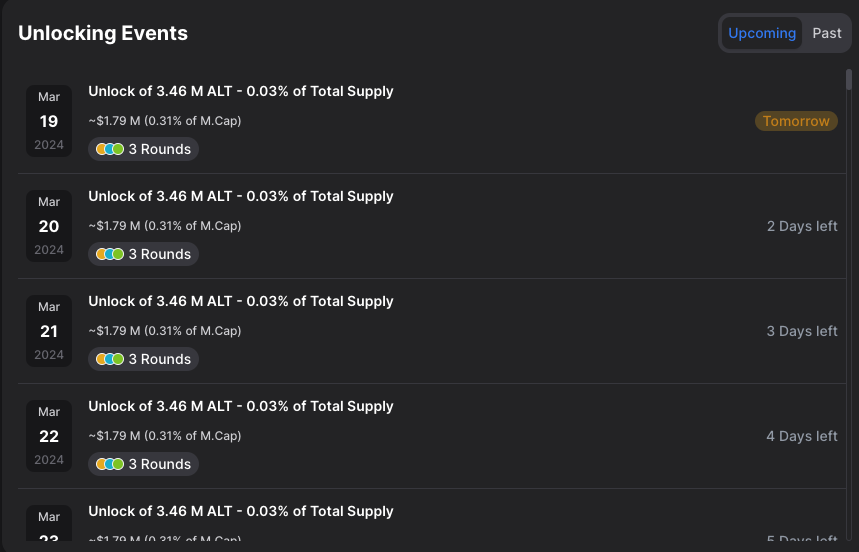
The project features minor daily releases. The next significant release is scheduled for July 25th, when 5% of the total supply will become available. Beginning in the third quarter of 2024, there will be a significant acceleration in the release schedule.
Source: DropsTap
Competitors
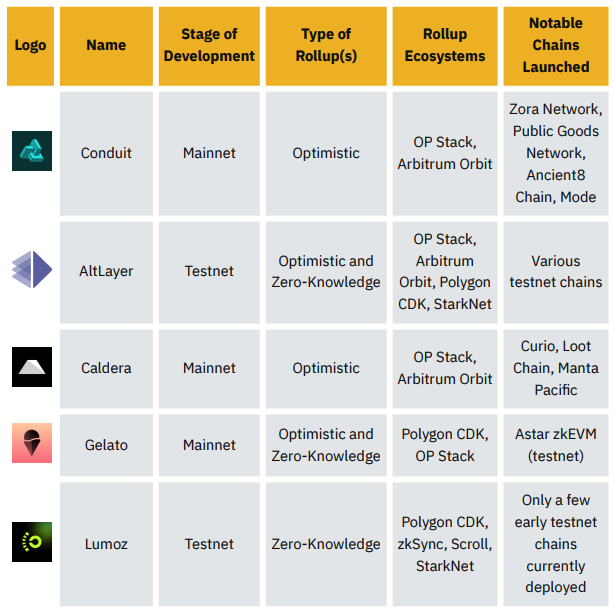
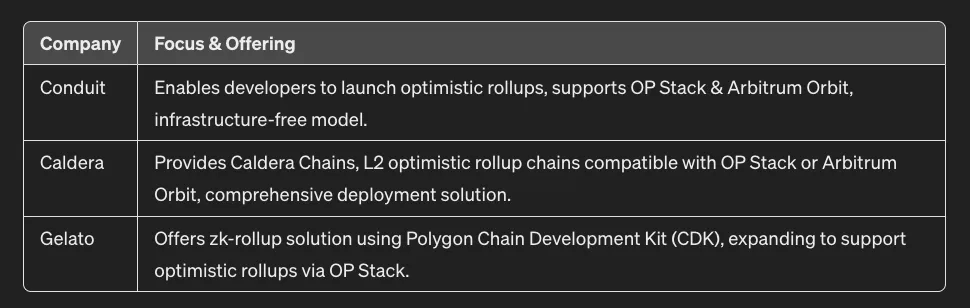
The RaaS industry is rapidly expanding, with several innovative projects at the forefront. In this competitive landscape, projects like Conduit, Caldera, and Gelato are carving out their unique positions. AltLayer distinguishes itself in the RaaS market by prioritizing versatility and delivering exceptional support across a wide range of protocols and functionalities.
Within this niche, AltLayer has already gained significant attention, capital, and market share, marking it as a leading contender among peers.
Below is a brief overview of the aforementioned competitors:
Bullish Fundamentals
● In 2023, rollups significantly enhanced Ethereum’s scalability, leading to substantial growth in Total Value Locked (TVL). AltLayer has solidified its position as a leader in the Rollup-as-a-Service market, signaling broad adoption potential.
● Supports both WASM and EVM virtual machines, expanding opportunities for application development.
● Launched "Turbo," a rollup stack specifically designed for GameFi, in September 2023, aiming to deliver a scalable, low-latency environment for gaming.
● In January 2024, partnered with Babylon Chain to integrate Bitcoin’s security into rollup validation, pioneering a decentralized security layer.
● Expected to benefit from Ethereum’s EIP-4844, a proposal aimed at reducing rollup costs and expanding technological accessibility.
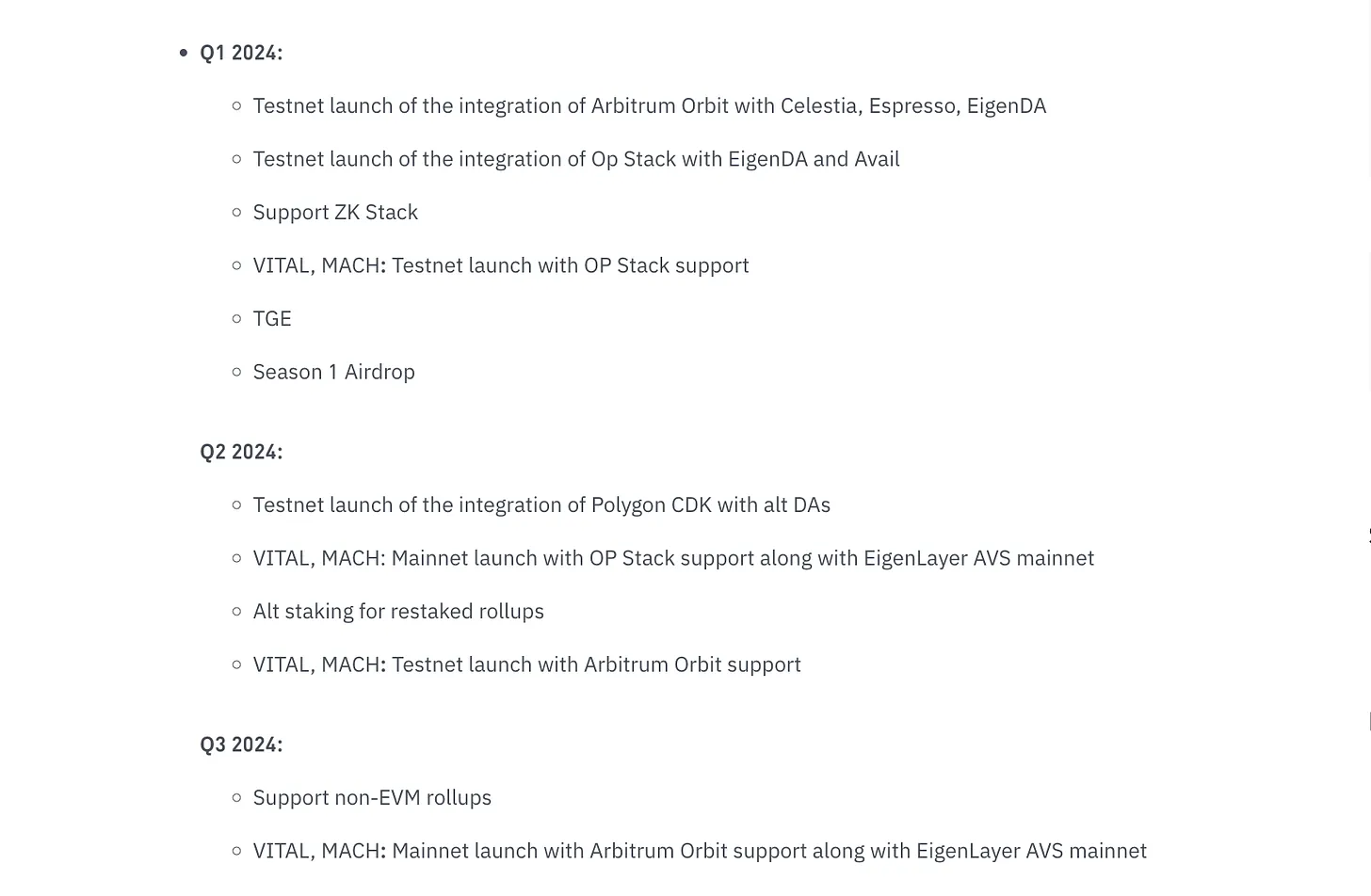
● Boasts a strategic roadmap filled with exciting plans and key milestones.
● Has secured significant support and formed critical partnerships, including collaborating with EigenLayer to address Ethereum’s scalability challenges through “Restaked Rollups.”
● Leverages Celestia for data availability, focusing on cost reduction and improved efficiency.
● Partnered with RISC Zero to integrate “on-demand” zero-knowledge proofs into optimistic rollups, enhancing security.
● Collaborated with Hyperlane to enable permissionless interoperability, improving communication and service integration within the AltLayer ecosystem and opening new opportunities for developers and projects.
Bearish Fundamentals
- Only 11% of AltLayer’s total token supply is currently in circulation. If market cap does not grow in tandem with token supply—especially if demand lags—it could lead to inflationary pressure.
- Its high FDV ($4.8 billion) may be seen as a sign of overvaluation, raising concerns about its current market pricing.
- AltLayer competes with other rollup projects, making differentiation increasingly difficult in a crowded rollup landscape.
- For AltLayer’s solutions to make a meaningful impact, widespread adoption by developers and users is required. Convincing the blockchain community to shift from familiar platforms to AltLayer could prove challenging.
- The complexity of AltLayer’s technology means maintaining smooth operations and security could become increasingly challenging as the project scales.
Conclusion
AltLayer stands out in the market with its highly adaptable RaaS solutions. With strong backing and impressive integration capabilities, it has become a preferred RaaS option. However, as the cryptocurrency market continues to evolve, careful consideration of potential supply dynamics and sustained demand remains essential.
We are Greythorn, a research-driven investment fund based in Singapore and Melbourne. We invite you to connect with us via our X and website. Feel free to reach out or visit our offices.
For more information, visit our Medium page, where we publish monthly market updates and in-depth research on projects such as Io.net, Morpheus AI, Bittensor, and EthenaLabs.
Join TechFlow official community to stay tuned
Telegram:https://t.me/TechFlowDaily
X (Twitter):https://x.com/TechFlowPost
X (Twitter) EN:https://x.com/BlockFlow_News
 Greythorn

![In-depth Analysis of Trade[XYZ]: How Were 92 Markets and 98% HIP-3 Trading Volume Established?](https://upload.techflowpost.com/upload/images/20260716/20260716061117965147.jpeg?x-oss-process=image/resize,p_50/quality,q_80)