









Opportunities and Development Paths for Layer2 Amid ETH FUD
TechFlow Selected TechFlow Selected
Opportunities and Development Paths for Layer2 Amid ETH FUD
Layer2 has a promising future, but current Ethereum Layer2 traffic is still below expectations.
 Navigating Web3 tides with focused insights
Author: Yu Zhong Kuangshui
Recently, there have been three main types of FUD surrounding $ETH:
1) Ethereum's current revenue is far lower than during the previous bull market (primarily due to the rise of Layer2s), yet its price is approaching new highs;
2) The emergence of Solana—a Layer1 ecosystem with stronger competitiveness and greater wealth effects—has intensified competition;
3) Following the Cancun upgrade, Ethereum’s expected revenue from Layer2 fees is projected to decline significantly.

From these points of FUD, it's clear that market pessimism toward Ethereum centers on how Layer2s and Solana are eroding Ethereum’s revenue—and paradoxically, Ethereum itself is accelerating this trend through the Cancun upgrade. From a purely revenue-focused perspective, Ethereum’s outlook does appear bleak, requiring massive growth in Layer2 activity to restore Layer1 revenues to the "normal" levels seen in the last bull run.
However, from the standpoint of ecosystem influence, Layer2 still has substantial room for growth post-Cancun.
According to VanEck’s research report on Ethereum Layer2, the market cap of Ethereum Layer2 could reach $1 trillion by 2030. The report highlights the critical role of Ethereum Layer2 in scaling the network, improving developer and user experiences, and advancing technical capabilities.
At ETH Taipei 2024, Vitalik Buterin noted that Ethereum core developers had hoped Layer2 networks would average three blobs per block, but current usage is about 67% below that target.
In other words, Layer2 has great potential—but current traffic across the entire Ethereum Layer2 ecosystem remains far below expectations. Clearly, both research institutions and Ethereum core developers are less focused on Ethereum’s immediate revenue, and more focused on how many users and developers Layer2 can capture. After all, users and developers form the foundation of network growth; only sufficient interaction volume can drive Layer2 revenue upward. And right now, Ethereum Layer2 has enormous growth potential.
Among Layer2 projects, two stand out as noteworthy examples: BaseChain and Metis—two complete opposites. The fundamental logic behind Base, Metis, and similar Layer2s is leveraging the EIP-4844 upgrade (Cancun) to achieve higher data throughput, lower costs, and reduced burden on Ethereum Layer1.
BaseChain’s sequencer is controlled by Coinbase, and its revenue counts as part of Coinbase’s income. Therefore, Coinbase has strong incentives to grow the BaseChain ecosystem (with wealth effects and strategies closely mirroring those of Solana). For Coinbase, the future revenue potential from BaseChain is significant—especially after the Cancun upgrade, which lowers costs and increases the profitability of the sequencer.
Then there’s Metis.
Metis reduces reliance on the Ethereum mainnet through optimized data processing and smart contract execution mechanisms, lowering transaction costs and confirmation times. Notably, Metis supports multiple revenue models and cost structures—including revenue generation via transaction fees, data compression, and smart contract execution. Additionally, Metis excels in user experience, particularly in fast deposits/withdrawals and transaction confirmations.
Most importantly, Metis follows a decentralized sequencer model—meaning the official team doesn’t take the sequencer revenue, but instead shares it broadly and builds a flywheel through ecosystem incentives. In my view, Metis offers a guiding principle for other Layer2s: to grow your ecosystem and attract developers and users, you must share the pie—unless, of course, you have a powerful backer like Coinbase.
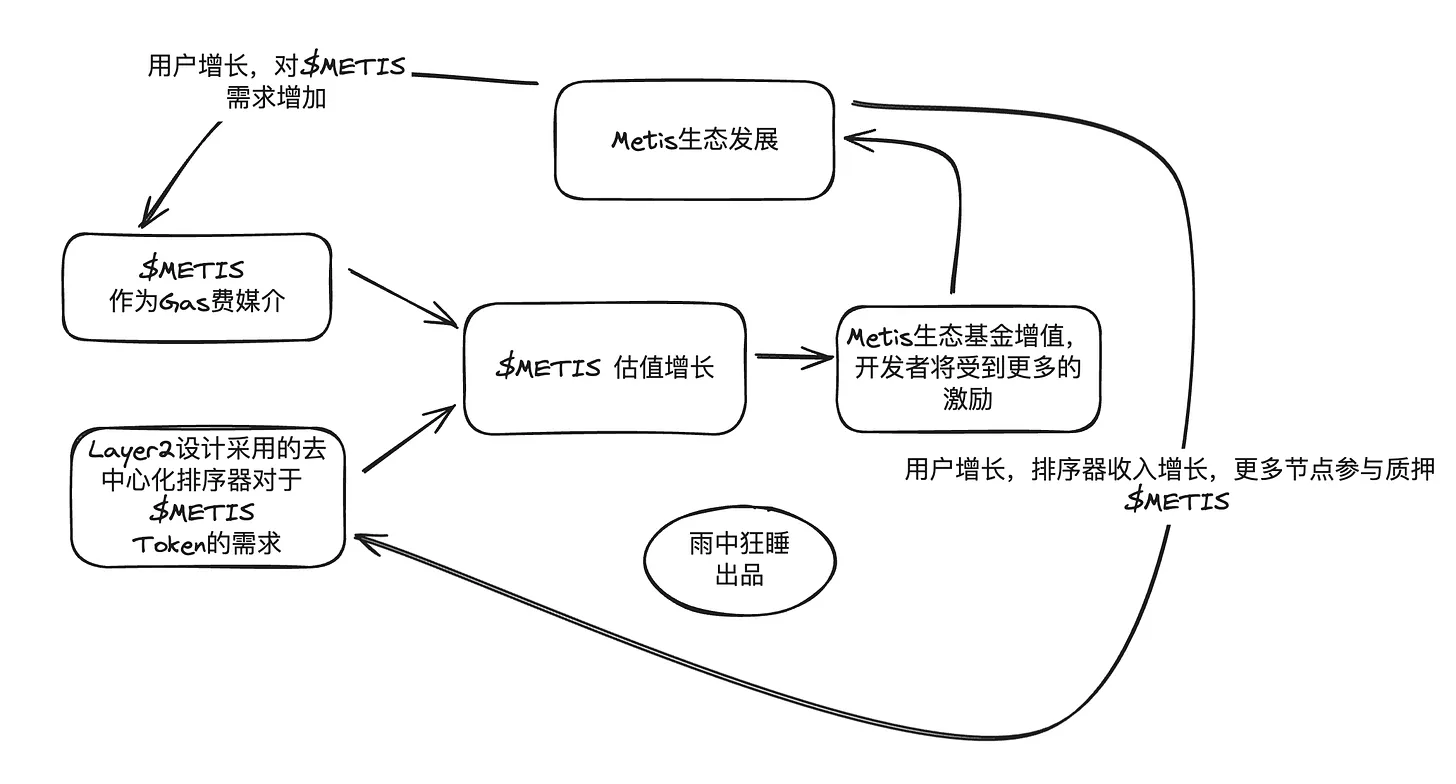
Ultimately, the Layer2 landscape will likely become highly competitive yet diverse. New Layer2s competing for users and developers are essentially competing for chain-level wealth effects, which are built in one of two ways:
1) Backed by a major player who orchestrates the ecosystem, providing resources and capital—BaseChain is a prime example, much like BSC in the previous cycle;
2) Creating a token-based flywheel with aggressive ecosystem incentives—Metis being a classic case.
Join TechFlow official community to stay tuned
Telegram:https://t.me/TechFlowDaily
X (Twitter):https://x.com/TechFlowPost
X (Twitter) EN:https://x.com/BlockFlow_News
 雨中狂睡Sleeping in the Rain






