








dappOS: The Intent Execution Network with $15.3M in Funding Led by Polychain
TechFlow Selected TechFlow Selected
dappOS: The Intent Execution Network with $15.3M in Funding Led by Polychain
The emergence of decentralized applications (DApps), such as Web3 gaming and Web3 social platforms, is bringing users from the traditional Web2 world into this new ecosystem.
 Navigating Web3 tides with focused insights
Original author: NIHATCAN YANIK, Cointelegraph
Translation: 009
The rapid expansion of blockchain technology brings both opportunities and challenges in achieving scalability and usability within an increasingly fragmented ecosystem. The intent-centric execution network dappOS innovatively introduces an Optimistic Minimum Staking (OMS) mechanism to enhance interaction efficiency securely and at low cost.
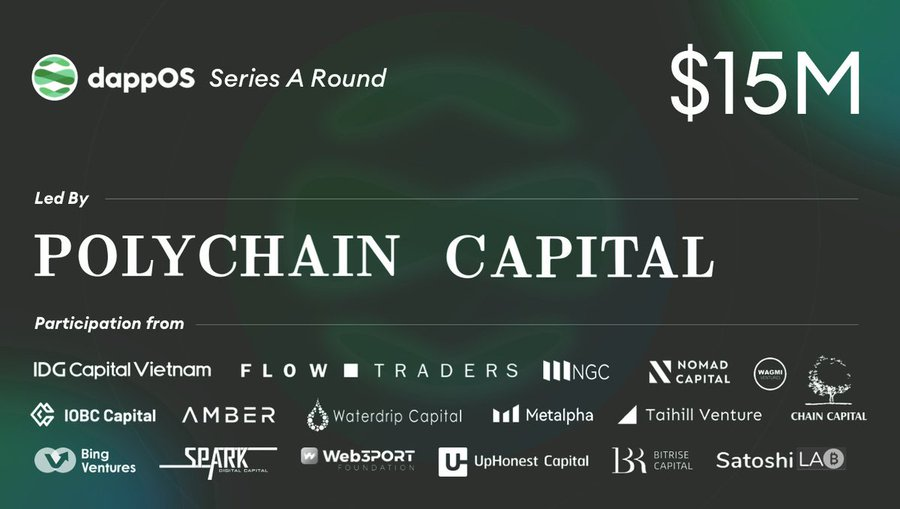
At the end of March 2024, dappOS raised $15.3 million in a Series A funding round led by Polychain, achieving a valuation of $300 million. Previously, dappOS completed a seed round backed by prominent institutions including Binance Labs and Sequoia China.

Ethereum co-founder Vitalik proposed during his keynote speech at Hong Kong Web3 Festival 2024 that the future of the Ethereum ecosystem will be Layer-2 centric.
As blockchain technology continues to evolve, usability and scalability have become central concerns for current infrastructure. The emergence of numerous L1s and L2s marks the beginning of a new era. L1 blockchains are foundational networks—such as Bitcoin and Ethereum—where all transactions are processed directly on-chain. However, as these networks grow, congestion and scalability issues arise.
L2 solutions, such as Bitcoin's Lightning Network and Ethereum's OP Rollups, aim to alleviate scalability problems by processing transactions off the main chain while ensuring their security remains anchored to the underlying L1 blockchain.
However, the proliferation of L1s and L2s has also introduced new challenges—fragmentation and isolation across blockchain ecosystems. Moreover, high valuations of established L1 and L2 blockchains incentivize the continuous emergence of new chains, attracting significant investments. This growth is expected to further fragment the Web3 ecosystem, making usability and interoperability increasingly difficult.
The rise of decentralized applications (DApps), such as Web3 gaming and Web3 social platforms, is bringing users from traditional Web2 worlds into the blockchain space. These new users, unfamiliar with the complexities of blockchain technology, seek simplified workflows and intuitive interfaces. Therefore, solutions and infrastructures tailored to their usage habits are critically needed.
dappOS: $15.3M Funding and the Launch of an Intent-Centric Execution Network
Amid urgent demand for simplified, user-centric infrastructure, a promising solution has emerged to bridge gaps within the fragmented ecosystem: dappOS, an intent-centric execution network, has secured $15.3 million in a Series A round led by Polychain, reaching a company valuation of $300 million.
This Polychain-led funding round included participation from a diverse group of investors, including Nomad Capital, IDG, Flow Traders, and NGC. The capital will be used to advance ongoing technical research and development.
Previously, dappOS was selected into the fifth season of Binance’s incubation program in December 2022 and received seed investment from Binance Labs and Sequoia China in July 2023.
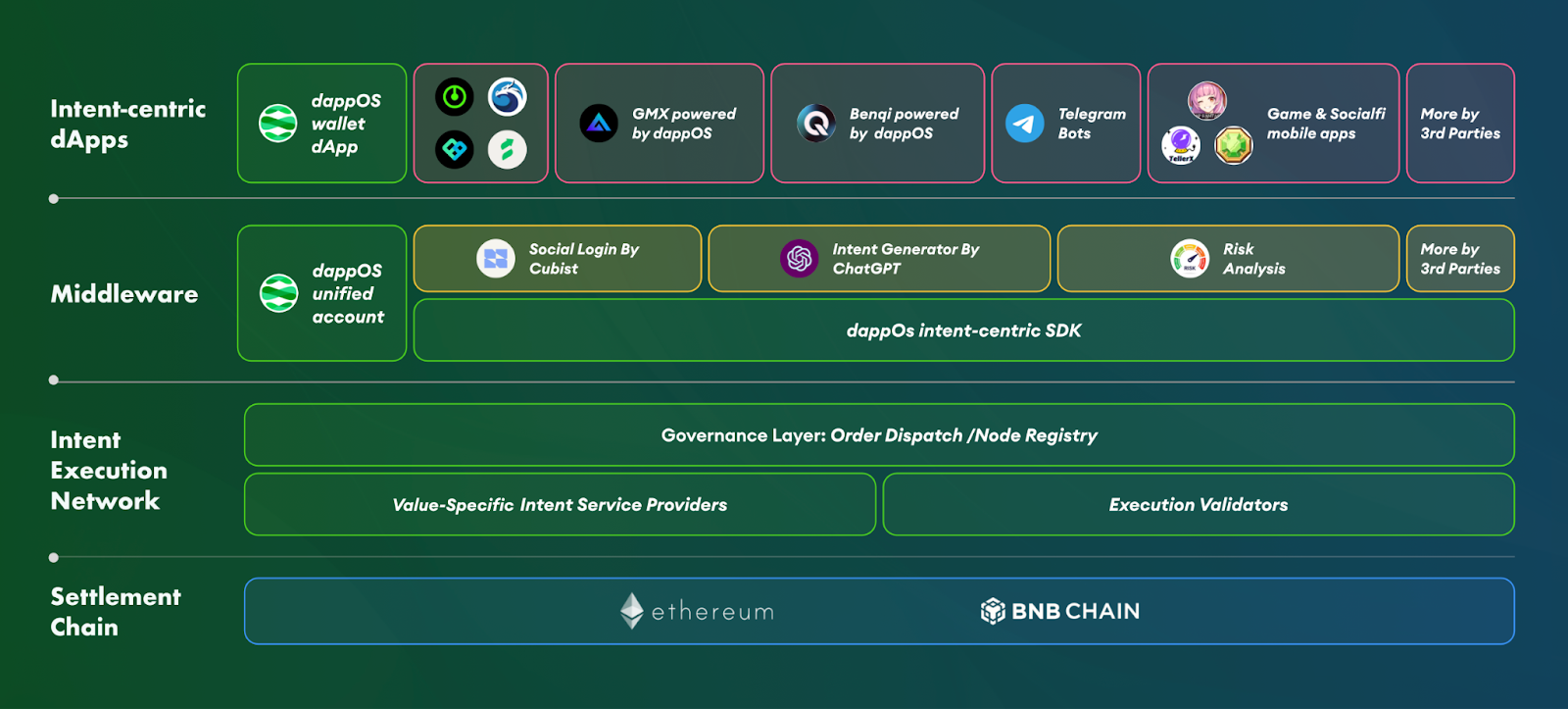
The project addresses supply-and-demand imbalances within the blockchain ecosystem by creating a two-sided market. On one side, service nodes stake collateral to offer various intent execution services. On the other, it provides developers with an infrastructure to efficiently generate intent tasks, fulfilling users’ needs to translate intentions into on-chain outcomes.
Innovative Security Solution: OMS
To improve efficiency and versatility, dappOS introduced the OMS (Optimistic Minimum Staking) mechanism.
OMS associates each task with a predefined value and potential compensation in case of failure, allowing task execution before result verification. If a task fails, the network penalizes the responsible service provider through a consensus process, ensuring that either the user’s submitted task succeeds or the user receives the pre-specified compensation.
dappOS’s OMS system benefits both service nodes—they only need to stake a minimal amount slightly above the total value of unfulfilled intent tasks—and users, who enjoy cost-effective and fast task execution. The post-task validation process enables a decentralized verification strategy, enhancing the network’s efficiency and security when handling diverse use cases.
With over 20 deep collaboration projects—including GMX, BENQI, and QuickSwap—dappOS has already accumulated more than 350,000 users.
Within the rapidly expanding and increasingly complex blockchain ecosystem, dappOS offers a seamless, user-centric solution for blockchain interactions. Its innovative approach promises to redefine how users and developers engage across fragmented blockchain networks and application scenarios.
Join TechFlow official community to stay tuned
Telegram:https://t.me/TechFlowDaily
X (Twitter):https://x.com/TechFlowPost
X (Twitter) EN:https://x.com/BlockFlow_News
 @Cointelegraph






