Karak, a Middle Eastern restaking project valued at $1 billion, faces community skepticism despite its prestigious funding background
TechFlow Selected TechFlow Selected
Karak, a Middle Eastern restaking project valued at $1 billion, faces community skepticism despite its prestigious funding background
As of April 9, Karak's TVL reached $100 million, a figure that seems incongruent with its high-profile backing lineup.
 Navigating Web3 tides with focused insights
Author: Frank, PANews
Recently, the Restaking sector has become one of the key narratives within the Layer2 space. The rapid surge in Eigenlayer’s TVL surpassing $10 billion, followed by Ether.fi breaking past $3 billion, have drawn strong market reactions. Projects in the Restaking space have almost universally become focal points of market attention—yet Karak, despite its impressive lineup of investors, appears to be an exception.
Karak is a type of milk tea popular in the Middle East, and this name highlights its regional origins. In December 2023, Karak announced it had raised $48 million in a Series A round at a valuation exceeding $1 billion, led by Lightspeed Venture Partners, with participation from Mubadala Capital, existing investors Pantera Capital, Framework Ventures, Bain Capital Ventures, Digital Currency Group, Coinbase, Proof Group, Nima Capital, Naval Ravikant, and others. Mubadala Capital is Abu Dhabi's second-largest fund, while the other backers are mostly well-known institutions in both traditional finance and the crypto industry. Notably, however, Nima Capital was accused by the community last year of dumping large amounts of its held tokens and real estate assets, leading to allegations of a "rug pull."
On February 28, Karak launched an early access program allowing users to earn XP points through restaking on its platform, but the response was lukewarm. On April 8, it opened private access channels; as of April 9, Karak’s total value locked (TVL) stood at $100 million. This level of TVL seems mismatched with its high-profile investor roster, prompting a steady stream of skepticism across social media.
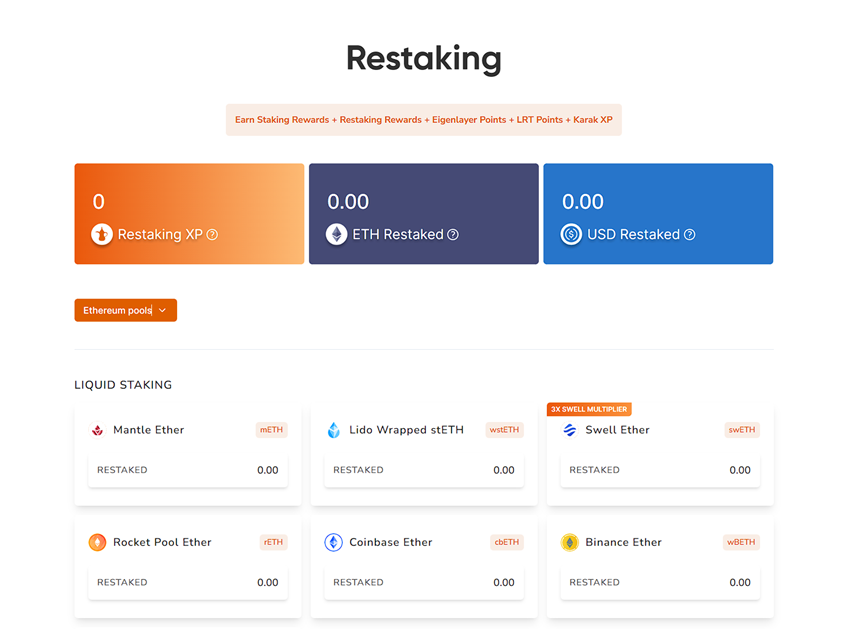
According to official materials, Karak is a universal restaking network similar to EigenLayer and other restaking projects, using a points-based incentive model to reward users for restaking and earning multiple yields. Currently, Karak supports restaking of major protocol assets across networks including Ethereum Mainnet, Arbitrum (L2), and K2 (L2). Its team members come from companies such as Coinbase, Google, AWS, Microsoft, Twitter, and Goldman Sachs.
Currently, Karak’s TVL stands at approximately $100 million, significantly lagging behind EigenLayer ($13 billion) and ether.fi ($3 billion). Part of this may be due to Karak still being in its early access phase. However, a more likely reason lies in widespread community skepticism regarding the project’s background.
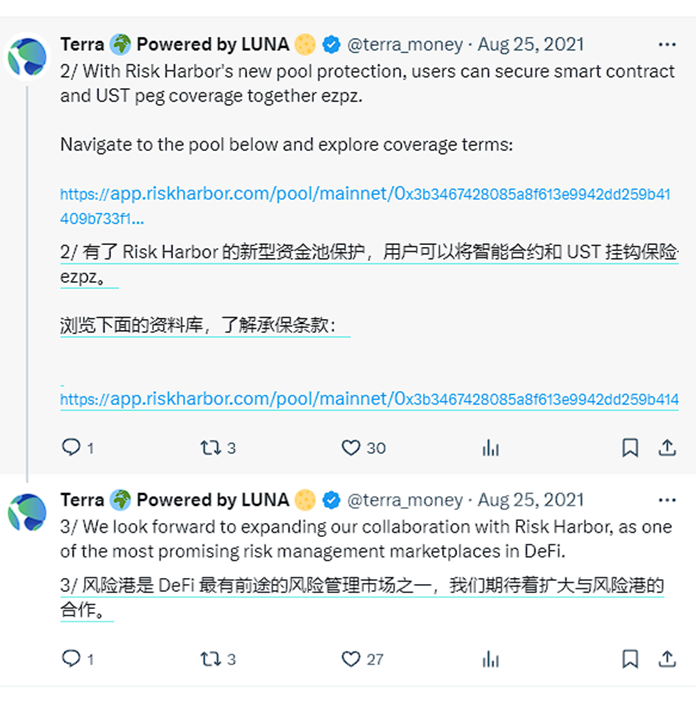
According to crypto influencer IAN (@cryptoian) on Twitter, Karak is backed by the same team behind Risk Harbor, which previously operated as a risk insurance service provider within the Terra ecosystem. At its peak, Risk Harbor ranked second in TVL within the Terra ecosystem and suffered heavy losses during the Terra collapse. Twitter user @RayRaspberry1 further alleged that the team misappropriated 200 million UST (worth $7 million at the time) from the community during their exit from Terra.
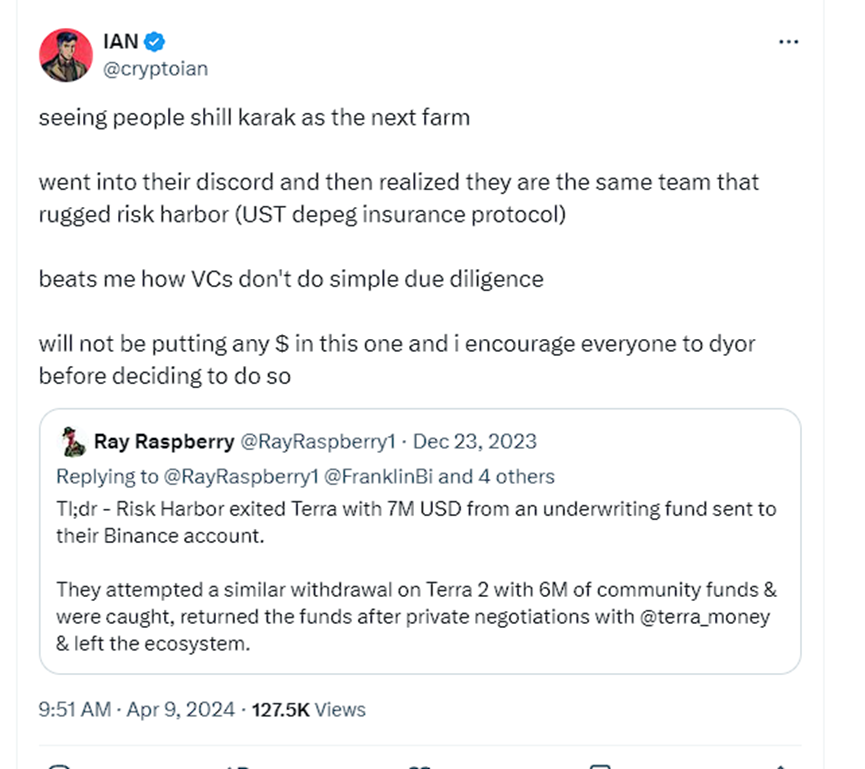
Victor Cheng, Karak’s CSO (Chief Strategy Officer), responded on Twitter, stating that the funds in question were part of a $1 billion allocation granted by the Terra Foundation to the Risk Harbor fund as collateral for its insurance pool. After UST collapsed, Risk Harbor sold $6 million worth of UST from its initial allocation to prevent further losses. These proceeds are now designated for the insurance fund backing the initial recapitalization pool.

Perhaps aiming to distance itself from past controversies, Risk Harbor has since rebranded to Andalusia Labs. Under this new entity, three products have been launched: Karak (a Layer2 network), Subsea (a digital asset risk marketplace, formerly Risk Harbor), and Watchtower (an institutional digital asset security platform).
Yet, these explanations appear insufficient in fully alleviating community concerns about Karak. One user commented: “All their posts are just about earning XP points through restaking. They never talk about progress, development, technology, or ecosystem growth.” As of now, Karak’s Telegram channel has around 5,700 members—a number that seems disproportionately low given its nearly $50 million in funding. Additionally, there remains no detailed public roadmap outlining how the XP points will ultimately be used. For Karak to grow its TVL, its first step may need to be resolving its ongoing public relations crisis.
Join TechFlow official community to stay tuned
Telegram:https://t.me/TechFlowDaily
X (Twitter):https://x.com/TechFlowPost
X (Twitter) EN:https://x.com/BlockFlow_News
 PANews