








After winning the top vote in Jupiter's first LFG launchpad and planning to issue the $ZEUS token on April 4, how promising is Zeus Network?
TechFlow Selected TechFlow Selected
After winning the top vote in Jupiter's first LFG launchpad and planning to issue the $ZEUS token on April 4, how promising is Zeus Network?
On April 3, Zeus Network raised $8 million in a new funding round led by Mechanism Capital, with participation from OKX Ventures and others.
 Navigating Web3 tides with focused insights
Author: Zen, PANews
At 9 PM on April 4, Zeus Network, the first public fundraising project on Jupiter LFG Launchpad, will launch its $ZEUS token and distribute airdrops to over 300,000 addresses, including participants in Jupiter voting, Zealy campaigns, and Dappie Gang NFT holders.
Launched by Jupiter, Solana's leading transaction aggregator, the LFG launchpad completed its initial LFG voting last month to select two high-quality projects for potential token issuance through the platform. The vote attracted 175,000 participants, with cross-chain communication project Zeus Network emerging as the clear winner, securing 58% of the votes.
Beyond strong community support, Zeus Network has also drawn interest from prominent investors and institutions. On the evening of April 3, it announced an $8 million funding round led by Mechanism Capital, with participation from OKX Ventures, Animoca Ventures, Big Brain Holdings, Lemniscap, The Spartan Group, and angel investors including Solana co-founder Anatoly Yakovenko, Stacks co-founder Muneeb Ali, and Mechanism Capital founder Andrew Kang.
At the end of last year, Zeus Network emerged into public view as a native, permissionless communication layer between Solana and Bitcoin. However, as the project evolves, its vision clearly extends far beyond this initial scope.
Zeus Network: The Potential and Possibilities of a Cross-Chain Communication Layer
Unlike traditional bridging mechanisms, Zeus Network does not simply transfer assets from one blockchain to another. Instead, it introduces a communication layer that securely locks Bitcoin on the BTC blockchain and transfers its value to Solana without asset bridging. This provides users with an efficient and secure experience for asset transfer and trading.
However, Zeus Network’s role as a cross-chain communication layer goes further. Leveraging the high performance and throughput of the SVM (Solana Virtual Machine) Zeus Layer, it can not only bring Bitcoin liquidity into the Solana ecosystem but also extend cross-chain communication capabilities to any blockchain, enabling interoperability across different blockchains.
Specifically, Zeus Network has the capability to connect multiple blockchain networks. Currently serving as a bridge between various chains, it primarily focuses on connecting other blockchains with Solana. This cross-chain functionality allows developers to build dApps that interact and communicate across Solana and other blockchains, enabling cross-chain data and value transfer. In the future, Zeus Network aims to expand its cross-chain communication capabilities further, allowing dApps to operate and deploy across multiple blockchains, broadening their application scope and offering users more diverse services and use cases.
As a platform connecting and facilitating communication between different blockchain networks, starting from the Solana ecosystem, Zeus Network is poised to promote the integration and development of blockchain ecosystems by providing seamless cross-chain solutions for developers and users. This will open up greater innovation opportunities and possibilities, driving the creation of more complex and feature-rich blockchain applications.
The First Ecosystem Application to Unlock BTC Liquidity on Solana
Leveraging its innovative Zeus consensus, Zeus Network’s first strategic move is to seamlessly facilitate connectivity between BTC and Solana, offering a secure, efficient, and decentralized solution for interacting with Bitcoin on the Solana blockchain. The launch of its flagship project, APOLLO, marks the beginning of this groundbreaking journey. Apollo is a comprehensive DeFi infrastructure designed to introduce and manage BTC liquidity within the Solana ecosystem using zBTC and the Zeus consensus mechanism.
zBTC represents an intrinsic asset on the Solana network, maintained through a trustless, decentralized two-way peg (2WP) mechanism ensuring a 1:1 parity with Bitcoin. This process relies on a protocol-based trust model, allowing users to lock their BTC on the Bitcoin blockchain and use or trade it as zBTC on Solana. By incorporating multi-signature consortium validation and SPV verification, zBTC ensures security during the locking and unlocking processes, preventing potential fraud or double-spending issues. This makes BTC transactions on Solana more efficient and lightweight while maintaining secure locking of Bitcoin and enabling liquidity on Solana.

This mechanism can bring greater liquidity and new use cases to the Solana ecosystem, fostering the growth of its DeFi landscape. For instance, zBTC could collaborate with DeFi protocols such as Solend, marginfi, and Kamino Finance, serving as a liquidity provision asset across various Solana-based DeFi platforms, offering users more liquidity options, or acting as collateral for lending and leveraged trading. It could also jointly develop innovative financial products and services. These integrations would enhance the diversity and completeness of the DeFi ecosystem, delivering broader financial services and improved user experiences.
Utility Token $ZEUS: Nearly Half Allocated to Ecosystem and Community Development
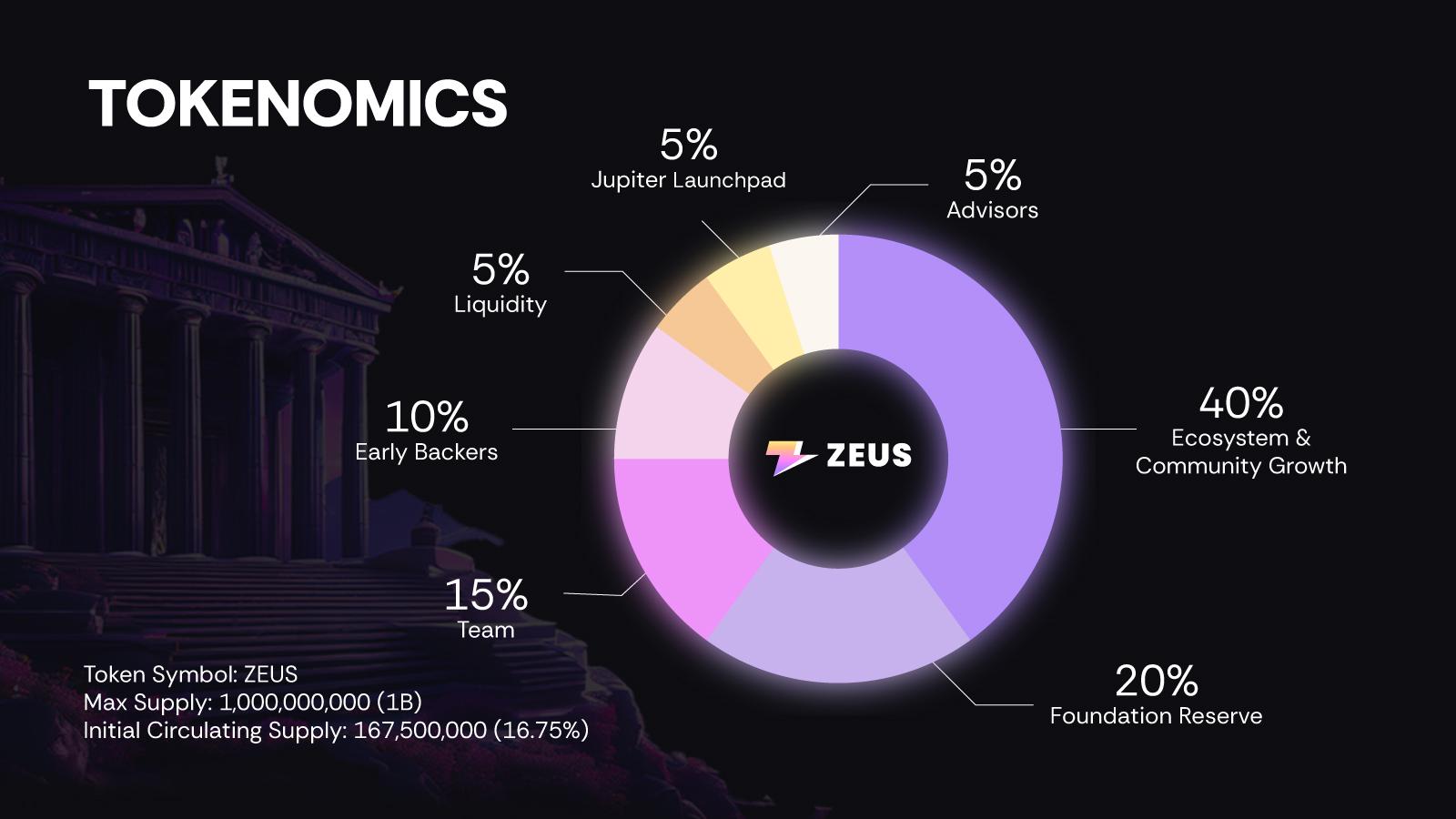
The total supply of the $ZEUS token is 1 billion, with 40% allocated specifically to foster the growth and development of the Zeus Network ecosystem and community. Of this portion, 10% will be released at the token generation event (TGE), including airdrops to Zeus community members. As a utility token, $ZEUS serves multiple functions and holds value across various applications within the Zeus Network, including:
-
Security: Holders can use $ZEUS tokens to enhance security features within the Zeus Network ecosystem, ensuring robust and protected environments for transactions and interactions.
-
Gas/Fuel/Service Access: $ZEUS tokens serve as the means to access and utilize various services within the Zeus Network ecosystem, such as paying transaction fees, fueling smart contracts, or accessing specific network functionalities.
-
Governance: $ZEUS token holders have the right to participate in governance decisions regarding the future development and direction of the Zeus Network platform. This includes voting on proposals, protocol upgrades, and other key decisions impacting the ecosystem.
-
Incentives: Participants in the Zeus Network ecosystem may receive $ZEUS tokens as incentives for contributing to the network’s growth and functionality. These rewards could include liquidity provision, token staking, or participation in community initiatives.
In addition to allocating nearly half of the tokens to the ecosystem and community, the $ZEUS tokenomics also designate portions for early supporters, Launchpad sales, liquidity, foundation reserves, team, and advisors, each with tailored cliff and vesting periods to ensure coordinated and sustainable distribution:
-
Early supporters and sponsors of Zeus Network (10%), with 5% released at TGE, followed by a 3-month cliff and 15-month vesting period;
-
Jupiter Launchpad sale (5%), fully released 100% at TGE;
-
Liquidity, for market makers and exchanges (5%), fully released 100% at TGE;
-
Ecosystem and community growth (40%), with 10% released at TGE and linear vesting over 24 months;
-
Foundation reserve (20%), supporting ongoing operations and future development, with 10% released at TGE and linear vesting over 24 months;
-
Core team members building and maintaining Zeus Network (15%), no release at TGE, 3-month cliff, followed by 15-month vesting;
-
Advisors providing guidance and support to the Zeus Network project (5%), with 5% released at TGE, 6-month cliff, and 15-month vesting period.
According to the recently published technical roadmap, Zeus Network will focus this year on three key areas: establishing Zeus Network nodes, enhancing $ZEUS token utility, and enabling native BTC staking (APOLLO), along with continuous upgrades and optimization of the Zeus Layer mainnet testnet. Specifically, Zeus will initiate the Muses upgrade in Q2, focusing on developing Zeus nodes to ensure network operation, while advancing the Apollo Testnet V0.3 launch; launch the Gaia upgrade in Q3, introducing $ZEUS staking and native $BTC staking on the Zeus Network; and roll out the Athena upgrade in Q4, releasing the Zeus Programming Library (ZPL) for project development.
Currently, Zeus Network plays a pivotal role in unlocking Bitcoin’s full potential on Solana. Through its unique cross-chain communication mechanism, Zeus Network ensures secure validation of assets on the Bitcoin side and enables seamless communication with Solana, paving the way for infinite possibilities for Bitcoin on Solana.
As one of the enablers supporting the Solana ecosystem, Zeus Network stands out through its distinctive interoperability. Going forward, its goal is to leverage Zeus consensus and the Solana Virtual Machine to overcome Bitcoin’s limitations, promoting token swaps, wallet integration, BTC Layer 2 integrations, and additional functionalities on the Zeus Network. If successfully implemented, these efforts will further advance the blockchain industry and deliver richer, faster financial experiences to users.
Join TechFlow official community to stay tuned
Telegram:https://t.me/TechFlowDaily
X (Twitter):https://x.com/TechFlowPost
X (Twitter) EN:https://x.com/BlockFlow_News
 PANews







