








Grayscale March Market Report: Bitcoin Hits New High Before Halving, Ethereum Lags Slightly
TechFlow Selected TechFlow Selected
Grayscale March Market Report: Bitcoin Hits New High Before Halving, Ethereum Lags Slightly
Bitcoin was one of the top-performing assets in March 2024.
 Navigating Web3 tides with focused insights
Author: Grayscale Research
Translation: Felix, PANews
TLDR:
-
Bitcoin has fully recovered from its 2021–2022 downturn, reaching a new all-time high in March 2024. Grayscale Research believes that central banks’ eagerness to cut interest rates may be driving increased demand for stores of value such as physical gold and Bitcoin.
-
Ethereum successfully implemented a major network upgrade, but Ether underperformed Bitcoin this month, likely due to market skepticism around the approval of a spot ETF in the U.S.
-
Bitcoin’s upcoming halving—scheduled for April 19—will cut issuance in half. Bitcoin’s predictable monetary policy stands in contrast to the uncertain outlook for fiat currencies.
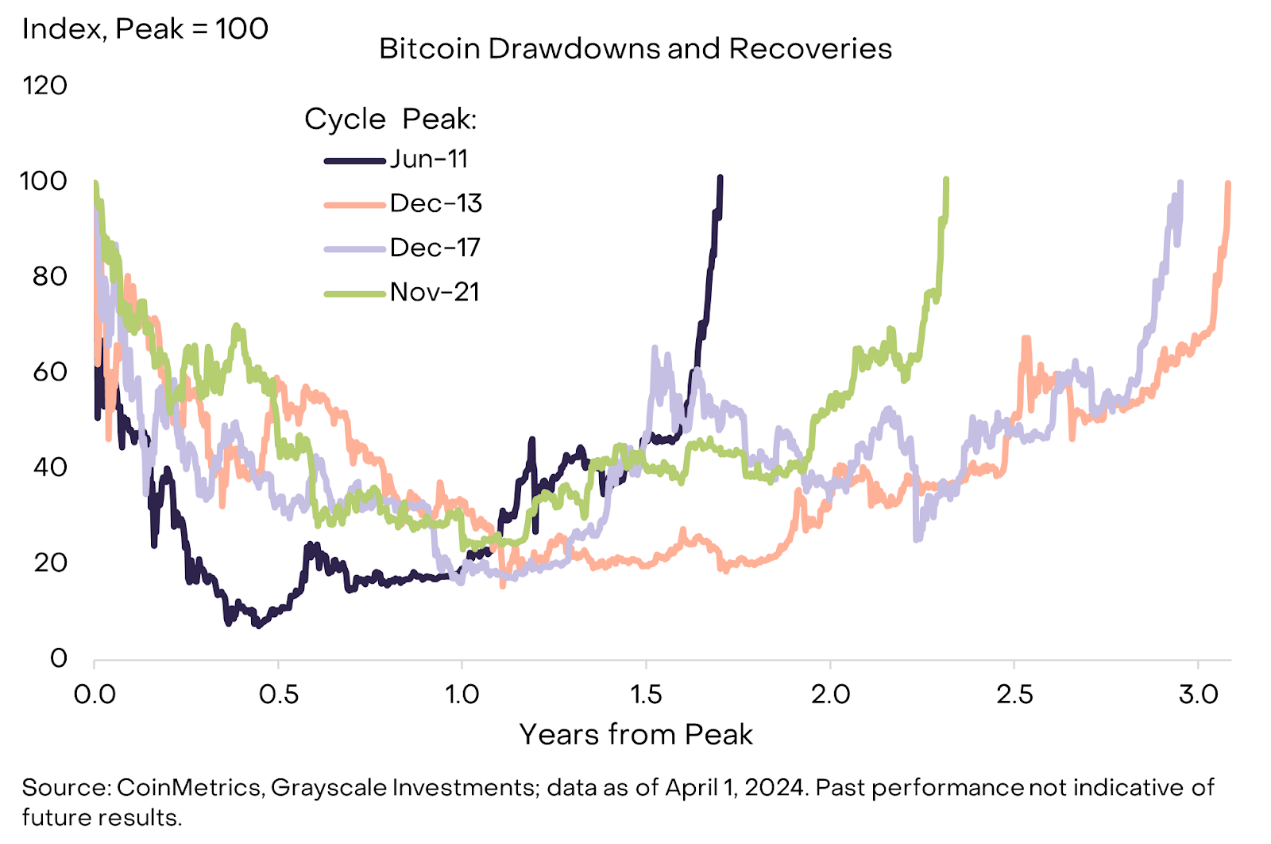
Bitcoin has made a strong comeback after a steep decline. In the previous crypto cycle, Bitcoin peaked at $69,000 in November 2021. It then fell approximately 75% over the following year, hitting a low of around $16,000 in November 2022, before beginning its recovery.
Overall, Bitcoin has rebounded faster than in the previous two cycles. It took just over two years to return to its prior peak (Chart 1). By comparison, Bitcoin took about three years to recover from each of its two earlier downturns, and roughly one-and-a-half years to recover from its first major drop. Grayscale Research believes we are now in the "mid-cycle" phase of another Bitcoin bull market, with prices likely to continue rising.
Chart 1: Bitcoin’s recovery is faster compared to the previous two cycles
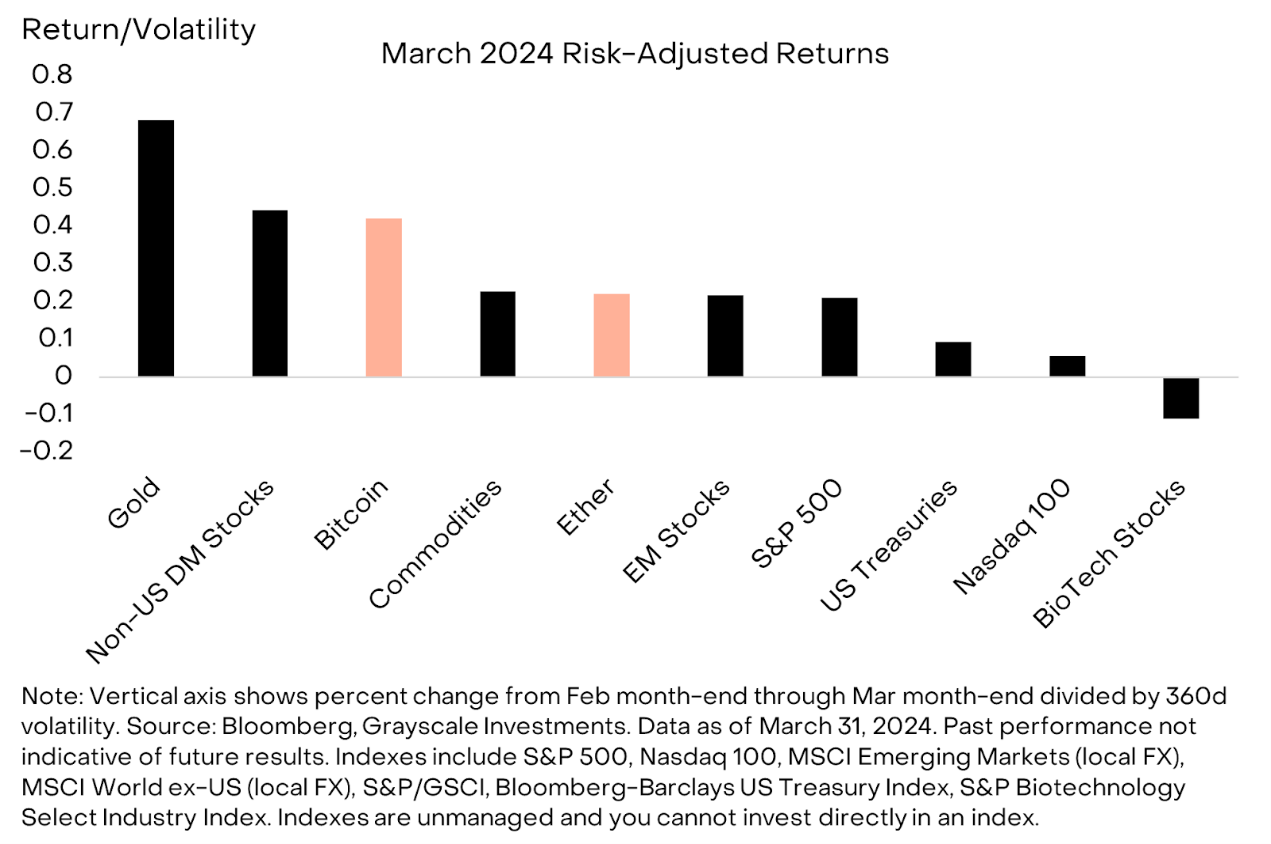
Many traditional assets also delivered positive returns in March 2024. On a risk-adjusted basis (accounting for each asset's volatility), Bitcoin ranked near the top of the spectrum, while Ether returned performance closer to the middle (Chart 2). Last month’s best-performing traditional asset classes included physical gold, developed-market non-U.S. equities, and energy-related stocks. Certain equity markets tied to emerging technologies like biotech lagged behind the broader market.
Chart 2: Bitcoin was among the top-performing assets in March 2024
One reason for the strong performance across markets last month may have been signals from central banks pointing toward rate cuts. According to Bloomberg surveys, every G10 central bank except Japan’s is expected to lower rates within the next year. Developments last month reinforced this outlook. For example, at its meeting on March 19–20, Federal Reserve officials indicated plans for three rate cuts this year despite expectations for strong GDP growth and elevated inflation. Similarly, the Bank of England had no officials supporting a rate hike for the first time since September 2021, and the Swiss National Bank unexpectedly cut rates on March 21.
With strong economic momentum, the eagerness of major central banks to cut rates could lead to rising market expectations for inflation. For instance, the difference between nominal bond yields and inflation-linked bond yields—the so-called “breakeven inflation” rate—has increased across maturities this year (Chart 3). Rising inflation risks may in turn boost demand for alternative stores of value such as physical gold and Bitcoin.
Chart 3: Market inflation expectations are rising

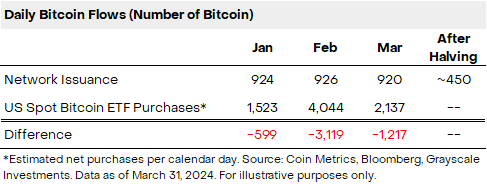
Despite Bitcoin hitting new highs, it declined by about 13% mid-month as traders reduced leverage and inflows into spot Bitcoin ETFs slowed. Over the full month of March, net inflows into U.S.-listed spot Bitcoin ETFs totaled $4.6 billion, down from $6 billion in February.
Although net inflows were lower than the prior month, they still far exceeded network issuance. U.S. ETFs are estimated to have purchased approximately 2,100 Bitcoin per trading day in March, compared to the network’s daily issuance of about 900 Bitcoin (Table 4). After the halving event in April, network issuance will drop to roughly 450 Bitcoin per day.
Chart 4: ETF inflows continue to exceed network issuance
Meanwhile, on March 13, the Ethereum network underwent a major upgrade aimed at reducing L2 costs and advancing Ethereum’s transition toward a modular architecture. The impact of the upgrade is visible on-chain: transaction costs on L2s such as Arbitrum and Optimism dropped from $0.21 and $0.23 in February to less than $0.01 post-upgrade, making transactions significantly cheaper for end users within the Ethereum ecosystem.
While the upgrade lowered transaction costs, Ether underperformed Bitcoin during the month, with the ETH/BTC price ratio falling to its lowest level since early January (Table 5). Ether’s valuation may have been dampened by declining market expectations for approval of a spot Ethereum ETF. According to data from decentralized prediction platform Polymarket, consensus expectations for SEC approval of a spot Ethereum ETF by the end of May have dropped from around 80% in January to just 21%. Whether spot Ethereum ETFs are approved in the current application wave is expected to be a key factor influencing token valuations over the next two months.
Chart 5: Despite a major network upgrade, Ether underperformed Bitcoin

According to Grayscale’s segmentation of the crypto market, the consumer and culture sector performed best in March, driven by high returns from “Memecoins” (Chart 6). Memecoins reflect internet culture; in crypto, memecoin-related tokens are primarily valued for entertainment purposes. These projects have historically generated no revenue or practical use cases (e.g., payments) and should therefore be viewed as extremely high-risk investments. That said, developers behind Shiba Inu (the second-largest memecoin in the consumer and culture category by market cap) are attempting to expand the project’s scope by launching an Ethereum L2.
Chart 6: Consumer and culture sector grew over 30%
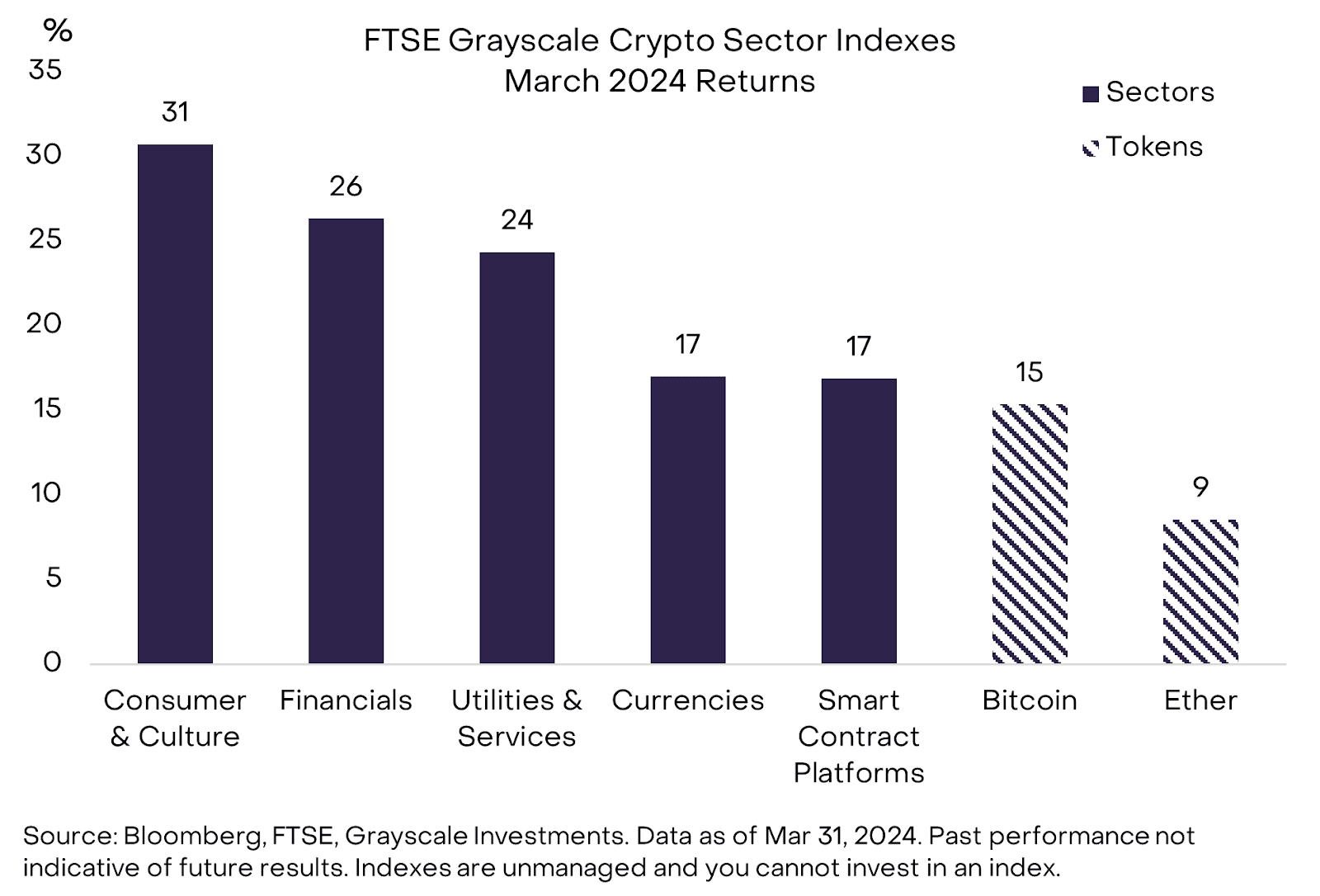
Various tokens in the finance sector also delivered solid returns this month, with top performers including Binance Coin (BNB), MakerDAO governance token (MKR), THORchain (RUNE), 0x (ZRX), and Ribbon Finance (RBN). Over recent months, Binance’s share of spot market trading volume has started to recover (currently at 46%), though it remains below its peak reached in February 2023.
Like all other asset markets, cryptocurrency valuations are influenced by both fundamental and technical factors. From a technical standpoint, net inflows into U.S.-listed spot Bitcoin ETFs may remain a key driver of Bitcoin’s price in the near term. These products currently represent about 4% of Bitcoin’s circulating supply, so any shifts in demand can meaningfully impact Bitcoin’s price.
However, Grayscale Research believes demand for Bitcoin ultimately stems partly from investor interest in its role as a “store of value.” Bitcoin is an alternative monetary system with a unique and highly predictable monetary policy. While the supply of dollars is determined by decisions made by the U.S. Treasury and Federal Reserve, Bitcoin’s supply is governed by pre-existing code: daily issuance halves every four years until the 21 million cap is reached.
In Grayscale Research’s view, when investors face uncertainty about the medium-term outlook for fiat currencies, they seek out assets with verifiable scarcity. Currently, such uncertainty appears to be rising: even as inflation remains above target, the Fed is preparing to cut rates; and the U.S. presidential election in November could prompt shifts in macroeconomic policy that, over time, may pressure the dollar’s value. Next month’s Bitcoin halving should remind investors that Bitcoin’s core attribute is its nature as a scarce digital asset—an alternative to fiat currencies whose future supply is uncertain.
Join TechFlow official community to stay tuned
Telegram:https://t.me/TechFlowDaily
X (Twitter):https://x.com/TechFlowPost
X (Twitter) EN:https://x.com/BlockFlow_News
 @Grayscale










